CitationWatch Review (2026): GEO Pricing, Limits & Alternatives
Bottom line
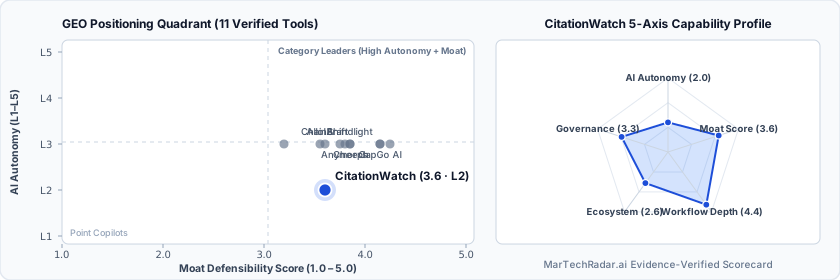
CitationWatch is a Web SaaS tool for GEO (GEO Brand Tracking & LLM Rank Tracking) in GEO & AI SEO. Pricing: From $149/mo. Best suited to DTC / eCommerce and Enterprise Brands. Editor ratings: AI autonomy L2 (workflow copilot); moat score 3.6/5.0 (Proprietary moat). Fact-checked by Jiacky Lee on Oct 15, 2026.
AI visibility and generative engine optimization tracking platform monitoring prompt citations, competitor mentions, and source URLs across generative.
CitationWatch buyer fit verdict: when to choose vs. when to walk away
Choose CitationWatch if (Best Fit)
- Target ICP & Stack Fit: You operate as DTC / eCommerce and Enterprise Brands requiring a Web SaaS deployment for GEO.
- L2 Architecture & Defensibility: Proprietary citation graph extraction across major conversational search interfaces, pairing hourly prompt-level tracking with agency reporting workflows.
- Commercial Model Fit: Your procurement budget aligns with From $149/mo.
Walk away from CitationWatch if (Deal-Breakers)
- Walk away if your workflow requires uncapped enterprise volume on the From $149/mo entry plan without upgrading tiers.
- Walk away if your workflow cannot tolerate stochastic output volatility: LLM non-determinism leads to dynamic response variances across identical prompt runs, making week-over-week mention volatility difficult to normalize without expansive statistical query sampling.
- Walk away if search engine interface churn is a deal-breaker for your team: Generative engine layouts and citation rendering mechanics update without warning, which can disrupt scraping parsers and temporarily degrade data extraction fidelity.
CitationWatch key facts & scorecard
| Pricing | From $149/moVendor pricing page |
|---|---|
| Free plan | No / not disclosed |
| Delivery | Web SaaS |
| Audience | DTC / eCommerce, Enterprise Brands |
| AI autonomy level | L2 · Workflow copilotEditor-verified |
| Moat tier & score | 3.6 / 5.0 · Proprietary moatEditor-verified |
| Funding | Bootstrapped |
| Headquarters | United States |
| Last verified |
CitationWatch pros & cons: strengths vs. operational limitations
Pros: core strengths & capabilities
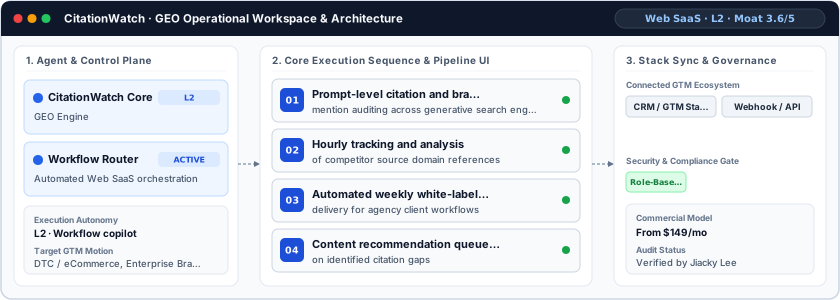
- Prompt-level citation and brand: mention auditing across generative search engines
- Hourly tracking and analysis: of competitor source domain references
- Automated weekly white-label reporting: delivery for agency client workflows
- Content recommendation queue based: on identified citation gaps
Cons: operational limitations & risks
- Stochastic Output Volatility: LLM non-determinism leads to dynamic response variances across identical prompt runs, making week-over-week mention volatility difficult to normalize without expansive statistical query sampling.
- Search Engine Interface Churn: Generative engine layouts and citation rendering mechanics update without warning, which can disrupt scraping parsers and temporarily degrade data extraction fidelity.
- Agency Client Ceilings: Entry-tier accounts face strict limits on tracked client workspaces and weekly delivery schedules, constraining larger consultancies that require programmatic data feeds.
CitationWatch TCO & deal-breaker stress test
Simulate 12-month stepped TCO, hidden cost multipliers, contract lock-in exposure, and stack failure modes using only facts verified by Jiacky Lee on · Capture SHA b06acfcd.
CitationWatch aligns with your 5-seat / $800/mo profile. Review the walk-away triggers and contract levers below before deployment.
| Plan / Tier | Verified Rate | Scale Fit | Scope & Quota Notes |
|---|---|---|---|
| Starter | $149/mo | 1–2 seats | For smaller local SEO teams that need a repeatable AI visibility reporting workflow without spr |
| Agency | $399/mo | 5 seats | For local SEO agencies managing multiple client verticals and weekly delivery at scale. |
- Moat Score
- 3.6 / 5.0
- AI Autonomy
- L2
- Free Tier / Trial
- None disclosed
Triggered audit signals & failure modes
- Published Self-Serve Entry FloorVerified Pricing Ledger
CitationWatch publishes a transparent entry point (From $149/mo) for initial validation before committing.
- Tier Fit for 5-Seat Scale: Agency ($399/mo)Verified Tier Schedule
For local SEO agencies managing multiple client verticals and weekly delivery at scale.
- Primary Operational Bottleneck: Agency Client CeilingsAudit by Jiacky Lee
Entry-tier accounts face strict limits on tracked client workspaces and weekly delivery schedules, constraining larger consultancies that require programmatic data feeds.
Hidden TCO Multipliers & Quota Gates
- Profile / Workspace Quota Ceilings: Base tiers cap the number of connected profiles, workspaces, or contact records, forcing tier upgrades before seat limits are reached.
- Stochastic Output Volatility: LLM non-determinism leads to dynamic response variances across identical prompt runs, making week-over-week mention volatility difficult to normalize without expansive statistical query sampling.
- Search Engine Interface Churn: Generative engine layouts and citation rendering mechanics update without warning, which can disrupt scraping parsers and temporarily degrade data extraction fidelity.
When to Walk Away & Negotiation Levers
- Walk away if your workflow requires uncapped enterprise volume on the From $149/mo entry plan without upgrading tiers.
- Walk away if your workflow cannot tolerate stochastic output volatility: LLM non-determinism leads to dynamic response variances across identical prompt runs, making week-over-week mention volatility difficult to normalize without expansive statistical query sampling.
- Walk away if search engine interface churn is a deal-breaker for your team: Generative engine layouts and citation rendering mechanics update without warning, which can disrupt scraping parsers and temporarily degrade data extraction fidelity.
- Validate exact quota thresholds (seats, credits, or API calls) included in CitationWatch's From $149/mo tier before converting from monthly to annual billing.
- Require a sandbox proof-of-concept testing stochastic output volatility against your live CRM/data schema before annual sign-off.
Ask a custom procurement or TCO stress-test question about CitationWatch
Lower 5-seat floor (~$15/mo vs. $399 / mo)
Lower 5-seat floor (~$29/mo vs. $399 / mo)
CitationWatch moat & subtrack positioning
Proprietary citation graph extraction across major conversational search interfaces, pairing hourly prompt-level tracking with agency reporting workflows.
Editorial review
Fact-checked by Jiacky Lee (Managing Editor, AI Autonomy & Moat Methodology) on .
Background
CitationWatch is an AI visibility and generative engine optimization monitoring platform based in the United States, engineered specifically for local SEO agencies and digital marketing teams. As generative search engines displace traditional organic listings, search specialists must account for which entities AI systems recommend and which sources they cite. CitationWatch addresses this operational job by monitoring brand mentions, competitor citations, and underlying source URLs across conversational engines, transforming unstructured generative answers into actionable client-facing audit reports.
How CitationWatch works
Operating at an L2 autonomy tier, the software runs a continuous batch-querying pipeline that samples AI search engines including Google AI Overviews, OpenAI ChatGPT, and Perplexity. The ingestion engine executes targeted commercial prompts on an hourly schedule, parsing raw conversational outputs to isolate brand mentions and extract linked citation sources. It cross-references these source domains against competitor benchmarks, isolating content gaps and populating an automated recommendation queue with publication domains required to build generative authority.
Limitations
Operational considerations and platform boundaries include:
- Stochastic Output Volatility: LLM non-determinism leads to dynamic response variances across identical prompt runs, making week-over-week mention volatility difficult to normalize without expansive statistical query sampling.
- Search Engine Interface Churn: Generative engine layouts and citation rendering mechanics update without warning, which can disrupt scraping parsers and temporarily degrade data extraction fidelity.
- Agency Client Ceilings: Entry-tier accounts face strict limits on tracked client workspaces and weekly delivery schedules, constraining larger consultancies that require programmatic data feeds.
CitationWatch pricing
The commercial licensing model uses tiered monthly subscriptions. The Starter tier is available from $149 per month (or $149/mo), supporting up to five active client accounts with weekly report runs and recommendation queues. For expanding consultancies, the Agency tier is priced at $399 per month, which removes client account caps and adds multi-seat agency workspaces alongside priority support channels.
How CitationWatch compares
Within the generative search optimization subtrack, CitationWatch competes with enterprise-focused tracking suites like AthenaHQ, Brandlight, and Anymorph. While AthenaHQ and Brandlight focus primarily on broad enterprise brand sentiment and custom enterprise API integrations, CitationWatch prioritizes localized SEO agencies needing rapid reporting workflows and domain-level citation tracking. For agencies managing client-facing local search accounts, CitationWatch provides an accessible reporting alternative to heavy corporate intelligence tools. It is best suited for enterprise marketing teams and growth practitioners seeking disciplined workflow orchestration.
Frequently asked questions about CitationWatch
How much does CitationWatch cost and what pricing tiers are available?
Published pricing summary for CitationWatch: From $149/mo. A permanent free plan is not disclosed for CitationWatch. Verified tier schedule: Starter ($149/mo for 1–2 seats); Agency ($399/mo for 5 seats). The commercial licensing model uses tiered monthly subscriptions. The Starter tier is available from $149 per month (or $149/mo), supporting up to five active client accounts with weekly report runs and recommendation queues.
How does CitationWatch work and how autonomous is its AI architecture?
AI visibility and generative engine optimization tracking platform monitoring prompt citations, competitor mentions, and source URLs across generative. Within GEO (GEO Brand Tracking & LLM Rank Tracking), MarTechRadar rates its execution architecture at L2 · Workflow copilot with a verified Moat Score of 3.6 / 5.0 (Proprietary moat). Proprietary citation graph extraction across major conversational search interfaces, pairing hourly prompt-level tracking with agency reporting workflows.
What are the main limitations of CitationWatch and when should buyers walk away?
Based on our editorial technical audit, key operational considerations and boundaries for CitationWatch include: (1) Stochastic Output Volatility: LLM non-determinism leads to dynamic response variances across identical prompt runs, making week-over-week mention volatility difficult to normalize without expansive statistical query sampling. (2) Search Engine Interface Churn: Generative engine layouts and citation rendering mechanics update without warning, which can disrupt scraping parsers and temporarily degrade data extraction fidelity. (3) Agency Client Ceilings: Entry-tier accounts face strict limits on tracked client workspaces and weekly delivery schedules, constraining larger consultancies that require programmatic data feeds. Primary procurement walk-away rule: Walk away if your workflow requires uncapped enterprise volume on the From $149/mo entry plan without upgrading tiers.
What integrations, compliance certifications, and contract terms apply to CitationWatch?
Key TCO multiplier to watch: Profile / Workspace Quota Ceilings (Base tiers cap the number of connected profiles, workspaces, or contact records, forcing tier upgrades before seat limits are reached.) Before signing a contract, procurement teams should validate exact quota thresholds (seats, credits, or API calls) included in CitationWatch's From $149/mo tier before converting from monthly to annual billing.
What are the best CitationWatch alternatives and head-to-head competitors in 2026?
Top fact-checked alternatives to CitationWatch in GEO (GEO Brand Tracking & LLM Rank Tracking) include Unveilr AI (Custom / enterprise pricing), BrandEcho (From $29/mo), ShopMentions (From $15/mo), Plynt (Custom / enterprise pricing). Within the generative search optimization subtrack, CitationWatch competes with enterprise-focused tracking suites like AthenaHQ, Brandlight, and Anymorph.
Verified sources & evidence trail
- Official product domain: https://citationwatch.com
- Commercial pricing verification: https://www.citationwatch.com/pricing
- Editorial audit sign-off: Fact-checked by Jiacky Lee on under the MarTechRadar Evidence-Ledger Protocol.