ShopMentions Review (2026): GEO Pricing, Limits & Alternatives
Bottom line
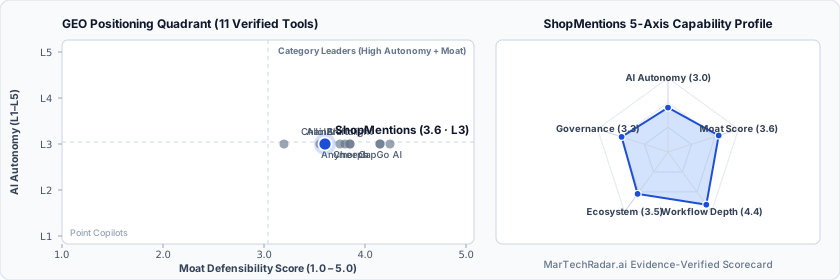
ShopMentions is a Web SaaS tool for GEO (GEO Brand Tracking & LLM Rank Tracking) in GEO & AI SEO. Pricing: From $15/mo. Best suited to DTC / eCommerce and Enterprise Brands. Editor ratings: AI autonomy L3 (conditional automation); moat score 3.6/5.0 (Proprietary moat). Fact-checked by Anna Xia on Oct 15, 2026.
ShopMentions is a specialized generative engine optimization (GEO) and LLM rank-tracking platform built natively for Shopify brands to monitor product.
ShopMentions buyer fit verdict: when to choose vs. when to walk away
Choose ShopMentions if (Best Fit)
- Target ICP & Stack Fit: You operate as DTC / eCommerce and Enterprise Brands requiring a Web SaaS deployment for GEO, with verified ecosystem connectivity for Salesforce, Shopify.
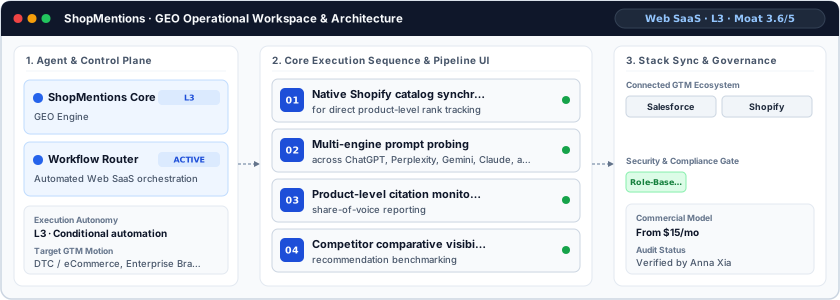
- L3 Architecture & Defensibility: ShopMentions develops defensibility via direct Shopify catalog integration, combining automated product catalog synchronization with prompt-probing across LLMs including ChatGPT, Perplexity, Gemini, Claude, and Google AI Overviews.
- Commercial Model Fit: Your procurement budget aligns with From $15/mo.
Walk away from ShopMentions if (Deal-Breakers)
- Walk away if your workflow requires uncapped enterprise volume on the From $15/mo entry plan without upgrading tiers.
- Walk away if your workflow cannot tolerate nondeterministic LLM variance: Users encounter operational friction and integration bottlenecks, as the pipeline struggles with Probabilistic output variance across LLM versions produces fluctuating recommendation rankings for identical prompts, requiring multi-run averaging that can consume allocated monthly query credits rapidly.
- Walk away if catalog scaling constraints is a deal-breaker for your team: Users encounter operational friction and integration bottlenecks, as the pipeline struggles with Stores managing deep inventories face tiered product-tracking caps, forcing catalog managers to manually prune untracked variants rather than monitoring entire enterprise product databases simultaneously.
ShopMentions key facts & scorecard
| Pricing | From $15/moVendor pricing page |
|---|---|
| Free plan | No / not disclosed |
| Delivery | Web SaaS |
| Audience | DTC / eCommerce, Enterprise Brands |
| AI autonomy level | L3 · Conditional automationEditor-verified |
| Moat tier & score | 3.6 / 5.0 · Proprietary moatEditor-verified |
| Funding | Bootstrapped |
| Ecosystem integrations | Salesforce, Shopify |
| Governance & docs | Terms ↗ · Privacy ↗ |
| Headquarters | United States |
| Last verified |
ShopMentions pros & cons: strengths vs. operational limitations
Pros: core strengths & capabilities
- Native Shopify catalog synchronization: for direct product-level rank tracking
- Multi-engine prompt probing: across ChatGPT, Perplexity, Gemini, Claude, and Google AI Overviews
- Product-level citation monitoring and: share-of-voice reporting
- Competitor comparative visibility and: recommendation benchmarking
Cons: operational limitations & risks
- Nondeterministic LLM Variance: Users encounter operational friction and integration bottlenecks, as the pipeline struggles with Probabilistic output variance across LLM versions produces fluctuating recommendation rankings for identical prompts, requiring multi-run averaging that can consume allocated monthly query credits rapidly.
- Catalog Scaling Constraints: Users encounter operational friction and integration bottlenecks, as the pipeline struggles with Stores managing deep inventories face tiered product-tracking caps, forcing catalog managers to manually prune untracked variants rather than monitoring entire enterprise product databases simultaneously.
- Platform Coupling: Users encounter operational friction and integration bottlenecks, as the pipeline struggles with The direct dependence on Shopify data structures creates operational hurdles for omnichannel merchants seeking to unify tracking across custom headless storefronts, BigCommerce, or Salesforce Commerce Cloud.
ShopMentions TCO & deal-breaker stress test
Simulate 12-month stepped TCO, hidden cost multipliers, contract lock-in exposure, and stack failure modes using only facts verified by Anna Xia on · Capture SHA 45096026.
ShopMentions aligns with your 5-seat / $800/mo profile. Review the walk-away triggers and contract levers below before deployment.
| Plan / Tier | Verified Rate | Scale Fit | Scope & Quota Notes |
|---|---|---|---|
| Entry / Starter | $15/mo | 1–2 seats | Never expire · $150.00 per 1,000 searches |
| Starter | $29/mo | 5 seats | Ideal for small stores |
| Growth | $79/mo | 15 seats | Ideal for growing catalogs |
- Moat Score
- 3.6 / 5.0
- AI Autonomy
- L3
- Free Tier / Trial
- None disclosed
Triggered audit signals & failure modes
- Published Self-Serve Entry FloorVerified Pricing Ledger
ShopMentions publishes a transparent entry point (From $15/mo) for initial validation before committing.
- Tier Fit for 5-Seat Scale: Starter ($29/mo)Verified Tier Schedule
Ideal for small stores
- Primary Operational Bottleneck: Nondeterministic LLM VarianceAudit by Anna Xia
Users encounter operational friction and integration bottlenecks, as the pipeline struggles with Probabilistic output variance across LLM versions produces fluctuating recommendation rankings for identical prompts, requiring multi-run averaging that can consume allocated monthly query credits rapidly.
Hidden TCO Multipliers & Quota Gates
- Annual Billing Headline vs. Monthly Premium: Headline entry rates reflect annual billing commitments (Save 17%); month-to-month flexibility carries a higher effective monthly rate or requires annual prepayment.
- Credit & Usage Burn Multiplier: Automated workflows consume metered credits/usage quotas; multi-step enrichment, voice minutes, or high-frequency agent runs can trigger mid-cycle top-up packs.
When to Walk Away & Negotiation Levers
- Walk away if your workflow requires uncapped enterprise volume on the From $15/mo entry plan without upgrading tiers.
- Walk away if your workflow cannot tolerate nondeterministic LLM variance: Users encounter operational friction and integration bottlenecks, as the pipeline struggles with Probabilistic output variance across LLM versions produces fluctuating recommendation rankings for identical prompts, requiring multi-run averaging that can consume allocated monthly query credits rapidly.
- Walk away if catalog scaling constraints is a deal-breaker for your team: Users encounter operational friction and integration bottlenecks, as the pipeline struggles with Stores managing deep inventories face tiered product-tracking caps, forcing catalog managers to manually prune untracked variants rather than monitoring entire enterprise product databases simultaneously.
- Validate exact quota thresholds (seats, credits, or API calls) included in ShopMentions's From $15/mo tier before converting from monthly to annual billing.
- Require a sandbox proof-of-concept testing nondeterministic LLM variance against your live CRM/data schema before annual sign-off.
Ask a custom procurement or TCO stress-test question about ShopMentions
Fits within $800/mo budget (From $149/mo)
Lower 5-seat floor (~$24/mo vs. $29 / mo)
ShopMentions key entities, modules & ecosystem stack
ShopMentions moat & subtrack positioning
ShopMentions develops defensibility via direct Shopify catalog integration, combining automated product catalog synchronization with prompt-probing across LLMs including ChatGPT, Perplexity, Gemini, Claude, and Google AI Overviews.
Editorial review
Fact-checked by Anna Xia (Senior B2B GTM & Revenue Systems Analyst) on .
Background
For direct-to-consumer digital commerce brands operating in conversational search environments, maintaining visibility requires tracking generative model citations rather than traditional index rankings. Headquartered in the United States, ShopMentions provides a generative engine optimization (GEO) and LLM rank-tracking platform designed specifically for digital merchants and e-commerce growth operators. By bridging the catalog infrastructure of the Shopify ecosystem with automated retrieval prompts across synthetic search tools, the platform equips merchants to evaluate whether conversational assistants recommend their stock keeping units over category alternatives.
How ShopMentions works
At the architectural level, ShopMentions operates an ingestion pipeline that synchronizes directly with a store's Shopify product catalog. The system translates structured product metadata into automated prompt variations simulating organic buyer queries across prominent frontier endpoints, including ChatGPT, Perplexity, Google Gemini, Anthropic Claude, and Google AI Overviews. Operable as an L3 semi-autonomous agent, the underlying polling workers query these engines, parse the natural language outputs, extract brand entity mentions, and benchmark relative placement on recommended product shortlists, flagging product attributes cited during each synthetic discovery session.
Limitations
Operational considerations and platform boundaries include:
- Nondeterministic LLM Variance: Users encounter operational friction and integration bottlenecks, as the pipeline struggles with Probabilistic output variance across LLM versions produces fluctuating recommendation rankings for identical prompts, requiring multi-run averaging that can consume allocated monthly query credits rapidly.
- Catalog Scaling Constraints: Users encounter operational friction and integration bottlenecks, as the pipeline struggles with Stores managing deep inventories face tiered product-tracking caps, forcing catalog managers to manually prune untracked variants rather than monitoring entire enterprise product databases simultaneously.
- Platform Coupling: Users encounter operational friction and integration bottlenecks, as the pipeline struggles with The direct dependence on Shopify data structures creates operational hurdles for omnichannel merchants seeking to unify tracking across custom headless storefronts, BigCommerce, or Salesforce Commerce Cloud.
ShopMentions pricing
ShopMentions delivers its platform via a tiered software-as-a-service model available through the Shopify App Store. Entry packages start from $15 per month for specialized configurations, scaling through self-serve tiers including a Starter tier at $29 per month for up to 20 products and 100 monthly scans, alongside a Growth tier at $79 per month supporting 500 products. Subscriptions include a three-day trial, with allowances scaling across query frequency, scan history retention, and automated content optimization modules.
How ShopMentions compares
Within the generative rank tracking market, ShopMentions differentiates itself from horizontal alternatives such as Anymorph, AthenaHQ, and Brandlight through its Shopify-native integration. While AthenaHQ and Brandlight deliver broader enterprise GEO monitoring spanning unstructured corporate web footprints, ShopMentions focuses purely on product-level catalog citations and transactional buyer intent prompts. It is best aligned with small to mid-market Shopify retail merchants requiring focused diagnostic visibility into LLM product recommendations without deploying bespoke enterprise tracking pipelines. It is best suited for enterprise marketing teams and growth practitioners seeking disciplined workflow orchestration.
Frequently asked questions about ShopMentions
How much does ShopMentions cost and what pricing tiers are available?
Published pricing summary for ShopMentions: From $15/mo. A permanent free plan is not disclosed for ShopMentions. Verified tier schedule: Entry / Starter ($15/mo for 1–2 seats); Starter ($29/mo for 5 seats); Growth ($79/mo for 15 seats). ShopMentions delivers its platform via a tiered software-as-a-service model available through the Shopify App Store.
How does ShopMentions work and how autonomous is its AI architecture?
ShopMentions is a specialized generative engine optimization (GEO) and LLM rank-tracking platform built natively for Shopify brands to monitor product. Within GEO (GEO Brand Tracking & LLM Rank Tracking), MarTechRadar rates its execution architecture at L3 · Conditional automation with a verified Moat Score of 3.6 / 5.0 (Proprietary moat). ShopMentions develops defensibility via direct Shopify catalog integration, combining automated product catalog synchronization with prompt-probing across LLMs including ChatGPT, Perplexity, Gemini, Claude, and Google AI Overviews.
What are the main limitations of ShopMentions and when should buyers walk away?
Based on our editorial technical audit, key operational considerations and boundaries for ShopMentions include: (1) Nondeterministic LLM Variance: Users encounter operational friction and integration bottlenecks, as the pipeline struggles with Probabilistic output variance across LLM versions produces fluctuating recommendation rankings for identical prompts, requiring multi-run averaging that can consume allocated monthly query credits rapidly. (2) Catalog Scaling Constraints: Users encounter operational friction and integration bottlenecks, as the pipeline struggles with Stores managing deep inventories face tiered product-tracking caps, forcing catalog managers to manually prune untracked variants rather than monitoring entire enterprise product databases simultaneously. (3) Platform Coupling: Users encounter operational friction and integration bottlenecks, as the pipeline struggles with The direct dependence on Shopify data structures creates operational hurdles for omnichannel merchants seeking to unify tracking across custom headless storefronts, BigCommerce, or Salesforce Commerce Cloud. Primary procurement walk-away rule: Walk away if your workflow requires uncapped enterprise volume on the From $15/mo entry plan without upgrading tiers.
What integrations, compliance certifications, and contract terms apply to ShopMentions?
Verified ecosystem and stack integrations include Salesforce, Shopify. Key TCO multiplier to watch: Annual Billing Headline vs. Monthly Premium (Headline entry rates reflect annual billing commitments (Save 17%); month-to-month flexibility carries a higher effective monthly rate or requires annual prepayment.) Before signing a contract, procurement teams should validate exact quota thresholds (seats, credits, or API calls) included in ShopMentions's From $15/mo tier before converting from monthly to annual billing.
What are the best ShopMentions alternatives and head-to-head competitors in 2026?
Top fact-checked alternatives to ShopMentions in GEO (GEO Brand Tracking & LLM Rank Tracking) include Senso (Pricing not disclosed), CitationWatch (From $149/mo), GeoRanking.ai (Custom / enterprise pricing), Novela Simulations (Custom / enterprise pricing). Within the generative rank tracking market, ShopMentions differentiates itself from horizontal alternatives such as Anymorph, AthenaHQ, and Brandlight through its Shopify-native integration.
Verified sources & evidence trail
- Official product domain: https://shopmentions.com
- Commercial pricing verification: https://shopmentions.com/pricing/
- First-party governance & documentation links: Terms · Privacy
- Editorial audit sign-off: Fact-checked by Anna Xia on under the MarTechRadar Evidence-Ledger Protocol.