Closera Review (2026): eCommerce Chatbot Pricing, Limits & Alternatives
Bottom line
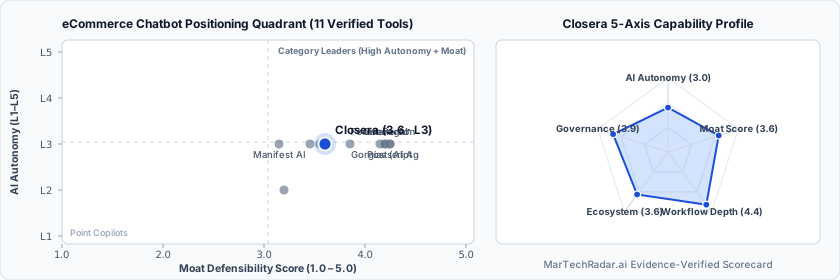
Closera is a Web SaaS tool for eCommerce Chatbot (Conversational eCommerce & Support Bots) in Lifecycle & CDP. Pricing: Pricing not disclosed. Best suited to B2B SaaS and Marketing & Growth Teams. Editor ratings: AI autonomy L3 (conditional automation); moat score 3.6/5.0 (Proprietary moat). Fact-checked by Jagmeet Sine on Oct 16, 2026.
AI personal shopping agent for ecommerce stores guiding visitors with tailored product recommendations and dynamic bundles to lift conversion and AOV.
Closera buyer fit verdict: when to choose vs. when to walk away
Choose Closera if (Best Fit)
- Target ICP & Stack Fit: You operate as B2B SaaS and Marketing & Growth Teams requiring a Web SaaS deployment for eCommerce Chatbot, with verified ecosystem connectivity for Gorgias.
- L3 Architecture & Defensibility: Embedding a real-time catalog-aware personal shopping agent into storefront product pages and cart drawers directly influences conversion rate and average order value.
- Commercial Model Fit: Your procurement budget aligns with Pricing not disclosed.
Walk away from Closera if (Deal-Breakers)
- Walk away if you require transparent self-serve monthly billing or your budget ceiling is under $1,000/mo (Closera requires sales-gated custom quoting).
- Walk away if your workflow cannot tolerate catalog metadata completeness bottleneck: The accuracy of consultative product recommendations depends heavily on structured merchant SKU descriptions, size charts, and review data; storefronts with sparse catalog metadata face an initial cold start onboarding bottleneck.
- Walk away if single-sku storefront relevance boundary is a deal-breaker for your team: Brands selling a single flagship SKU without complex sizing, shade matching, or cross-sell bundle permutations gain limited incremental lift from a guided personal shopper compared to multi-category catalogs.
Closera key facts & scorecard
| Pricing | Pricing not disclosed |
|---|---|
| Free plan | No / not disclosed |
| Delivery | Web SaaS |
| Audience | B2B SaaS, Marketing & Growth Teams |
| AI autonomy level | L3 · Conditional automationEditor-verified |
| Moat tier & score | 3.6 / 5.0 · Proprietary moatEditor-verified |
| Funding | Pre-seed |
| Total funding | $500K |
| Founders | Anmol Tukrel, Chinmay Patel |
| Company size | 2-10 employees |
| Ecosystem integrations | Gorgias |
| Headquarters | San Francisco, California |
| Founded | 2025 |
| Last verified |
Closera pros & cons: strengths vs. operational limitations
Pros: core strengths & capabilities
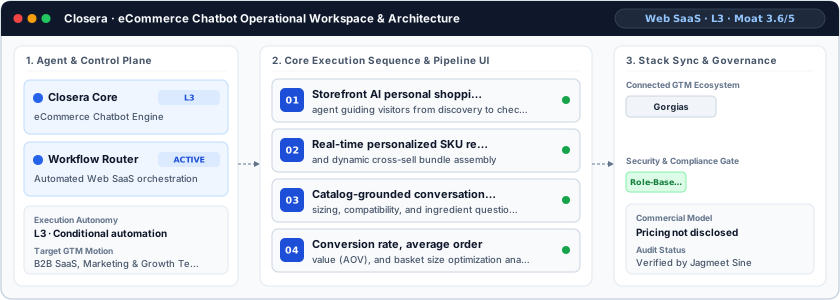
- Storefront AI personal shopping: agent guiding visitors from discovery to checkout completion
- Real-time personalized SKU recommendations: and dynamic cross-sell bundle assembly
- Catalog-grounded conversational Q&A resolving: sizing, compatibility, and ingredient questions
- Conversion rate, average order: value (AOV), and basket size optimization analytics
Cons: operational limitations & risks
- Catalog Metadata Completeness Bottleneck: The accuracy of consultative product recommendations depends heavily on structured merchant SKU descriptions, size charts, and review data; storefronts with sparse catalog metadata face an initial cold start onboarding bottleneck.
- Single-SKU Storefront Relevance Boundary: Brands selling a single flagship SKU without complex sizing, shade matching, or cross-sell bundle permutations gain limited incremental lift from a guided personal shopper compared to multi-category catalogs.
- Brand Tone & Discount Governance Barrier: Configuring autonomous bundling and promotional incentives requires strict margin guardrails so the AI agent does not over-discount or make unapproved product claims, creating a merchandising governance barrier.
Closera TCO & deal-breaker stress test
Simulate 12-month stepped TCO, hidden cost multipliers, contract lock-in exposure, and stack failure modes using only facts verified by Jagmeet Sine on · Capture SHA 57afa006.
Closera triggers high-severity friction under your 5-seat / $800/mo constraints. Benchmark the verified subtrack alternatives below before committing.
| Plan / Tier | Verified Rate | Scale Fit | Scope & Quota Notes |
|---|---|---|---|
| Enterprise / Custom | Custom quote | 15–50+ seats (Enterprise SLA) | Sales-negotiated annual contract for custom volume, SSO/RBAC governance, and dedicated SLA. |
- Moat Score
- 3.6 / 5.0
- AI Autonomy
- L3
- Free Tier / Trial
- None disclosed
Triggered audit signals & failure modes
- Opaque Enterprise Quoting vs. SMB/Mid-Market BudgetVerified Pricing Ledger
Closera does not disclose a public self-serve floor (Pricing not disclosed). Buyers with a $800/mo cap face high sales-qualification friction.
- Sales-Gated Contract TermsFact-checked by Jagmeet Sine
Pricing is available on request through enterprise sales quotes, with customized tiers based on seat counts or usage volume. Ecommerce merchants can book a live product demonstration via the Closera website to evaluate storefront integration and conversion attribution models.
- Primary Operational Bottleneck: Catalog Metadata Completeness BottleneckAudit by Jagmeet Sine
The accuracy of consultative product recommendations depends heavily on structured merchant SKU descriptions, size charts, and review data; storefronts with sparse catalog metadata face an initial cold start onboarding bottleneck.
Hidden TCO Multipliers & Quota Gates
- Catalog Metadata Completeness Bottleneck: The accuracy of consultative product recommendations depends heavily on structured merchant SKU descriptions, size charts, and review data; storefronts with sparse catalog metadata face an initial cold start onboarding bottleneck.
- Single-SKU Storefront Relevance Boundary: Brands selling a single flagship SKU without complex sizing, shade matching, or cross-sell bundle permutations gain limited incremental lift from a guided personal shopper compared to multi-category catalogs.
When to Walk Away & Negotiation Levers
- Walk away if you require transparent self-serve monthly billing or your budget ceiling is under $1,000/mo (Closera requires sales-gated custom quoting).
- Walk away if your workflow cannot tolerate catalog metadata completeness bottleneck: The accuracy of consultative product recommendations depends heavily on structured merchant SKU descriptions, size charts, and review data; storefronts with sparse catalog metadata face an initial cold start onboarding bottleneck.
- Walk away if single-sku storefront relevance boundary is a deal-breaker for your team: Brands selling a single flagship SKU without complex sizing, shade matching, or cross-sell bundle permutations gain limited incremental lift from a guided personal shopper compared to multi-category catalogs.
- Demand a 30- to 60-day paid pilot opt-out clause in the Closera order form before signing a 12-month enterprise commitment.
- Require a sandbox proof-of-concept testing catalog metadata completeness bottleneck against your live CRM/data schema before annual sign-off.
Ask a custom procurement or TCO stress-test question about Closera
Lower 5-seat floor (~$20/mo vs. Custom Quote) · Transparent self-serve entry without mandatory annual lock-in
Lower 5-seat floor (~$43/mo vs. Custom Quote) · Transparent self-serve entry without mandatory annual lock-in
Closera key entities, modules & ecosystem stack
Closera moat & subtrack positioning
Embedding a real-time catalog-aware personal shopping agent into storefront product pages and cart drawers directly influences conversion rate and average order value.
Editorial review
Fact-checked by Jagmeet Sine (Senior MarTech Infrastructure & Agentic Workflow Architect) on .
Background
Founded in 2025 by Anmol Tukrel and Chinmay Patel and headquartered in San Francisco, California, Closera (closera.com) is an AI personal shopping agent platform built for online ecommerce storefronts and direct-to-consumer retail brands. Operating with a team of 2 to 10 employees and backed by $500K in Pre-Seed funding from Y Combinator (S25), the company brings the consultative experience of an in-store luxury retail associate to digital storefronts, turning passive catalog browsing into active guided purchasing.
How Closera works
Closera operates at Level 3 autonomy through a catalog-indexed retrieval-augmented generation (RAG) pipeline, real-time session intent tracker, and dynamic bundling engine. Embedded directly onto an ecommerce merchant's storefront, the AI agent monitors visitor browsing behavior, product comparisons, and hesitation signals. Instead of functioning as a generic FAQ support widget that deflects tickets, Closera proactively initiates consultative shopping conversations—answering specific sizing, compatibility, or material questions, assembling personalized multi-item bundles, and injecting one-click add-to-cart recommendations designed to lift conversion rates, average order value (AOV), and units per order.
Limitations
Operational limitations and technical trade-offs include:
- Catalog Metadata Completeness Bottleneck: The accuracy of consultative product recommendations depends heavily on structured merchant SKU descriptions, size charts, and review data; storefronts with sparse catalog metadata face an initial cold start onboarding bottleneck.
- Single-SKU Storefront Relevance Boundary: Brands selling a single flagship SKU without complex sizing, shade matching, or cross-sell bundle permutations gain limited incremental lift from a guided personal shopper compared to multi-category catalogs.
- Brand Tone & Discount Governance Barrier: Configuring autonomous bundling and promotional incentives requires strict margin guardrails so the AI agent does not over-discount or make unapproved product claims, creating a merchandising governance barrier.
Closera pricing
Pricing is available on request through enterprise sales quotes, with customized tiers based on seat counts or usage volume. Ecommerce merchants can book a live product demonstration via the Closera website to evaluate storefront integration and conversion attribution models.
How Closera compares
Within the Conversational eCommerce & Support Bots category, Closera competes against AI shopping and support alternatives such as Cenote, Rep AI, and Gorgias. Versus off-site voice/SMS recovery agents like Cenote or post-purchase ticket desks like Gorgias, Closera differentiates itself by focusing on in-session on-site conversion, personalized catalog consultation, and dynamic AOV bundling. Multi-SKU apparel, beauty, and specialty retail brands choose Closera to maximize revenue per visitor.
Frequently asked questions about Closera
How much does Closera cost and does it require a custom enterprise quote?
Published pricing summary for Closera: Pricing not disclosed. A permanent free plan is not disclosed for Closera. Pricing is available on request through enterprise sales quotes, with customized tiers based on seat counts or usage volume. Ecommerce merchants can book a live product demonstration via the Closera website to evaluate storefront integration and conversion attribution models.
How does Closera work and how autonomous is its AI architecture?
AI personal shopping agent for ecommerce stores guiding visitors with tailored product recommendations and dynamic bundles to lift conversion and AOV. Within eCommerce Chatbot (Conversational eCommerce & Support Bots), MarTechRadar rates its execution architecture at L3 · Conditional automation with a verified Moat Score of 3.6 / 5.0 (Proprietary moat). Embedding a real-time catalog-aware personal shopping agent into storefront product pages and cart drawers directly influences conversion rate and average order value. Corporate profile: Founded by Anmol Tukrel, Chinmay Patel, operating at 2-10 employees scale.
What are the main limitations of Closera and when should buyers walk away?
Based on our editorial technical audit, key operational considerations and boundaries for Closera include: (1) Catalog Metadata Completeness Bottleneck: The accuracy of consultative product recommendations depends heavily on structured merchant SKU descriptions, size charts, and review data; storefronts with sparse catalog metadata face an initial cold start onboarding bottleneck. (2) Single-SKU Storefront Relevance Boundary: Brands selling a single flagship SKU without complex sizing, shade matching, or cross-sell bundle permutations gain limited incremental lift from a guided personal shopper compared to multi-category catalogs. (3) Brand Tone & Discount Governance Barrier: Configuring autonomous bundling and promotional incentives requires strict margin guardrails so the AI agent does not over-discount or make unapproved product claims, creating a merchandising governance barrier. Primary procurement walk-away rule: Walk away if you require transparent self-serve monthly billing or your budget ceiling is under $1,000/mo (Closera requires sales-gated custom quoting).
What integrations, compliance certifications, and contract terms apply to Closera?
Verified ecosystem and stack integrations include Gorgias. Key TCO multiplier to watch: Catalog Metadata Completeness Bottleneck (The accuracy of consultative product recommendations depends heavily on structured merchant SKU descriptions, size charts, and review data; storefronts with sparse catalog metadata face an initial cold start onboarding bottleneck.) Before signing a contract, procurement teams should demand a 30- to 60-day paid pilot opt-out clause in the Closera order form before signing a 12-month enterprise commitment.
What are the best Closera alternatives and head-to-head competitors in 2026?
Top fact-checked alternatives to Closera in eCommerce Chatbot (Conversational eCommerce & Support Bots) include Cenote (Pricing not disclosed), Rep AI ($20–$73/mo), LivePerson (Custom / enterprise pricing), Intercom Fin for Marketing (From $0.99/mo). Within the Conversational eCommerce & Support Bots category, Closera competes against AI shopping and support alternatives such as Cenote, Rep AI, and Gorgias.
Verified sources & evidence trail
- Official product domain: https://closera.com
- Commercial pricing verification: Verified against official vendor pricing policy (Pricing not disclosed)
- Verified corporate entity profiles (
sameAs): LinkedIn Company Profile · Crunchbase Entity Record - Editorial audit sign-off: Fact-checked by Jagmeet Sine on under the MarTechRadar Evidence-Ledger Protocol.