Coffee Review (2026): AI SDR Pricing, Limits & Alternatives
Bottom line
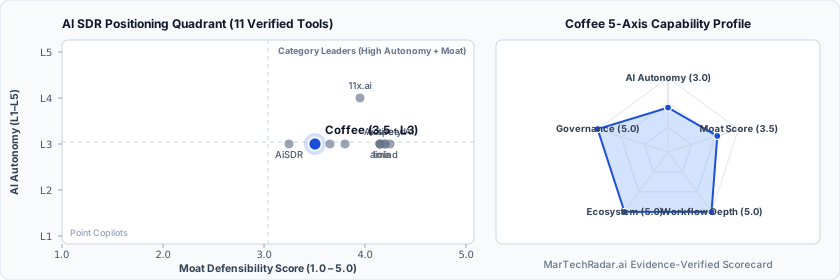
Coffee is a Web SaaS tool for AI SDR (Autonomous B2B Sales Agents & AI BDRs) in AI SDR & Outbound. Pricing: From $25/seat/mo · Enterprise plan. Best suited to B2B SaaS and Growth Teams. Editor ratings: AI autonomy L3 (conditional automation); moat score 3.5/5.0 (Proprietary moat). Fact-checked by Jagmeet Sine on Oct 16, 2026.
Autonomous AI CRM agent automating meeting notes, contact enrichment, and pipeline updates across Salesforce, HubSpot, or standalone mode.
Coffee buyer fit verdict: when to choose vs. when to walk away
Choose Coffee if (Best Fit)
- Target ICP & Stack Fit: You operate as B2B SaaS and Growth Teams requiring a Web SaaS deployment for AI SDR, with verified ecosystem connectivity for Salesforce, HubSpot, Pipedrive, Outreach.
- L3 Architecture & Defensibility: Dual deployment flexibility as a standalone CRM or bidirectional Salesforce/HubSpot overlay, combined with native MCP connectivity and SOC 2 Type II plus HIPAA compliance, establishes strong workflow retention.
- Commercial Model Fit: Your procurement budget aligns with From $25/seat/mo · Enterprise plan.
Walk away from Coffee if (Deal-Breakers)
- Walk away if your workflow requires uncapped enterprise volume on the From $25/seat/mo · Enterprise plan entry plan without upgrading tiers.
- Walk away if your workflow cannot tolerate upstream communication governance barrier: Automated pipeline logging requires broad read permissions across corporate email inboxes, calendars, and meeting recording streams, which can create a governance barrier for regulated enterprises.
- Walk away if CRM schema friction is a deal-breaker for your team: Companion Mode struggles with deeply customized legacy Salesforce or HubSpot object schemas unless administrators resolve field-mapping friction and deduplication rules upfront.
Coffee key facts & scorecard
| Pricing | From $25/seat/mo · Enterprise planVendor pricing page |
|---|---|
| Free plan | No / not disclosed |
| Delivery | Web SaaS |
| Audience | B2B SaaS, Growth Teams |
| AI autonomy level | L3 · Conditional automationEditor-verified |
| Moat tier & score | 3.5 / 5.0 · Proprietary moatEditor-verified |
| Funding | Seed |
| Total funding | SeedBacked by Salesforce Ventures, Greylock, Next Play Ventures |
| Founders | Doug Camplejohn |
| Company size | 11-50 employees |
| Ecosystem integrations | Salesforce, HubSpot, Pipedrive, Outreach, Salesloft, Apollo.io |
| Compliance & governance | SOC 2, GDPR, HIPAA |
| Governance & docs | Trust & Security ↗ · System Status ↗ · Terms ↗ · Privacy ↗ |
| Headquarters | Vancouver, Washington, United States |
| Founded | 2024 |
| Last verified |
Coffee pros & cons: strengths vs. operational limitations
Pros: core strengths & capabilities
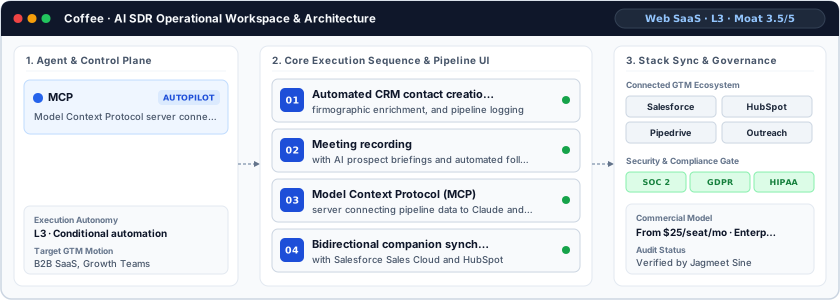
- Automated CRM contact creation,: firmographic enrichment, and pipeline logging
- Meeting recording: with AI prospect briefings and automated follow-up drafting
- Model Context Protocol (MCP): server connecting pipeline data to Claude and ChatGPT
- Bidirectional companion synchronization: with Salesforce Sales Cloud and HubSpot
- CRM Grader and ICP Builder utilities: for auditing legacy pipeline hygiene
Cons: operational limitations & risks
- Upstream Communication Governance Barrier: Automated pipeline logging requires broad read permissions across corporate email inboxes, calendars, and meeting recording streams, which can create a governance barrier for regulated enterprises.
- CRM Schema Friction: Companion Mode struggles with deeply customized legacy Salesforce or HubSpot object schemas unless administrators resolve field-mapping friction and deduplication rules upfront.
- Enterprise Commitment Bottleneck: While individual seat plans are accessible, scaling to multi-team enterprise governance introduces a steep minimum contract commitment, making the Venti tier not built for micro-agencies without dedicated RevOps oversight.
Coffee TCO & deal-breaker stress test
Simulate 12-month stepped TCO, hidden cost multipliers, contract lock-in exposure, and stack failure modes using only facts verified by Jagmeet Sine on · Capture SHA be93bacb.
Coffee aligns with your 5-seat / $800/mo profile. Review the walk-away triggers and contract levers below before deployment.
| Plan / Tier | Verified Rate | Scale Fit | Scope & Quota Notes |
|---|---|---|---|
| Entry / Starter | $25/seat/mo | 1–2 seats | Verified $25/seat/mo published rate on vendor pricing schedule. |
| Growth / Professional | $50/seat/mo | 5 seats | Verified $50/seat/mo published rate on vendor pricing schedule. |
| Enterprise / Custom | Custom quote | 15–50+ seats (Enterprise SLA) | Sales-negotiated annual contract for custom volume, SSO/RBAC governance, and dedicated SLA. |
- Moat Score
- 3.5 / 5.0
- AI Autonomy
- L3
- Free Tier / Trial
- None disclosed
Triggered audit signals & failure modes
- Published Self-Serve Entry FloorVerified Pricing Ledger
Coffee publishes a transparent entry point (From $25/seat/mo · Enterprise plan) for initial validation before committing.
- Linear Per-Seat Scaling (5 Seats × $25/seat/mo)Commercial Model Audit
Base license scales linearly with operator headcount ($125/mo for 5 seats on Entry / Starter).
- Primary Operational Bottleneck: Enterprise Commitment BottleneckAudit by Jagmeet Sine
While individual seat plans are accessible, scaling to multi-team enterprise governance introduces a steep minimum contract commitment, making the Venti tier not built for micro-agencies without dedicated RevOps oversight.
Hidden TCO Multipliers & Quota Gates
- Per-Seat Linear Scaling: Coffee prices licenses on a per-user/seat basis (From $25/seat/mo · Enterprise plan); expanding from 2 to 15+ operators multiplies base recurring spend linearly.
- Annual Billing Headline vs. Monthly Premium: Headline entry rates reflect annual billing commitments (Save up to 25%); month-to-month flexibility carries a higher effective monthly rate or requires annual prepayment.
- Credit & Usage Burn Multiplier: Automated workflows consume metered credits/usage quotas; multi-step enrichment, voice minutes, or high-frequency agent runs can trigger mid-cycle top-up packs.
When to Walk Away & Negotiation Levers
- Walk away if your workflow requires uncapped enterprise volume on the From $25/seat/mo · Enterprise plan entry plan without upgrading tiers.
- Walk away if your workflow cannot tolerate upstream communication governance barrier: Automated pipeline logging requires broad read permissions across corporate email inboxes, calendars, and meeting recording streams, which can create a governance barrier for regulated enterprises.
- Walk away if CRM schema friction is a deal-breaker for your team: Companion Mode struggles with deeply customized legacy Salesforce or HubSpot object schemas unless administrators resolve field-mapping friction and deduplication rules upfront.
- Validate exact quota thresholds (seats, credits, or API calls) included in Coffee's From $25/seat/mo · Enterprise plan tier before converting from monthly to annual billing.
- Require a sandbox proof-of-concept testing upstream communication governance barrier against your live CRM/data schema before annual sign-off.
Ask a custom procurement or TCO stress-test question about Coffee
Lower 5-seat floor (~$20/mo vs. $125 / mo)
Fits within $800/mo budget (From $404/mo)
Coffee key entities, modules & ecosystem stack
Model Context Protocol server connecting pipeline data to Claude and ChatGPT
Coffee moat & subtrack positioning
Dual deployment flexibility as a standalone CRM or bidirectional Salesforce/HubSpot overlay, combined with native MCP connectivity and SOC 2 Type II plus HIPAA compliance, establishes strong workflow retention.
Editorial review
Fact-checked by Jagmeet Sine (Senior MarTech Infrastructure & Agentic Workflow Architect) on .
Background
Founded in 2024 by CEO Doug Camplejohn and headquartered in Vancouver, Washington, Coffee is an AI-first customer relationship management platform backed by Seed funding from Salesforce Ventures, Greylock, and Next Play Ventures. Operating with a team of 11-50 employees, the company builds an autonomous CRM agent for account executives, sales development representatives, and revenue operations leaders. Rather than forcing sales teams to manually log call notes, update deal stages, and append contact fields after every prospect interaction, Coffee automates data capture directly from communication streams and deploys either as a standalone CRM for lean commercial teams or as a Companion Mode overlay on top of Salesforce and HubSpot.
How Coffee works
At the architectural layer, Coffee operates at Level 3 autonomy by ingesting telemetry from Google Workspace, Microsoft 365, Slack, and video conferencing sessions across Zoom, Google Meet, and Microsoft Teams. Its agentic pipeline automatically creates contact and company records, populates Clay-Lite enrichment columns, generates pre-call prospect briefings, and runs specialized modules including a CRM Grader and an ICP Builder. Through its Ask Coffee conversational interface and native Model Context Protocol (MCP) server, revenue teams query live pipeline status inside Anthropic Claude, OpenAI ChatGPT, or Google Gemini while maintaining bidirectional synchronization with Salesforce, HubSpot, Salesloft, Outreach, and Docusign.
Limitations
Operational considerations, technical trade-offs, and platform boundaries include:
- Upstream Communication Governance Barrier: Automated pipeline logging requires broad read permissions across corporate email inboxes, calendars, and meeting recording streams, which can create a governance barrier for regulated enterprises.
- CRM Schema Friction: Companion Mode struggles with deeply customized legacy Salesforce or HubSpot object schemas unless administrators resolve field-mapping friction and deduplication rules upfront.
- Enterprise Commitment Bottleneck: While individual seat plans are accessible, scaling to multi-team enterprise governance introduces a steep minimum contract commitment, making the Venti tier not built for micro-agencies without dedicated RevOps oversight.
Coffee pricing
Coffee structures its commercial pricing around per-seat subscriptions and enterprise workspace licenses with a 14-day free trial. The Tall plan starts at $25/seat/mo and the Grande tier is priced at $50/seat/mo, while the enterprise Venti tier starts at $2,000/mo billed annually. Security and compliance controls documented on its trust center include SOC 2 Type II certification, GDPR compliance, HIPAA compliance with Business Associate Agreements, CASA Tier 2 verification, and zero LLM training on customer data.
How Coffee compares
Within the AI SDR and AI-native CRM and autonomous sales agent category, Coffee competes directly against legacy CRM suites such as Pipedrive, Close, HubSpot, and Salesforce as well as emerging AI-first CRM alternatives including Clarify, Day AI, and folk, alongside verified subtrack peers such as Confido and Unify. Unlike standalone enrichment utilities such as Apollo.io that still rely on manual CRM hygiene, Coffee differentiates itself by combining a zero-data-entry system of record with bidirectional Companion Mode synchronization and native MCP server access. Consequently, the platform is best suited for growth-stage B2B sales teams and mid-market RevOps organizations seeking automated pipeline capture.
Frequently asked questions about Coffee
How much does Coffee cost per seat and does it have a free plan?
Published pricing summary for Coffee: From $25/seat/mo · Enterprise plan. A permanent free plan is not disclosed for Coffee. Verified tier schedule: Entry / Starter ($25/seat/mo for 1–2 seats); Growth / Professional ($50/seat/mo for 5 seats); Enterprise / Custom (Custom quote for 15–50+ seats (Enterprise SLA)). Coffee structures its commercial pricing around per-seat subscriptions and enterprise workspace licenses with a 14-day free trial. The Tall plan starts at $25/seat/mo and the Grande tier is priced at $50/seat/mo, while the enterprise Venti tier starts at $2,000/mo billed annually.
How does Coffee work and how autonomous is its AI architecture?
Autonomous AI CRM agent automating meeting notes, contact enrichment, and pipeline updates across Salesforce, HubSpot, or standalone mode. Within AI SDR (Autonomous B2B Sales Agents & AI BDRs), MarTechRadar rates its execution architecture at L3 · Conditional automation with a verified Moat Score of 3.5 / 5.0 (Proprietary moat). Dual deployment flexibility as a standalone CRM or bidirectional Salesforce/HubSpot overlay, combined with native MCP connectivity and SOC 2 Type II plus HIPAA compliance, establishes strong workflow retention. Corporate profile: Founded by Doug Camplejohn, operating at 11-50 employees scale.
What are the main limitations of Coffee and when should buyers walk away?
Based on our editorial technical audit, key operational considerations and boundaries for Coffee include: (1) Upstream Communication Governance Barrier: Automated pipeline logging requires broad read permissions across corporate email inboxes, calendars, and meeting recording streams, which can create a governance barrier for regulated enterprises. (2) CRM Schema Friction: Companion Mode struggles with deeply customized legacy Salesforce or HubSpot object schemas unless administrators resolve field-mapping friction and deduplication rules upfront. (3) Enterprise Commitment Bottleneck: While individual seat plans are accessible, scaling to multi-team enterprise governance introduces a steep minimum contract commitment, making the Venti tier not built for micro-agencies without dedicated RevOps oversight. Primary procurement walk-away rule: Walk away if your workflow requires uncapped enterprise volume on the From $25/seat/mo · Enterprise plan entry plan without upgrading tiers.
What integrations, compliance certifications, and contract terms apply to Coffee?
Verified ecosystem and stack integrations include Salesforce, HubSpot, Pipedrive, Outreach, Salesloft, Apollo.io, Slack, Microsoft Teams, Zoom, Google Workspace. Documented security and governance attestations include SOC 2, GDPR, HIPAA. First-party governance and developer endpoints verified on domain include: Trust/Security (https://www.coffee.ai/security), Status (https://status.coffee.ai). Key TCO multiplier to watch: Per-Seat Linear Scaling (Coffee prices licenses on a per-user/seat basis (From $25/seat/mo · Enterprise plan); expanding from 2 to 15+ operators multiplies base recurring spend linearly.) Before signing a contract, procurement teams should validate exact quota thresholds (seats, credits, or API calls) included in Coffee's From $25/seat/mo · Enterprise plan tier before converting from monthly to annual billing.
What are the best Coffee alternatives and head-to-head competitors in 2026?
Top fact-checked alternatives to Coffee in AI SDR (Autonomous B2B Sales Agents & AI BDRs) include Unify (From $20/mo), Confido (Custom / enterprise pricing), R[AI]SING SUN (From $404/mo), Salesflare (From $1/mo). Within the AI SDR and AI-native CRM and autonomous sales agent category, Coffee competes directly against legacy CRM suites such as Pipedrive, Close, HubSpot, and Salesforce as well as emerging AI-first CRM alternatives including Clarify, Day AI, and folk, alongside verified subtrack peers such as Confido and Unify.
Verified sources & evidence trail
- Official product domain: https://coffee.ai
- Commercial pricing verification: https://www.coffee.ai/pricing
- Verified corporate entity profiles (
sameAs): LinkedIn Company Profile · Crunchbase Entity Record - First-party governance & documentation links: Trust & Security · System Status · Terms · Privacy
- Editorial audit sign-off: Fact-checked by Jagmeet Sine on under the MarTechRadar Evidence-Ledger Protocol.