Connecty Review (2026): DCO Pricing, Limits & Alternatives
Bottom line
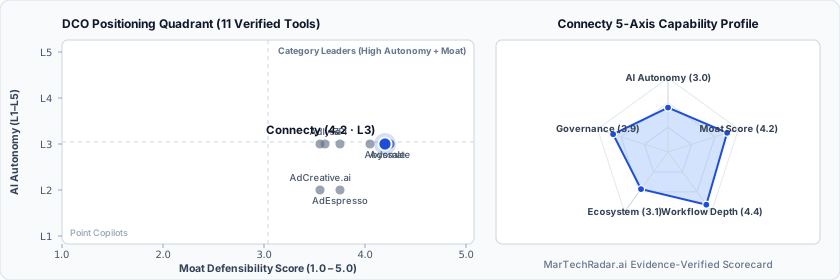
Connecty is a Web SaaS tool for DCO (Dynamic Creative Optimization / DCO) in AdTech & Paid Media. Pricing: Free plan · $0/mo · Enterprise plan. Best suited to Performance Marketing Directors, Ad Agencies and Retail Media Advertisers. Editor ratings: AI autonomy L3 (conditional automation); moat score 4.2/5.0 (Proprietary moat). Fact-checked by Jagmeet Sine on Oct 11, 2026.
Connecty is an AI-powered visual advertising analytics and optimization engine that deconstructs video ads frame by frame to automate creative attribution.
Connecty buyer fit verdict: when to choose vs. when to walk away
Choose Connecty if (Best Fit)
- Target ICP & Stack Fit: You operate as Performance Marketing Directors, Ad Agencies and Retail Media Advertisers requiring a Web SaaS deployment for DCO.
- L3 Architecture & Defensibility: Connecty builds defensibility around its granular frame-level creative decomposition linked directly to downstream ad account performance data and post-click landing page consistency.
- Commercial Model Fit: Your procurement budget aligns with Free plan · $0/mo · Enterprise plan and want a self-serve free tier for zero-cost initial validation.
Walk away from Connecty if (Deal-Breakers)
- Walk away if your workflow requires uncapped enterprise volume on the Free plan · $0/mo · Enterprise plan entry plan without upgrading tiers.
- Walk away if your workflow cannot tolerate attribution latency and ad spend minimums: Statistical confidence in frame-level visual asset attribution requires high impression volumes, leaving low-spend campaigns susceptible to noisy algorithmic recommendations.
- Walk away if walled-garden API dependency is a deal-breaker for your team: The platform relies heavily on Meta ad network ingestion pipelines, making programmatic adjustments vulnerable to upstream schema updates, rate limiting, and ad tracking restrictions.
Connecty key facts & scorecard
| Pricing | Free plan · $0/mo · Enterprise planVendor pricing page |
|---|---|
| Free plan | Yes |
| Delivery | Web SaaS |
| Audience | Performance Marketing Directors, Ad Agencies, Retail Media Advertisers |
| AI autonomy level | L3 · Conditional automationEditor-verified |
| Moat tier & score | 4.2 / 5.0 · Proprietary moatEditor-verified |
| Funding | Pre-seed |
| Total funding | $1.8MBacked by Notion Capital, Marathon Venture Capital |
| Founders | Aish Agarwal, Peter Wisniewski |
| Company size | 2-10 employees |
| Governance & docs | Terms ↗ · Privacy ↗ |
| Headquarters | San Francisco, California |
| Founded | 2024 |
| Last verified |
Connecty pros & cons: strengths vs. operational limitations
Pros: core strengths & capabilities
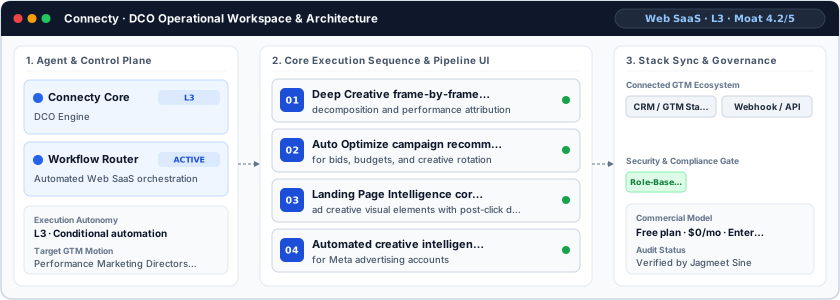
- Deep Creative frame-by-frame visual: decomposition and performance attribution
- Auto Optimize campaign recommendation engine: for bids, budgets, and creative rotation
- Landing Page Intelligence correlating: ad creative visual elements with post-click destination pages
- Automated creative intelligence reporting: for Meta advertising accounts
Cons: operational limitations & risks
- Attribution Latency and Ad Spend Minimums: Statistical confidence in frame-level visual asset attribution requires high impression volumes, leaving low-spend campaigns susceptible to noisy algorithmic recommendations.
- Walled-Garden API Dependency: The platform relies heavily on Meta ad network ingestion pipelines, making programmatic adjustments vulnerable to upstream schema updates, rate limiting, and ad tracking restrictions.
- Creative Generation Gap: Connecty diagnoses failures and recommends creative alterations but does not automatically synthesize new video assets in-engine, requiring manual intervention by external video editing teams.
Connecty TCO & deal-breaker stress test
Simulate 12-month stepped TCO, hidden cost multipliers, contract lock-in exposure, and stack failure modes using only facts verified by Jagmeet Sine on · Capture SHA a9f1b293.
Connecty is viable for 5 seats, but requires commercial or technical verification on the flagged items below.
| Plan / Tier | Verified Rate | Scale Fit | Scope & Quota Notes |
|---|---|---|---|
| Free / Sandbox | $0 | 1–2 seats (Evaluation) | Entry free tier with capped usage or feature quotas for initial workflow testing. |
| Entry / Starter | $799/mo | 1–2 seats | For under $50K/mo ad spend |
| Enterprise / Custom | Custom quote | 15–50+ seats (Enterprise SLA) | Sales-negotiated annual contract for custom volume, SSO/RBAC governance, and dedicated SLA. |
- Moat Score
- 4.2 / 5.0
- AI Autonomy
- L3
- Free Tier / Trial
- Free plan
Triggered audit signals & failure modes
- Opaque Enterprise Quoting vs. SMB/Mid-Market BudgetVerified Pricing Ledger
Connecty does not disclose a public self-serve floor (Free plan · $0/mo · Enterprise plan). Buyers with a $800/mo cap face high sales-qualification friction.
- Published Self-Serve Entry FloorVerified Pricing Ledger
Connecty publishes a transparent entry point (Free plan · $0/mo · Enterprise plan) with a free tier for initial validation before committing.
- Primary Operational Bottleneck: Attribution Latency and Ad Spend MinimumsAudit by Jagmeet Sine
Statistical confidence in frame-level visual asset attribution requires high impression volumes, leaving low-spend campaigns susceptible to noisy algorithmic recommendations.
Hidden TCO Multipliers & Quota Gates
- Credit & Usage Burn Multiplier: Automated workflows consume metered credits/usage quotas; multi-step enrichment, voice minutes, or high-frequency agent runs can trigger mid-cycle top-up packs.
- Attribution Latency and Ad Spend Minimums: Statistical confidence in frame-level visual asset attribution requires high impression volumes, leaving low-spend campaigns susceptible to noisy algorithmic recommendations.
- Walled-Garden API Dependency: The platform relies heavily on Meta ad network ingestion pipelines, making programmatic adjustments vulnerable to upstream schema updates, rate limiting, and ad tracking restrictions.
When to Walk Away & Negotiation Levers
- Walk away if your workflow requires uncapped enterprise volume on the Free plan · $0/mo · Enterprise plan entry plan without upgrading tiers.
- Walk away if your workflow cannot tolerate attribution latency and ad spend minimums: Statistical confidence in frame-level visual asset attribution requires high impression volumes, leaving low-spend campaigns susceptible to noisy algorithmic recommendations.
- Walk away if walled-garden API dependency is a deal-breaker for your team: The platform relies heavily on Meta ad network ingestion pipelines, making programmatic adjustments vulnerable to upstream schema updates, rate limiting, and ad tracking restrictions.
- Validate exact quota thresholds (seats, credits, or API calls) included in Connecty's Free plan · $0/mo · Enterprise plan tier before converting from monthly to annual billing.
- Require a sandbox proof-of-concept testing attribution latency and ad spend minimums against your live CRM/data schema before annual sign-off.
Ask a custom procurement or TCO stress-test question about Connecty
Lower 5-seat floor (~$99/mo vs. Custom Quote)
Lower 5-seat floor (~$36/mo vs. Custom Quote)
Connecty moat & subtrack positioning
Connecty builds defensibility around its granular frame-level creative decomposition linked directly to downstream ad account performance data and post-click landing page consistency.
Editorial review
Fact-checked by Jagmeet Sine (Senior MarTech Infrastructure & Agentic Workflow Architect) on .
Background
Backed by $1.8M in pre-seed venture capital, Connecty was established in 2024 in San Francisco, California, to address structural diagnostic blind spots in performance marketing. Tailored for growth marketers, performance marketing leads, and paid social agencies managing visual ad volume across Meta channels, the platform shifts creative analytics away from aggregated post-hoc reporting toward computational asset deconstruction. As a Meta-verified Tech Provider, Connecty delivers automated intelligence on visual ad assets to optimize dynamic ad performance.
How Connecty works
Operating at an L3 autonomy profile, Connecty extracts performance telemetry directly via advertising APIs while concurrently ingesting raw video and image creative files. The architecture runs through its Deep Creative subsystem, utilizing computer vision and multimodal models to disassemble video assets frame by frame, isolating visual hooks, pacing, transcription semantics, and on-screen elements. Connecty correlates these decomposed variables against conversion events and down-funnel metrics. Its Landing Page Intelligence engine crawls post-click destinations to verify visual continuity, while the Auto Optimize layer outputs structured bidding, allocation, and creative swap actions.
Limitations
Operational considerations and platform boundaries include:
- Attribution Latency and Ad Spend Minimums: Statistical confidence in frame-level visual asset attribution requires high impression volumes, leaving low-spend campaigns susceptible to noisy algorithmic recommendations.
- Walled-Garden API Dependency: The platform relies heavily on Meta ad network ingestion pipelines, making programmatic adjustments vulnerable to upstream schema updates, rate limiting, and ad tracking restrictions.
- Creative Generation Gap: Connecty diagnoses failures and recommends creative alterations but does not automatically synthesize new video assets in-engine, requiring manual intervention by external video editing teams.
Connecty pricing
Connecty operates a tiered SaaS subscription model spanning self-serve tiers and bespoke contracts. Deployment begins with a self-serve tier evaluated through a $0 entry point alongside a 14-day evaluation window. Higher operational tiers scale based on tracked monthly advertising spend, monitored creative volume, and feature access covering Auto Optimize, Deep Creative, and Landing Page Intelligence, supplemented by custom enterprise agreements for multi-brand agencies requiring unified reporting.
How Connecty compares
Connecty competes within the dynamic creative optimization and visual analytics domain alongside solutions like 7Pi, Abyssale, and AdCreative.ai. While Abyssale focuses primarily on programmatic banner generation workflows and AdCreative.ai emphasizes generative template production, Connecty prioritizes deep diagnostic telemetry and post-click alignment. It foregoes native asset synthesis in favor of frame-by-frame diagnostic granularity, positioning itself as a fit for direct-to-consumer enterprises seeking performance attribution across active paid social campaigns.
Direct competitors & market radar
Top algorithmic competitors based on category positioning, capability overlap, and ICP alignment.
Frequently asked questions about Connecty
How much does Connecty cost and what pricing tiers are available?
Published pricing summary for Connecty: Free plan · $0/mo · Enterprise plan. Connecty includes a free tier or sandbox entry point. Verified tier schedule: Free / Sandbox ($0 for 1–2 seats (Evaluation)); Entry / Starter ($799/mo for 1–2 seats); Enterprise / Custom (Custom quote for 15–50+ seats (Enterprise SLA)). Connecty operates a tiered SaaS subscription model spanning self-serve tiers and bespoke contracts. Deployment begins with a self-serve tier evaluated through a $0 entry point alongside a 14-day evaluation window.
How does Connecty work and how autonomous is its AI architecture?
Connecty is an AI-powered visual advertising analytics and optimization engine that deconstructs video ads frame by frame to automate creative attribution. Within DCO (Dynamic Creative Optimization / DCO), MarTechRadar rates its execution architecture at L3 · Conditional automation with a verified Moat Score of 4.2 / 5.0 (Proprietary moat). Connecty builds defensibility around its granular frame-level creative decomposition linked directly to downstream ad account performance data and post-click landing page consistency. Corporate profile: Founded by Aish Agarwal, Peter Wisniewski, operating at 2-10 employees scale.
What are the main limitations of Connecty and when should buyers walk away?
Based on our editorial technical audit, key operational considerations and boundaries for Connecty include: (1) Attribution Latency and Ad Spend Minimums: Statistical confidence in frame-level visual asset attribution requires high impression volumes, leaving low-spend campaigns susceptible to noisy algorithmic recommendations. (2) Walled-Garden API Dependency: The platform relies heavily on Meta ad network ingestion pipelines, making programmatic adjustments vulnerable to upstream schema updates, rate limiting, and ad tracking restrictions. (3) Creative Generation Gap: Connecty diagnoses failures and recommends creative alterations but does not automatically synthesize new video assets in-engine, requiring manual intervention by external video editing teams. Primary procurement walk-away rule: Walk away if your workflow requires uncapped enterprise volume on the Free plan · $0/mo · Enterprise plan entry plan without upgrading tiers.
What integrations, compliance certifications, and contract terms apply to Connecty?
Key TCO multiplier to watch: Credit & Usage Burn Multiplier (Automated workflows consume metered credits/usage quotas; multi-step enrichment, voice minutes, or high-frequency agent runs can trigger mid-cycle top-up packs.) Before signing a contract, procurement teams should validate exact quota thresholds (seats, credits, or API calls) included in Connecty's Free plan · $0/mo · Enterprise plan tier before converting from monthly to annual billing.
What are the best Connecty alternatives and head-to-head competitors in 2026?
Top fact-checked alternatives to Connecty in DCO (Dynamic Creative Optimization / DCO) include Conversion Maker (Custom / enterprise pricing), Adomate (From $99/mo), Adwave (Free plan · $0/mo · Enterprise plan), Hookmill (Free plan · $0/mo · Enterprise plan). Connecty competes within the dynamic creative optimization and visual analytics domain alongside solutions like 7Pi, Abyssale, and AdCreative.ai.
Verified sources & evidence trail
- Official product domain: https://connecty.ai/
- Commercial pricing verification: https://connecty.ai/pricing
- Verified corporate entity profiles (
sameAs): LinkedIn Company Profile · Crunchbase Entity Record - First-party governance & documentation links: Terms · Privacy
- Editorial audit sign-off: Fact-checked by Jagmeet Sine on under the MarTechRadar Evidence-Ledger Protocol.