Disco Review (2026): AI Marketing Agent Pricing, Limits & Alternatives
Bottom line
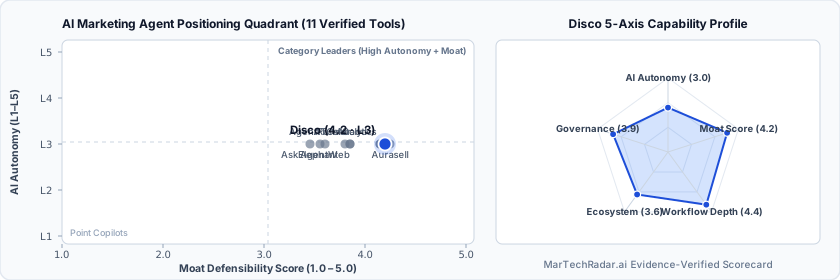
Disco is a Web SaaS tool for AI Marketing Agent (Autonomous Marketing Agents & Digital Coworkers) in Agent & Marketing Ops. Pricing: Custom / enterprise pricing. Best suited to GTM Operations Teams, Enterprise Marketing Executives and Automated Ops Teams. Editor ratings: AI autonomy L3 (conditional automation); moat score 4.2/5.0 (Proprietary moat). Fact-checked by Anna Xia on Oct 12, 2026.
Collaborative commerce media network and autonomous cross-merchandising engine that surfaces contextual partner offers post-purchase to acquire customers.
Disco buyer fit verdict: when to choose vs. when to walk away
Choose Disco if (Best Fit)
- Target ICP & Stack Fit: You operate as GTM Operations Teams, Enterprise Marketing Executives and Automated Ops Teams requiring a Web SaaS deployment for AI Marketing Agent, with verified ecosystem connectivity for Shopify.
- L3 Architecture & Defensibility: Proprietary cross-brand transaction graph, multi-merchant shopper affinity dataset, and embedded checkout extension real estate across large DTC merchant ecosystems.
- Commercial Model Fit: Your procurement budget aligns with Custom / enterprise pricing.
Walk away from Disco if (Deal-Breakers)
- Walk away if you require transparent self-serve monthly billing or your budget ceiling is under $1,000/mo (Disco requires sales-gated custom quoting).
- Walk away if your workflow cannot tolerate checkout extensibility latency: Network response times during high-volume flash sales can encounter API rate constraints, degrading dynamic widget load speeds on order confirmation pages.
- Walk away if catalog affinity cold starts is a deal-breaker for your team: Niche brands in low-density consumer categories experience longer algorithmic warm-up periods before the collaborative recommendation model establishes stable attribution gains.
Disco key facts & scorecard
| Pricing | Custom / enterprise pricing |
|---|---|
| Free plan | No / not disclosed |
| Delivery | Web SaaS |
| Audience | GTM Operations Teams, Enterprise Marketing Executives, Automated Ops Teams |
| AI autonomy level | L3 · Conditional automationEditor-verified |
| Moat tier & score | 4.2 / 5.0 · Proprietary moatEditor-verified |
| Funding | Series A |
| Total funding | $25.8MBacked by Bessemer Venture Partners |
| Founders | Conner Sherline |
| Company size | 11-50 employees |
| Ecosystem integrations | Shopify |
| Governance & docs | API & Docs ↗ · Terms ↗ · Privacy ↗ |
| Headquarters | San Francisco |
| Founded | 2020 |
| Last verified |
Disco pros & cons: strengths vs. operational limitations
Pros: core strengths & capabilities
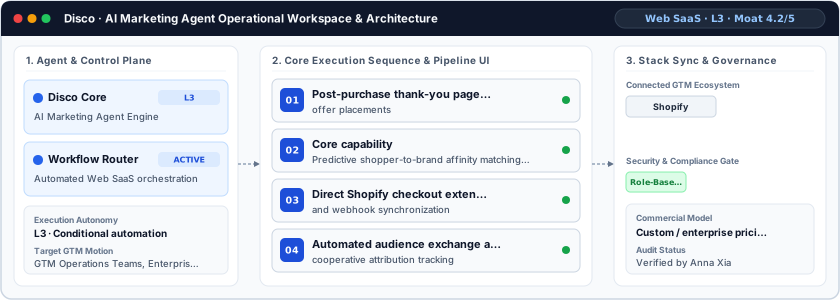
- Post-purchase thank-you page cross-merchant: offer placements
- Core capability: Predictive shopper-to-brand affinity matching algorithms
- Direct Shopify checkout extension: and webhook synchronization
- Automated audience exchange and: cooperative attribution tracking
Cons: operational limitations & risks
- Checkout Extensibility Latency: Network response times during high-volume flash sales can encounter API rate constraints, degrading dynamic widget load speeds on order confirmation pages.
- Catalog Affinity Cold Starts: Niche brands in low-density consumer categories experience longer algorithmic warm-up periods before the collaborative recommendation model establishes stable attribution gains.
- Attribution Window Blindspots: Cross-network voucher redemptions that lapse outside deterministic multi-touch attribution windows fail to reconcile against off-platform repeat purchases.
Disco TCO & deal-breaker stress test
Simulate 12-month stepped TCO, hidden cost multipliers, contract lock-in exposure, and stack failure modes using only facts verified by Anna Xia on · Capture SHA 67c09c02.
Disco triggers high-severity friction under your 5-seat / $800/mo constraints. Benchmark the verified subtrack alternatives below before committing.
| Plan / Tier | Verified Rate | Scale Fit | Scope & Quota Notes |
|---|---|---|---|
| Enterprise / Custom | Custom quote | 15–50+ seats (Enterprise SLA) | Sales-negotiated annual contract for custom volume, SSO/RBAC governance, and dedicated SLA. |
- Moat Score
- 4.2 / 5.0
- AI Autonomy
- L3
- Free Tier / Trial
- None disclosed
Triggered audit signals & failure modes
- Opaque Enterprise Quoting vs. SMB/Mid-Market BudgetVerified Pricing Ledger
Disco does not disclose a public self-serve floor (Custom / enterprise pricing). Buyers with a $800/mo cap face high sales-qualification friction.
- Sales-Gated Contract TermsFact-checked by Anna Xia
Disco's commercial pricing is available on request through tailored enterprise sales quotes based on organizational scale and seats.
- Primary Operational Bottleneck: Checkout Extensibility LatencyAudit by Anna Xia
Network response times during high-volume flash sales can encounter API rate constraints, degrading dynamic widget load speeds on order confirmation pages.
Hidden TCO Multipliers & Quota Gates
- Checkout Extensibility Latency: Network response times during high-volume flash sales can encounter API rate constraints, degrading dynamic widget load speeds on order confirmation pages.
- Catalog Affinity Cold Starts: Niche brands in low-density consumer categories experience longer algorithmic warm-up periods before the collaborative recommendation model establishes stable attribution gains.
When to Walk Away & Negotiation Levers
- Walk away if you require transparent self-serve monthly billing or your budget ceiling is under $1,000/mo (Disco requires sales-gated custom quoting).
- Walk away if your workflow cannot tolerate checkout extensibility latency: Network response times during high-volume flash sales can encounter API rate constraints, degrading dynamic widget load speeds on order confirmation pages.
- Walk away if catalog affinity cold starts is a deal-breaker for your team: Niche brands in low-density consumer categories experience longer algorithmic warm-up periods before the collaborative recommendation model establishes stable attribution gains.
- Demand a 30- to 60-day paid pilot opt-out clause in the Disco order form before signing a 12-month enterprise commitment.
- Require a sandbox proof-of-concept testing checkout extensibility latency against your live CRM/data schema before annual sign-off.
Ask a custom procurement or TCO stress-test question about Disco
Lower 5-seat floor (~$10/mo vs. Custom Quote) · Transparent self-serve entry without mandatory annual lock-in
Lower 5-seat floor (~$79/mo vs. Custom Quote) · Transparent self-serve entry without mandatory annual lock-in
Disco key entities, modules & ecosystem stack
Disco moat & subtrack positioning
Proprietary cross-brand transaction graph, multi-merchant shopper affinity dataset, and embedded checkout extension real estate across large DTC merchant ecosystems.
Editorial review
Fact-checked by Anna Xia (Senior B2B GTM & Revenue Systems Analyst) on .
Background
Disco addresses rising customer acquisition costs across programmatic channels by transforming the post-transaction checkout envelope into a cooperative merchant media network. Headquartered in San Francisco and founded in 2020, the company has secured $25.8M in venture funding. Engineered primarily for direct-to-consumer growth leaders and e-commerce marketing operators, Disco builds a collective audience distribution model that leverages high-intent post-purchase inventory across non-competing storefronts.
How Disco works
At the architectural layer, the system autonomy, Disco functions through an event-driven cross-merchant recommendation architecture integrated via native Shopify APIs and checkout extensions. Upon order completion, an event stream transmits basket metadata, sku telemetry, and hashed customer attributes into Disco's affinity engine. Machine learning models assess cross-brand conversion propensities in real time, deterministically rendering dynamic partner brand offers directly on the confirmation view without exposing raw merchant customer data.
Limitations
Operational considerations and platform boundaries include:
- Checkout Extensibility Latency: Network response times during high-volume flash sales can encounter API rate constraints, degrading dynamic widget load speeds on order confirmation pages.
- Catalog Affinity Cold Starts: Niche brands in low-density consumer categories experience longer algorithmic warm-up periods before the collaborative recommendation model establishes stable attribution gains.
- Attribution Window Blindspots: Cross-network voucher redemptions that lapse outside deterministic multi-touch attribution windows fail to reconcile against off-platform repeat purchases.
Disco pricing
Disco's commercial pricing is available on request through tailored enterprise sales quotes based on organizational scale and seats. The model scales with transaction throughput, cross-merchant network usage, and customized integration governance, completely omitting published seat tiers in favor of contract arrangements governed by monthly processing volume.
How Disco compares
While horizontal agents like ai-marketing-claude focus on generative ad copy, and platforms like allGood and AskElephant execute autonomous conversation pipelines, Disco focuses strictly on transactional checkout real estate and partner audience syndication. Disco represents the optimal architecture for mid-market to enterprise Shopify merchants seeking collaborative, non-auction customer acquisition channels that bypass traditional ad exchanges. Enterprise procurement teams evaluating deployment readiness should assess API webhook throughput, role-based access governance, and bilateral data synchronization latency against existing marketing technology infrastructure before committing to multi-year production rollouts.
Direct competitors & market radar
Top algorithmic competitors based on category positioning, capability overlap, and ICP alignment.
Frequently asked questions about Disco
How much does Disco cost and does it require a custom enterprise quote?
Published pricing summary for Disco: Custom / enterprise pricing. A permanent free plan is not disclosed for Disco. Disco's commercial pricing is available on request through tailored enterprise sales quotes based on organizational scale and seats.
How does Disco work and how autonomous is its AI architecture?
Collaborative commerce media network and autonomous cross-merchandising engine that surfaces contextual partner offers post-purchase to acquire customers. Within AI Marketing Agent (Autonomous Marketing Agents & Digital Coworkers), MarTechRadar rates its execution architecture at L3 · Conditional automation with a verified Moat Score of 4.2 / 5.0 (Proprietary moat). Proprietary cross-brand transaction graph, multi-merchant shopper affinity dataset, and embedded checkout extension real estate across large DTC merchant ecosystems. Corporate profile: Founded by Conner Sherline, operating at 11-50 employees scale.
What are the main limitations of Disco and when should buyers walk away?
Based on our editorial technical audit, key operational considerations and boundaries for Disco include: (1) Checkout Extensibility Latency: Network response times during high-volume flash sales can encounter API rate constraints, degrading dynamic widget load speeds on order confirmation pages. (2) Catalog Affinity Cold Starts: Niche brands in low-density consumer categories experience longer algorithmic warm-up periods before the collaborative recommendation model establishes stable attribution gains. (3) Attribution Window Blindspots: Cross-network voucher redemptions that lapse outside deterministic multi-touch attribution windows fail to reconcile against off-platform repeat purchases. Primary procurement walk-away rule: Walk away if you require transparent self-serve monthly billing or your budget ceiling is under $1,000/mo (Disco requires sales-gated custom quoting).
What integrations, compliance certifications, and contract terms apply to Disco?
Verified ecosystem and stack integrations include Shopify. First-party governance and developer endpoints verified on domain include: API Docs (https://docs.disconetwork.com/developers/overview). Key TCO multiplier to watch: Checkout Extensibility Latency (Network response times during high-volume flash sales can encounter API rate constraints, degrading dynamic widget load speeds on order confirmation pages.) Before signing a contract, procurement teams should demand a 30- to 60-day paid pilot opt-out clause in the Disco order form before signing a 12-month enterprise commitment.
What are the best Disco alternatives and head-to-head competitors in 2026?
Top fact-checked alternatives to Disco in AI Marketing Agent (Autonomous Marketing Agents & Digital Coworkers) include PartnerStack (Custom / enterprise pricing), Blaze (From $79/mo), Monaco ($10,000 usage-based), Bardeen (From $10/mo). While horizontal agents like ai-marketing-claude focus on generative ad copy, and platforms like allGood and AskElephant execute autonomous conversation pipelines, Disco focuses strictly on transactional checkout real estate and partner audience syndication.
Verified sources & evidence trail
- Official product domain: https://www.disconetwork.com/
- Commercial pricing verification: Verified against official vendor pricing policy (Custom / enterprise pricing)
- Verified corporate entity profiles (
sameAs): LinkedIn Company Profile · Crunchbase Entity Record - First-party governance & documentation links: API & Docs · Terms · Privacy
- Editorial audit sign-off: Fact-checked by Anna Xia on under the MarTechRadar Evidence-Ledger Protocol.