Dynamiks.ai Review (2026): AI SDR Pricing, Limits & Alternatives
Bottom line
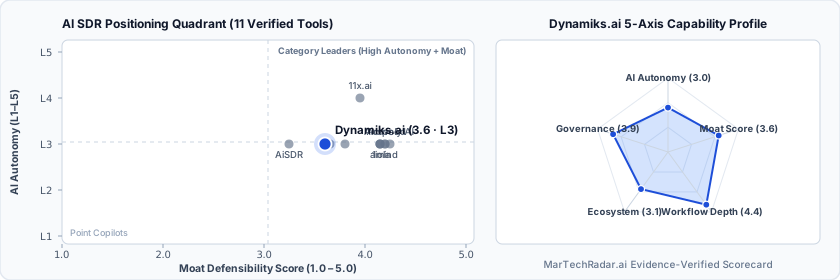
Dynamiks.ai is a Web SaaS tool for AI SDR (Autonomous B2B Sales Agents & AI BDRs) in AI SDR & Outbound. Pricing: Custom / enterprise pricing. Best suited to B2B Sales Leaders, SDR/BDR Teams and Revenue Operations (RevOps). Editor ratings: AI autonomy L3 (conditional automation); moat score 3.6/5.0 (Proprietary moat). Fact-checked by Jagmeet Sine on Oct 14, 2026.
Autonomous pipeline quarterback agent that integrates with CRM data to formulate account strategies, coach reps, and automate sales execution workflows.
Dynamiks.ai buyer fit verdict: when to choose vs. when to walk away
Choose Dynamiks.ai if (Best Fit)
- Target ICP & Stack Fit: You operate as B2B Sales Leaders, SDR/BDR Teams and Revenue Operations (RevOps) requiring a Web SaaS deployment for AI SDR.
- L3 Architecture & Defensibility: Dynamiks.ai positions its moat around deal orchestration graph models and bidirectional CRM telemetry, though its early capital footprint of $300K presents an ongoing engineering defensibility challenge against better-capitalized sales agent providers.
- Commercial Model Fit: Your procurement budget aligns with Custom / enterprise pricing.
Walk away from Dynamiks.ai if (Deal-Breakers)
- Walk away if you require transparent self-serve monthly billing or your budget ceiling is under $1,000/mo (Dynamiks.ai requires sales-gated custom quoting).
- Walk away if your workflow cannot tolerate CRM schema variance: The strategy engine depends on structured deal stages and opportunity histories, causing erratic plan generation when deployed on non-standard or heavily customized CRM schemas.
- Walk away if bi-directional sync latency is a deal-breaker for your team: Polling cycles and API rate constraints across external sales tools introduce telemetry delays, occasionally causing the agent to base intervention playbooks on stale opportunity states.
Dynamiks.ai key facts & scorecard
| Pricing | Custom / enterprise pricing |
|---|---|
| Free plan | No / not disclosed |
| Delivery | Web SaaS |
| Audience | B2B Sales Leaders, SDR/BDR Teams, Revenue Operations (RevOps) |
| AI autonomy level | L3 · Conditional automationEditor-verified |
| Moat tier & score | 3.6 / 5.0 · Proprietary moatEditor-verified |
| Funding | Pre-seed |
| Total funding | $300K |
| Founders | Nicolas Maquaire |
| Company size | 2-10 employees |
| Headquarters | San Francisco, CA |
| Founded | 2024 |
| Last verified |
Dynamiks.ai pros & cons: strengths vs. operational limitations
Pros: core strengths & capabilities
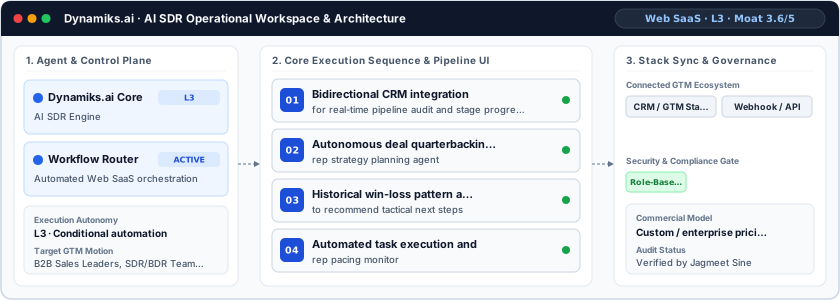
- Bidirectional CRM integration: for real-time pipeline audit and stage progression
- Autonomous deal quarterbacking and: rep strategy planning agent
- Historical win-loss pattern analysis: to recommend tactical next steps
- Automated task execution and: rep pacing monitor
Cons: operational limitations & risks
- CRM Schema Variance: The strategy engine depends on structured deal stages and opportunity histories, causing erratic plan generation when deployed on non-standard or heavily customized CRM schemas.
- Bi-directional Sync Latency: Polling cycles and API rate constraints across external sales tools introduce telemetry delays, occasionally causing the agent to base intervention playbooks on stale opportunity states.
- Cold-Start Attribution Gaps: In nascent sales teams without significant closed-won historical logs, the engine defaults to generic execution heuristics rather than calibrated firmographic win patterns.
Dynamiks.ai TCO & deal-breaker stress test
Simulate 12-month stepped TCO, hidden cost multipliers, contract lock-in exposure, and stack failure modes using only facts verified by Jagmeet Sine on · Capture SHA 198cb31a.
Dynamiks.ai triggers high-severity friction under your 5-seat / $800/mo constraints. Benchmark the verified subtrack alternatives below before committing.
| Plan / Tier | Verified Rate | Scale Fit | Scope & Quota Notes |
|---|---|---|---|
| Enterprise / Custom | Custom quote | 15–50+ seats (Enterprise SLA) | Sales-negotiated annual contract for custom volume, SSO/RBAC governance, and dedicated SLA. |
- Moat Score
- 3.6 / 5.0
- AI Autonomy
- L3
- Free Tier / Trial
- None disclosed
Triggered audit signals & failure modes
- Opaque Enterprise Quoting vs. SMB/Mid-Market BudgetVerified Pricing Ledger
Dynamiks.ai does not disclose a public self-serve floor (Custom / enterprise pricing). Buyers with a $800/mo cap face high sales-qualification friction.
- Sales-Gated Contract TermsFact-checked by Jagmeet Sine
Dynamiks.ai distributes its software through a direct sales structure, offering custom enterprise pricing based on sales organization scale and deployed agent seats.
- Primary Operational Bottleneck: CRM Schema VarianceAudit by Jagmeet Sine
The strategy engine depends on structured deal stages and opportunity histories, causing erratic plan generation when deployed on non-standard or heavily customized CRM schemas.
Hidden TCO Multipliers & Quota Gates
- Profile / Workspace Quota Ceilings: Base tiers cap the number of connected profiles, workspaces, or contact records, forcing tier upgrades before seat limits are reached.
- CRM Schema Variance: The strategy engine depends on structured deal stages and opportunity histories, causing erratic plan generation when deployed on non-standard or heavily customized CRM schemas.
- Bi-directional Sync Latency: Polling cycles and API rate constraints across external sales tools introduce telemetry delays, occasionally causing the agent to base intervention playbooks on stale opportunity states.
When to Walk Away & Negotiation Levers
- Walk away if you require transparent self-serve monthly billing or your budget ceiling is under $1,000/mo (Dynamiks.ai requires sales-gated custom quoting).
- Walk away if your workflow cannot tolerate CRM schema variance: The strategy engine depends on structured deal stages and opportunity histories, causing erratic plan generation when deployed on non-standard or heavily customized CRM schemas.
- Walk away if bi-directional sync latency is a deal-breaker for your team: Polling cycles and API rate constraints across external sales tools introduce telemetry delays, occasionally causing the agent to base intervention playbooks on stale opportunity states.
- Demand a 30- to 60-day paid pilot opt-out clause in the Dynamiks.ai order form before signing a 12-month enterprise commitment.
- Require a sandbox proof-of-concept testing CRM schema variance against your live CRM/data schema before annual sign-off.
Ask a custom procurement or TCO stress-test question about Dynamiks.ai
Lower 5-seat floor (~$41/mo vs. Custom Quote) · Transparent self-serve entry without mandatory annual lock-in
Offers a free tier (Free plan · $0/mo) · Transparent self-serve entry without mandatory annual lock-in
Dynamiks.ai moat & subtrack positioning
Dynamiks.ai positions its moat around deal orchestration graph models and bidirectional CRM telemetry, though its early capital footprint of $300K presents an ongoing engineering defensibility challenge against better-capitalized sales agent providers.
Editorial review
Fact-checked by Jagmeet Sine (Senior MarTech Infrastructure & Agentic Workflow Architect) on .
Background
Solving the persistent problem of deal slippage and uneven pipeline discipline, Dynamiks.ai provides an autonomous pipeline orchestration agent designed to assist individual account executives. Headquartered in San Francisco, CA, and founded in 2024, the company launched with $300K in pre-seed backing to deliver an autonomous coworker model for revenue operations teams. Built specifically for sales managers and enterprise account executives, the platform assigns a digital agent to each seller to maintain deal veracity and formulate tactical playbooks directly from pipeline signals.
How Dynamiks.ai works
Operating at an L3 autonomy profile, Dynamiks.ai pairs an asynchronous reasoning engine with bidirectional CRM connectors across objects like opportunities, contacts, and activity histories. The core service acts as an autonomous deal strategist that parses pipeline movements, identifies dormant stakeholder threads, and evaluates historical win patterns against active opportunity states. When anomalous pipeline stall points are detected, the system formulates intervention plans, suggests deal velocity tactics, and generates next-step tasks for reps while logging updates back into the CRM schema without manual data entry.
Limitations
Operational considerations and platform boundaries include:
- CRM Schema Variance: The strategy engine depends on structured deal stages and opportunity histories, causing erratic plan generation when deployed on non-standard or heavily customized CRM schemas.
- Bi-directional Sync Latency: Polling cycles and API rate constraints across external sales tools introduce telemetry delays, occasionally causing the agent to base intervention playbooks on stale opportunity states.
- Cold-Start Attribution Gaps: In nascent sales teams without significant closed-won historical logs, the engine defaults to generic execution heuristics rather than calibrated firmographic win patterns.
Dynamiks.ai pricing
Dynamiks.ai distributes its software through a direct sales structure, offering custom enterprise pricing based on sales organization scale and deployed agent seats. Commercial pricing is available on request through tailored enterprise sales quotes based on organizational scale and seats. Contracts typically follow annual commitments that include onboarding support, CRM workspace integration, and security reviews.
How Dynamiks.ai compares
Within the autonomous sales execution category, Dynamiks.ai operates alongside platforms like 11x.ai, 1mind, and Actively AI. While 11x.ai focuses primarily on outbound top-of-funnel prospecting via autonomous SDRs, Dynamiks.ai differentiates by anchoring on mid-funnel pipeline governance and rep-level execution strategy. Unlike Actively AI and 1mind, which emphasize automated buyer engagement and conversational qualification, Dynamiks.ai targets the internal rep-to-deal interface. It is best suited for mid-market B2B software companies seeking automated deal discipline across complex multi-stakeholder sales cycles.
Direct competitors & market radar
Top algorithmic competitors based on category positioning, capability overlap, and ICP alignment.
Frequently asked questions about Dynamiks.ai
How much does Dynamiks.ai cost and does it require a custom enterprise quote?
Published pricing summary for Dynamiks.ai: Custom / enterprise pricing. A permanent free plan is not disclosed for Dynamiks.ai. Dynamiks.ai distributes its software through a direct sales structure, offering custom enterprise pricing based on sales organization scale and deployed agent seats. Commercial pricing is available on request through tailored enterprise sales quotes based on organizational scale and seats.
How does Dynamiks.ai work and how autonomous is its AI architecture?
Autonomous pipeline quarterback agent that integrates with CRM data to formulate account strategies, coach reps, and automate sales execution workflows. Within AI SDR (Autonomous B2B Sales Agents & AI BDRs), MarTechRadar rates its execution architecture at L3 · Conditional automation with a verified Moat Score of 3.6 / 5.0 (Proprietary moat). Dynamiks.ai positions its moat around deal orchestration graph models and bidirectional CRM telemetry, though its early capital footprint of $300K presents an ongoing engineering defensibility challenge against better-capitalized sales agent providers. Corporate profile: Founded by Nicolas Maquaire, operating at 2-10 employees scale.
What are the main limitations of Dynamiks.ai and when should buyers walk away?
Based on our editorial technical audit, key operational considerations and boundaries for Dynamiks.ai include: (1) CRM Schema Variance: The strategy engine depends on structured deal stages and opportunity histories, causing erratic plan generation when deployed on non-standard or heavily customized CRM schemas. (2) Bi-directional Sync Latency: Polling cycles and API rate constraints across external sales tools introduce telemetry delays, occasionally causing the agent to base intervention playbooks on stale opportunity states. (3) Cold-Start Attribution Gaps: In nascent sales teams without significant closed-won historical logs, the engine defaults to generic execution heuristics rather than calibrated firmographic win patterns. Primary procurement walk-away rule: Walk away if you require transparent self-serve monthly billing or your budget ceiling is under $1,000/mo (Dynamiks.ai requires sales-gated custom quoting).
What integrations, compliance certifications, and contract terms apply to Dynamiks.ai?
Key TCO multiplier to watch: Profile / Workspace Quota Ceilings (Base tiers cap the number of connected profiles, workspaces, or contact records, forcing tier upgrades before seat limits are reached.) Before signing a contract, procurement teams should demand a 30- to 60-day paid pilot opt-out clause in the Dynamiks.ai order form before signing a 12-month enterprise commitment.
What are the best Dynamiks.ai alternatives and head-to-head competitors in 2026?
Top fact-checked alternatives to Dynamiks.ai in AI SDR (Autonomous B2B Sales Agents & AI BDRs) include Dux-Soup (From $41.25/mo), Endgame (Custom / enterprise pricing), Burbuxa (Free plan · $0/mo · Enterprise plan), Expandi (From $1/mo). Within the autonomous sales execution category, Dynamiks.ai operates alongside platforms like 11x.ai, 1mind, and Actively AI.
Verified sources & evidence trail
- Official product domain: https://www.dynamiks.ai/
- Commercial pricing verification: Verified against official vendor pricing policy (Custom / enterprise pricing)
- Verified corporate entity profiles (
sameAs): LinkedIn Company Profile · Crunchbase Entity Record - Editorial audit sign-off: Fact-checked by Jagmeet Sine on under the MarTechRadar Evidence-Ledger Protocol.