Dux-Soup Review (2026): AI SDR Pricing, Limits & Alternatives
Bottom line
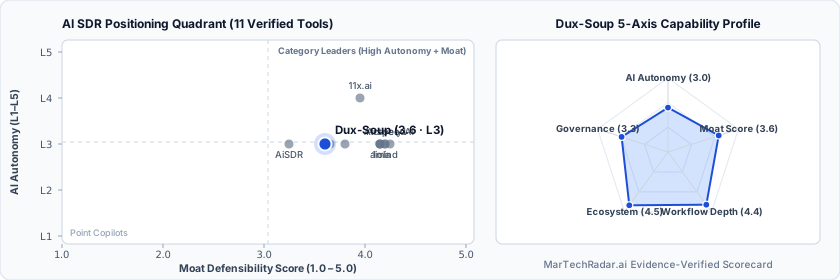
Dux-Soup is a Web SaaS tool for AI SDR (Autonomous B2B Sales Agents & AI BDRs) in AI SDR & Outbound. Pricing: From $41.25/mo. Best suited to Creators / Solo. Editor ratings: AI autonomy L3 (conditional automation); moat score 3.6/5.0 (Proprietary moat). Fact-checked by Sarah Per on Oct 14, 2026.
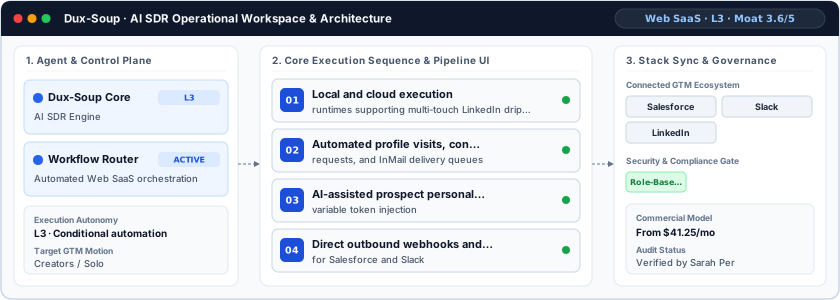
Client-side and cloud-managed LinkedIn automation engine providing scheduled connection requests, multi-stage drip messaging sequences, and AI-assisted.
Dux-Soup buyer fit verdict: when to choose vs. when to walk away
Choose Dux-Soup if (Best Fit)
- Target ICP & Stack Fit: You operate as Creators / Solo requiring a Web SaaS deployment for AI SDR, with verified ecosystem connectivity for Salesforce, Slack, LinkedIn.
- L3 Architecture & Defensibility: Sustained installed base longevity since 2015 and entrenched workflow familiarity across SMB prospecting ecosystems, constrained by client-side browser DOM execution and platform policy changes.
- Commercial Model Fit: Your procurement budget aligns with From $41.25/mo.
Walk away from Dux-Soup if (Deal-Breakers)
- Walk away if your workflow requires uncapped enterprise volume on the From $41.25/mo entry plan without upgrading tiers.
- Walk away if your workflow cannot tolerate browser runtime dependency: Local execution modes require persistent local machine uptime and uninterrupted browser instances to complete scheduled sequence queues.
- Walk away if platform throttling and session invalidation is a deal-breaker for your team: Heavy reliance on LinkedIn session cookies exposes users to account rate-limiting, CAPTCHA hurdles, or temporary security checkpoints when action thresholds trip.
Dux-Soup key facts & scorecard
| Pricing | From $41.25/moVendor pricing page |
|---|---|
| Free plan | No / not disclosed |
| Delivery | Web SaaS |
| Audience | Creators / Solo |
| AI autonomy level | L3 · Conditional automationEditor-verified |
| Moat tier & score | 3.6 / 5.0 · Proprietary moatEditor-verified |
| Funding | Venture-backed |
| Founders | Will van der Sanden |
| Company size | 1-10 employees |
| Ecosystem integrations | Salesforce, Slack, LinkedIn |
| Headquarters | Mountain View, California, United States |
| Founded | 2015 |
| Last verified |
Dux-Soup pros & cons: strengths vs. operational limitations
Pros: core strengths & capabilities
- Local and cloud execution: runtimes supporting multi-touch LinkedIn drip sequences
- Automated profile visits, connection: requests, and InMail delivery queues
- AI-assisted prospect personalization and: variable token injection
- Direct outbound webhooks and native connectors: for Salesforce and Slack
Cons: operational limitations & risks
- Browser Runtime Dependency: Local execution modes require persistent local machine uptime and uninterrupted browser instances to complete scheduled sequence queues.
- Platform Throttling and Session Invalidation: Heavy reliance on LinkedIn session cookies exposes users to account rate-limiting, CAPTCHA hurdles, or temporary security checkpoints when action thresholds trip.
- Unidirectional Channel Scope: The system operates exclusively within LinkedIn surfaces, lacking unified cross-channel mailbox rotation, native cold email deliverability checks, and domain warming.
Dux-Soup TCO & deal-breaker stress test
Simulate 12-month stepped TCO, hidden cost multipliers, contract lock-in exposure, and stack failure modes using only facts verified by Sarah Per on · Capture SHA 96b623fd.
Dux-Soup aligns with your 5-seat / $800/mo profile. Review the walk-away triggers and contract levers below before deployment.
| Plan / Tier | Verified Rate | Scale Fit | Scope & Quota Notes |
|---|---|---|---|
| Entry / Starter | $41.25/mo | 1–2 seats | Verified $41.25/mo published rate on vendor pricing schedule. |
| Growth / Professional | $55/mo | 5 seats | Verified $55/mo published rate on vendor pricing schedule. |
| Scale / Advanced | $74.17/mo | 15 seats | Verified $74.17/mo published rate on vendor pricing schedule. |
- Moat Score
- 3.6 / 5.0
- AI Autonomy
- L3
- Free Tier / Trial
- None disclosed
Triggered audit signals & failure modes
- Published Self-Serve Entry FloorVerified Pricing Ledger
Dux-Soup publishes a transparent entry point (From $41.25/mo) for initial validation before committing.
- Tier Fit for 5-Seat Scale: Growth / Professional ($55/mo)Verified Tier Schedule
Verified $55/mo published rate on vendor pricing schedule.
- Primary Operational Bottleneck: Browser Runtime DependencyAudit by Sarah Per
Local execution modes require persistent local machine uptime and uninterrupted browser instances to complete scheduled sequence queues.
Hidden TCO Multipliers & Quota Gates
- Per-Seat Linear Scaling: Dux-Soup prices licenses on a per-user/seat basis (From $41.25/mo); expanding from 2 to 15+ operators multiplies base recurring spend linearly.
- Annual Billing Headline vs. Monthly Premium: Headline entry rates reflect annual billing commitments (SAVE 25%); month-to-month flexibility carries a higher effective monthly rate or requires annual prepayment.
When to Walk Away & Negotiation Levers
- Walk away if your workflow requires uncapped enterprise volume on the From $41.25/mo entry plan without upgrading tiers.
- Walk away if your workflow cannot tolerate browser runtime dependency: Local execution modes require persistent local machine uptime and uninterrupted browser instances to complete scheduled sequence queues.
- Walk away if platform throttling and session invalidation is a deal-breaker for your team: Heavy reliance on LinkedIn session cookies exposes users to account rate-limiting, CAPTCHA hurdles, or temporary security checkpoints when action thresholds trip.
- Validate exact quota thresholds (seats, credits, or API calls) included in Dux-Soup's From $41.25/mo tier before converting from monthly to annual billing.
- Require a sandbox proof-of-concept testing browser runtime dependency against your live CRM/data schema before annual sign-off.
Ask a custom procurement or TCO stress-test question about Dux-Soup
Offers a free tier (Free plan · From $0/mo)
Verified AI SDR peer (Custom / enterprise pricing · Moat 4.2/5.0)
Dux-Soup key entities, modules & ecosystem stack
Dux-Soup moat & subtrack positioning
Sustained installed base longevity since 2015 and entrenched workflow familiarity across SMB prospecting ecosystems, constrained by client-side browser DOM execution and platform policy changes.
Editorial review
Fact-checked by Sarah Per (Principal Content Systems & Generative Media Editor) on .
Background
For outbound growth teams tasked with scaling social prospect pipeline generation, Dux-Soup delivers structured LinkedIn execution infrastructure. Established in 2015 in Mountain View, California, United States, the platform provides automated prospecting sequences tailored for individual agency consultants and mid-market business development representatives seeking programmatic top-of-funnel lead generation without complex orchestration stacks.
How Dux-Soup works
At the mechanical level, Dux-Soup functions via a desktop application or browser runner that interfaces with LinkedIn user sessions. The engine translates user-configured campaign workflows into serialized human-like DOM actions—such as sequential profile views, connection dispatches, and endorsement actions—while large-scale intervals via randomized execution schedules. Prospect metadata is scraped from active browser sessions, filtered through customizable rule parameters, and synchronized downstream through webhook pipes and native endpoints into CRM environments.
Limitations
Operational considerations and platform boundaries include:
- Browser Runtime Dependency: Local execution modes require persistent local machine uptime and uninterrupted browser instances to complete scheduled sequence queues.
- Platform Throttling and Session Invalidation: Heavy reliance on LinkedIn session cookies exposes users to account rate-limiting, CAPTCHA hurdles, or temporary security checkpoints when action thresholds trip.
- Unidirectional Channel Scope: The system operates exclusively within LinkedIn surfaces, lacking unified cross-channel mailbox rotation, native cold email deliverability checks, and domain warming.
Dux-Soup pricing
The commercial model operates on a per-seat subscription structure delineated by execution topology. Under annual billing schedules, entry pricing begins from $41.25 per seat, while flexible month-to-month contracts scale to $55 per seat for local desktop deployment, with tiered packages incorporating team management dashboards and expanded cloud capabilities.
How Dux-Soup compares
Compared to autonomous AI outbound platforms like 11x.ai, 1mind, and Actively AI—which deploy cloud-native sovereign agents across both email and social layers—Dux-Soup remains focused as an execution runner rather than a multi-channel synthesis platform. It represents a pragmatic operational choice for individual practitioners who require transparent rule-based automation while retaining direct tactile control over their messaging sequences. Enterprise procurement teams evaluating deployment readiness should assess API webhook throughput, role-based access governance, and bilateral data synchronization latency against existing marketing technology infrastructure before committing to multi-year production rollouts.
Direct competitors & market radar
Top algorithmic competitors based on category positioning, capability overlap, and ICP alignment.
Frequently asked questions about Dux-Soup
How much does Dux-Soup cost and what pricing tiers are available?
Published pricing summary for Dux-Soup: From $41.25/mo. A permanent free plan is not disclosed for Dux-Soup. Verified tier schedule: Entry / Starter ($41.25/mo for 1–2 seats); Growth / Professional ($55/mo for 5 seats); Scale / Advanced ($74.17/mo for 15 seats). The commercial model operates on a per-seat subscription structure delineated by execution topology.
How does Dux-Soup work and how autonomous is its AI architecture?
Client-side and cloud-managed LinkedIn automation engine providing scheduled connection requests, multi-stage drip messaging sequences, and AI-assisted. Within AI SDR (Autonomous B2B Sales Agents & AI BDRs), MarTechRadar rates its execution architecture at L3 · Conditional automation with a verified Moat Score of 3.6 / 5.0 (Proprietary moat). Sustained installed base longevity since 2015 and entrenched workflow familiarity across SMB prospecting ecosystems, constrained by client-side browser DOM execution and platform policy changes. Corporate profile: Founded by Will van der Sanden, operating at 1-10 employees scale.
What are the main limitations of Dux-Soup and when should buyers walk away?
Based on our editorial technical audit, key operational considerations and boundaries for Dux-Soup include: (1) Browser Runtime Dependency: Local execution modes require persistent local machine uptime and uninterrupted browser instances to complete scheduled sequence queues. (2) Platform Throttling and Session Invalidation: Heavy reliance on LinkedIn session cookies exposes users to account rate-limiting, CAPTCHA hurdles, or temporary security checkpoints when action thresholds trip. (3) Unidirectional Channel Scope: The system operates exclusively within LinkedIn surfaces, lacking unified cross-channel mailbox rotation, native cold email deliverability checks, and domain warming. Primary procurement walk-away rule: Walk away if your workflow requires uncapped enterprise volume on the From $41.25/mo entry plan without upgrading tiers.
What integrations, compliance certifications, and contract terms apply to Dux-Soup?
Verified ecosystem and stack integrations include Salesforce, Slack, LinkedIn. Key TCO multiplier to watch: Per-Seat Linear Scaling (Dux-Soup prices licenses on a per-user/seat basis (From $41.25/mo); expanding from 2 to 15+ operators multiplies base recurring spend linearly.) Before signing a contract, procurement teams should validate exact quota thresholds (seats, credits, or API calls) included in Dux-Soup's From $41.25/mo tier before converting from monthly to annual billing.
What are the best Dux-Soup alternatives and head-to-head competitors in 2026?
Top fact-checked alternatives to Dux-Soup in AI SDR (Autonomous B2B Sales Agents & AI BDRs) include Bounti.ai (Free plan · From $0/mo), Enrola (Custom / enterprise pricing), Wayy (Custom / enterprise pricing), Momentum (Custom / enterprise pricing). Compared to autonomous AI outbound platforms like 11x.ai, 1mind, and Actively AI—which deploy cloud-native sovereign agents across both email and social layers—Dux-Soup remains focused as an execution runner rather than a multi-channel synthesis platform.
Verified sources & evidence trail
- Official product domain: https://dux-soup.com
- Commercial pricing verification: https://www.dux-soup.com/pricing
- Verified corporate entity profiles (
sameAs): Crunchbase Entity Record - Editorial audit sign-off: Fact-checked by Sarah Per on under the MarTechRadar Evidence-Ledger Protocol.