emberos Review (2026): GEO Pricing, Limits & Alternatives
Bottom line
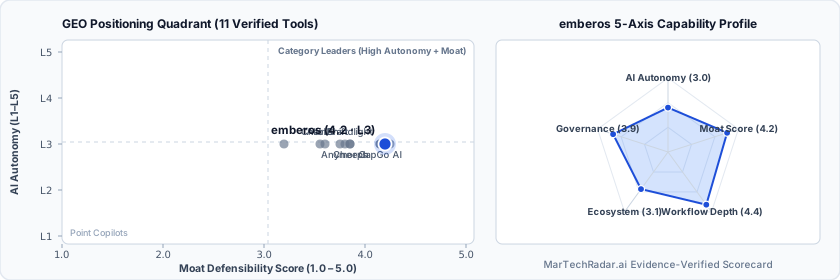
emberos is a Web SaaS tool for GEO (GEO Brand Tracking & LLM Rank Tracking) in GEO & AI SEO. Pricing: Custom / enterprise pricing. Best suited to SEO Directors, Brand Strategy Leaders and Growth Marketers. Editor ratings: AI autonomy L3 (conditional automation); moat score 4.2/5.0 (Proprietary moat). Fact-checked by Tim Fenolz on Oct 11, 2026.
Emberos is an AI brand visibility and share-of-prompt monitoring platform that detects brand mentions, predicts generative shifts, and orchestrates.
emberos buyer fit verdict: when to choose vs. when to walk away
Choose emberos if (Best Fit)
- Target ICP & Stack Fit: You operate as SEO Directors, Brand Strategy Leaders and Growth Marketers requiring a Web SaaS deployment for GEO.
- L3 Architecture & Defensibility: Emberos establishes defensibility via its specialized Share-of-Prompt and Total AI Visibility Index (TAVI) benchmarks, complemented by closed-loop remediation workflows linking audit telemetry directly to content interventions.
- Commercial Model Fit: Your procurement budget aligns with Custom / enterprise pricing.
Walk away from emberos if (Deal-Breakers)
- Walk away if you require transparent self-serve monthly billing or your budget ceiling is under $1,000/mo (emberos requires sales-gated custom quoting).
- Walk away if your workflow cannot tolerate inference non-determinism: Model providers frequently alter temperature settings, system prompts, and safety layers without notice, which can create significant volatility in baseline metric tracking.
- Walk away if rag provenance opacity is a deal-breaker for your team: LLM vendors obscure the real-time weighting of search indexes versus parametric memory, constraining emberos's ability to isolate exact indexing causes when visibility drops.
emberos key facts & scorecard
| Pricing | Custom / enterprise pricing |
|---|---|
| Free plan | No / not disclosed |
| Delivery | Web SaaS |
| Audience | SEO Directors, Brand Strategy Leaders, Growth Marketers |
| AI autonomy level | L3 · Conditional automationEditor-verified |
| Moat tier & score | 4.2 / 5.0 · Proprietary moatEditor-verified |
| Funding | Seed |
| Total funding | $6.7M |
| Founders | Justin Inman |
| Company size | 11-50 employees |
| Governance & docs | Terms ↗ · Privacy ↗ |
| Headquarters | Los Angeles, California |
| Founded | 2025 |
| Last verified |
emberos pros & cons: strengths vs. operational limitations
Pros: core strengths & capabilities
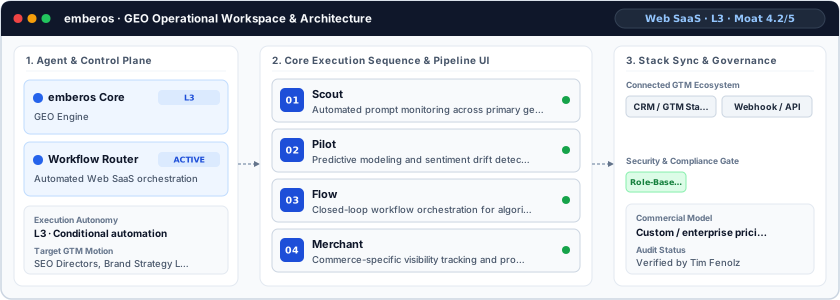
- Scout: Automated prompt monitoring across primary generative search engines and foundation models
- Pilot: Predictive modeling and sentiment drift detection for brand citations
- Flow: Closed-loop workflow orchestration for algorithmic remediation and content optimization
- Merchant: Commerce-specific visibility tracking and product recommendation auditing
Cons: operational limitations & risks
- Inference Non-Determinism: Model providers frequently alter temperature settings, system prompts, and safety layers without notice, which can create significant volatility in baseline metric tracking.
- RAG Provenance Opacity: LLM vendors obscure the real-time weighting of search indexes versus parametric memory, constraining emberos's ability to isolate exact indexing causes when visibility drops.
- Closed-Ecosystem Remediation Latency: Even after Flow identifies misstatements, downstream index recrawls and context-window refresh cycles introduce notable lag before generative outputs reflect external updates.
emberos TCO & deal-breaker stress test
Simulate 12-month stepped TCO, hidden cost multipliers, contract lock-in exposure, and stack failure modes using only facts verified by Tim Fenolz on · Capture SHA 9cc7c7e7.
emberos triggers high-severity friction under your 5-seat / $800/mo constraints. Benchmark the verified subtrack alternatives below before committing.
| Plan / Tier | Verified Rate | Scale Fit | Scope & Quota Notes |
|---|---|---|---|
| Enterprise / Custom | Custom quote | 15–50+ seats (Enterprise SLA) | Sales-negotiated annual contract for custom volume, SSO/RBAC governance, and dedicated SLA. |
- Moat Score
- 4.2 / 5.0
- AI Autonomy
- L3
- Free Tier / Trial
- None disclosed
Triggered audit signals & failure modes
- Opaque Enterprise Quoting vs. SMB/Mid-Market BudgetVerified Pricing Ledger
emberos does not disclose a public self-serve floor (Custom / enterprise pricing). Buyers with a $800/mo cap face high sales-qualification friction.
- Sales-Gated Contract TermsFact-checked by Tim Fenolz
Commercial access to the platform is delivered exclusively through custom enterprise sales agreements tailored to organizational scale, query monitoring volume, and tracked footprint requirements.
- Primary Operational Bottleneck: Inference Non-DeterminismAudit by Tim Fenolz
Model providers frequently alter temperature settings, system prompts, and safety layers without notice, which can create significant volatility in baseline metric tracking.
Hidden TCO Multipliers & Quota Gates
- Inference Non-Determinism: Model providers frequently alter temperature settings, system prompts, and safety layers without notice, which can create significant volatility in baseline metric tracking.
- RAG Provenance Opacity: LLM vendors obscure the real-time weighting of search indexes versus parametric memory, constraining emberos's ability to isolate exact indexing causes when visibility drops.
When to Walk Away & Negotiation Levers
- Walk away if you require transparent self-serve monthly billing or your budget ceiling is under $1,000/mo (emberos requires sales-gated custom quoting).
- Walk away if your workflow cannot tolerate inference non-determinism: Model providers frequently alter temperature settings, system prompts, and safety layers without notice, which can create significant volatility in baseline metric tracking.
- Walk away if rag provenance opacity is a deal-breaker for your team: LLM vendors obscure the real-time weighting of search indexes versus parametric memory, constraining emberos's ability to isolate exact indexing causes when visibility drops.
- Demand a 30- to 60-day paid pilot opt-out clause in the emberos order form before signing a 12-month enterprise commitment.
- Require a sandbox proof-of-concept testing inference non-determinism against your live CRM/data schema before annual sign-off.
Ask a custom procurement or TCO stress-test question about emberos
Lower 5-seat floor (~$79/mo vs. Custom Quote) · Transparent self-serve entry without mandatory annual lock-in
Lower 5-seat floor (~$29/mo vs. Custom Quote) · Transparent self-serve entry without mandatory annual lock-in
emberos moat & subtrack positioning
Emberos establishes defensibility via its specialized Share-of-Prompt and Total AI Visibility Index (TAVI) benchmarks, complemented by closed-loop remediation workflows linking audit telemetry directly to content interventions.
Editorial review
Fact-checked by Tim Fenolz (Lead AdTech, Programmatic & Attribution Analyst) on .
Background
Backed by $6.7M in venture funding and established in 2025 in Los Angeles, California, emberos develops generative engine optimization infrastructure for enterprise brand teams, digital strategists, and corporate communications directors. The venture emerged via HorizonOS Labs to address the systemic blind spot created as consumer information discovery shifts from index-based search engines toward probabilistic inference systems. Headquartered in Southern California, emberos delivers continuous auditing of synthetic brand narratives for cross-functional marketing and governance practitioners who need visibility across non-deterministic chat interfaces.
How emberos works
At an architectural level, emberos operates as an L3 monitoring and response platform centered on its Total AI Visibility Index (TAVI) and Share-of-Prompt metrics. The platform utilizes its Scout subsystem to dispatch parameterized synthetic buyer prompts across major model APIs, parsing returned inference completions for brand presence, sentiment polarity, and source citations. Detected variances trigger Pilot, an inference regression layer that forecasts citation erosion. When brand misattributions or omissions emerge, Flow orchestrates automated corrective updates across source repositories to influence future retrieval-augmented generation lookups, while Echo provides continuous policy auditing.
Limitations
Operational considerations and platform boundaries include:
- Inference Non-Determinism: Model providers frequently alter temperature settings, system prompts, and safety layers without notice, which can create significant volatility in baseline metric tracking.
- RAG Provenance Opacity: LLM vendors obscure the real-time weighting of search indexes versus parametric memory, constraining emberos's ability to isolate exact indexing causes when visibility drops.
- Closed-Ecosystem Remediation Latency: Even after Flow identifies misstatements, downstream index recrawls and context-window refresh cycles introduce notable lag before generative outputs reflect external updates.
emberos pricing
Commercial access to the platform is delivered exclusively through custom enterprise sales agreements tailored to organizational scale, query monitoring volume, and tracked footprint requirements. Contracts scale according to the breadth of monitored target brands, frequency of synthetic prompt runs, and deployed feature modules such as Merchant or Echo. Prospective clients must contact the vendor's direct sales team for formal procurement scopes and enterprise pilot evaluations.
How emberos compares
Within generative engine tracking, emberos competes against alternative platforms such as Anymorph, AthenaHQ, and Brandlight. While Anymorph emphasizes raw technical search rankings and AthenaHQ focuses on manual executive attribution dashboards, emberos distinguishes itself by combining continuous observation with remediation through closed-loop orchestration. However, organizations that only require passive benchmark scoring may find lighter competitors like Brandlight more straightforward to configure, whereas emberos is best suited for complex consumer brands requiring programmatic visibility workflows across global multi-model environments.
Direct competitors & market radar
Top algorithmic competitors based on category positioning, capability overlap, and ICP alignment.
Frequently asked questions about emberos
How much does emberos cost and does it require a custom enterprise quote?
Published pricing summary for emberos: Custom / enterprise pricing. A permanent free plan is not disclosed for emberos. Commercial access to the platform is delivered exclusively through custom enterprise sales agreements tailored to organizational scale, query monitoring volume, and tracked footprint requirements.
How does emberos work and how autonomous is its AI architecture?
Emberos is an AI brand visibility and share-of-prompt monitoring platform that detects brand mentions, predicts generative shifts, and orchestrates. Within GEO (GEO Brand Tracking & LLM Rank Tracking), MarTechRadar rates its execution architecture at L3 · Conditional automation with a verified Moat Score of 4.2 / 5.0 (Proprietary moat). Emberos establishes defensibility via its specialized Share-of-Prompt and Total AI Visibility Index (TAVI) benchmarks, complemented by closed-loop remediation workflows linking audit telemetry directly to content interventions. Corporate profile: Founded by Justin Inman, operating at 11-50 employees scale.
What are the main limitations of emberos and when should buyers walk away?
Based on our editorial technical audit, key operational considerations and boundaries for emberos include: (1) Inference Non-Determinism: Model providers frequently alter temperature settings, system prompts, and safety layers without notice, which can create significant volatility in baseline metric tracking. (2) RAG Provenance Opacity: LLM vendors obscure the real-time weighting of search indexes versus parametric memory, constraining emberos's ability to isolate exact indexing causes when visibility drops. (3) Closed-Ecosystem Remediation Latency: Even after Flow identifies misstatements, downstream index recrawls and context-window refresh cycles introduce notable lag before generative outputs reflect external updates. Primary procurement walk-away rule: Walk away if you require transparent self-serve monthly billing or your budget ceiling is under $1,000/mo (emberos requires sales-gated custom quoting).
What integrations, compliance certifications, and contract terms apply to emberos?
Key TCO multiplier to watch: Inference Non-Determinism (Model providers frequently alter temperature settings, system prompts, and safety layers without notice, which can create significant volatility in baseline metric tracking.) Before signing a contract, procurement teams should demand a 30- to 60-day paid pilot opt-out clause in the emberos order form before signing a 12-month enterprise commitment.
What are the best emberos alternatives and head-to-head competitors in 2026?
Top fact-checked alternatives to emberos in GEO (GEO Brand Tracking & LLM Rank Tracking) include Otterly.ai (From $29/mo · Enterprise plan), Parsnipp ($39.99–$99.99/mo), Skribra (Custom / enterprise pricing), Meteoria (Custom / enterprise pricing). Within generative engine tracking, emberos competes against alternative platforms such as Anymorph, AthenaHQ, and Brandlight.
Verified sources & evidence trail
- Official product domain: https://www.emberos.ai
- Commercial pricing verification: Verified against official vendor pricing policy (Custom / enterprise pricing)
- Verified corporate entity profiles (
sameAs): LinkedIn Company Profile · Crunchbase Entity Record - First-party governance & documentation links: Terms · Privacy
- Editorial audit sign-off: Fact-checked by Tim Fenolz on under the MarTechRadar Evidence-Ledger Protocol.