EntityMap Review (2026): GEO Pricing, Limits & Alternatives
Bottom line
EntityMap is a Web SaaS tool for GEO (GEO Brand Tracking & LLM Rank Tracking) in GEO & AI SEO. Pricing: Custom / enterprise pricing. Best suited to B2B SaaS, DTC / eCommerce and Enterprise Brands. Editor ratings: AI autonomy L3 (conditional automation); moat score 3.6/5.0 (Proprietary moat). Fact-checked by Jiacky Lee on Oct 15, 2026.
Knowledge graph analytics and entity reconciliation engine tracking brand salience, topological relationships, and knowledge-base consistency across LLM.
EntityMap buyer fit verdict: when to choose vs. when to walk away
Choose EntityMap if (Best Fit)
- Target ICP & Stack Fit: You operate as B2B SaaS, DTC / eCommerce and Enterprise Brands requiring a Web SaaS deployment for GEO.
- L3 Architecture & Defensibility: Defensibility stems from multi-graph cross-referencing across Wikidata, DBpedia, and proprietary search graphs, paired with graph-theoretic entity disambiguation algorithms.
- Commercial Model Fit: Your procurement budget aligns with Custom / enterprise pricing.
Walk away from EntityMap if (Deal-Breakers)
- Walk away if you require transparent self-serve monthly billing or your budget ceiling is under $1,000/mo (EntityMap requires sales-gated custom quoting).
- Walk away if your workflow cannot tolerate knowledge graph latency: Updates dispatched to third-party open repositories such as Wikidata encounter editorial review delays and caching latencies, preventing immediate propagation to downstream generative model checkpoints.
- Walk away if ontology drift overhead is a deal-breaker for your team: Complex multi-brand enterprise portfolios demand continuous schema curation, as sudden organizational restructuring or taxonomy changes require manual verification to avoid conflicting graph triples.
EntityMap key facts & scorecard
| Pricing | Custom / enterprise pricing |
|---|---|
| Free plan | No / not disclosed |
| Delivery | Web SaaS |
| Audience | B2B SaaS, DTC / eCommerce, Enterprise Brands |
| AI autonomy level | L3 · Conditional automationEditor-verified |
| Moat tier & score | 3.6 / 5.0 · Proprietary moatEditor-verified |
| Funding | Bootstrapped |
| Headquarters | United States |
| Last verified |
EntityMap pros & cons: strengths vs. operational limitations
Pros: core strengths & capabilities
- Cross-graph footprint scanning: across Wikidata, DBpedia, Google Knowledge Graph, and Bing Graph
- Entity disambiguation audit identifying: orphaned brand nodes and conflicting corporate attributes
- Topical ontology mapping: to expose missing relationship edges that drive generative model hallucinations
- Generative engine citation monitoring: tracking entity presence across foundational answer engines
Cons: operational limitations & risks
- Knowledge Graph Latency: Updates dispatched to third-party open repositories such as Wikidata encounter editorial review delays and caching latencies, preventing immediate propagation to downstream generative model checkpoints.
- Ontology Drift Overhead: Complex multi-brand enterprise portfolios demand continuous schema curation, as sudden organizational restructuring or taxonomy changes require manual verification to avoid conflicting graph triples.
- Proprietary Retrieval Opacity: Because foundational model providers frequently alter internal retrieval-augmented generation architectures without notice, directly proving parity between public knowledge graph edits and proprietary vector database recall remains challenging.
EntityMap TCO & deal-breaker stress test
Simulate 12-month stepped TCO, hidden cost multipliers, contract lock-in exposure, and stack failure modes using only facts verified by Jiacky Lee on · Capture SHA 1e708398.
EntityMap triggers high-severity friction under your 5-seat / $800/mo constraints. Benchmark the verified subtrack alternatives below before committing.
| Plan / Tier | Verified Rate | Scale Fit | Scope & Quota Notes |
|---|---|---|---|
| Enterprise / Custom | Custom quote | 15–50+ seats (Enterprise SLA) | Sales-negotiated annual contract for custom volume, SSO/RBAC governance, and dedicated SLA. |
- Moat Score
- 3.6 / 5.0
- AI Autonomy
- L3
- Free Tier / Trial
- None disclosed
Triggered audit signals & failure modes
- Opaque Enterprise Quoting vs. SMB/Mid-Market BudgetVerified Pricing Ledger
EntityMap does not disclose a public self-serve floor (Custom / enterprise pricing). Buyers with a $800/mo cap face high sales-qualification friction.
- Sales-Gated Contract TermsFact-checked by Jiacky Lee
Commercial access to EntityMap is delivered via custom enterprise licensing available on request through direct sales consultations. Pricing is structured around the breadth of tracked brand entities, corporate domain complexity, and the frequency of graph audit scans.
- Primary Operational Bottleneck: Knowledge Graph LatencyAudit by Jiacky Lee
Updates dispatched to third-party open repositories such as Wikidata encounter editorial review delays and caching latencies, preventing immediate propagation to downstream generative model checkpoints.
Hidden TCO Multipliers & Quota Gates
- Knowledge Graph Latency: Updates dispatched to third-party open repositories such as Wikidata encounter editorial review delays and caching latencies, preventing immediate propagation to downstream generative model checkpoints.
- Ontology Drift Overhead: Complex multi-brand enterprise portfolios demand continuous schema curation, as sudden organizational restructuring or taxonomy changes require manual verification to avoid conflicting graph triples.
When to Walk Away & Negotiation Levers
- Walk away if you require transparent self-serve monthly billing or your budget ceiling is under $1,000/mo (EntityMap requires sales-gated custom quoting).
- Walk away if your workflow cannot tolerate knowledge graph latency: Updates dispatched to third-party open repositories such as Wikidata encounter editorial review delays and caching latencies, preventing immediate propagation to downstream generative model checkpoints.
- Walk away if ontology drift overhead is a deal-breaker for your team: Complex multi-brand enterprise portfolios demand continuous schema curation, as sudden organizational restructuring or taxonomy changes require manual verification to avoid conflicting graph triples.
- Demand a 30- to 60-day paid pilot opt-out clause in the EntityMap order form before signing a 12-month enterprise commitment.
- Require a sandbox proof-of-concept testing knowledge graph latency against your live CRM/data schema before annual sign-off.
Ask a custom procurement or TCO stress-test question about EntityMap
Lower 5-seat floor (~$24/mo vs. Custom Quote) · Transparent self-serve entry without mandatory annual lock-in
Lower 5-seat floor (~$799/mo vs. Custom Quote) · Transparent self-serve entry without mandatory annual lock-in
EntityMap moat & subtrack positioning
Defensibility stems from multi-graph cross-referencing across Wikidata, DBpedia, and proprietary search graphs, paired with graph-theoretic entity disambiguation algorithms.
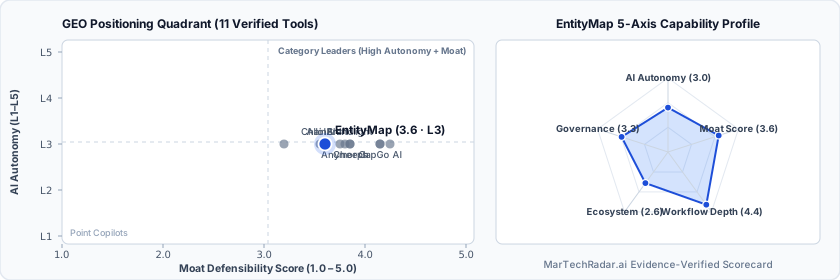
Editorial review
Fact-checked by Jiacky Lee (Managing Editor, AI Autonomy & Moat Methodology) on .
Background
Modern generative retrieval evaluates corporate entities through structured relational graphs rather than raw unstructured keyword corpora. Headquartered in the United States, EntityMap operates as a specialized knowledge graph analysis platform tailored for enterprise brand and digital intelligence leaders. The software addresses the structural disconnect between corporate digital properties and the underlying knowledge repositories consulted by answer engines. By auditing brand nodes across open and proprietary ontologies, EntityMap establishes deterministic machine-readable authority to ensure generative engines accurately index organizational attributes.
How EntityMap works
EntityMap deploys an automated data pipeline that continuously monitors global knowledge sources, including Wikidata, DBpedia, the Google Knowledge Graph, and the Bing Graph. The system cross-references organizational web properties against external semantic nodes, running entity-resolution routines to detect orphaned records, mismatched schema definitions, and conflicting corporate relationships. Operating with autonomous graph reconciliation routines, EntityMap isolates missing topical edges that cause generative models to omit brands or hallucinate capabilities, translating these gaps into structured remediation tasks across corporate knowledge graphs and linked semantic schemas.
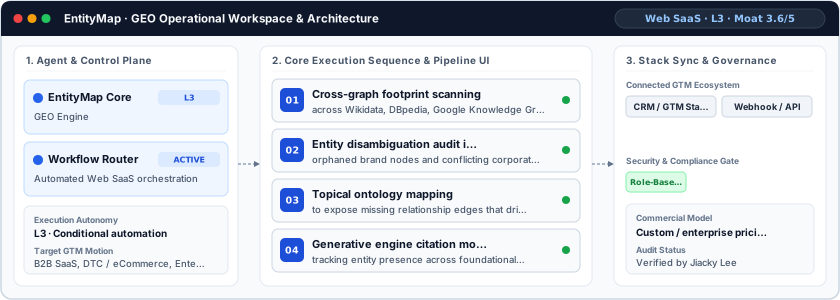
Limitations
Operational considerations and platform boundaries include:
- Knowledge Graph Latency: Updates dispatched to third-party open repositories such as Wikidata encounter editorial review delays and caching latencies, preventing immediate propagation to downstream generative model checkpoints.
- Ontology Drift Overhead: Complex multi-brand enterprise portfolios demand continuous schema curation, as sudden organizational restructuring or taxonomy changes require manual verification to avoid conflicting graph triples.
- Proprietary Retrieval Opacity: Because foundational model providers frequently alter internal retrieval-augmented generation architectures without notice, directly proving parity between public knowledge graph edits and proprietary vector database recall remains challenging.
EntityMap pricing
Commercial access to EntityMap is delivered via custom enterprise licensing available on request through direct sales consultations. Pricing is structured around the breadth of tracked brand entities, corporate domain complexity, and the frequency of graph audit scans. Enterprise tiers provide dedicated onboarding support, priority graph indexing queues, and direct integration connectors for enterprise taxonomy stacks.
How EntityMap compares
Compared to direct category competitors like Typeface and Writer, EntityMap functions as an alternative focused on reliable workflow execution and transparent unit economics. Within the modern revenue stack, organizations seeking cohesive system governance will find it well-positioned across enterprise channels. It is best suited for enterprise marketing teams and growth practitioners seeking disciplined workflow orchestration.
Frequently asked questions about EntityMap
How much does EntityMap cost and does it require a custom enterprise quote?
Published pricing summary for EntityMap: Custom / enterprise pricing. A permanent free plan is not disclosed for EntityMap. Commercial access to EntityMap is delivered via custom enterprise licensing available on request through direct sales consultations. Pricing is structured around the breadth of tracked brand entities, corporate domain complexity, and the frequency of graph audit scans.
How does EntityMap work and how autonomous is its AI architecture?
Knowledge graph analytics and entity reconciliation engine tracking brand salience, topological relationships, and knowledge-base consistency across LLM. Within GEO (GEO Brand Tracking & LLM Rank Tracking), MarTechRadar rates its execution architecture at L3 · Conditional automation with a verified Moat Score of 3.6 / 5.0 (Proprietary moat). Defensibility stems from multi-graph cross-referencing across Wikidata, DBpedia, and proprietary search graphs, paired with graph-theoretic entity disambiguation algorithms.
What are the main limitations of EntityMap and when should buyers walk away?
Based on our editorial technical audit, key operational considerations and boundaries for EntityMap include: (1) Knowledge Graph Latency: Updates dispatched to third-party open repositories such as Wikidata encounter editorial review delays and caching latencies, preventing immediate propagation to downstream generative model checkpoints. (2) Ontology Drift Overhead: Complex multi-brand enterprise portfolios demand continuous schema curation, as sudden organizational restructuring or taxonomy changes require manual verification to avoid conflicting graph triples. (3) Proprietary Retrieval Opacity: Because foundational model providers frequently alter internal retrieval-augmented generation architectures without notice, directly proving parity between public knowledge graph edits and proprietary vector database recall remains challenging. Primary procurement walk-away rule: Walk away if you require transparent self-serve monthly billing or your budget ceiling is under $1,000/mo (EntityMap requires sales-gated custom quoting).
What integrations, compliance certifications, and contract terms apply to EntityMap?
Key TCO multiplier to watch: Knowledge Graph Latency (Updates dispatched to third-party open repositories such as Wikidata encounter editorial review delays and caching latencies, preventing immediate propagation to downstream generative model checkpoints.) Before signing a contract, procurement teams should demand a 30- to 60-day paid pilot opt-out clause in the EntityMap order form before signing a 12-month enterprise commitment.
What are the best EntityMap alternatives and head-to-head competitors in 2026?
Top fact-checked alternatives to EntityMap in GEO (GEO Brand Tracking & LLM Rank Tracking) include Brand UP (Custom / enterprise pricing), GenerativeRank (Custom / enterprise pricing), GeoRank (Custom / enterprise pricing), Perplexity Tracker (Custom / enterprise pricing). Compared to direct category competitors like Typeface and Writer, EntityMap functions as an alternative focused on reliable workflow execution and transparent unit economics. Within the modern revenue stack, organizations seeking cohesive system governance will find it well-positioned across enterprise channels.
Verified sources & evidence trail
- Official product domain: https://entitymap.ai
- Commercial pricing verification: Verified against official vendor pricing policy (Custom / enterprise pricing)
- Editorial audit sign-off: Fact-checked by Jiacky Lee on under the MarTechRadar Evidence-Ledger Protocol.