Fermat Commerce Review (2026): Social Media Scheduling Pricing, Limits & Alternatives
Bottom line
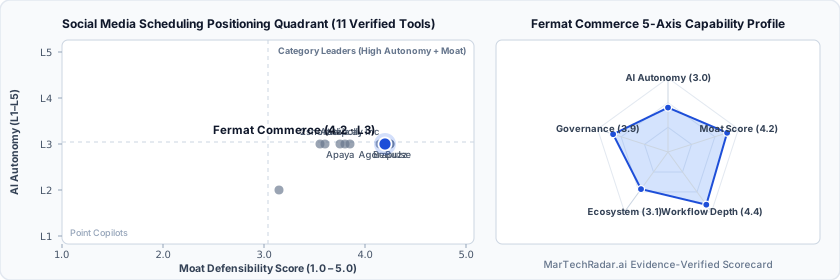
Fermat Commerce is a Web SaaS tool for Social Media Scheduling (Social Media Scheduling & Auto-Publishing) in Social & Influencer. Pricing: Custom / enterprise pricing. Best suited to Social Media Managers, Creator & Influencer Agencies and Brand Community Ops. Editor ratings: AI autonomy L3 (conditional automation); moat score 4.2/5.0 (Proprietary moat). Fact-checked by Tim Fenolz on Oct 14, 2026.
AI-native dynamic commerce experience platform that analyzes session intent and uses digital twin models to generate real-time post-click shopping funnels.
Fermat Commerce buyer fit verdict: when to choose vs. when to walk away
Choose Fermat Commerce if (Best Fit)
- Target ICP & Stack Fit: You operate as Social Media Managers, Creator & Influencer Agencies and Brand Community Ops requiring a Web SaaS deployment for Social Media Scheduling.
- L3 Architecture & Defensibility: Proprietary session-level intent modeling and synthetic customer digital twin architecture ('august'), backed by extensive venture capital to optimize dynamic commerce surfaces.
- Commercial Model Fit: Your procurement budget aligns with Custom / enterprise pricing.
Walk away from Fermat Commerce if (Deal-Breakers)
- Walk away if you require transparent self-serve monthly billing or your budget ceiling is under $1,000/mo (Fermat Commerce requires sales-gated custom quoting).
- Walk away if your workflow cannot tolerate attribution model latency: The system depends on clean upstream tracking parameters, causing degraded personalization logic whenever tracking tags or UTM parameters are stripped by mobile browsers or privacy extensions.
- Walk away if product catalog synchronization is a deal-breaker for your team: High-velocity inventory updates or rapid price shifts can cause momentary cache invalidation lags across dynamically generated commerce variants, risking out-of-stock checkouts.
Fermat Commerce key facts & scorecard
| Pricing | Custom / enterprise pricing |
|---|---|
| Free plan | No / not disclosed |
| Delivery | Web SaaS |
| Audience | Social Media Managers, Creator & Influencer Agencies, Brand Community Ops |
| AI autonomy level | L3 · Conditional automationEditor-verified |
| Moat tier & score | 4.2 / 5.0 · Proprietary moatEditor-verified |
| Funding | Series B |
| Total funding | $74M |
| Founders | Rishabh Jain, Shreyas Kumar |
| Company size | 51-100 employees |
| Governance & docs | Terms ↗ · Privacy ↗ |
| Headquarters | San Francisco, CA |
| Founded | 2021 |
| Last verified |
Fermat Commerce pros & cons: strengths vs. operational limitations
Pros: core strengths & capabilities
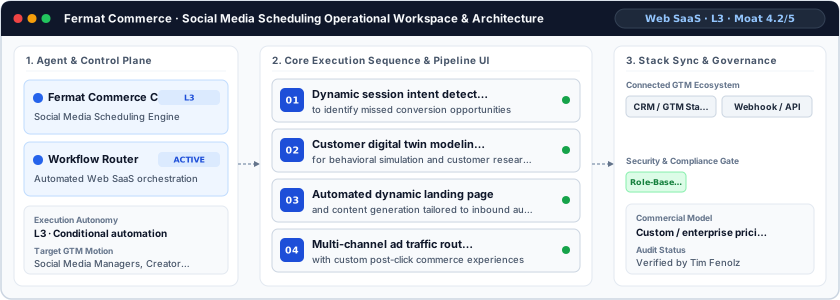
- Dynamic session intent detection: to identify missed conversion opportunities
- Customer digital twin modeling (august): for behavioral simulation and customer research
- Automated dynamic landing page: and content generation tailored to inbound audience channels
- Multi-channel ad traffic routing: with custom post-click commerce experiences
Cons: operational limitations & risks
- Attribution Model Latency: The system depends on clean upstream tracking parameters, causing degraded personalization logic whenever tracking tags or UTM parameters are stripped by mobile browsers or privacy extensions.
- Product Catalog Synchronization: High-velocity inventory updates or rapid price shifts can cause momentary cache invalidation lags across dynamically generated commerce variants, risking out-of-stock checkouts.
- Training Data Thresholds: The august digital twin agent requires substantial historical transaction volume to generate reliable behavioral simulations, limiting efficacy for nascent catalogs with low baseline traffic.
Fermat Commerce TCO & deal-breaker stress test
Simulate 12-month stepped TCO, hidden cost multipliers, contract lock-in exposure, and stack failure modes using only facts verified by Tim Fenolz on · Capture SHA b8ad3afb.
Fermat Commerce triggers high-severity friction under your 5-seat / $800/mo constraints. Benchmark the verified subtrack alternatives below before committing.
| Plan / Tier | Verified Rate | Scale Fit | Scope & Quota Notes |
|---|---|---|---|
| Enterprise / Custom | Custom quote | 15–50+ seats (Enterprise SLA) | Sales-negotiated annual contract for custom volume, SSO/RBAC governance, and dedicated SLA. |
- Moat Score
- 4.2 / 5.0
- AI Autonomy
- L3
- Free Tier / Trial
- None disclosed
Triggered audit signals & failure modes
- Opaque Enterprise Quoting vs. SMB/Mid-Market BudgetVerified Pricing Ledger
Fermat Commerce does not disclose a public self-serve floor (Custom / enterprise pricing). Buyers with a $800/mo cap face high sales-qualification friction.
- Sales-Gated Contract TermsFact-checked by Tim Fenolz
Commercial procurement for Fermat Commerce is deployed via a closed B2B framework. The vendor does not publish fixed public rates, and commercial pricing is available on request through tailored enterprise sales quotes based on organizational scale and seats.
- Primary Operational Bottleneck: Attribution Model LatencyAudit by Tim Fenolz
The system depends on clean upstream tracking parameters, causing degraded personalization logic whenever tracking tags or UTM parameters are stripped by mobile browsers or privacy extensions.
Hidden TCO Multipliers & Quota Gates
- Attribution Model Latency: The system depends on clean upstream tracking parameters, causing degraded personalization logic whenever tracking tags or UTM parameters are stripped by mobile browsers or privacy extensions.
- Product Catalog Synchronization: High-velocity inventory updates or rapid price shifts can cause momentary cache invalidation lags across dynamically generated commerce variants, risking out-of-stock checkouts.
When to Walk Away & Negotiation Levers
- Walk away if you require transparent self-serve monthly billing or your budget ceiling is under $1,000/mo (Fermat Commerce requires sales-gated custom quoting).
- Walk away if your workflow cannot tolerate attribution model latency: The system depends on clean upstream tracking parameters, causing degraded personalization logic whenever tracking tags or UTM parameters are stripped by mobile browsers or privacy extensions.
- Walk away if product catalog synchronization is a deal-breaker for your team: High-velocity inventory updates or rapid price shifts can cause momentary cache invalidation lags across dynamically generated commerce variants, risking out-of-stock checkouts.
- Demand a 30- to 60-day paid pilot opt-out clause in the Fermat Commerce order form before signing a 12-month enterprise commitment.
- Require a sandbox proof-of-concept testing attribution model latency against your live CRM/data schema before annual sign-off.
Ask a custom procurement or TCO stress-test question about Fermat Commerce
Lower 5-seat floor (~$15/mo vs. Custom Quote) · Transparent self-serve entry without mandatory annual lock-in
Lower 5-seat floor (~$395/mo vs. Custom Quote) · Transparent self-serve entry without mandatory annual lock-in
Fermat Commerce moat & subtrack positioning
Proprietary session-level intent modeling and synthetic customer digital twin architecture ('august'), backed by extensive venture capital to optimize dynamic commerce surfaces.
Editorial review
Fact-checked by Tim Fenolz (Lead AdTech, Programmatic & Attribution Analyst) on .
Background
Backed by $74M in venture capital, Fermat Commerce was founded in 2021 in San Francisco, CA, to solve the conversion breakdown between social acquisition channels and static commerce landing pages. Designed for performance marketing leaders and direct-to-consumer growth architects, the software focuses on dynamic, session-level purchase funnels. Rather than directing paid traffic to rigid product detail pages, the system bridges ad discovery and transactional conversion by generating context-specific post-click experiences tailored to incoming audience traffic.
How Fermat Commerce works
Architecturally, Fermat Commerce operates at Level 3 autonomy by pairing incoming ad metadata with on-site behavioral signals. Its session ingestion layer captures channel attribution, referrer creative, and user navigation paths to determine intent vectors in real time. Through its generative agent model, known as august, the platform references synthetic digital twins of real consumers to predict hesitation points, recommend interventions, and dynamically construct personalized shopping experiences without developer intervention.
Limitations
Operational considerations and platform boundaries include:
- Attribution Model Latency: The system depends on clean upstream tracking parameters, causing degraded personalization logic whenever tracking tags or UTM parameters are stripped by mobile browsers or privacy extensions.
- Product Catalog Synchronization: High-velocity inventory updates or rapid price shifts can cause momentary cache invalidation lags across dynamically generated commerce variants, risking out-of-stock checkouts.
- Training Data Thresholds: The august digital twin agent requires substantial historical transaction volume to generate reliable behavioral simulations, limiting efficacy for nascent catalogs with low baseline traffic.
Fermat Commerce pricing
Commercial procurement for Fermat Commerce is deployed via a closed B2B framework. The vendor does not publish fixed public rates, and commercial pricing is available on request through tailored enterprise sales quotes based on organizational scale and seats. Contracts typically account for gross merchandise volume processed, active domain endpoints, monthly unique visitor consumption, and dedicated technical onboarding support.
How Fermat Commerce compares
Within multi-channel social commerce and scheduling stacks, Fermat Commerce diverges from broadcast schedulers like Agorapulse, Antela.ai, Inc., and Apaya. While conventional platforms prioritize multi-account social publishing queues, community moderation, and scheduled post calendars, Fermat Commerce anchors its value directly to post-click ad monetization and dynamic page construction. This architecture is optimal for high-spend consumer brands seeking automated on-site funnel adaptation rather than simple outbound social dispatch.
Direct competitors & market radar
Top algorithmic competitors based on category positioning, capability overlap, and ICP alignment.
Frequently asked questions about Fermat Commerce
How much does Fermat Commerce cost and does it require a custom enterprise quote?
Published pricing summary for Fermat Commerce: Custom / enterprise pricing. A permanent free plan is not disclosed for Fermat Commerce. Commercial procurement for Fermat Commerce is deployed via a closed B2B framework. The vendor does not publish fixed public rates, and commercial pricing is available on request through tailored enterprise sales quotes based on organizational scale and seats.
How does Fermat Commerce work and how autonomous is its AI architecture?
AI-native dynamic commerce experience platform that analyzes session intent and uses digital twin models to generate real-time post-click shopping funnels. Within Social Media Scheduling (Social Media Scheduling & Auto-Publishing), MarTechRadar rates its execution architecture at L3 · Conditional automation with a verified Moat Score of 4.2 / 5.0 (Proprietary moat). Proprietary session-level intent modeling and synthetic customer digital twin architecture ('august'), backed by extensive venture capital to optimize dynamic commerce surfaces. Corporate profile: Founded by Rishabh Jain, Shreyas Kumar, operating at 51-100 employees scale.
What are the main limitations of Fermat Commerce and when should buyers walk away?
Based on our editorial technical audit, key operational considerations and boundaries for Fermat Commerce include: (1) Attribution Model Latency: The system depends on clean upstream tracking parameters, causing degraded personalization logic whenever tracking tags or UTM parameters are stripped by mobile browsers or privacy extensions. (2) Product Catalog Synchronization: High-velocity inventory updates or rapid price shifts can cause momentary cache invalidation lags across dynamically generated commerce variants, risking out-of-stock checkouts. (3) Training Data Thresholds: The august digital twin agent requires substantial historical transaction volume to generate reliable behavioral simulations, limiting efficacy for nascent catalogs with low baseline traffic. Primary procurement walk-away rule: Walk away if you require transparent self-serve monthly billing or your budget ceiling is under $1,000/mo (Fermat Commerce requires sales-gated custom quoting).
What integrations, compliance certifications, and contract terms apply to Fermat Commerce?
Key TCO multiplier to watch: Attribution Model Latency (The system depends on clean upstream tracking parameters, causing degraded personalization logic whenever tracking tags or UTM parameters are stripped by mobile browsers or privacy extensions.) Before signing a contract, procurement teams should demand a 30- to 60-day paid pilot opt-out clause in the Fermat Commerce order form before signing a 12-month enterprise commitment.
What are the best Fermat Commerce alternatives and head-to-head competitors in 2026?
Top fact-checked alternatives to Fermat Commerce in Social Media Scheduling (Social Media Scheduling & Auto-Publishing) include eClincher (Free plan · $0/mo · Enterprise plan), FeedHive (From $15/mo), BeBuzz (Custom / enterprise pricing), Commune (Custom / enterprise pricing). Within multi-channel social commerce and scheduling stacks, Fermat Commerce diverges from broadcast schedulers like Agorapulse, Antela.ai, Inc., and Apaya.
Verified sources & evidence trail
- Official product domain: https://fermatcommerce.com
- Commercial pricing verification: Verified against official vendor pricing policy (Custom / enterprise pricing)
- Verified corporate entity profiles (
sameAs): LinkedIn Company Profile · Crunchbase Entity Record - First-party governance & documentation links: Terms · Privacy
- Editorial audit sign-off: Fact-checked by Tim Fenolz on under the MarTechRadar Evidence-Ledger Protocol.