Funnel.io Review (2026): Marketing Attribution Pricing, Limits & Alternatives
Bottom line
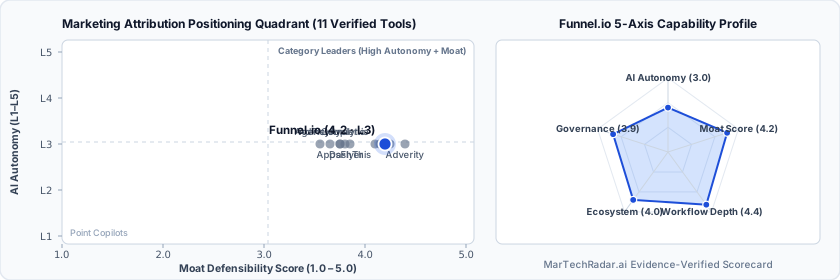
Funnel.io is a Web SaaS tool for Marketing Attribution (Multi-Touch Attribution & eCommerce Dashboards) in Analytics & Attribution. Pricing: From $300/mo. Best suited to DTC / eCommerce and Enterprise Brands. Editor ratings: AI autonomy L3 (conditional automation); moat score 4.2/5.0 (Proprietary moat). Fact-checked by Tim Fenolz on Oct 11, 2026.
Automated marketing data hub providing multi-channel data ingestion, normalization, and export pipelines to business intelligence and analytics destinations.
Funnel.io buyer fit verdict: when to choose vs. when to walk away
Choose Funnel.io if (Best Fit)
- Target ICP & Stack Fit: You operate as DTC / eCommerce and Enterprise Brands requiring a Web SaaS deployment for Marketing Attribution, with verified ecosystem connectivity for Snowflake, Google BigQuery.
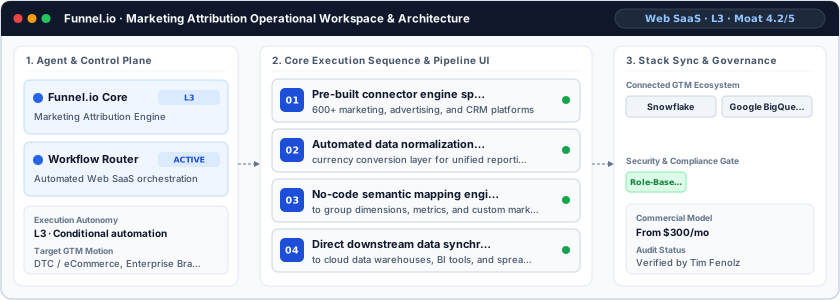
- L3 Architecture & Defensibility: Maintains an extensive library of over 600 pre-configured marketing API connectors alongside an automated transformation and semantic mapping engine that shields data teams from ongoing downstream schema breaks.
- Commercial Model Fit: Your procurement budget aligns with From $300/mo.
Walk away from Funnel.io if (Deal-Breakers)
- Walk away if your team is at early validation stage with a <$250/mo tool budget (Funnel.io starts at From $300/mo before seat or usage expansion).
- Walk away if your workflow cannot tolerate API rate limits and sync latency: High-volume ad accounts often experience batch ingestion delays when platform rate caps throttles downstream historical backfills across large date ranges.
- Walk away if attribution logic constraints is a deal-breaker for your team: The system aggregates cross-channel metrics effectively but lacks native algorithmic or clickstream-level multi-touch attribution modeling, requiring external statistical engines.
Funnel.io key facts & scorecard
| Pricing | From $300/moVendor pricing page |
|---|---|
| Free plan | No / not disclosed |
| Delivery | Web SaaS |
| Audience | DTC / eCommerce, Enterprise Brands |
| AI autonomy level | L3 · Conditional automationEditor-verified |
| Moat tier & score | 4.2 / 5.0 · Proprietary moatEditor-verified |
| Funding | Undisclosed |
| Total funding | $213.8MBacked by Hercules Capital, Eight Roads Ventures |
| Founders | Fredrik Skantze, Per Made |
| Company size | 201-500 employees |
| Ecosystem integrations | Snowflake, Google BigQuery |
| Governance & docs | Privacy ↗ |
| Headquarters | Stockholm, Stockholm County |
| Founded | 2014 |
| Last verified |
Funnel.io pros & cons: strengths vs. operational limitations
Pros: core strengths & capabilities
- Pre-built connector engine spanning: 600+ marketing, advertising, and CRM platforms
- Automated data normalization and: currency conversion layer for unified reporting
- No-code semantic mapping engine: to group dimensions, metrics, and custom marketing KPIs
- Direct downstream data synchronization: to cloud data warehouses, BI tools, and spreadsheets
Cons: operational limitations & risks
- API Rate Limits and Sync Latency: High-volume ad accounts often experience batch ingestion delays when platform rate caps throttles downstream historical backfills across large date ranges.
- Attribution Logic Constraints: The system aggregates cross-channel metrics effectively but lacks native algorithmic or clickstream-level multi-touch attribution modeling, requiring external statistical engines.
- Schema Maintenance Dependencies: Custom ad network transformations demand continuous rule reconfiguration whenever upstream channel vendors introduce undocumented changes to native reporting endpoints.
Funnel.io TCO & deal-breaker stress test
Simulate 12-month stepped TCO, hidden cost multipliers, contract lock-in exposure, and stack failure modes using only facts verified by Tim Fenolz on · Capture SHA 9d109d1a.
Funnel.io aligns with your 5-seat / $800/mo profile. Review the walk-away triggers and contract levers below before deployment.
| Plan / Tier | Verified Rate | Scale Fit | Scope & Quota Notes |
|---|---|---|---|
| Starter | $300/mo | Unlimited seats (Entry credits) | Connect, store and prepare your marketing data. Ask Funnel AI for instant answers and build rep |
| Business | $600/mo | Unlimited seats (Growth credits) | Advanced capabilities and custom set-up possibilities, with 500+ connectors, extensive reportin |
- Moat Score
- 4.2 / 5.0
- AI Autonomy
- L3
- Free Tier / Trial
- None disclosed
Triggered audit signals & failure modes
- Published Self-Serve Entry FloorVerified Pricing Ledger
Funnel.io publishes a transparent entry point (From $300/mo) for initial validation before committing.
- Tier Fit for 5-Seat Scale: Business ($600/mo)Verified Tier Schedule
Advanced capabilities and custom set-up possibilities, with 500+ connectors, extensive reportin
- Primary Operational Bottleneck: API Rate Limits and Sync LatencyAudit by Tim Fenolz
High-volume ad accounts often experience batch ingestion delays when platform rate caps throttles downstream historical backfills across large date ranges.
Hidden TCO Multipliers & Quota Gates
- Annual Billing Headline vs. Monthly Premium: Headline entry rates reflect annual billing commitments; month-to-month flexibility carries a higher effective monthly rate or requires annual prepayment.
- Credit & Usage Burn Multiplier: Automated workflows consume metered credits/usage quotas; multi-step enrichment, voice minutes, or high-frequency agent runs can trigger mid-cycle top-up packs.
- Enterprise Governance & Add-On Gating: Advanced capabilities such as Single Sign-On (SSO), custom role permissions, or specialized analytics modules are gated behind upper tiers or paid add-ons.
When to Walk Away & Negotiation Levers
- Walk away if your team is at early validation stage with a <$250/mo tool budget (Funnel.io starts at From $300/mo before seat or usage expansion).
- Walk away if your workflow cannot tolerate API rate limits and sync latency: High-volume ad accounts often experience batch ingestion delays when platform rate caps throttles downstream historical backfills across large date ranges.
- Walk away if attribution logic constraints is a deal-breaker for your team: The system aggregates cross-channel metrics effectively but lacks native algorithmic or clickstream-level multi-touch attribution modeling, requiring external statistical engines.
- Negotiate price-lock protection on additional seats and overage credits above the From $300/mo entry tier.
- Require a sandbox proof-of-concept testing API rate limits and sync latency against your live CRM/data schema before annual sign-off.
Ask a custom procurement or TCO stress-test question about Funnel.io
Lower 5-seat floor (~$11/mo vs. $600 / mo)
Lower 5-seat floor (~$240/mo vs. $600 / mo)
Funnel.io key entities, modules & ecosystem stack
Funnel.io moat & subtrack positioning
Maintains an extensive library of over 600 pre-configured marketing API connectors alongside an automated transformation and semantic mapping engine that shields data teams from ongoing downstream schema breaks.
Editorial review
Fact-checked by Tim Fenolz (Lead AdTech, Programmatic & Attribution Analyst) on .
Background
Established around a modular data hub architecture, Funnel.io abstracts the technical overhead of manual marketing extract, transform, and load (ETL) workflows. Headquartered in Stockholm, Stockholm County, and founded in 2014, the company has raised $213.8M in aggregate equity and debt funding. Built for growth marketing directors, performance media leads, and enterprise analytics engineers, Funnel.io centralizes disjointed advertising, CRM, and analytics telemetry into an analytics-ready warehouse layer without requiring manual pipeline maintenance from internal data engineering units.
How Funnel.io works
At its operational core, Funnel.io operates as a specialized data synchronization pipeline operating at L3 autonomy. The platform deploys automated fetch workers across more than 600 pre-built API connectors to extract raw granular ad spend, impression, and conversion metrics on scheduled cadences. Ingested records flow through a deterministic normalization layer that unifies date conventions, UTM parameters, and multi-currency exchange rates. Users define transformation rules and semantic metrics through a no-code interface, after which clean, aggregated datasets sync continuously into downstream destinations including BigQuery, Snowflake, and Looker Studio.
Limitations
Operational considerations and platform boundaries include:
- API Rate Limits and Sync Latency: High-volume ad accounts often experience batch ingestion delays when platform rate caps throttles downstream historical backfills across large date ranges.
- Attribution Logic Constraints: The system aggregates cross-channel metrics effectively but lacks native algorithmic or clickstream-level multi-touch attribution modeling, requiring external statistical engines.
- Schema Maintenance Dependencies: Custom ad network transformations demand continuous rule reconfiguration whenever upstream channel vendors introduce undocumented changes to native reporting endpoints.
Funnel.io pricing
Commercial procurement operates on an annual subscription framework tiered by connector access, data destinations, and overall ingested volume. Entry-level access starts from $300 per month billed annually, granting starter connectivity to primary ad networks and baseline data destinations. Higher-tier packages scale in pricing based on dedicated enterprise connector requirements, custom export frequency, and data governance guarantees.
How Funnel.io compares
Within multi-channel data aggregation, Funnel.io occupies a targeted middle tier between enterprise data integration platforms and mobile measurement partners. While Adverity delivers deeper enterprise ETL data transformations and extensive on-premise governance, Funnel.io requires less setup overhead for non-technical marketing teams. Conversely, mobile attribution partners like AppsFlyer and Adjust focus on native mobile SDK deterministic event tracking and deep-linking, whereas Funnel.io excels strictly at consolidating macro reporting metrics across disparate paid channels. The platform is best matched for mid-market and enterprise marketing teams requiring reliable ad spend aggregation into BI layers.
Frequently asked questions about Funnel.io
How much does Funnel.io cost and what pricing tiers are available?
Published pricing summary for Funnel.io: From $300/mo. A permanent free plan is not disclosed for Funnel.io. Verified tier schedule: Starter ($300/mo for Unlimited seats (Entry credits)); Business ($600/mo for Unlimited seats (Growth credits)). Commercial procurement operates on an annual subscription framework tiered by connector access, data destinations, and overall ingested volume. Entry-level access starts from $300 per month billed annually, granting starter connectivity to primary ad networks and baseline data destinations.
How does Funnel.io work and how autonomous is its AI architecture?
Automated marketing data hub providing multi-channel data ingestion, normalization, and export pipelines to business intelligence and analytics destinations. Within Marketing Attribution (Multi-Touch Attribution & eCommerce Dashboards), MarTechRadar rates its execution architecture at L3 · Conditional automation with a verified Moat Score of 4.2 / 5.0 (Proprietary moat). Maintains an extensive library of over 600 pre-configured marketing API connectors alongside an automated transformation and semantic mapping engine that shields data teams from ongoing downstream schema breaks. Corporate profile: Founded by Fredrik Skantze, Per Made, operating at 201-500 employees scale.
What are the main limitations of Funnel.io and when should buyers walk away?
Based on our editorial technical audit, key operational considerations and boundaries for Funnel.io include: (1) API Rate Limits and Sync Latency: High-volume ad accounts often experience batch ingestion delays when platform rate caps throttles downstream historical backfills across large date ranges. (2) Attribution Logic Constraints: The system aggregates cross-channel metrics effectively but lacks native algorithmic or clickstream-level multi-touch attribution modeling, requiring external statistical engines. (3) Schema Maintenance Dependencies: Custom ad network transformations demand continuous rule reconfiguration whenever upstream channel vendors introduce undocumented changes to native reporting endpoints. Primary procurement walk-away rule: Walk away if your team is at early validation stage with a <$250/mo tool budget (Funnel.io starts at From $300/mo before seat or usage expansion).
What integrations, compliance certifications, and contract terms apply to Funnel.io?
Verified ecosystem and stack integrations include Snowflake, Google BigQuery. Key TCO multiplier to watch: Annual Billing Headline vs. Monthly Premium (Headline entry rates reflect annual billing commitments; month-to-month flexibility carries a higher effective monthly rate or requires annual prepayment.) Before signing a contract, procurement teams should negotiate price-lock protection on additional seats and overage credits above the From $300/mo entry tier.
What are the best Funnel.io alternatives and head-to-head competitors in 2026?
Top fact-checked alternatives to Funnel.io in Marketing Attribution (Multi-Touch Attribution & eCommerce Dashboards) include Adverity (Custom / enterprise pricing), FastMoss (From $30/yr), Glassbox (Custom / enterprise pricing), Fivetran (From $240/mo). Within multi-channel data aggregation, Funnel.io occupies a targeted middle tier between enterprise data integration platforms and mobile measurement partners.
Verified sources & evidence trail
- Official product domain: https://funnel.io
- Commercial pricing verification: https://funnel.io/pricing
- Verified corporate entity profiles (
sameAs): LinkedIn Company Profile · Crunchbase Entity Record - First-party governance & documentation links: Privacy
- Editorial audit sign-off: Fact-checked by Tim Fenolz on under the MarTechRadar Evidence-Ledger Protocol.