Hexus Review (2026): AI SDR Pricing, Limits & Alternatives
Bottom line
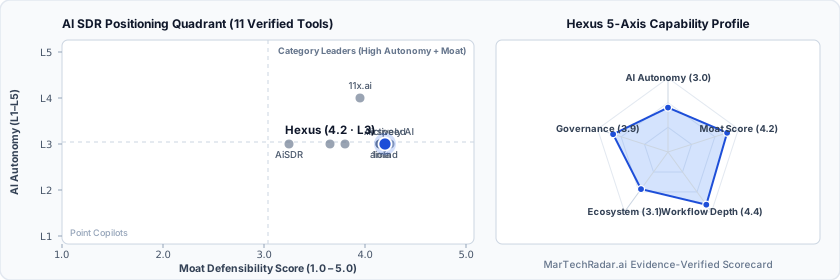
Hexus is a Web SaaS tool for AI SDR (Autonomous B2B Sales Agents & AI BDRs) in AI SDR & Outbound. Pricing: From $49/mo. Best suited to B2B Sales Leaders, SDR/BDR Teams and Revenue Operations (RevOps). Editor ratings: AI autonomy L3 (conditional automation); moat score 4.2/5.0 (Proprietary moat). Fact-checked by Anthony Hay on Oct 12, 2026.
Autonomous agent platform capturing software workflows to automatically synthesize interactive product demos, guides, and sales enablement assets.
Hexus buyer fit verdict: when to choose vs. when to walk away
Choose Hexus if (Best Fit)
- Target ICP & Stack Fit: You operate as B2B Sales Leaders, SDR/BDR Teams and Revenue Operations (RevOps) requiring a Web SaaS deployment for AI SDR.
- L3 Architecture & Defensibility: Proprietary DOM interaction logging and programmatic conversion into dynamic product walkthroughs, backed by integration into Olto's autonomous revenue agent architecture.
- Commercial Model Fit: Your procurement budget aligns with From $49/mo.
Walk away from Hexus if (Deal-Breakers)
- Walk away if your workflow requires uncapped enterprise volume on the From $49/mo entry plan without upgrading tiers.
- Walk away if your workflow cannot tolerate dom drift fragility: Dynamic single-page application updates and shadow DOM elements can corrupt capture sequences, requiring manual step remediation whenever target application layouts change.
- Walk away if canvas element blindness is a deal-breaker for your team: Applications rendering non-standard UI components via WebGL or HTML5 canvas bypass standard DOM traversal, preventing automatic event segmentation and text extraction.
Hexus key facts & scorecard
| Pricing | From $49/moVendor pricing page |
|---|---|
| Free plan | No / not disclosed |
| Delivery | Web SaaS |
| Audience | B2B Sales Leaders, SDR/BDR Teams, Revenue Operations (RevOps) |
| AI autonomy level | L3 · Conditional automationEditor-verified |
| Moat tier & score | 4.2 / 5.0 · Proprietary moatEditor-verified |
| Funding | AcquiredAcquired by Olto |
| Total funding | $1.6MBacked by Pear VC, Liquid 2 Ventures |
| Company size | 2-10 employees |
| Governance & docs | Terms ↗ · Privacy ↗ |
| Headquarters | San Francisco |
| Founded | 2023 |
| Last verified |
Hexus pros & cons: strengths vs. operational limitations
Pros: core strengths & capabilities
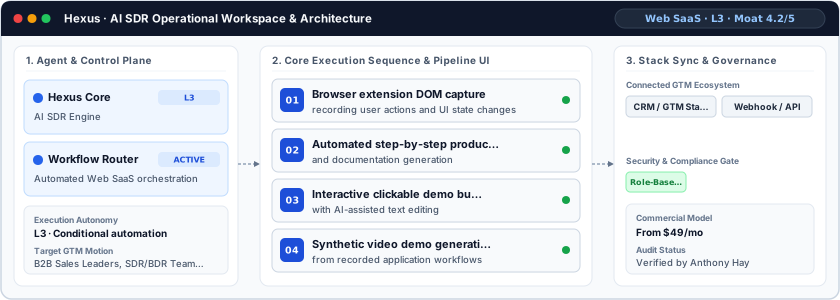
- Browser extension DOM capture: recording user actions and UI state changes
- Automated step-by-step product guide: and documentation generation
- Interactive clickable demo builder: with AI-assisted text editing
- Synthetic video demo generation: from recorded application workflows
Cons: operational limitations & risks
- DOM Drift Fragility: Dynamic single-page application updates and shadow DOM elements can corrupt capture sequences, requiring manual step remediation whenever target application layouts change.
- Canvas Element Blindness: Applications rendering non-standard UI components via WebGL or HTML5 canvas bypass standard DOM traversal, preventing automatic event segmentation and text extraction.
- Synthetic Voice Modulation: The automated audio narration pipeline lacks granular control over complex technical terminology pronunciation and cadence adjustments during auto-generated video creation.
Hexus TCO & deal-breaker stress test
Simulate 12-month stepped TCO, hidden cost multipliers, contract lock-in exposure, and stack failure modes using only facts verified by Anthony Hay on · Capture SHA 65e99212.
Hexus aligns with your 5-seat / $800/mo profile. Review the walk-away triggers and contract levers below before deployment.
| Plan / Tier | Verified Rate | Scale Fit | Scope & Quota Notes |
|---|---|---|---|
| Entry / Starter | $49/mo | 1–2 seats | Advanced Extension (Screen capture, Video recording, HTML Editor) |
| Team | $499/mo | 5 seats | Verified $499/mo tier from vendor pricing schedule. |
- Moat Score
- 4.2 / 5.0
- AI Autonomy
- L3
- Free Tier / Trial
- None disclosed
Triggered audit signals & failure modes
- Published Self-Serve Entry FloorVerified Pricing Ledger
Hexus publishes a transparent entry point (From $49/mo) for initial validation before committing.
- Tier Fit for 5-Seat Scale: Team ($499/mo)Verified Tier Schedule
Verified $499/mo tier from vendor pricing schedule.
- Primary Operational Bottleneck: DOM Drift FragilityAudit by Anthony Hay
Dynamic single-page application updates and shadow DOM elements can corrupt capture sequences, requiring manual step remediation whenever target application layouts change.
Hidden TCO Multipliers & Quota Gates
- Annual Billing Headline vs. Monthly Premium: Headline entry rates reflect annual billing commitments (Save 20%); month-to-month flexibility carries a higher effective monthly rate or requires annual prepayment.
- Credit & Usage Burn Multiplier: Automated workflows consume metered credits/usage quotas; multi-step enrichment, voice minutes, or high-frequency agent runs can trigger mid-cycle top-up packs.
- Enterprise Governance & Add-On Gating: Advanced capabilities such as Single Sign-On (SSO), custom role permissions, or specialized analytics modules are gated behind upper tiers or paid add-ons.
When to Walk Away & Negotiation Levers
- Walk away if your workflow requires uncapped enterprise volume on the From $49/mo entry plan without upgrading tiers.
- Walk away if your workflow cannot tolerate dom drift fragility: Dynamic single-page application updates and shadow DOM elements can corrupt capture sequences, requiring manual step remediation whenever target application layouts change.
- Walk away if canvas element blindness is a deal-breaker for your team: Applications rendering non-standard UI components via WebGL or HTML5 canvas bypass standard DOM traversal, preventing automatic event segmentation and text extraction.
- Validate exact quota thresholds (seats, credits, or API calls) included in Hexus's From $49/mo tier before converting from monthly to annual billing.
- Require a sandbox proof-of-concept testing dom drift fragility against your live CRM/data schema before annual sign-off.
Ask a custom procurement or TCO stress-test question about Hexus
Lower 5-seat floor (~$9/mo vs. $499 / mo)
Lower 5-seat floor (~$79/mo vs. $499 / mo)
Hexus moat & subtrack positioning
Proprietary DOM interaction logging and programmatic conversion into dynamic product walkthroughs, backed by integration into Olto's autonomous revenue agent architecture.
Editorial review
Fact-checked by Anthony Hay (Senior SEO, Search Intelligence & Content Operations Editor) on .
Background
Hexus approaches product-led go-to-market workflows by converting raw UI interaction logs into structured buyer-enablement collateral. Established in 2023 and based in San Francisco, the company raised $1.6M in venture funding before joining Olto to integrate product-trained agents directly into revenue operations. The platform targets product marketing teams, sales engineers, and growth leaders who require automated translation of software features into interactive buyer touchpoints without manual video editing or documentation authoring.
How Hexus works
At an architectural level, Hexus deploys a browser extension to capture application state transitions, telemetry, and Document Object Model (DOM) mutations during user walkthroughs. The capture pipeline parses sequential click events, cursor coordinates, and page state snapshots into an indexed execution timeline. Generative language and rendering models subsequently ingest this structural data to synthesize multi-format artifacts, including interactive click-through sandboxes, narrated video assets, and markdown technical guides with minimal operator oversight.
Limitations
Operational considerations and platform boundaries include:
- DOM Drift Fragility: Dynamic single-page application updates and shadow DOM elements can corrupt capture sequences, requiring manual step remediation whenever target application layouts change.
- Canvas Element Blindness: Applications rendering non-standard UI components via WebGL or HTML5 canvas bypass standard DOM traversal, preventing automatic event segmentation and text extraction.
- Synthetic Voice Modulation: The automated audio narration pipeline lacks granular control over complex technical terminology pronunciation and cadence adjustments during auto-generated video creation.
Hexus pricing
Commercial access operates primarily on a tiered software-as-a-service subscription. Pricing begins at $49 per month for the entry-level single-seat tier, which includes the advanced screen capture extension, flow creation tools, and baseline editing automation. High-volume production and multi-seat team governance require upgrading to higher subscription tiers, with annual billing configurations offering baseline platform discounts.
How Hexus compares
Within revenue automation, Hexus operates as a product-demonstration asset generator rather than a direct outbound communication engine. While autonomous BDR platforms such as 11x.ai, 1mind, and Actively AI direct algorithmic capacity toward prospecting cadence orchestration and outbound email personalization, Hexus optimizes downstream evaluation by automating technical collateral generation. Mid-market software organizations deploying product-led acquisition funnels benefit most from its workflow, pairing synthetic product walkthroughs alongside conventional SDR operations.
Direct competitors & market radar
Top algorithmic competitors based on category positioning, capability overlap, and ICP alignment.
Frequently asked questions about Hexus
How much does Hexus cost and what pricing tiers are available?
Published pricing summary for Hexus: From $49/mo. A permanent free plan is not disclosed for Hexus. Verified tier schedule: Entry / Starter ($49/mo for 1–2 seats); Team ($499/mo for 5 seats). Commercial access operates primarily on a tiered software-as-a-service subscription. Pricing begins at $49 per month for the entry-level single-seat tier, which includes the advanced screen capture extension, flow creation tools, and baseline editing automation.
How does Hexus work and how autonomous is its AI architecture?
Autonomous agent platform capturing software workflows to automatically synthesize interactive product demos, guides, and sales enablement assets. Within AI SDR (Autonomous B2B Sales Agents & AI BDRs), MarTechRadar rates its execution architecture at L3 · Conditional automation with a verified Moat Score of 4.2 / 5.0 (Proprietary moat). Proprietary DOM interaction logging and programmatic conversion into dynamic product walkthroughs, backed by integration into Olto's autonomous revenue agent architecture. Corporate profile: operating at 2-10 employees scale, acquired by Olto.
What are the main limitations of Hexus and when should buyers walk away?
Based on our editorial technical audit, key operational considerations and boundaries for Hexus include: (1) DOM Drift Fragility: Dynamic single-page application updates and shadow DOM elements can corrupt capture sequences, requiring manual step remediation whenever target application layouts change. (2) Canvas Element Blindness: Applications rendering non-standard UI components via WebGL or HTML5 canvas bypass standard DOM traversal, preventing automatic event segmentation and text extraction. (3) Synthetic Voice Modulation: The automated audio narration pipeline lacks granular control over complex technical terminology pronunciation and cadence adjustments during auto-generated video creation. Primary procurement walk-away rule: Walk away if your workflow requires uncapped enterprise volume on the From $49/mo entry plan without upgrading tiers.
What integrations, compliance certifications, and contract terms apply to Hexus?
Key TCO multiplier to watch: Annual Billing Headline vs. Monthly Premium (Headline entry rates reflect annual billing commitments (Save 20%); month-to-month flexibility carries a higher effective monthly rate or requires annual prepayment.) Before signing a contract, procurement teams should validate exact quota thresholds (seats, credits, or API calls) included in Hexus's From $49/mo tier before converting from monthly to annual billing.
What are the best Hexus alternatives and head-to-head competitors in 2026?
Top fact-checked alternatives to Hexus in AI SDR (Autonomous B2B Sales Agents & AI BDRs) include Walnut (Free plan · $0/mo · Enterprise plan), Groove.co (Custom / enterprise pricing), Nexuscale.ai (From $79/mo), Alpharun (Custom / enterprise pricing). Within revenue automation, Hexus operates as a product-demonstration asset generator rather than a direct outbound communication engine.
Verified sources & evidence trail
- Official product domain: https://www.hexus.ai/
- Commercial pricing verification: https://www.hexus.ai/pricing
- Verified corporate entity profiles (
sameAs): LinkedIn Company Profile · Crunchbase Entity Record - First-party governance & documentation links: Terms · Privacy
- Editorial audit sign-off: Fact-checked by Anthony Hay on under the MarTechRadar Evidence-Ledger Protocol.