LightSite AI Review (2026): GEO Pricing, Limits & Alternatives
Bottom line
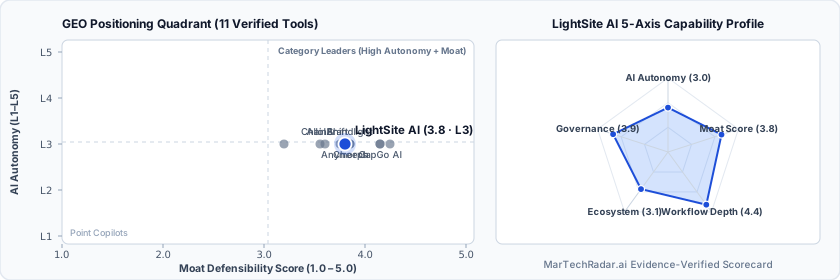
LightSite AI is a Web SaaS tool for GEO (GEO Brand Tracking & LLM Rank Tracking) in GEO & AI SEO. Pricing: From $129/mo. Best suited to SEO Directors, Brand Strategy Leaders and Growth Marketers. Editor ratings: AI autonomy L3 (conditional automation); moat score 3.8/5.0 (Proprietary moat). Fact-checked by Vasilia Xia on Oct 11, 2026.
Generative engine optimization and technical website formatting platform transforming web content into machine-readable structures for AI answer engines.
LightSite AI buyer fit verdict: when to choose vs. when to walk away
Choose LightSite AI if (Best Fit)
- Target ICP & Stack Fit: You operate as SEO Directors, Brand Strategy Leaders and Growth Marketers requiring a Web SaaS deployment for GEO.
- L3 Architecture & Defensibility: LightSite AI couples automated JSON-LD entity generation with direct LLM citation auditing. Its primary defensibility rests on proprietary parsing algorithms that translate unstructured marketing copy into linked open data models specifically optimized for retrieval-augmented generation pipelines.
- Commercial Model Fit: Your procurement budget aligns with From $129/mo.
Walk away from LightSite AI if (Deal-Breakers)
- Walk away if your workflow requires uncapped enterprise volume on the From $129/mo entry plan without upgrading tiers.
- Walk away if your workflow cannot tolerate algorithmic latency and retraining lags: LLM visibility metrics exhibit significant attribution window lag because foundational model weights and retrieval-augmented search indexes update on asynchronous, non-deterministic cadences.
- Walk away if edge injection execution fragility is a deal-breaker for your team: Automated script injection can induce DOM hydration conflicts on complex single-page applications, requiring regular schema maintenance to avoid breaking client-side rendering.
LightSite AI key facts & scorecard
| Pricing | From $129/moVendor pricing page |
|---|---|
| Free plan | No / not disclosed |
| Delivery | Web SaaS |
| Audience | SEO Directors, Brand Strategy Leaders, Growth Marketers |
| AI autonomy level | L3 · Conditional automationEditor-verified |
| Moat tier & score | 3.8 / 5.0 · Proprietary moatEditor-verified |
| Funding | Pre-seed |
| Total funding | $450KBacked by Fusion |
| Founders | Stas Levitan |
| Company size | 11-50 employees |
| Governance & docs | DPA ↗ · Privacy ↗ |
| Headquarters | Herzliya, Tel Aviv, Israel |
| Founded | 2025 |
| Last verified |
LightSite AI pros & cons: strengths vs. operational limitations
Pros: core strengths & capabilities
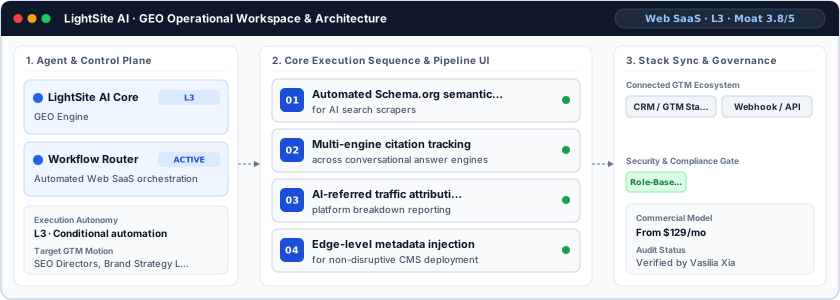
- Automated Schema.org semantic data generation: for AI search scrapers
- Multi-engine citation tracking: across conversational answer engines
- AI-referred traffic attribution and: platform breakdown reporting
- Edge-level metadata injection: for non-disruptive CMS deployment
Cons: operational limitations & risks
- Algorithmic Latency and Retraining Lags: LLM visibility metrics exhibit significant attribution window lag because foundational model weights and retrieval-augmented search indexes update on asynchronous, non-deterministic cadences.
- Edge Injection Execution Fragility: Automated script injection can induce DOM hydration conflicts on complex single-page applications, requiring regular schema maintenance to avoid breaking client-side rendering.
- Restricted Monitoring Bandwidth: Strict monthly prompt quotas cap query simulation density, preventing real-time geographic or continuous longitudinal rank tracking across localized search variants.
LightSite AI TCO & deal-breaker stress test
Simulate 12-month stepped TCO, hidden cost multipliers, contract lock-in exposure, and stack failure modes using only facts verified by Vasilia Xia on · Capture SHA 2b5620db.
LightSite AI aligns with your 5-seat / $800/mo profile. Review the walk-away triggers and contract levers below before deployment.
| Plan / Tier | Verified Rate | Scale Fit | Scope & Quota Notes |
|---|---|---|---|
| Entry / Starter | $129/mo | Unlimited seats (Entry credits) | Verified $129/mo tier from vendor pricing schedule. |
| Growth | $299/mo | Unlimited seats (Growth credits) | For brands that want AI search visibility, competitor monitoring, traffic attribution, and clea |
- Moat Score
- 3.8 / 5.0
- AI Autonomy
- L3
- Free Tier / Trial
- None disclosed
Triggered audit signals & failure modes
- Published Self-Serve Entry FloorVerified Pricing Ledger
LightSite AI publishes a transparent entry point (From $129/mo) for initial validation before committing.
- Tier Fit for 5-Seat Scale: Growth ($299/mo)Verified Tier Schedule
For brands that want AI search visibility, competitor monitoring, traffic attribution, and clea
- Primary Operational Bottleneck: Algorithmic Latency and Retraining LagsAudit by Vasilia Xia
LLM visibility metrics exhibit significant attribution window lag because foundational model weights and retrieval-augmented search indexes update on asynchronous, non-deterministic cadences.
Hidden TCO Multipliers & Quota Gates
- Annual Billing Headline vs. Monthly Premium: Headline entry rates reflect annual billing commitments; month-to-month flexibility carries a higher effective monthly rate or requires annual prepayment.
- Algorithmic Latency and Retraining Lags: LLM visibility metrics exhibit significant attribution window lag because foundational model weights and retrieval-augmented search indexes update on asynchronous, non-deterministic cadences.
- Edge Injection Execution Fragility: Automated script injection can induce DOM hydration conflicts on complex single-page applications, requiring regular schema maintenance to avoid breaking client-side rendering.
When to Walk Away & Negotiation Levers
- Walk away if your workflow requires uncapped enterprise volume on the From $129/mo entry plan without upgrading tiers.
- Walk away if your workflow cannot tolerate algorithmic latency and retraining lags: LLM visibility metrics exhibit significant attribution window lag because foundational model weights and retrieval-augmented search indexes update on asynchronous, non-deterministic cadences.
- Walk away if edge injection execution fragility is a deal-breaker for your team: Automated script injection can induce DOM hydration conflicts on complex single-page applications, requiring regular schema maintenance to avoid breaking client-side rendering.
- Validate exact quota thresholds (seats, credits, or API calls) included in LightSite AI's From $129/mo tier before converting from monthly to annual billing.
- Require a sandbox proof-of-concept testing algorithmic latency and retraining lags against your live CRM/data schema before annual sign-off.
Ask a custom procurement or TCO stress-test question about LightSite AI
Lower 5-seat floor (~$250/mo vs. $299 / mo)
Lower 5-seat floor (~$99/mo vs. $299 / mo)
LightSite AI moat & subtrack positioning
LightSite AI couples automated JSON-LD entity generation with direct LLM citation auditing. Its primary defensibility rests on proprietary parsing algorithms that translate unstructured marketing copy into linked open data models specifically optimized for retrieval-augmented generation pipelines.
Editorial review
Fact-checked by Vasilia Xia (E-Commerce, Lifecycle & Retention Marketing Analyst) on .
Background
Architected at the intersection of technical schema markup and synthetic search indexing, LightSite AI addresses the structural invisibility corporate websites experience across generative answer engines. Established in 2025 in Herzliya, Tel Aviv, Israel, with $450K in pre-seed backing, the vendor engineers optimization software for digital marketing directors and enterprise web architects. The platform functions as a targeted technical infrastructure layer, standardizing dynamic web content into explicit semantic formats consumed by conversational retrieval systems.
How LightSite AI works
At its architectural core, the system runs an automated ingestion pipeline that indexes client digital properties to extract entities, relationships, and product attributes. Operating under an L3 conditional autonomy model, it synthesizes linked JSON-LD payloads and semantic microdata, injecting them via edge scripts or CMS connectors to bypass core application redesigns. LightSite AI runs prompt-simulation routines across major commercial foundational models, calculating visibility vectors and tracking platform-level citation provenance to surface exact answer engine referral paths.
Limitations
Operational considerations and platform boundaries include:
- Algorithmic Latency and Retraining Lags: LLM visibility metrics exhibit significant attribution window lag because foundational model weights and retrieval-augmented search indexes update on asynchronous, non-deterministic cadences.
- Edge Injection Execution Fragility: Automated script injection can induce DOM hydration conflicts on complex single-page applications, requiring regular schema maintenance to avoid breaking client-side rendering.
- Restricted Monitoring Bandwidth: Strict monthly prompt quotas cap query simulation density, preventing real-time geographic or continuous longitudinal rank tracking across localized search variants.
LightSite AI pricing
Commercial distribution relies on tiered software-as-a-service subscriptions billed annually. The baseline Foundation tier starts from $129 per month, provisioning technical AI search readiness tooling, website structuring modules, and visibility tracking limited to 500 query prompts per billing cycle. Higher-tier packages expand prompt throughput capacities and provide automated edge deployment configurations, backed by a standard seven-day trial.
How LightSite AI compares
Within the generative engine optimization category, LightSite AI competes directly against specialized monitoring platforms such as Anymorph, AthenaHQ, and Brandlight. While competitors like AthenaHQ and Brandlight prioritize corporate narrative monitoring, executive brand sentiment, and high-level conversational share of voice, LightSite AI focuses on technical crawling optimization, dynamic semantic markup, and edge infrastructure. The product fits mid-market marketing organizations that require programmatic schema remediation to secure synthetic search citations without executing fundamental website rebuilds.
Direct competitors & market radar
Top algorithmic competitors based on category positioning, capability overlap, and ICP alignment.
Frequently asked questions about LightSite AI
How much does LightSite AI cost and what pricing tiers are available?
Published pricing summary for LightSite AI: From $129/mo. A permanent free plan is not disclosed for LightSite AI. Verified tier schedule: Entry / Starter ($129/mo for Unlimited seats (Entry credits)); Growth ($299/mo for Unlimited seats (Growth credits)). Commercial distribution relies on tiered software-as-a-service subscriptions billed annually. The baseline Foundation tier starts from $129 per month, provisioning technical AI search readiness tooling, website structuring modules, and visibility tracking limited to 500 query prompts per billing cycle.
How does LightSite AI work and how autonomous is its AI architecture?
Generative engine optimization and technical website formatting platform transforming web content into machine-readable structures for AI answer engines. Within GEO (GEO Brand Tracking & LLM Rank Tracking), MarTechRadar rates its execution architecture at L3 · Conditional automation with a verified Moat Score of 3.8 / 5.0 (Proprietary moat). LightSite AI couples automated JSON-LD entity generation with direct LLM citation auditing. Its primary defensibility rests on proprietary parsing algorithms that translate unstructured marketing copy into linked open data models specifically optimized for retrieval-augmented generation pipelines. Corporate profile: Founded by Stas Levitan, operating at 11-50 employees scale.
What are the main limitations of LightSite AI and when should buyers walk away?
Based on our editorial technical audit, key operational considerations and boundaries for LightSite AI include: (1) Algorithmic Latency and Retraining Lags: LLM visibility metrics exhibit significant attribution window lag because foundational model weights and retrieval-augmented search indexes update on asynchronous, non-deterministic cadences. (2) Edge Injection Execution Fragility: Automated script injection can induce DOM hydration conflicts on complex single-page applications, requiring regular schema maintenance to avoid breaking client-side rendering. (3) Restricted Monitoring Bandwidth: Strict monthly prompt quotas cap query simulation density, preventing real-time geographic or continuous longitudinal rank tracking across localized search variants. Primary procurement walk-away rule: Walk away if your workflow requires uncapped enterprise volume on the From $129/mo entry plan without upgrading tiers.
What integrations, compliance certifications, and contract terms apply to LightSite AI?
First-party governance and developer endpoints verified on domain include: DPA (https://www.lightsite.ai/data-processing-addendum). Key TCO multiplier to watch: Annual Billing Headline vs. Monthly Premium (Headline entry rates reflect annual billing commitments; month-to-month flexibility carries a higher effective monthly rate or requires annual prepayment.) Before signing a contract, procurement teams should validate exact quota thresholds (seats, credits, or API calls) included in LightSite AI's From $129/mo tier before converting from monthly to annual billing.
What are the best LightSite AI alternatives and head-to-head competitors in 2026?
Top fact-checked alternatives to LightSite AI in GEO (GEO Brand Tracking & LLM Rank Tracking) include Brandlight (Custom / enterprise pricing), Rankscale (From $99/mo), Petra Labs (Custom / enterprise pricing), Scrunch AI (From $250/mo). Within the generative engine optimization category, LightSite AI competes directly against specialized monitoring platforms such as Anymorph, AthenaHQ, and Brandlight.
Verified sources & evidence trail
- Official product domain: https://www.lightsite.ai/
- Commercial pricing verification: https://www.lightsite.ai/pricing
- Verified corporate entity profiles (
sameAs): LinkedIn Company Profile · Crunchbase Entity Record - First-party governance & documentation links: DPA · Privacy
- Editorial audit sign-off: Fact-checked by Vasilia Xia on under the MarTechRadar Evidence-Ledger Protocol.