Scrunch AI Review (2026): GEO Pricing, Limits & Alternatives
Bottom line
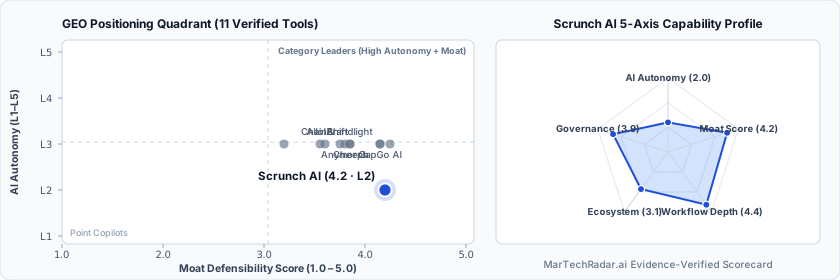
Scrunch AI is a Web SaaS tool for GEO (GEO Brand Tracking & LLM Rank Tracking) in GEO & AI SEO. Pricing: From $250/mo. Best suited to B2B SaaS and DTC / eCommerce. Editor ratings: AI autonomy L2 (workflow copilot); moat score 4.2/5.0 (Proprietary moat). Fact-checked by Anna Xia on Oct 15, 2026.
Generative engine optimization and brand visibility platform tracking LLM citations, agent traffic, and generating agent-optimized pages.
Scrunch AI buyer fit verdict: when to choose vs. when to walk away
Choose Scrunch AI if (Best Fit)
- Target ICP & Stack Fit: You operate as B2B SaaS and DTC / eCommerce requiring a Web SaaS deployment for GEO.
- L2 Architecture & Defensibility: Deep integration with enterprise content infrastructure post-acquisition by Sitecore, combined with specialized agent-facing landing page generation (Agent Pages) that structures content specifically for retrieval-augmented generation engines.
- Commercial Model Fit: Your procurement budget aligns with From $250/mo.
Walk away from Scrunch AI if (Deal-Breakers)
- Walk away if your team is at early validation stage with a <$250/mo tool budget (Scrunch AI starts at From $250/mo before seat or usage expansion).
- Walk away if your workflow cannot tolerate crawler ingestion latency: LLM knowledge indexing pipelines do not update in real time, causing latency between deploying structured Agent Pages and observing measurable changes in synthetic answer citations.
- Walk away if bot detection brittleness is a deal-breaker for your team: Discerning synthetic agent traffic from generic web scrapers relies on user-agent strings and behavioural heuristics, which break when autonomous crawlers mask their identities.
Scrunch AI key facts & scorecard
| Pricing | From $250/moVendor pricing page |
|---|---|
| Free plan | No / not disclosed |
| Delivery | Web SaaS |
| Audience | B2B SaaS, DTC / eCommerce |
| AI autonomy level | L2 · Workflow copilotEditor-verified |
| Moat tier & score | 4.2 / 5.0 · Proprietary moatEditor-verified |
| Funding | AcquiredAcquired by Sitecore |
| Total funding | $19M |
| Founders | Chris Andrew, Robert MacCloy |
| Company size | 51-200 employees |
| Governance & docs | Terms ↗ · Privacy ↗ |
| Headquarters | Salt Lake City, Utah, United States |
| Founded | 2023 |
| Last verified |
Scrunch AI pros & cons: strengths vs. operational limitations
Pros: core strengths & capabilities
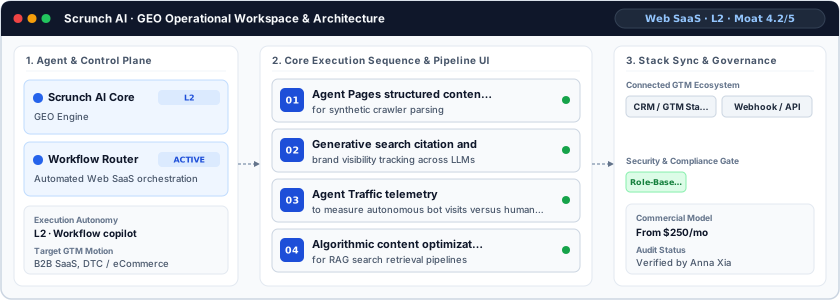
- Agent Pages structured content generation: for synthetic crawler parsing
- Generative search citation and: brand visibility tracking across LLMs
- Agent Traffic telemetry: to measure autonomous bot visits versus human sessions
- Algorithmic content optimization: for RAG search retrieval pipelines
Cons: operational limitations & risks
- Crawler Ingestion Latency: LLM knowledge indexing pipelines do not update in real time, causing latency between deploying structured Agent Pages and observing measurable changes in synthetic answer citations.
- Bot Detection Brittleness: Discerning synthetic agent traffic from generic web scrapers relies on user-agent strings and behavioural heuristics, which break when autonomous crawlers mask their identities.
- Dynamic Prompt Drift: Non-deterministic LLM temperature settings create stochastic output variations, requiring high prompt sampling density to confirm statistically valid citation shifts.
Scrunch AI TCO & deal-breaker stress test
Simulate 12-month stepped TCO, hidden cost multipliers, contract lock-in exposure, and stack failure modes using only facts verified by Anna Xia on · Capture SHA 6f3790c1.
Scrunch AI aligns with your 5-seat / $800/mo profile. Review the walk-away triggers and contract levers below before deployment.
| Plan / Tier | Verified Rate | Scale Fit | Scope & Quota Notes |
|---|---|---|---|
| Core | $250/mo | 1–2 seats | For teams to evaluate Scrunch, establish AI visibility benchmarks, and prove impact before scal |
- Moat Score
- 4.2 / 5.0
- AI Autonomy
- L2
- Free Tier / Trial
- None disclosed
Triggered audit signals & failure modes
- Published Self-Serve Entry FloorVerified Pricing Ledger
Scrunch AI publishes a transparent entry point (From $250/mo) for initial validation before committing.
- Primary Operational Bottleneck: Crawler Ingestion LatencyAudit by Anna Xia
LLM knowledge indexing pipelines do not update in real time, causing latency between deploying structured Agent Pages and observing measurable changes in synthetic answer citations.
Hidden TCO Multipliers & Quota Gates
- Credit & Usage Burn Multiplier: Automated workflows consume metered credits/usage quotas; multi-step enrichment, voice minutes, or high-frequency agent runs can trigger mid-cycle top-up packs.
- Enterprise Governance & Add-On Gating: Advanced capabilities such as Single Sign-On (SSO), custom role permissions, or specialized analytics modules are gated behind upper tiers or paid add-ons.
When to Walk Away & Negotiation Levers
- Walk away if your team is at early validation stage with a <$250/mo tool budget (Scrunch AI starts at From $250/mo before seat or usage expansion).
- Walk away if your workflow cannot tolerate crawler ingestion latency: LLM knowledge indexing pipelines do not update in real time, causing latency between deploying structured Agent Pages and observing measurable changes in synthetic answer citations.
- Walk away if bot detection brittleness is a deal-breaker for your team: Discerning synthetic agent traffic from generic web scrapers relies on user-agent strings and behavioural heuristics, which break when autonomous crawlers mask their identities.
- Negotiate price-lock protection on additional seats and overage credits above the From $250/mo entry tier.
- Require a sandbox proof-of-concept testing crawler ingestion latency against your live CRM/data schema before annual sign-off.
Ask a custom procurement or TCO stress-test question about Scrunch AI
Lower 5-seat floor (~$129/mo vs. From $250 / mo)
Lower 5-seat floor (~$49/mo vs. From $250 / mo)
Scrunch AI moat & subtrack positioning
Deep integration with enterprise content infrastructure post-acquisition by Sitecore, combined with specialized agent-facing landing page generation (Agent Pages) that structures content specifically for retrieval-augmented generation engines.
Editorial review
Fact-checked by Anna Xia (Senior B2B GTM & Revenue Systems Analyst) on .
Background
Established in 2023 in Salt Lake City, Utah, United States, Scrunch AI built generative engine optimization infrastructure prior to its acquisition by Sitecore, having accumulated $19M in total funding. The platform serves enterprise digital marketing leaders, technical SEO strategists, and growth teams navigating generative AI discovery engines. Instead of focusing solely on conventional search crawlers, Scrunch AI addresses visibility shifts caused by autonomous agents and conversational language models.
How Scrunch AI works
At an architectural level, Scrunch AI operates an L2 autonomous telemetry and ingestion system designed to monitor how large language models cite brand collateral. The system ingests search prompt variants, queries multiple model endpoints, and computes synthetic citation shares. Simultaneously, its Agent Pages engine dynamically serves structured, machine-readable representations of web pages, optimizing data ingestion pipelines for RAG systems while tracking autonomous bot visits via specialized Agent Traffic monitoring.
Limitations
Operational considerations and platform boundaries include:
- Crawler Ingestion Latency: LLM knowledge indexing pipelines do not update in real time, causing latency between deploying structured Agent Pages and observing measurable changes in synthetic answer citations.
- Bot Detection Brittleness: Discerning synthetic agent traffic from generic web scrapers relies on user-agent strings and behavioural heuristics, which break when autonomous crawlers mask their identities.
- Dynamic Prompt Drift: Non-deterministic LLM temperature settings create stochastic output variations, requiring high prompt sampling density to confirm statistically valid citation shifts.
Scrunch AI pricing
Commercial access to Scrunch AI is structured via tiered SaaS subscriptions starting from $250 per month. Pricing scales based on domain footprint, prompt tracking frequency, and the volume of generated Agent Pages. Enterprise deployments requiring direct Sitecore CMS connectors, high-frequency prompt audits, and custom data warehouse integrations require negotiated enterprise contracts.
How Scrunch AI compares
Within generative engine tracking, Scrunch AI competes against AthenaHQ, Anymorph, and Brandlight. While AthenaHQ focuses strictly on conversational prompt auditing and Anymorph emphasizes dark-funnel attribution, Scrunch AI differentiates through active content remediation via its Agent Pages framework. It serves large-scale web operations that require structured automated publishing rather than passive observation boards. It is best suited for enterprise marketing teams and growth practitioners seeking disciplined workflow orchestration.
Direct competitors & market radar
Top algorithmic competitors based on category positioning, capability overlap, and ICP alignment.
Frequently asked questions about Scrunch AI
How much does Scrunch AI cost and what pricing tiers are available?
Published pricing summary for Scrunch AI: From $250/mo. A permanent free plan is not disclosed for Scrunch AI. Commercial access to Scrunch AI is structured via tiered SaaS subscriptions starting from $250 per month. Pricing scales based on domain footprint, prompt tracking frequency, and the volume of generated Agent Pages.
How does Scrunch AI work and how autonomous is its AI architecture?
Generative engine optimization and brand visibility platform tracking LLM citations, agent traffic, and generating agent-optimized pages. Within GEO (GEO Brand Tracking & LLM Rank Tracking), MarTechRadar rates its execution architecture at L2 · Workflow copilot with a verified Moat Score of 4.2 / 5.0 (Proprietary moat). Deep integration with enterprise content infrastructure post-acquisition by Sitecore, combined with specialized agent-facing landing page generation (Agent Pages) that structures content specifically for retrieval-augmented generation engines. Corporate profile: Founded by Chris Andrew, Robert MacCloy, operating at 51-200 employees scale, acquired by Sitecore.
What are the main limitations of Scrunch AI and when should buyers walk away?
Based on our editorial technical audit, key operational considerations and boundaries for Scrunch AI include: (1) Crawler Ingestion Latency: LLM knowledge indexing pipelines do not update in real time, causing latency between deploying structured Agent Pages and observing measurable changes in synthetic answer citations. (2) Bot Detection Brittleness: Discerning synthetic agent traffic from generic web scrapers relies on user-agent strings and behavioural heuristics, which break when autonomous crawlers mask their identities. (3) Dynamic Prompt Drift: Non-deterministic LLM temperature settings create stochastic output variations, requiring high prompt sampling density to confirm statistically valid citation shifts. Primary procurement walk-away rule: Walk away if your team is at early validation stage with a <$250/mo tool budget (Scrunch AI starts at From $250/mo before seat or usage expansion).
What integrations, compliance certifications, and contract terms apply to Scrunch AI?
Key TCO multiplier to watch: Credit & Usage Burn Multiplier (Automated workflows consume metered credits/usage quotas; multi-step enrichment, voice minutes, or high-frequency agent runs can trigger mid-cycle top-up packs.) Before signing a contract, procurement teams should negotiate price-lock protection on additional seats and overage credits above the From $250/mo entry tier.
What are the best Scrunch AI alternatives and head-to-head competitors in 2026?
Top fact-checked alternatives to Scrunch AI in GEO (GEO Brand Tracking & LLM Rank Tracking) include Anymorph (From $799/mo), LightSite AI (From $129/mo), Yolando (Free plan · $0/mo · Enterprise plan), Kollavo ($49/mo). Within generative engine tracking, Scrunch AI competes against AthenaHQ, Anymorph, and Brandlight. While AthenaHQ focuses strictly on conversational prompt auditing and Anymorph emphasizes dark-funnel attribution, Scrunch AI differentiates through active content remediation via its Agent Pages framework.
Verified sources & evidence trail
- Official product domain: https://scrunchai.com
- Commercial pricing verification: https://scrunch.com/pricing/
- Verified corporate entity profiles (
sameAs): LinkedIn Company Profile · Crunchbase Entity Record - First-party governance & documentation links: Terms · Privacy
- Editorial audit sign-off: Fact-checked by Anna Xia on under the MarTechRadar Evidence-Ledger Protocol.