Mixmax Review (2026): AI SDR Pricing, Limits & Alternatives
Bottom line
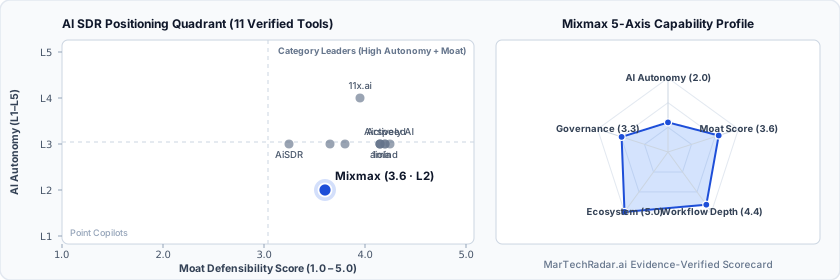
Mixmax is a Web SaaS tool for AI SDR (Autonomous B2B Sales Agents & AI BDRs) in AI SDR & Outbound. Pricing: Free plan · $0/mo · Enterprise plan. Best suited to B2B SaaS. Editor ratings: AI autonomy L2 (workflow copilot); moat score 3.6/5.0 (Proprietary moat). Fact-checked by Vasilia Xia on Oct 14, 2026.
Sales engagement and inbox productivity platform embedding interactive scheduling, automated email sequences, and CRM synchronization directly inside Gmail.
Mixmax buyer fit verdict: when to choose vs. when to walk away
Choose Mixmax if (Best Fit)
- Target ICP & Stack Fit: You operate as B2B SaaS requiring a Web SaaS deployment for AI SDR, with verified ecosystem connectivity for Salesforce, HubSpot, Outreach, Google Workspace.
- L2 Architecture & Defensibility: Deep client-side browser and workspace integration with native Gmail UI composition, coupled with bi-directional syncing engines for CRM objects.
- Commercial Model Fit: Your procurement budget aligns with Free plan · $0/mo · Enterprise plan and want a self-serve free tier for zero-cost initial validation.
Walk away from Mixmax if (Deal-Breakers)
- Walk away if your workflow requires uncapped enterprise volume on the Free plan · $0/mo · Enterprise plan entry plan without upgrading tiers.
- Walk away if your workflow cannot tolerate workspace environment constraints: The architecture depends heavily on Google Workspace and Chrome browser runtimes, rendering deployment non-viable for enterprise organizations standardized strictly on native desktop Microsoft Outlook environments.
- Walk away if mailbox API rate limits is a deal-breaker for your team: Because dispatches rely on underlying Gmail sending limits rather than dedicated SMTP relay pools, scaled outbound sequences encounter strict provider throttles when scaling pipeline volumes.
Mixmax key facts & scorecard
| Pricing | Free plan · $0/mo · Enterprise planVendor pricing page |
|---|---|
| Free plan | Yes |
| Delivery | Web SaaS |
| Audience | B2B SaaS |
| AI autonomy level | L2 · Workflow copilotEditor-verified |
| Moat tier & score | 3.6 / 5.0 · Proprietary moatEditor-verified |
| Funding | Series A |
| Company size | 51-200 employees |
| Ecosystem integrations | Salesforce, HubSpot, Outreach, Google Workspace, Gmail, Microsoft Outlook |
| Governance & docs | Trust & Security ↗ · System Status ↗ · API & Docs ↗ · Terms ↗ · Privacy ↗ |
| Headquarters | San Francisco, CA |
| Last verified |
Mixmax pros & cons: strengths vs. operational limitations
Pros: core strengths & capabilities
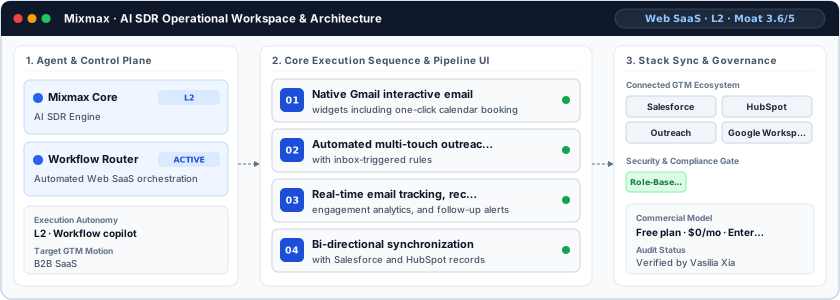
- Native Gmail interactive email: widgets including one-click calendar booking
- Automated multi-touch outreach sequences: with inbox-triggered rules
- Real-time email tracking, recipient: engagement analytics, and follow-up alerts
- Bi-directional synchronization: with Salesforce and HubSpot records
Cons: operational limitations & risks
- Workspace Environment Constraints: The architecture depends heavily on Google Workspace and Chrome browser runtimes, rendering deployment non-viable for enterprise organizations standardized strictly on native desktop Microsoft Outlook environments.
- Mailbox API Rate Limits: Because dispatches rely on underlying Gmail sending limits rather than dedicated SMTP relay pools, scaled outbound sequences encounter strict provider throttles when scaling pipeline volumes.
- CRM Schema Field Mappings: Bi-directional object syncing requires meticulous custom field maintenance in enterprise Salesforce setups, often producing sync latency or collision errors when pipeline schemas update independently.
Mixmax TCO & deal-breaker stress test
Simulate 12-month stepped TCO, hidden cost multipliers, contract lock-in exposure, and stack failure modes using only facts verified by Vasilia Xia on · Capture SHA e625d6e4.
Mixmax is viable for 5 seats, but requires commercial or technical verification on the flagged items below.
| Plan / Tier | Verified Rate | Scale Fit | Scope & Quota Notes |
|---|---|---|---|
| Free / Sandbox | $0 | 1–2 seats (Evaluation) | Entry free tier with capped usage or feature quotas for initial workflow testing. |
| Entry / Starter | $19/mo | 1–2 seats | Verified $19/mo tier from vendor pricing schedule. |
| Growth / Professional | $25/mo | 5 seats | Verified $25/mo tier from vendor pricing schedule. |
| Scale / Advanced | $29/mo | 15 seats | Unlimited email tracking & inbox categorization. |
- Moat Score
- 3.6 / 5.0
- AI Autonomy
- L2
- Free Tier / Trial
- Free plan
Triggered audit signals & failure modes
- Opaque Enterprise Quoting vs. SMB/Mid-Market BudgetVerified Pricing Ledger
Mixmax does not disclose a public self-serve floor (Free plan · $0/mo · Enterprise plan). Buyers with a $800/mo cap face high sales-qualification friction.
- Published Self-Serve Entry FloorVerified Pricing Ledger
Mixmax publishes a transparent entry point (Free plan · $0/mo · Enterprise plan) with a free tier for initial validation before committing.
- Tier Fit for 5-Seat Scale: Entry / Starter ($19/mo)Verified Tier Schedule
Verified $19/mo tier from vendor pricing schedule.
- Primary Operational Bottleneck: Workspace Environment ConstraintsAudit by Vasilia Xia
The architecture depends heavily on Google Workspace and Chrome browser runtimes, rendering deployment non-viable for enterprise organizations standardized strictly on native desktop Microsoft Outlook environments.
Hidden TCO Multipliers & Quota Gates
- Per-Seat Linear Scaling: Mixmax prices licenses on a per-user/seat basis (Free plan · $0/mo · Enterprise plan); expanding from 2 to 15+ operators multiplies base recurring spend linearly.
- Annual Billing Headline vs. Monthly Premium: Headline entry rates reflect annual billing commitments; month-to-month flexibility carries a higher effective monthly rate or requires annual prepayment.
- Credit & Usage Burn Multiplier: Automated workflows consume metered credits/usage quotas; multi-step enrichment, voice minutes, or high-frequency agent runs can trigger mid-cycle top-up packs.
When to Walk Away & Negotiation Levers
- Walk away if your workflow requires uncapped enterprise volume on the Free plan · $0/mo · Enterprise plan entry plan without upgrading tiers.
- Walk away if your workflow cannot tolerate workspace environment constraints: The architecture depends heavily on Google Workspace and Chrome browser runtimes, rendering deployment non-viable for enterprise organizations standardized strictly on native desktop Microsoft Outlook environments.
- Walk away if mailbox API rate limits is a deal-breaker for your team: Because dispatches rely on underlying Gmail sending limits rather than dedicated SMTP relay pools, scaled outbound sequences encounter strict provider throttles when scaling pipeline volumes.
- Validate exact quota thresholds (seats, credits, or API calls) included in Mixmax's Free plan · $0/mo · Enterprise plan tier before converting from monthly to annual billing.
- Require a sandbox proof-of-concept testing workspace environment constraints against your live CRM/data schema before annual sign-off.
Ask a custom procurement or TCO stress-test question about Mixmax
Lower 5-seat floor (~$39/mo vs. Custom Quote)
Verified AI SDR peer (Custom / enterprise pricing · Moat 4.2/5.0)
Mixmax key entities, modules & ecosystem stack
Mixmax moat & subtrack positioning
Deep client-side browser and workspace integration with native Gmail UI composition, coupled with bi-directional syncing engines for CRM objects.
Editorial review
Fact-checked by Vasilia Xia (E-Commerce, Lifecycle & Retention Marketing Analyst) on .
Background
Mixmax delivers an inbox-native sales engagement workspace designed to compress the outbound communication cycle for revenue professionals. Headquartered in San Francisco, CA, the company builds specifically for account executives, customer success managers, and full-cycle sellers who conduct primary relationship workflows directly within Google Workspace. Instead of isolating pipeline management inside standalone web applications, the platform anchors automated multi-touch follow-ups, recipient engagement tracking, and scheduling tools inside the rep's daily mail interface to preserve operational context.
How Mixmax works
At the systems layer, Mixmax operates as an L2 human-in-the-loop sales engagement layer integrating deeply with the Gmail API via browser-side extensions and cloud microservices. Outreach flows are orchestrated through rules-based sequential engines that trigger personalized follow-ups conditioned on prospect behavior, such as opens, clicks, or calendar bookings. Outbound dispatches route through the user’s primary workspace transport protocol to mirror standard sender behavior, while bi-directional sync engines capture communication metadata and pipe updates directly into Salesforce and HubSpot CRM fields without manual logging.
Limitations
Operational considerations and platform boundaries include:
- Workspace Environment Constraints: The architecture depends heavily on Google Workspace and Chrome browser runtimes, rendering deployment non-viable for enterprise organizations standardized strictly on native desktop Microsoft Outlook environments.
- Mailbox API Rate Limits: Because dispatches rely on underlying Gmail sending limits rather than dedicated SMTP relay pools, scaled outbound sequences encounter strict provider throttles when scaling pipeline volumes.
- CRM Schema Field Mappings: Bi-directional object syncing requires meticulous custom field maintenance in enterprise Salesforce setups, often producing sync latency or collision errors when pipeline schemas update independently.
Mixmax pricing
Mixmax structures its commercial licensing around a tiered per-seat subscription. Prospective deployments can evaluate baseline functionality via a free tier at $0 per month, which offers core scheduling and email tracking utilities. Commercial tiers scale up from $29 per user billed monthly for expanded sequencing capabilities, advanced CRM integration hooks, shared team asset repositories, and consolidated reporting dashboards. High-volume teams require custom enterprise agreements to access administrative controls and centralized domain management.
How Mixmax compares
Within the outbound engagement spectrum, Mixmax targets execution velocity rather than fully automated outbound workflows. Whereas autonomous BDR engines such as 11x.ai, 1mind, and Actively AI deploy synthetic agents to research and draft outreach end-to-end without direct human intervention, Mixmax preserves seller control at the mail composition layer. This design favors enterprise revenue organizations with high-touch, relationship-driven sales models where full-cycle representatives require inbox automation tools instead of fully delegated, algorithmic pipeline generation.
Direct competitors & market radar
Top algorithmic competitors based on category positioning, capability overlap, and ICP alignment.
Frequently asked questions about Mixmax
How much does Mixmax cost and what pricing tiers are available?
Published pricing summary for Mixmax: Free plan · $0/mo · Enterprise plan. Mixmax includes a free tier or sandbox entry point. Verified tier schedule: Free / Sandbox ($0 for 1–2 seats (Evaluation)); Entry / Starter ($19/mo for 1–2 seats); Growth / Professional ($25/mo for 5 seats); Scale / Advanced ($29/mo for 15 seats). Mixmax structures its commercial licensing around a tiered per-seat subscription. Prospective deployments can evaluate baseline functionality via a free tier at $0 per month, which offers core scheduling and email tracking utilities.
How does Mixmax work and how autonomous is its AI architecture?
Sales engagement and inbox productivity platform embedding interactive scheduling, automated email sequences, and CRM synchronization directly inside Gmail. Within AI SDR (Autonomous B2B Sales Agents & AI BDRs), MarTechRadar rates its execution architecture at L2 · Workflow copilot with a verified Moat Score of 3.6 / 5.0 (Proprietary moat). Deep client-side browser and workspace integration with native Gmail UI composition, coupled with bi-directional syncing engines for CRM objects. Corporate profile: operating at 51-200 employees scale.
What are the main limitations of Mixmax and when should buyers walk away?
Based on our editorial technical audit, key operational considerations and boundaries for Mixmax include: (1) Workspace Environment Constraints: The architecture depends heavily on Google Workspace and Chrome browser runtimes, rendering deployment non-viable for enterprise organizations standardized strictly on native desktop Microsoft Outlook environments. (2) Mailbox API Rate Limits: Because dispatches rely on underlying Gmail sending limits rather than dedicated SMTP relay pools, scaled outbound sequences encounter strict provider throttles when scaling pipeline volumes. (3) CRM Schema Field Mappings: Bi-directional object syncing requires meticulous custom field maintenance in enterprise Salesforce setups, often producing sync latency or collision errors when pipeline schemas update independently. Primary procurement walk-away rule: Walk away if your workflow requires uncapped enterprise volume on the Free plan · $0/mo · Enterprise plan entry plan without upgrading tiers.
What integrations, compliance certifications, and contract terms apply to Mixmax?
Verified ecosystem and stack integrations include Salesforce, HubSpot, Outreach, Google Workspace, Gmail, Microsoft Outlook. First-party governance and developer endpoints verified on domain include: Trust/Security (https://www.mixmax.com/security), Status (https://status.mixmax.com), API Docs (https://developer.mixmax.com). Key TCO multiplier to watch: Per-Seat Linear Scaling (Mixmax prices licenses on a per-user/seat basis (Free plan · $0/mo · Enterprise plan); expanding from 2 to 15+ operators multiplies base recurring spend linearly.) Before signing a contract, procurement teams should validate exact quota thresholds (seats, credits, or API calls) included in Mixmax's Free plan · $0/mo · Enterprise plan tier before converting from monthly to annual billing.
What are the best Mixmax alternatives and head-to-head competitors in 2026?
Top fact-checked alternatives to Mixmax in AI SDR (Autonomous B2B Sales Agents & AI BDRs) include Singulate (Custom / enterprise pricing), Enginy (Custom / enterprise pricing), Overpath (Custom / enterprise pricing), Augment AI Corp (Custom / enterprise pricing). Within the outbound engagement spectrum, Mixmax targets execution velocity rather than fully automated outbound workflows.
Verified sources & evidence trail
- Official product domain: https://mixmax.com
- Commercial pricing verification: https://www.mixmax.com/pricing
- Verified corporate entity profiles (
sameAs): LinkedIn Company Profile · Crunchbase Entity Record - First-party governance & documentation links: Trust & Security · System Status · API & Docs · Terms · Privacy
- Editorial audit sign-off: Fact-checked by Vasilia Xia on under the MarTechRadar Evidence-Ledger Protocol.