NanoCorp Review (2026): DCO Pricing, Limits & Alternatives
Bottom line
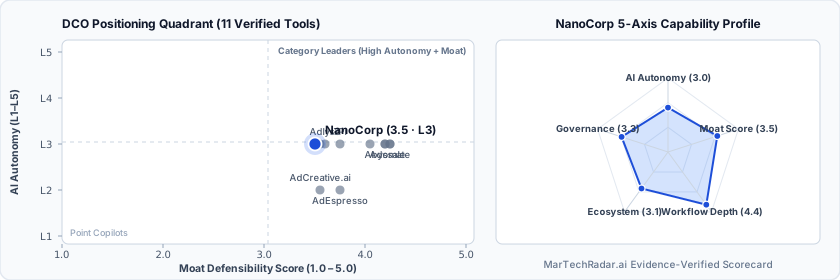
NanoCorp is a Web SaaS tool for DCO (Dynamic Creative Optimization / DCO) in AdTech & Paid Media. Pricing: $30/mo. Best suited to Performance Marketing Directors, Ad Agencies and Retail Media Advertisers. Editor ratings: AI autonomy L3 (conditional automation); moat score 3.5/5.0 (Proprietary moat). Fact-checked by Sarah Per on Oct 10, 2026.
Autonomous business generation platform coordinating multi-agent systems to scaffold landing pages, synthesize dynamic marketing assets, handle checkout.
NanoCorp buyer fit verdict: when to choose vs. when to walk away
Choose NanoCorp if (Best Fit)
- Target ICP & Stack Fit: You operate as Performance Marketing Directors, Ad Agencies and Retail Media Advertisers requiring a Web SaaS deployment for DCO, with verified ecosystem connectivity for Outreach.
- L3 Architecture & Defensibility: Defensibility centers on end-to-end autonomous business execution combining code generation from repositories with integrated payment checkout, custom subdomains, and automated operational agent cycles.
- Commercial Model Fit: Your procurement budget aligns with $30/mo.
Walk away from NanoCorp if (Deal-Breakers)
- Walk away if your workflow requires uncapped enterprise volume on the $30/mo entry plan without upgrading tiers.
- Walk away if your workflow cannot tolerate agent execution caps: Operational cycles run against rigid monthly quota boundaries, which can pause automated marketing workflows or conversion checkouts once allocated usage thresholds are hit during active campaigns.
- Walk away if ecosystem isolation is a deal-breaker for your team: Deployment relies on internal hosting domains and proprietary routing infrastructure, limiting custom DNS configurations, advanced reverse-proxy setups, and native integration into third-party enterprise CDNs.
NanoCorp key facts & scorecard
| Pricing | $30/moVendor pricing page |
|---|---|
| Free plan | No / not disclosed |
| Delivery | Web SaaS |
| Audience | Performance Marketing Directors, Ad Agencies, Retail Media Advertisers |
| AI autonomy level | L3 · Conditional automationEditor-verified |
| Moat tier & score | 3.5 / 5.0 · Proprietary moatEditor-verified |
| Funding | Seed |
| Total funding | SeedBacked by Pioneer Fund |
| Ecosystem integrations | Outreach |
| Governance & docs | API & Docs ↗ · Terms ↗ · Privacy ↗ |
| Headquarters | San Francisco, California |
| Founded | 2026 |
| Last verified |
NanoCorp pros & cons: strengths vs. operational limitations
Pros: core strengths & capabilities
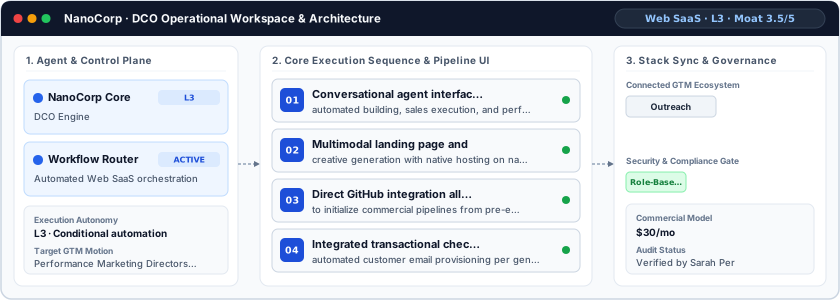
- Conversational agent interface orchestrating: automated building, sales execution, and performance reporting
- Multimodal landing page and: creative generation with native hosting on nanocorp.app subdomains
- Direct GitHub integration allowing agents: to initialize commercial pipelines from pre-existing repositories
- Integrated transactional checkout and: automated customer email provisioning per generated business entity
Cons: operational limitations & risks
- Agent Execution Caps: Operational cycles run against rigid monthly quota boundaries, which can pause automated marketing workflows or conversion checkouts once allocated usage thresholds are hit during active campaigns.
- Ecosystem Isolation: Deployment relies on internal hosting domains and proprietary routing infrastructure, limiting custom DNS configurations, advanced reverse-proxy setups, and native integration into third-party enterprise CDNs.
- Dormancy Drift: Inactivity or subscription lapses immediately freeze checkout gateways and operational messaging daemons, risking lead churn and broken customer payment funnels without persistent external database fallbacks.
NanoCorp TCO & deal-breaker stress test
Simulate 12-month stepped TCO, hidden cost multipliers, contract lock-in exposure, and stack failure modes using only facts verified by Sarah Per on · Capture SHA 8c83de33.
NanoCorp aligns with your 5-seat / $800/mo profile. Review the walk-away triggers and contract levers below before deployment.
| Plan / Tier | Verified Rate | Scale Fit | Scope & Quota Notes |
|---|---|---|---|
| Entry / Starter | $30/mo | 1–2 seats | Verified $30/mo tier from vendor pricing schedule. |
- Moat Score
- 3.5 / 5.0
- AI Autonomy
- L3
- Free Tier / Trial
- None disclosed
Triggered audit signals & failure modes
- Published Self-Serve Entry FloorVerified Pricing Ledger
NanoCorp publishes a transparent entry point ($30/mo) for initial validation before committing.
- Primary Operational Bottleneck: Agent Execution CapsAudit by Sarah Per
Operational cycles run against rigid monthly quota boundaries, which can pause automated marketing workflows or conversion checkouts once allocated usage thresholds are hit during active campaigns.
Hidden TCO Multipliers & Quota Gates
- Credit & Usage Burn Multiplier: Automated workflows consume metered credits/usage quotas; multi-step enrichment, voice minutes, or high-frequency agent runs can trigger mid-cycle top-up packs.
- Agent Execution Caps: Operational cycles run against rigid monthly quota boundaries, which can pause automated marketing workflows or conversion checkouts once allocated usage thresholds are hit during active campaigns.
- Ecosystem Isolation: Deployment relies on internal hosting domains and proprietary routing infrastructure, limiting custom DNS configurations, advanced reverse-proxy setups, and native integration into third-party enterprise CDNs.
When to Walk Away & Negotiation Levers
- Walk away if your workflow requires uncapped enterprise volume on the $30/mo entry plan without upgrading tiers.
- Walk away if your workflow cannot tolerate agent execution caps: Operational cycles run against rigid monthly quota boundaries, which can pause automated marketing workflows or conversion checkouts once allocated usage thresholds are hit during active campaigns.
- Walk away if ecosystem isolation is a deal-breaker for your team: Deployment relies on internal hosting domains and proprietary routing infrastructure, limiting custom DNS configurations, advanced reverse-proxy setups, and native integration into third-party enterprise CDNs.
- Validate exact quota thresholds (seats, credits, or API calls) included in NanoCorp's $30/mo tier before converting from monthly to annual billing.
- Require a sandbox proof-of-concept testing agent execution caps against your live CRM/data schema before annual sign-off.
Ask a custom procurement or TCO stress-test question about NanoCorp
Fits within $800/mo budget (From $36/mo)
Verified DCO peer (Custom / enterprise pricing · Moat 4.4/5.0)
NanoCorp key entities, modules & ecosystem stack
NanoCorp moat & subtrack positioning
Defensibility centers on end-to-end autonomous business execution combining code generation from repositories with integrated payment checkout, custom subdomains, and automated operational agent cycles.
Editorial review
Fact-checked by Sarah Per (Principal Content Systems & Generative Media Editor) on .
Background
Conceived as an agentic architecture for synthetic business deployment, NanoCorp was founded in 2026 in San Francisco, California. The platform targets growth operators, digital product incubators, and technical founders seeking to bypass traditional dynamic creative optimization bottlenecks through autonomous systems. Rather than treating advertising collateral as isolated static media, NanoCorp couples conversational agent orchestration with turnkey digital storefront infrastructure. Within digital commercial pipelines, the software serves as an autonomous execution engine that unifies landing page synthesis, promotional messaging, and conversion mechanics under an agentic operating model.
How NanoCorp works
At its architectural core, NanoCorp operates at Level 3 autonomy by coupling conversational agent reasoning with automated asset scaffolding. The ingestion pipeline accepts structured user prompts or direct GitHub repository repositories to derive product positioning and core value propositions. From these inputs, the agent runtime provisions a nanocorp.app subdomain, structures web layouts, configures checkout endpoints, and provisions dedicated email routing. Execution cycles trigger downstream tasks, generating dynamic copy, running promotional outreach, and capturing user transactions, while scheduled agent cycles ingest transactional metrics to iteratively adjust outward-facing marketing assets and storefront copy.
Limitations
Operational considerations and platform boundaries include:
- Agent Execution Caps: Operational cycles run against rigid monthly quota boundaries, which can pause automated marketing workflows or conversion checkouts once allocated usage thresholds are hit during active campaigns.
- Ecosystem Isolation: Deployment relies on internal hosting domains and proprietary routing infrastructure, limiting custom DNS configurations, advanced reverse-proxy setups, and native integration into third-party enterprise CDNs.
- Dormancy Drift: Inactivity or subscription lapses immediately freeze checkout gateways and operational messaging daemons, risking lead churn and broken customer payment funnels without persistent external database fallbacks.
NanoCorp pricing
Commercial access is structured around monthly subscriptions and credit allowances. Evaluation begins on a 3-day trial at $0, providing 15 welcome credits, a single active business entity, a nanocorp.app domain, and transactional checkout access without upfront payment details. Production workloads utilize the Founder tier priced at $30 per month, which yields 30 credits monthly for continuous agent cycles. Accounts exceeding trial duration transition into dormancy, pausing agent execution, custom email capabilities, and checkout gateways while preserving core database records.
How NanoCorp compares
NanoCorp occupies a distinct position against dynamic creative optimization and automated production tools such as AdCreative.ai, Abyssale, and 7Pi. While Abyssale and AdCreative.ai focus on deterministic banner generation, brand compliance rules, and API-driven image variations, NanoCorp prioritizes holistic business deployment with autonomous sales logic and commerce scaffolding. The platform trades granular typography constraints and media-mix governance for autonomous agency. Consequently, NanoCorp fits agile product experimenters and growth incubators validating minimal viable propositions rather than enterprise brand teams requiring strict vector-level governance.
Frequently asked questions about NanoCorp
How much does NanoCorp cost and what pricing tiers are available?
Published pricing summary for NanoCorp: $30/mo. A permanent free plan is not disclosed for NanoCorp. Commercial access is structured around monthly subscriptions and credit allowances. Evaluation begins on a 3-day trial at $0, providing 15 welcome credits, a single active business entity, a nanocorp.app domain, and transactional checkout access without upfront payment details.
How does NanoCorp work and how autonomous is its AI architecture?
Autonomous business generation platform coordinating multi-agent systems to scaffold landing pages, synthesize dynamic marketing assets, handle checkout. Within DCO (Dynamic Creative Optimization / DCO), MarTechRadar rates its execution architecture at L3 · Conditional automation with a verified Moat Score of 3.5 / 5.0 (Proprietary moat). Defensibility centers on end-to-end autonomous business execution combining code generation from repositories with integrated payment checkout, custom subdomains, and automated operational agent cycles.
What are the main limitations of NanoCorp and when should buyers walk away?
Based on our editorial technical audit, key operational considerations and boundaries for NanoCorp include: (1) Agent Execution Caps: Operational cycles run against rigid monthly quota boundaries, which can pause automated marketing workflows or conversion checkouts once allocated usage thresholds are hit during active campaigns. (2) Ecosystem Isolation: Deployment relies on internal hosting domains and proprietary routing infrastructure, limiting custom DNS configurations, advanced reverse-proxy setups, and native integration into third-party enterprise CDNs. (3) Dormancy Drift: Inactivity or subscription lapses immediately freeze checkout gateways and operational messaging daemons, risking lead churn and broken customer payment funnels without persistent external database fallbacks. Primary procurement walk-away rule: Walk away if your workflow requires uncapped enterprise volume on the $30/mo entry plan without upgrading tiers.
What integrations, compliance certifications, and contract terms apply to NanoCorp?
Verified ecosystem and stack integrations include Outreach. First-party governance and developer endpoints verified on domain include: API Docs (https://docs.nanocorp.so). Key TCO multiplier to watch: Credit & Usage Burn Multiplier (Automated workflows consume metered credits/usage quotas; multi-step enrichment, voice minutes, or high-frequency agent runs can trigger mid-cycle top-up packs.) Before signing a contract, procurement teams should validate exact quota thresholds (seats, credits, or API calls) included in NanoCorp's $30/mo tier before converting from monthly to annual billing.
What are the best NanoCorp alternatives and head-to-head competitors in 2026?
Top fact-checked alternatives to NanoCorp in DCO (Dynamic Creative Optimization / DCO) include Celtra (Custom / enterprise pricing), Bannerflow (Custom / enterprise pricing), AIChief (Custom / enterprise pricing), SWYM.ai (Custom / enterprise pricing). NanoCorp occupies a distinct position against dynamic creative optimization and automated production tools such as AdCreative.ai, Abyssale, and 7Pi.
Verified sources & evidence trail
- Official product domain: https://www.nanocorp.so/
- Commercial pricing verification: https://www.nanocorp.so/pricing
- First-party governance & documentation links: API & Docs · Terms · Privacy
- Editorial audit sign-off: Fact-checked by Sarah Per on under the MarTechRadar Evidence-Ledger Protocol.