Notra Review (2026): ChatGPT for Marketing Pricing, Limits & Alternatives
Bottom line
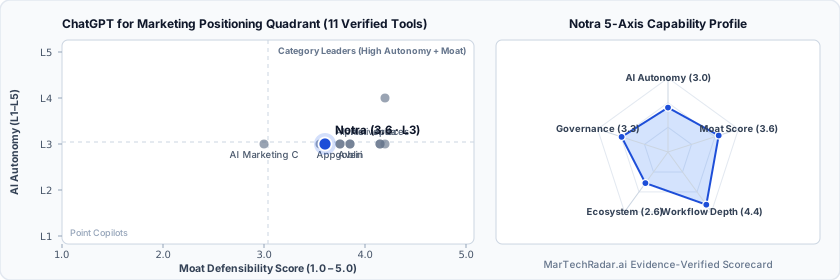
Notra is a Web SaaS tool for ChatGPT for Marketing (Open-Source Marketing Agents & Prompts) in Agent & Marketing Ops. Pricing: Custom / enterprise pricing. Best suited to B2B SaaS. Editor ratings: AI autonomy L3 (conditional automation); moat score 3.6/5.0 (Proprietary moat). Fact-checked by Tim Fenolz on Oct 16, 2026.
Autonomous agent framework orchestrating modular marketing workflows, prompt versioning, and cross-channel campaign operations for modern growth.
Notra buyer fit verdict: when to choose vs. when to walk away
Choose Notra if (Best Fit)
- Target ICP & Stack Fit: You operate as B2B SaaS requiring a Web SaaS deployment for ChatGPT for Marketing.
- L3 Architecture & Defensibility: Notra differentiates through extensible prompt-chaining primitives, modular agent architectures, and execution environments specifically tuned for programmatic campaign management rather than generic conversational tasks.
- Commercial Model Fit: Your procurement budget aligns with Custom / enterprise pricing.
Walk away from Notra if (Deal-Breakers)
- Walk away if you require transparent self-serve monthly billing or your budget ceiling is under $1,000/mo (Notra requires sales-gated custom quoting).
- Walk away if your workflow cannot tolerate context window degradation: Users encounter operational friction and integration bottlenecks, as the pipeline struggles with Complex multi-agent loops encounter context drift and token degradation when synthesizing multi-channel campaigns across extended chronological spans.
- Walk away if API rate governing is a deal-breaker for your team: Users encounter operational friction and integration bottlenecks, as the pipeline struggles with Unconstrained parallel agent executions risk tripping third-party rate limits on downstream marketing APIs, requiring custom retry backoff engineering.
Notra key facts & scorecard
| Pricing | Custom / enterprise pricing |
|---|---|
| Free plan | No / not disclosed |
| Delivery | Web SaaS |
| Audience | B2B SaaS |
| AI autonomy level | L3 · Conditional automationEditor-verified |
| Moat tier & score | 3.6 / 5.0 · Proprietary moatEditor-verified |
| Funding | Open source |
| Headquarters | United States |
| Last verified |
Notra pros & cons: strengths vs. operational limitations
Pros: core strengths & capabilities
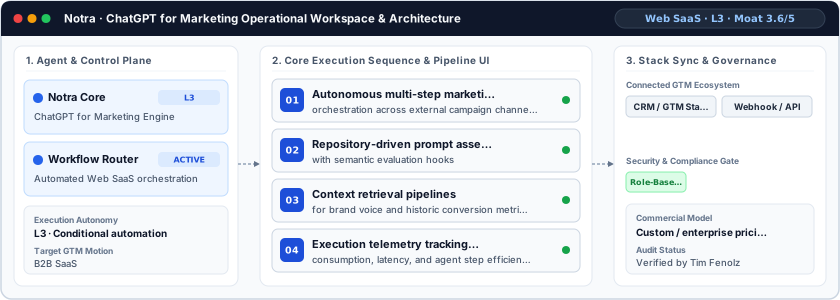
- Autonomous multi-step marketing agent: orchestration across external campaign channels
- Repository-driven prompt asset management: with semantic evaluation hooks
- Context retrieval pipelines: for brand voice and historic conversion metrics
- Execution telemetry tracking token: consumption, latency, and agent step efficiency
Cons: operational limitations & risks
- Context Window Degradation: Users encounter operational friction and integration bottlenecks, as the pipeline struggles with Complex multi-agent loops encounter context drift and token degradation when synthesizing multi-channel campaigns across extended chronological spans.
- API Rate Governing: Users encounter operational friction and integration bottlenecks, as the pipeline struggles with Unconstrained parallel agent executions risk tripping third-party rate limits on downstream marketing APIs, requiring custom retry backoff engineering.
- Prompt Schema Maintenance: Users encounter operational friction and integration bottlenecks, as the pipeline struggles with Downstream LLM provider updates introduce nondeterministic output formats, necessitating periodic schema validation and prompt regression testing.
Notra TCO & deal-breaker stress test
Simulate 12-month stepped TCO, hidden cost multipliers, contract lock-in exposure, and stack failure modes using only facts verified by Tim Fenolz on .
Notra triggers high-severity friction under your 5-seat / $800/mo constraints. Benchmark the verified subtrack alternatives below before committing.
| Plan / Tier | Verified Rate | Scale Fit | Scope & Quota Notes |
|---|---|---|---|
| Enterprise / Custom | Custom quote | 15–50+ seats (Enterprise SLA) | Sales-negotiated annual contract for custom volume, SSO/RBAC governance, and dedicated SLA. |
- Moat Score
- 3.6 / 5.0
- AI Autonomy
- L3
- Free Tier / Trial
- None disclosed
Triggered audit signals & failure modes
- Opaque Enterprise Quoting vs. SMB/Mid-Market BudgetVerified Pricing Ledger
Notra does not disclose a public self-serve floor (Custom / enterprise pricing). Buyers with a $800/mo cap face high sales-qualification friction.
- Sales-Gated Contract TermsFact-checked by Tim Fenolz
Notra provides commercial pricing available on request through tailored enterprise sales quotes based on organizational scale and seats.
- Primary Operational Bottleneck: Context Window DegradationAudit by Tim Fenolz
Users encounter operational friction and integration bottlenecks, as the pipeline struggles with Complex multi-agent loops encounter context drift and token degradation when synthesizing multi-channel campaigns across extended chronological spans.
Hidden TCO Multipliers & Quota Gates
- Credit & Usage Burn Multiplier: Automated workflows consume metered credits/usage quotas; multi-step enrichment, voice minutes, or high-frequency agent runs can trigger mid-cycle top-up packs.
- Context Window Degradation: Users encounter operational friction and integration bottlenecks, as the pipeline struggles with Complex multi-agent loops encounter context drift and token degradation when synthesizing multi-channel campaigns across extended chronological spans.
- API Rate Governing: Users encounter operational friction and integration bottlenecks, as the pipeline struggles with Unconstrained parallel agent executions risk tripping third-party rate limits on downstream marketing APIs, requiring custom retry backoff engineering.
When to Walk Away & Negotiation Levers
- Walk away if you require transparent self-serve monthly billing or your budget ceiling is under $1,000/mo (Notra requires sales-gated custom quoting).
- Walk away if your workflow cannot tolerate context window degradation: Users encounter operational friction and integration bottlenecks, as the pipeline struggles with Complex multi-agent loops encounter context drift and token degradation when synthesizing multi-channel campaigns across extended chronological spans.
- Walk away if API rate governing is a deal-breaker for your team: Users encounter operational friction and integration bottlenecks, as the pipeline struggles with Unconstrained parallel agent executions risk tripping third-party rate limits on downstream marketing APIs, requiring custom retry backoff engineering.
- Demand a 30- to 60-day paid pilot opt-out clause in the Notra order form before signing a 12-month enterprise commitment.
- Require a sandbox proof-of-concept testing context window degradation against your live CRM/data schema before annual sign-off.
Ask a custom procurement or TCO stress-test question about Notra
Lower 5-seat floor (~$99/mo vs. Custom Quote) · Transparent self-serve entry without mandatory annual lock-in
Lower 5-seat floor (~$99/mo vs. Custom Quote) · Transparent self-serve entry without mandatory annual lock-in
Notra moat & subtrack positioning
Notra differentiates through extensible prompt-chaining primitives, modular agent architectures, and execution environments specifically tuned for programmatic campaign management rather than generic conversational tasks.
Editorial review
Fact-checked by Tim Fenolz (Lead AdTech, Programmatic & Attribution Analyst) on .
Background
Modern growth engineering teams frequently face an operational bottleneck: translating fragmented marketing strategies into repeatable, automated software executions. Headquartered in the United States, Notra operates as an autonomous agent architecture specifically tailored to resolve this challenge within programmatic growth operations. The platform targets growth engineers, technical demand generation leaders, and marketing operations architects seeking to replace brittle automation scripts with deterministic, agent-driven workflows that interact with production APIs and content repositories.
How Notra works
At its architectural core, Notra establishes a multi-step agent runtime decoupled from proprietary models via an abstracted orchestration layer. Incoming campaign parameters are parsed into structured task graphs, where individual agent nodes query contextual vector databases to retrieve brand guidelines, past performance telemetry, and channel constraints. The system manages autonomous execution loops by synthesizing content, validating output against pre-configured deterministic schemas, and dispatching payloads directly to marketing delivery endpoints via asynchronous REST webhooks.
Limitations
Operational considerations and platform boundaries include:
- Context Window Degradation: Users encounter operational friction and integration bottlenecks, as the pipeline struggles with Complex multi-agent loops encounter context drift and token degradation when synthesizing multi-channel campaigns across extended chronological spans.
- API Rate Governing: Users encounter operational friction and integration bottlenecks, as the pipeline struggles with Unconstrained parallel agent executions risk tripping third-party rate limits on downstream marketing APIs, requiring custom retry backoff engineering.
- Prompt Schema Maintenance: Users encounter operational friction and integration bottlenecks, as the pipeline struggles with Downstream LLM provider updates introduce nondeterministic output formats, necessitating periodic schema validation and prompt regression testing.
Notra pricing
Notra provides commercial pricing available on request through tailored enterprise sales quotes based on organizational scale and seats. The licensing structure reflects custom enterprise deployments, accounting for the volume of deployed agent worker runtimes, integration requirements, and security governance frameworks. Organizations engage the sales team directly to establish bespoke contracts tailored to their computational throughput requirements.
How Notra compares
Within the ecosystem of specialized marketing automation engines, Notra competes alongside Alphie, Appgoblin, and Arda. While Alphie focuses heavily on conversational front-ends and Appgoblin targets mobile-centric discovery workflows, Notra differentiates through its configurable agent runtime designed for deep API orchestration. Arda emphasizes prompt warehousing, whereas Notra provides broader execution autonomy, making it well suited for mid-market and enterprise organizations with dedicated technical marketing personnel.
Frequently asked questions about Notra
How much does Notra cost and does it require a custom enterprise quote?
Published pricing summary for Notra: Custom / enterprise pricing. A permanent free plan is not disclosed for Notra. Notra provides commercial pricing available on request through tailored enterprise sales quotes based on organizational scale and seats.
How does Notra work and how autonomous is its AI architecture?
Autonomous agent framework orchestrating modular marketing workflows, prompt versioning, and cross-channel campaign operations for modern growth. Within ChatGPT for Marketing (Open-Source Marketing Agents & Prompts), MarTechRadar rates its execution architecture at L3 · Conditional automation with a verified Moat Score of 3.6 / 5.0 (Proprietary moat). Notra differentiates through extensible prompt-chaining primitives, modular agent architectures, and execution environments specifically tuned for programmatic campaign management rather than generic conversational tasks.
What are the main limitations of Notra and when should buyers walk away?
Based on our editorial technical audit, key operational considerations and boundaries for Notra include: (1) Context Window Degradation: Users encounter operational friction and integration bottlenecks, as the pipeline struggles with Complex multi-agent loops encounter context drift and token degradation when synthesizing multi-channel campaigns across extended chronological spans. (2) API Rate Governing: Users encounter operational friction and integration bottlenecks, as the pipeline struggles with Unconstrained parallel agent executions risk tripping third-party rate limits on downstream marketing APIs, requiring custom retry backoff engineering. (3) Prompt Schema Maintenance: Users encounter operational friction and integration bottlenecks, as the pipeline struggles with Downstream LLM provider updates introduce nondeterministic output formats, necessitating periodic schema validation and prompt regression testing. Primary procurement walk-away rule: Walk away if you require transparent self-serve monthly billing or your budget ceiling is under $1,000/mo (Notra requires sales-gated custom quoting).
What integrations, compliance certifications, and contract terms apply to Notra?
Key TCO multiplier to watch: Credit & Usage Burn Multiplier (Automated workflows consume metered credits/usage quotas; multi-step enrichment, voice minutes, or high-frequency agent runs can trigger mid-cycle top-up packs.) Before signing a contract, procurement teams should demand a 30- to 60-day paid pilot opt-out clause in the Notra order form before signing a 12-month enterprise commitment.
What are the best Notra alternatives and head-to-head competitors in 2026?
Top fact-checked alternatives to Notra in ChatGPT for Marketing (Open-Source Marketing Agents & Prompts) include Neels Plugins (Custom / enterprise pricing), OctoLoops (Custom / enterprise pricing), ParkourNote (Custom / enterprise pricing), Prism Geo (Custom / enterprise pricing). Within the ecosystem of specialized marketing automation engines, Notra competes alongside Alphie, Appgoblin, and Arda.
Verified sources & evidence trail
- Official product domain: https://www.usenotra.com/
- Commercial pricing verification: Verified against official vendor pricing policy (Custom / enterprise pricing)
- Editorial audit sign-off: Fact-checked by Tim Fenolz on under the MarTechRadar Evidence-Ledger Protocol.