Parloa Review (2026): AI Calling Pricing, Limits & Alternatives
Bottom line
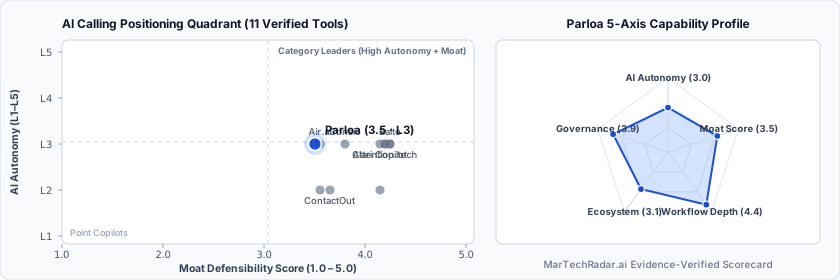
Parloa is a Web SaaS tool for AI Calling (Conversational Voice Calling Agents) in AI SDR & Outbound. Pricing: Custom / enterprise pricing. Best suited to Growth Marketing Teams and Digital Marketing Leaders. Editor ratings: AI autonomy L3 (conditional automation); moat score 3.5/5.0 (Proprietary moat). Fact-checked by Jiacky Lee on Oct 10, 2026.
Enterprise conversational voice calling platform orchestrating natural, low-latency customer service dialogues and automated multi-turn phone workflows.
Parloa buyer fit verdict: when to choose vs. when to walk away
Choose Parloa if (Best Fit)
- Target ICP & Stack Fit: You operate as Growth Marketing Teams and Digital Marketing Leaders requiring a Web SaaS deployment for AI Calling.
- L3 Architecture & Defensibility: Substantial venture capital reserve, specialized low-latency speech orchestration layer, deep telephony carrier integrations, and proprietary dialogue state management models tailored for enterprise contact centers.
- Commercial Model Fit: Your procurement budget aligns with Custom / enterprise pricing.
Walk away from Parloa if (Deal-Breakers)
- Walk away if you require transparent self-serve monthly billing or your budget ceiling is under $1,000/mo (Parloa requires sales-gated custom quoting).
- Walk away if your workflow cannot tolerate telephony latency jitter: Network packet loss and transcontinental SIP routing introduce latency spikes that degrade turn-taking mechanics during complex speech overlaps.
- Walk away if back-end API timeouts is a deal-breaker for your team: Synchronous calls to legacy ERP or CRM systems that exceed three hundred milliseconds cause noticeable synthetic pauses in natural dialogue flow.
Parloa key facts & scorecard
| Pricing | Custom / enterprise pricing |
|---|---|
| Free plan | No / not disclosed |
| Delivery | Web SaaS |
| Audience | Growth Marketing Teams, Digital Marketing Leaders |
| AI autonomy level | L3 · Conditional automationEditor-verified |
| Moat tier & score | 3.5 / 5.0 · Proprietary moatEditor-verified |
| Funding | Series B |
| Total funding | $562.0MBacked by General Catalyst, EQT Ventures, Altimeter Capital |
| Founders | Malte Kosub, Stefan Ostwald |
| Company size | 201-500 employees |
| Governance & docs | Trust & Security ↗ |
| Headquarters | Germany |
| Founded | 2018 |
| Last verified |
Parloa pros & cons: strengths vs. operational limitations
Pros: core strengths & capabilities
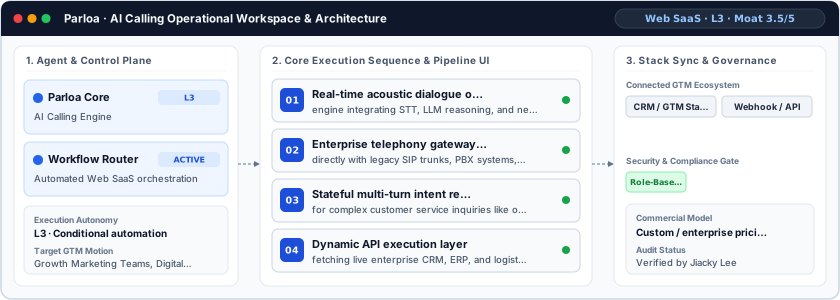
- Real-time acoustic dialogue orchestration: engine integrating STT, LLM reasoning, and neural TTS pipelines
- Enterprise telephony gateway interfacing: directly with legacy SIP trunks, PBX systems, and cloud CCaaS environments
- Stateful multi-turn intent resolution: for complex customer service inquiries like order tracking and scheduling
- Dynamic API execution layer: fetching live enterprise CRM, ERP, and logistics data mid-call
Cons: operational limitations & risks
- Telephony Latency Jitter: Network packet loss and transcontinental SIP routing introduce latency spikes that degrade turn-taking mechanics during complex speech overlaps.
- Back-End API Timeouts: Synchronous calls to legacy ERP or CRM systems that exceed three hundred milliseconds cause noticeable synthetic pauses in natural dialogue flow.
- Acoustic Disambiguation: Handling heavily accented vernacular, background ambient noise, or alphanumeric inputs like tracking numbers often requires manual fallback escalation to human operators.
Parloa TCO & deal-breaker stress test
Simulate 12-month stepped TCO, hidden cost multipliers, contract lock-in exposure, and stack failure modes using only facts verified by Jiacky Lee on · Capture SHA 8b2d7c9e.
Parloa triggers high-severity friction under your 5-seat / $800/mo constraints. Benchmark the verified subtrack alternatives below before committing.
| Plan / Tier | Verified Rate | Scale Fit | Scope & Quota Notes |
|---|---|---|---|
| Enterprise / Custom | Custom quote | 15–50+ seats (Enterprise SLA) | Sales-negotiated annual contract for custom volume, SSO/RBAC governance, and dedicated SLA. |
- Moat Score
- 3.5 / 5.0
- AI Autonomy
- L3
- Free Tier / Trial
- None disclosed
Triggered audit signals & failure modes
- Opaque Enterprise Quoting vs. SMB/Mid-Market BudgetVerified Pricing Ledger
Parloa does not disclose a public self-serve floor (Custom / enterprise pricing). Buyers with a $800/mo cap face high sales-qualification friction.
- Sales-Gated Contract TermsFact-checked by Jiacky Lee
Commercial pricing is available on request through tailored enterprise sales quotes based on organizational scale and seats.
- Primary Operational Bottleneck: Telephony Latency JitterAudit by Jiacky Lee
Network packet loss and transcontinental SIP routing introduce latency spikes that degrade turn-taking mechanics during complex speech overlaps.
Hidden TCO Multipliers & Quota Gates
- Credit & Usage Burn Multiplier: Automated workflows consume metered credits/usage quotas; multi-step enrichment, voice minutes, or high-frequency agent runs can trigger mid-cycle top-up packs.
- Telephony Latency Jitter: Network packet loss and transcontinental SIP routing introduce latency spikes that degrade turn-taking mechanics during complex speech overlaps.
- Back-End API Timeouts: Synchronous calls to legacy ERP or CRM systems that exceed three hundred milliseconds cause noticeable synthetic pauses in natural dialogue flow.
When to Walk Away & Negotiation Levers
- Walk away if you require transparent self-serve monthly billing or your budget ceiling is under $1,000/mo (Parloa requires sales-gated custom quoting).
- Walk away if your workflow cannot tolerate telephony latency jitter: Network packet loss and transcontinental SIP routing introduce latency spikes that degrade turn-taking mechanics during complex speech overlaps.
- Walk away if back-end API timeouts is a deal-breaker for your team: Synchronous calls to legacy ERP or CRM systems that exceed three hundred milliseconds cause noticeable synthetic pauses in natural dialogue flow.
- Demand a 30- to 60-day paid pilot opt-out clause in the Parloa order form before signing a 12-month enterprise commitment.
- Require a sandbox proof-of-concept testing telephony latency jitter against your live CRM/data schema before annual sign-off.
Ask a custom procurement or TCO stress-test question about Parloa
Lower 5-seat floor (~$75/mo vs. Custom Quote) · Transparent self-serve entry without mandatory annual lock-in
Lower 5-seat floor (~$299/mo vs. Custom Quote) · Transparent self-serve entry without mandatory annual lock-in
Parloa moat & subtrack positioning
Substantial venture capital reserve, specialized low-latency speech orchestration layer, deep telephony carrier integrations, and proprietary dialogue state management models tailored for enterprise contact centers.
Editorial review
Fact-checked by Jiacky Lee (Managing Editor, AI Autonomy & Moat Methodology) on .
Background
Backed by $562.0M in total venture funding, Parloa was founded in 2018 in Germany to re-engineer customer communications through autonomous phone agents. The vendor provides contact center leaders, customer experience executives, and enterprise operations heads with an automated telephony architecture that handles high-volume inbound inquiries without human intervention. Within the conversational voice calling category, the platform transforms manual interactive voice response menus into fluid conversational dialogues that resolve complex customer intents over standard telecommunication carriers.
How Parloa works
At its technical core, the platform operates as an L3 autonomous dialogue engine coordinating low-latency speech-to-text, context-aware large language model reasoning, and neural text-to-speech synthesis over direct SIP and WebRTC connections. When an inbound caller connects, the system continuously streams raw audio buffers into an acoustic pipeline that manages barge-in events and voice-activity detection. Mid-dialogue, the agent queries external customer records and logistics backends through asynchronous webhooks, synthesizing structured data into natural language responses within sub-second latency windows.
Limitations
Operational considerations and platform boundaries include:
- Telephony Latency Jitter: Network packet loss and transcontinental SIP routing introduce latency spikes that degrade turn-taking mechanics during complex speech overlaps.
- Back-End API Timeouts: Synchronous calls to legacy ERP or CRM systems that exceed three hundred milliseconds cause noticeable synthetic pauses in natural dialogue flow.
- Acoustic Disambiguation: Handling heavily accented vernacular, background ambient noise, or alphanumeric inputs like tracking numbers often requires manual fallback escalation to human operators.
Parloa pricing
Commercial pricing is available on request through tailored enterprise sales quotes based on organizational scale and seats. The underlying structure incorporates consumption-oriented billing calibrated by billable telephony minutes for voice agents and total resolved interaction volumes for digital channels. The model scales dynamically according to use-case reasoning complexity, token processing requirements, and required external backend API integration overhead.
How Parloa compares
In contrast to developer-first telephony tooling like Bland.ai or vertical unified communications suites such as Dialpad Ai, Parloa focuses squarely on complex enterprise contact center automation. While Consio targets modular voice applications, Parloa differentiates through its hardened enterprise telephony connectors and deep carrier-grade infrastructure. The software fits Global 2000 customer service operations processing millions of annual calls that demand stateful CRM orchestration, strict compliance, and automated inbound deflection.
Direct competitors & market radar
Top algorithmic competitors based on category positioning, capability overlap, and ICP alignment.
Frequently asked questions about Parloa
How much does Parloa cost and does it require a custom enterprise quote?
Published pricing summary for Parloa: Custom / enterprise pricing. A permanent free plan is not disclosed for Parloa. Commercial pricing is available on request through tailored enterprise sales quotes based on organizational scale and seats. The underlying structure incorporates consumption-oriented billing calibrated by billable telephony minutes for voice agents and total resolved interaction volumes for digital channels.
How does Parloa work and how autonomous is its AI architecture?
Enterprise conversational voice calling platform orchestrating natural, low-latency customer service dialogues and automated multi-turn phone workflows. Within AI Calling (Conversational Voice Calling Agents), MarTechRadar rates its execution architecture at L3 · Conditional automation with a verified Moat Score of 3.5 / 5.0 (Proprietary moat). Substantial venture capital reserve, specialized low-latency speech orchestration layer, deep telephony carrier integrations, and proprietary dialogue state management models tailored for enterprise contact centers. Corporate profile: Founded by Malte Kosub, Stefan Ostwald, operating at 201-500 employees scale.
What are the main limitations of Parloa and when should buyers walk away?
Based on our editorial technical audit, key operational considerations and boundaries for Parloa include: (1) Telephony Latency Jitter: Network packet loss and transcontinental SIP routing introduce latency spikes that degrade turn-taking mechanics during complex speech overlaps. (2) Back-End API Timeouts: Synchronous calls to legacy ERP or CRM systems that exceed three hundred milliseconds cause noticeable synthetic pauses in natural dialogue flow. (3) Acoustic Disambiguation: Handling heavily accented vernacular, background ambient noise, or alphanumeric inputs like tracking numbers often requires manual fallback escalation to human operators. Primary procurement walk-away rule: Walk away if you require transparent self-serve monthly billing or your budget ceiling is under $1,000/mo (Parloa requires sales-gated custom quoting).
What integrations, compliance certifications, and contract terms apply to Parloa?
First-party governance and developer endpoints verified on domain include: Trust/Security (https://trust.parloa.com). Key TCO multiplier to watch: Credit & Usage Burn Multiplier (Automated workflows consume metered credits/usage quotas; multi-step enrichment, voice minutes, or high-frequency agent runs can trigger mid-cycle top-up packs.) Before signing a contract, procurement teams should demand a 30- to 60-day paid pilot opt-out clause in the Parloa order form before signing a 12-month enterprise commitment.
What are the best Parloa alternatives and head-to-head competitors in 2026?
Top fact-checked alternatives to Parloa in AI Calling (Conversational Voice Calling Agents) include Bland.ai (Free plan · $299/mo · Enterprise plan), Dialpad Ai ($15–$25/seat/mo · Enterprise plan), Consio (From $0.10/mo), Vapi.ai (From $0.05 usage-based). In contrast to developer-first telephony tooling like Bland.ai or vertical unified communications suites such as Dialpad Ai, Parloa focuses squarely on complex enterprise contact center automation.
Verified sources & evidence trail
- Official product domain: https://parloa.com
- Commercial pricing verification: Verified against official vendor pricing policy (Custom / enterprise pricing)
- Verified corporate entity profiles (
sameAs): LinkedIn Company Profile · Crunchbase Entity Record - First-party governance & documentation links: Trust & Security
- Editorial audit sign-off: Fact-checked by Jiacky Lee on under the MarTechRadar Evidence-Ledger Protocol.