Perpetua Review (2026): Product Feed Management Pricing, Limits & Alternatives
Bottom line
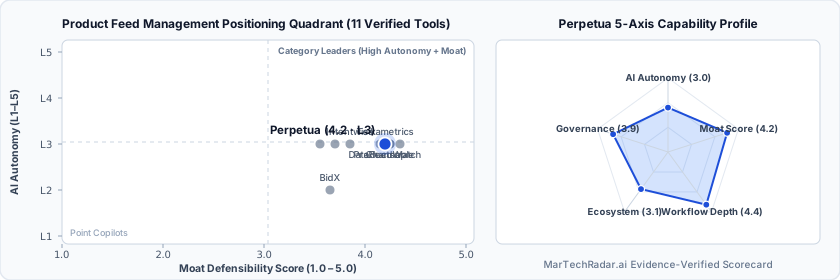
Perpetua is a Web SaaS tool for Product Feed Management (Retail Media & Product Feed Management) in AdTech & Paid Media. Pricing: From $695/mo. Best suited to DTC / eCommerce. Editor ratings: AI autonomy L3 (conditional automation); moat score 4.2/5.0 (Proprietary moat). Fact-checked by Vasilia Xia on Oct 7, 2026.
Algorithmic retail media optimization software designed to automate bid execution, keyword harvesting, and marketplace advertising across Amazon and Walmart.
Perpetua buyer fit verdict: when to choose vs. when to walk away
Choose Perpetua if (Best Fit)
- Target ICP & Stack Fit: You operate as DTC / eCommerce requiring a Web SaaS deployment for Product Feed Management.
- L3 Architecture & Defensibility: Deep direct API integrations with multi-marketplace retail ad networks and streaming analytics ingestion via Amazon Marketing Stream, tied into programmatic goal-based optimization algorithms.
- Commercial Model Fit: Your procurement budget aligns with From $695/mo.
Walk away from Perpetua if (Deal-Breakers)
- Walk away if your team is at early validation stage with a <$250/mo tool budget (Perpetua starts at From $695/mo before seat or usage expansion).
- Walk away if your workflow cannot tolerate marketplace API rate limits and latency: Intraday bidding depends heavily on publisher API stability; downstream rate limiting or delayed reporting ingestion from third-party networks can stall automated bid changes.
- Walk away if algorithmic cold-start overhead is a deal-breaker for your team: New product launches without historical conversion data require manual budget buffers and baseline seeding periods before the optimization models can establish reliable predictive bids.
Perpetua key facts & scorecard
| Pricing | From $695/moVendor pricing page |
|---|---|
| Free plan | No / not disclosed |
| Delivery | Web SaaS |
| Audience | DTC / eCommerce |
| AI autonomy level | L3 · Conditional automationEditor-verified |
| Moat tier & score | 4.2 / 5.0 · Proprietary moatEditor-verified |
| Funding | AcquiredAcquired by Ascential |
| Total funding | $10MBacked by Ascential |
| Founders | Alexander Good, Joe Rideout, Rosco Hill |
| Company size | 201-500 employees |
| Governance & docs | Terms ↗ · Privacy ↗ |
| Headquarters | Toronto, Ontario |
| Founded | 2016 |
| Last verified |
Perpetua pros & cons: strengths vs. operational limitations
Pros: core strengths & capabilities
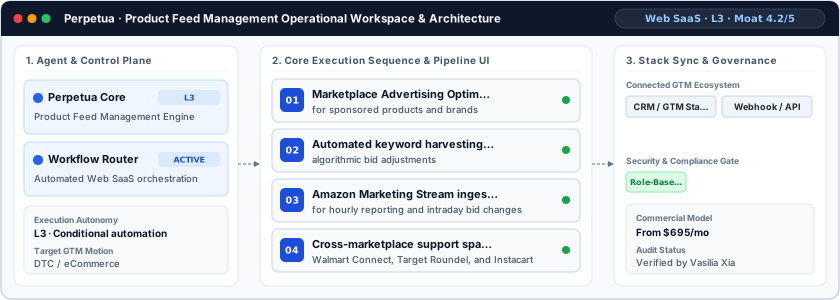
- Marketplace Advertising Optimization: for sponsored products and brands
- Automated keyword harvesting and: algorithmic bid adjustments
- Amazon Marketing Stream ingestion: for hourly reporting and intraday bid changes
- Cross-marketplace support spanning Amazon,: Walmart Connect, Target Roundel, and Instacart
Cons: operational limitations & risks
- Marketplace API Rate Limits and Latency: Intraday bidding depends heavily on publisher API stability; downstream rate limiting or delayed reporting ingestion from third-party networks can stall automated bid changes.
- Algorithmic Cold-Start Overhead: New product launches without historical conversion data require manual budget buffers and baseline seeding periods before the optimization models can establish reliable predictive bids.
- Cross-Network Inventory Synchronization Lag: Discrepancies between physical warehouse ERP stock counts and retail platform inventory feeds can cause brief windows of ad spend on out-of-stock SKU variations.
Perpetua TCO & deal-breaker stress test
Simulate 12-month stepped TCO, hidden cost multipliers, contract lock-in exposure, and stack failure modes using only facts verified by Vasilia Xia on · Capture SHA 5d60ad54.
Perpetua is viable for 5 seats, but requires commercial or technical verification on the flagged items below.
| Plan / Tier | Verified Rate | Scale Fit | Scope & Quota Notes |
|---|---|---|---|
| Essentials | $695/mo | 1–2 seats | Up to 10k in monthly ad spend |
- Moat Score
- 4.2 / 5.0
- AI Autonomy
- L3
- Free Tier / Trial
- None disclosed
Triggered audit signals & failure modes
- Published Self-Serve Entry FloorVerified Pricing Ledger
Perpetua publishes a transparent entry point (From $695/mo) for initial validation before committing.
- Primary Operational Bottleneck: Algorithmic Cold-Start OverheadAudit by Vasilia Xia
New product launches without historical conversion data require manual budget buffers and baseline seeding periods before the optimization models can establish reliable predictive bids.
Hidden TCO Multipliers & Quota Gates
- Marketplace API Rate Limits and Latency: Intraday bidding depends heavily on publisher API stability; downstream rate limiting or delayed reporting ingestion from third-party networks can stall automated bid changes.
- Algorithmic Cold-Start Overhead: New product launches without historical conversion data require manual budget buffers and baseline seeding periods before the optimization models can establish reliable predictive bids.
When to Walk Away & Negotiation Levers
- Walk away if your team is at early validation stage with a <$250/mo tool budget (Perpetua starts at From $695/mo before seat or usage expansion).
- Walk away if your workflow cannot tolerate marketplace API rate limits and latency: Intraday bidding depends heavily on publisher API stability; downstream rate limiting or delayed reporting ingestion from third-party networks can stall automated bid changes.
- Walk away if algorithmic cold-start overhead is a deal-breaker for your team: New product launches without historical conversion data require manual budget buffers and baseline seeding periods before the optimization models can establish reliable predictive bids.
- Negotiate price-lock protection on additional seats and overage credits above the From $695/mo entry tier.
- Require a sandbox proof-of-concept testing marketplace API rate limits and latency against your live CRM/data schema before annual sign-off.
Ask a custom procurement or TCO stress-test question about Perpetua
Lower 5-seat floor (~$29/mo vs. From $695 / mo)
Lower 5-seat floor (~$64/mo vs. From $695 / mo)
Perpetua moat & subtrack positioning
Deep direct API integrations with multi-marketplace retail ad networks and streaming analytics ingestion via Amazon Marketing Stream, tied into programmatic goal-based optimization algorithms.
Editorial review
Fact-checked by Vasilia Xia (E-Commerce, Lifecycle & Retention Marketing Analyst) on .
Background
Established in 2016 in Toronto, Ontario, Perpetua secured $10M in venture backing before being acquired by Ascential to expand its programmatic retail commerce footprint. The platform targets omnichannel brand manufacturers, marketplace aggregators, and retail media agencies managing high-SKU digital storefronts. Operating within retail media and marketplace advertising, Perpetua addresses the manual overhead of daily campaign adjustments across fragmented retail ad networks.
How Perpetua works
Operating at an L3 autonomy level, Perpetua executes algorithmic bid adjustments and automated keyword harvesting based on brand-defined target metrics like return on ad spend and target cost of sale. The engine ingests programmatic catalog metadata, inventory availability, and streaming auction metrics via direct marketplace connections including Amazon Marketing Stream and Walmart Connect APIs. Perpetua processes continuous hourly performance feeds to update bid valuations, pause out-of-stock items, and isolate high-converting search queries.
Limitations
Operational considerations and platform boundaries include:
- Marketplace API Rate Limits and Latency: Intraday bidding depends heavily on publisher API stability; downstream rate limiting or delayed reporting ingestion from third-party networks can stall automated bid changes.
- Algorithmic Cold-Start Overhead: New product launches without historical conversion data require manual budget buffers and baseline seeding periods before the optimization models can establish reliable predictive bids.
- Cross-Network Inventory Synchronization Lag: Discrepancies between physical warehouse ERP stock counts and retail platform inventory feeds can cause brief windows of ad spend on out-of-stock SKU variations.
Perpetua pricing
Perpetua licenses its software via tiered monthly subscriptions starting at $695. The base tier covers accounts spending up to ten thousand dollars per month in retail media advertising, while higher tiers introduce a variable percentage surcharge based on total managed media spend alongside access to hourly intraday optimization.
How Perpetua compares
In contrast to pure-play feed syndicators like Channable and DataFeedWatch, which prioritize merchant catalog formatting and export mapping, Perpetua focuses primarily on programmatic ad optimization and auction bidding. Compared to Amazon-centric bid managers like BidX, Perpetua offers unified orchestration across retail media platforms including Walmart and Instacart, suiting enterprise consumer brands requiring multi-retailer campaign execution.
Direct competitors & market radar
Top algorithmic competitors based on category positioning, capability overlap, and ICP alignment.
Frequently asked questions about Perpetua
How much does Perpetua cost and what pricing tiers are available?
Published pricing summary for Perpetua: From $695/mo. A permanent free plan is not disclosed for Perpetua. Perpetua licenses its software via tiered monthly subscriptions starting at $695.
How does Perpetua work and how autonomous is its AI architecture?
Algorithmic retail media optimization software designed to automate bid execution, keyword harvesting, and marketplace advertising across Amazon and Walmart. Within Product Feed Management (Retail Media & Product Feed Management), MarTechRadar rates its execution architecture at L3 · Conditional automation with a verified Moat Score of 4.2 / 5.0 (Proprietary moat). Deep direct API integrations with multi-marketplace retail ad networks and streaming analytics ingestion via Amazon Marketing Stream, tied into programmatic goal-based optimization algorithms. Corporate profile: Founded by Alexander Good, Joe Rideout, Rosco Hill, operating at 201-500 employees scale, acquired by Ascential.
What are the main limitations of Perpetua and when should buyers walk away?
Based on our editorial technical audit, key operational considerations and boundaries for Perpetua include: (1) Marketplace API Rate Limits and Latency: Intraday bidding depends heavily on publisher API stability; downstream rate limiting or delayed reporting ingestion from third-party networks can stall automated bid changes. (2) Algorithmic Cold-Start Overhead: New product launches without historical conversion data require manual budget buffers and baseline seeding periods before the optimization models can establish reliable predictive bids. (3) Cross-Network Inventory Synchronization Lag: Discrepancies between physical warehouse ERP stock counts and retail platform inventory feeds can cause brief windows of ad spend on out-of-stock SKU variations. Primary procurement walk-away rule: Walk away if your team is at early validation stage with a <$250/mo tool budget (Perpetua starts at From $695/mo before seat or usage expansion).
What integrations, compliance certifications, and contract terms apply to Perpetua?
Key TCO multiplier to watch: Marketplace API Rate Limits and Latency (Intraday bidding depends heavily on publisher API stability; downstream rate limiting or delayed reporting ingestion from third-party networks can stall automated bid changes.) Before signing a contract, procurement teams should negotiate price-lock protection on additional seats and overage credits above the From $695/mo entry tier.
What are the best Perpetua alternatives and head-to-head competitors in 2026?
Top fact-checked alternatives to Perpetua in Product Feed Management (Retail Media & Product Feed Management) include Pacvue (Custom / enterprise pricing), BidX (Custom / enterprise pricing), Teikametrics (From $149/yr), Channable (From $29/mo). In contrast to pure-play feed syndicators like Channable and DataFeedWatch, which prioritize merchant catalog formatting and export mapping, Perpetua focuses primarily on programmatic ad optimization and auction bidding.
Verified sources & evidence trail
- Official product domain: https://perpetua.io
- Commercial pricing verification: https://perpetua.io/pricing/
- Verified corporate entity profiles (
sameAs): LinkedIn Company Profile · Crunchbase Entity Record - First-party governance & documentation links: Terms · Privacy
- Editorial audit sign-off: Fact-checked by Vasilia Xia on under the MarTechRadar Evidence-Ledger Protocol.