Feedonomics Review (2026): Product Feed Management Pricing, Limits & Alternatives
Bottom line
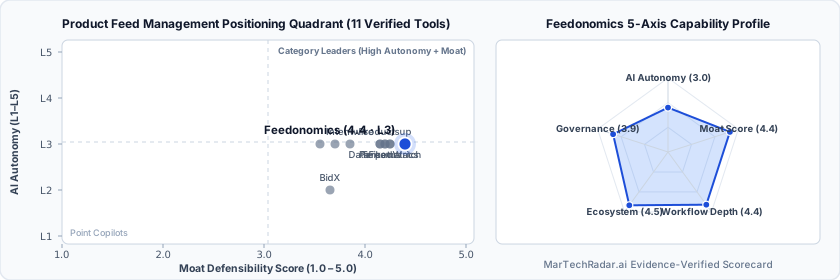
Feedonomics is a Web SaaS tool for Product Feed Management (Retail Media & Product Feed Management) in AdTech & Paid Media. Pricing: Custom / enterprise pricing. Best suited to DTC / eCommerce and Enterprise Brands. Editor ratings: AI autonomy L3 (conditional automation); moat score 4.4/5.0 (Proprietary moat (category leader)). Fact-checked by Vasilia Xia on Oct 4, 2026.
Enterprise product feed management and catalog syndication engine optimizing structured e-commerce data across marketplaces and advertising channels.
Feedonomics buyer fit verdict: when to choose vs. when to walk away
Choose Feedonomics if (Best Fit)
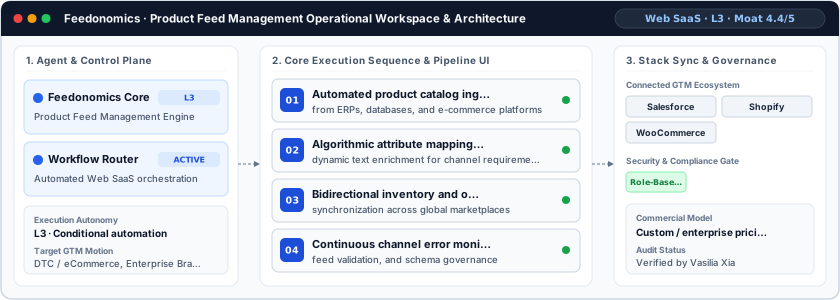
- Target ICP & Stack Fit: You operate as DTC / eCommerce and Enterprise Brands requiring a Web SaaS deployment for Product Feed Management, with verified ecosystem connectivity for Salesforce, Shopify, WooCommerce.
- L3 Architecture & Defensibility: Deep catalog governance infrastructure combining the FeedIQ rule engine, multi-channel taxonomy normalization, managed feed operations, and native integration within BigCommerce's ecosystem.
- Commercial Model Fit: Your procurement budget aligns with Custom / enterprise pricing.
Walk away from Feedonomics if (Deal-Breakers)
- Walk away if you require transparent self-serve monthly billing or your budget ceiling is under $1,000/mo (Feedonomics requires sales-gated custom quoting).
- Walk away if your workflow cannot tolerate taxonomy maintenance latency: When marketplaces update category hierarchies or required attributes without adequate notice, ingestion rules require manual intervention by feed specialists to prevent syndication suspensions.
- Walk away if high-frequency inventory sync delays is a deal-breaker for your team: Extremely volatile catalog updates across multi-million SKU environments can encounter API batch throttles on external retail ad networks, resulting in transient stockout overselling.
Feedonomics key facts & scorecard
| Pricing | Custom / enterprise pricing |
|---|---|
| Free plan | No / not disclosed |
| Delivery | Web SaaS |
| Audience | DTC / eCommerce, Enterprise Brands |
| AI autonomy level | L3 · Conditional automationEditor-verified |
| Moat tier & score | 4.4 / 5.0 · Proprietary moat (category leader)Editor-verified |
| Funding | AcquiredAcquired by BigCommerce |
| Total funding | $145.0MBacked by BigCommerce |
| Founders | Brian Roizen, Robert Roizen, Shawn Lipman |
| Company size | 201-500 employees |
| Ecosystem integrations | Salesforce, Shopify, WooCommerce |
| Governance & docs | Privacy ↗ |
| Headquarters | Los Angeles, United States |
| Founded | 2014 |
| Last verified |
Feedonomics pros & cons: strengths vs. operational limitations
Pros: core strengths & capabilities
- Automated product catalog ingestion: from ERPs, databases, and e-commerce platforms
- Algorithmic attribute mapping and: dynamic text enrichment for channel requirements
- Bidirectional inventory and order: synchronization across global marketplaces
- Continuous channel error monitoring,: feed validation, and schema governance
Cons: operational limitations & risks
- Taxonomy maintenance latency: When marketplaces update category hierarchies or required attributes without adequate notice, ingestion rules require manual intervention by feed specialists to prevent syndication suspensions.
- High-frequency inventory sync delays: Extremely volatile catalog updates across multi-million SKU environments can encounter API batch throttles on external retail ad networks, resulting in transient stockout overselling.
- Downstream configuration opacity: Complex custom transformation scripts built within the FeedIQ layer can obscure baseline product attribute lineage, complicating root-cause debugging when cross-channel pricing rules collide.
Feedonomics TCO & deal-breaker stress test
Simulate 12-month stepped TCO, hidden cost multipliers, contract lock-in exposure, and stack failure modes using only facts verified by Vasilia Xia on · Capture SHA 06fc9460.
Feedonomics triggers high-severity friction under your 5-seat / $800/mo constraints. Benchmark the verified subtrack alternatives below before committing.
| Plan / Tier | Verified Rate | Scale Fit | Scope & Quota Notes |
|---|---|---|---|
| Enterprise / Custom | Custom quote | 15–50+ seats (Enterprise SLA) | Sales-negotiated annual contract for custom volume, SSO/RBAC governance, and dedicated SLA. |
- Moat Score
- 4.4 / 5.0
- AI Autonomy
- L3
- Free Tier / Trial
- None disclosed
Triggered audit signals & failure modes
- Opaque Enterprise Quoting vs. SMB/Mid-Market BudgetVerified Pricing Ledger
Feedonomics does not disclose a public self-serve floor (Custom / enterprise pricing). Buyers with a $800/mo cap face high sales-qualification friction.
- Sales-Gated Contract TermsFact-checked by Vasilia Xia
Commercial access is provisioned through tailored enterprise sales quotes based on catalog scale, SKU density, connected destination channels, and required service levels.
- Primary Operational Bottleneck: Taxonomy maintenance latencyAudit by Vasilia Xia
When marketplaces update category hierarchies or required attributes without adequate notice, ingestion rules require manual intervention by feed specialists to prevent syndication suspensions.
Hidden TCO Multipliers & Quota Gates
- Credit & Usage Burn Multiplier: Automated workflows consume metered credits/usage quotas; multi-step enrichment, voice minutes, or high-frequency agent runs can trigger mid-cycle top-up packs.
- Taxonomy maintenance latency: When marketplaces update category hierarchies or required attributes without adequate notice, ingestion rules require manual intervention by feed specialists to prevent syndication suspensions.
- High-frequency inventory sync delays: Extremely volatile catalog updates across multi-million SKU environments can encounter API batch throttles on external retail ad networks, resulting in transient stockout overselling.
When to Walk Away & Negotiation Levers
- Walk away if you require transparent self-serve monthly billing or your budget ceiling is under $1,000/mo (Feedonomics requires sales-gated custom quoting).
- Walk away if your workflow cannot tolerate taxonomy maintenance latency: When marketplaces update category hierarchies or required attributes without adequate notice, ingestion rules require manual intervention by feed specialists to prevent syndication suspensions.
- Walk away if high-frequency inventory sync delays is a deal-breaker for your team: Extremely volatile catalog updates across multi-million SKU environments can encounter API batch throttles on external retail ad networks, resulting in transient stockout overselling.
- Demand a 30- to 60-day paid pilot opt-out clause in the Feedonomics order form before signing a 12-month enterprise commitment.
- Require a sandbox proof-of-concept testing taxonomy maintenance latency against your live CRM/data schema before annual sign-off.
Ask a custom procurement or TCO stress-test question about Feedonomics
Lower 5-seat floor (~$29/mo vs. Custom Quote) · Transparent self-serve entry without mandatory annual lock-in
Lower 5-seat floor (~$64/mo vs. Custom Quote) · Transparent self-serve entry without mandatory annual lock-in
Feedonomics key entities, modules & ecosystem stack
Feedonomics moat & subtrack positioning
Deep catalog governance infrastructure combining the FeedIQ rule engine, multi-channel taxonomy normalization, managed feed operations, and native integration within BigCommerce's ecosystem.
Editorial review
Fact-checked by Vasilia Xia (E-Commerce, Lifecycle & Retention Marketing Analyst) on .
Background
Architectured around centralized catalog governance, Feedonomics, established in 2014 in Los Angeles, United States, resolves channel-specific product data fragmentation for high-volume merchants. Backed by $145.0M in total transaction capital from its acquisition by BigCommerce, the platform targets omnichannel digital marketing leaders, enterprise merchandising directors, and performance agencies. The solution establishes an intermediary operational pipeline between back-office enterprise resource planning systems and hundreds of external marketplace destinations, ensuring technical compliance across diverse advertising networks.
How Feedonomics works
Feedonomics operates as an L3 automated data pipeline anchored by its FeedIQ transformation engine. The system ingests raw catalog records via API webhooks, SFTP batch transfers, or database extracts, standardizing disparate schemas into a unified product taxonomy. It then executes programmatic attribute transformations, token replacements, and category mappings tailored to the dynamic schemas of destinations like Google Shopping, Amazon, and Walmart. Bidirectional synchronization synchronizes inventory availability, price parity, and order routing back to the core transactional system while continuously flagging schema violations, alongside native workflow integrations for Salesforce, Shopify, and WooCommerce.
Limitations
Operational considerations and platform boundaries include:
- Taxonomy maintenance latency: When marketplaces update category hierarchies or required attributes without adequate notice, ingestion rules require manual intervention by feed specialists to prevent syndication suspensions.
- High-frequency inventory sync delays: Extremely volatile catalog updates across multi-million SKU environments can encounter API batch throttles on external retail ad networks, resulting in transient stockout overselling.
- Downstream configuration opacity: Complex custom transformation scripts built within the FeedIQ layer can obscure baseline product attribute lineage, complicating root-cause debugging when cross-channel pricing rules collide.
Feedonomics pricing
Commercial access is provisioned through tailored enterprise sales quotes based on catalog scale, SKU density, connected destination channels, and required service levels. The vendor provides both self-directed infrastructure access and full-service managed feed operations, with annual contracts scaled to integration complexity. Prospective organizations must consult the sales engineering division directly to establish formal scope parameters, integration audits, and organizational licensing agreements.
How Feedonomics compares
Within the retail feed landscape, Feedonomics competes against Channable, DataFeedWatch, and BidX. While Channable and DataFeedWatch emphasize self-serve configuration and mid-market velocity for standardized e-commerce storefronts, Feedonomics differentiates through heavy-duty schema transformation logic and managed enterprise services. BidX focuses heavily on programmatic bid automation for retail media ad placements. Feedonomics is purpose-built for enterprise omnichannel retailers managing complex multi-market catalog distribution across millions of SKUs.
Direct competitors & market radar
Top algorithmic competitors based on category positioning, capability overlap, and ICP alignment.
Frequently asked questions about Feedonomics
How much does Feedonomics cost and does it require a custom enterprise quote?
Published pricing summary for Feedonomics: Custom / enterprise pricing. A permanent free plan is not disclosed for Feedonomics. Commercial access is provisioned through tailored enterprise sales quotes based on catalog scale, SKU density, connected destination channels, and required service levels.
How does Feedonomics work and how autonomous is its AI architecture?
Enterprise product feed management and catalog syndication engine optimizing structured e-commerce data across marketplaces and advertising channels. Within Product Feed Management (Retail Media & Product Feed Management), MarTechRadar rates its execution architecture at L3 · Conditional automation with a verified Moat Score of 4.4 / 5.0 (Proprietary moat (category leader)). Deep catalog governance infrastructure combining the FeedIQ rule engine, multi-channel taxonomy normalization, managed feed operations, and native integration within BigCommerce's ecosystem. Corporate profile: Founded by Brian Roizen, Robert Roizen, Shawn Lipman, operating at 201-500 employees scale, acquired by BigCommerce.
What are the main limitations of Feedonomics and when should buyers walk away?
Based on our editorial technical audit, key operational considerations and boundaries for Feedonomics include: (1) Taxonomy maintenance latency: When marketplaces update category hierarchies or required attributes without adequate notice, ingestion rules require manual intervention by feed specialists to prevent syndication suspensions. (2) High-frequency inventory sync delays: Extremely volatile catalog updates across multi-million SKU environments can encounter API batch throttles on external retail ad networks, resulting in transient stockout overselling. (3) Downstream configuration opacity: Complex custom transformation scripts built within the FeedIQ layer can obscure baseline product attribute lineage, complicating root-cause debugging when cross-channel pricing rules collide. Primary procurement walk-away rule: Walk away if you require transparent self-serve monthly billing or your budget ceiling is under $1,000/mo (Feedonomics requires sales-gated custom quoting).
What integrations, compliance certifications, and contract terms apply to Feedonomics?
Verified ecosystem and stack integrations include Salesforce, Shopify, WooCommerce. Key TCO multiplier to watch: Credit & Usage Burn Multiplier (Automated workflows consume metered credits/usage quotas; multi-step enrichment, voice minutes, or high-frequency agent runs can trigger mid-cycle top-up packs.) Before signing a contract, procurement teams should demand a 30- to 60-day paid pilot opt-out clause in the Feedonomics order form before signing a 12-month enterprise commitment.
What are the best Feedonomics alternatives and head-to-head competitors in 2026?
Top fact-checked alternatives to Feedonomics in Product Feed Management (Retail Media & Product Feed Management) include Channable (From $29/mo), BidX (Custom / enterprise pricing), DataFeedWatch ($64–$239/mo), GoDataFeed ($39/mo). Within the retail feed landscape, Feedonomics competes against Channable, DataFeedWatch, and BidX.
Verified sources & evidence trail
- Official product domain: https://feedonomics.com
- Commercial pricing verification: Verified against official vendor pricing policy (Custom / enterprise pricing)
- Verified corporate entity profiles (
sameAs): LinkedIn Company Profile · Crunchbase Entity Record - First-party governance & documentation links: Privacy
- Editorial audit sign-off: Fact-checked by Vasilia Xia on under the MarTechRadar Evidence-Ledger Protocol.