Intentwise Review (2026): Product Feed Management Pricing, Limits & Alternatives
Bottom line
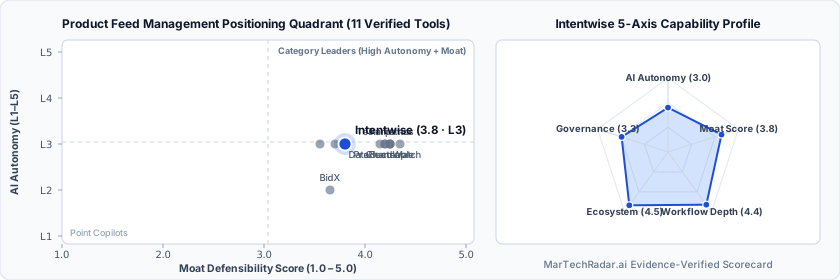
Intentwise is a Web SaaS tool for Product Feed Management (Retail Media & Product Feed Management) in AdTech & Paid Media. Pricing: Custom / enterprise pricing. Best suited to DTC / eCommerce and Enterprise Brands. Editor ratings: AI autonomy L3 (conditional automation); moat score 3.8/5.0 (Proprietary moat). Fact-checked by Vasilia Xia on Oct 12, 2026.
Commerce observability and retail media advertising platform that unifies ad optimization, retail analytics, and data pipeline management across marketplaces.
Intentwise buyer fit verdict: when to choose vs. when to walk away
Choose Intentwise if (Best Fit)
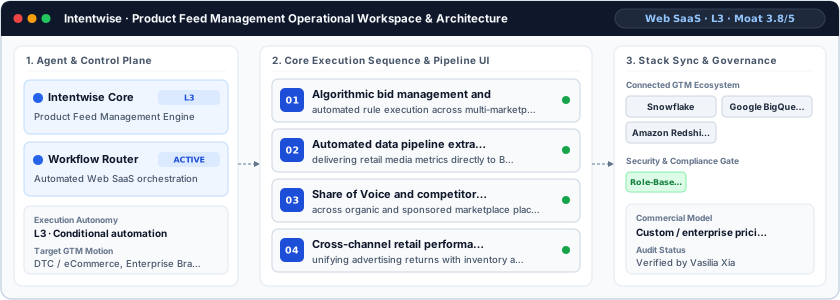
- Target ICP & Stack Fit: You operate as DTC / eCommerce and Enterprise Brands requiring a Web SaaS deployment for Product Feed Management, with verified ecosystem connectivity for Snowflake, Google BigQuery, Amazon Redshift.
- L3 Architecture & Defensibility: Intentwise builds its moat through deep connector coverage across closed retail media walled gardens (Amazon, Walmart, Instacart) paired with an automated pipeline that federates advertising telemetry directly into client-owned enterprise data warehouses.
- Commercial Model Fit: Your procurement budget aligns with Custom / enterprise pricing.
Walk away from Intentwise if (Deal-Breakers)
- Walk away if you require transparent self-serve monthly billing or your budget ceiling is under $1,000/mo (Intentwise requires sales-gated custom quoting).
- Walk away if your workflow cannot tolerate API rate limits and sync latency: Data ingestion intervals remain strictly dependent on third-party marketplace API throttling, creating reporting delays during volatile shopping surges.
- Walk away if schema maintenance overhead is a deal-breaker for your team: Upstream taxonomy adjustments or attribution changes across differing retail media networks require frequent custom mapping reconfigurations.
Intentwise key facts & scorecard
| Pricing | Custom / enterprise pricing |
|---|---|
| Free plan | No / not disclosed |
| Delivery | Web SaaS |
| Audience | DTC / eCommerce, Enterprise Brands |
| AI autonomy level | L3 · Conditional automationEditor-verified |
| Moat tier & score | 3.8 / 5.0 · Proprietary moatEditor-verified |
| Funding | Bootstrapped |
| Total funding | BootstrappedBacked by Founders |
| Founders | Raghu Kashyap, Sreenath Reddy |
| Company size | 51-200 employees |
| Ecosystem integrations | Snowflake, Google BigQuery, Amazon Redshift |
| Governance & docs | Terms ↗ · Privacy ↗ |
| Headquarters | San Diego, California |
| Founded | 2015 |
| Last verified |
Intentwise pros & cons: strengths vs. operational limitations
Pros: core strengths & capabilities
- Algorithmic bid management and: automated rule execution across multi-marketplace ad units
- Automated data pipeline extraction: delivering retail media metrics directly to BigQuery, Snowflake, and Redshift
- Share of Voice and competitor shelf tracking: across organic and sponsored marketplace placements
- Cross-channel retail performance analytics: unifying advertising returns with inventory and buy-box availability
Cons: operational limitations & risks
- API Rate Limits and Sync Latency: Data ingestion intervals remain strictly dependent on third-party marketplace API throttling, creating reporting delays during volatile shopping surges.
- Schema Maintenance Overhead: Upstream taxonomy adjustments or attribution changes across differing retail media networks require frequent custom mapping reconfigurations.
- Attribution Window Lag: Discrepant 14-day conversion lookback periods between retail networks complicate real-time intraday algorithmic bid adjustments.
Intentwise TCO & deal-breaker stress test
Simulate 12-month stepped TCO, hidden cost multipliers, contract lock-in exposure, and stack failure modes using only facts verified by Vasilia Xia on · Capture SHA 1efdb5be.
Intentwise triggers high-severity friction under your 5-seat / $800/mo constraints. Benchmark the verified subtrack alternatives below before committing.
| Plan / Tier | Verified Rate | Scale Fit | Scope & Quota Notes |
|---|---|---|---|
| Enterprise / Custom | Custom quote | 15–50+ seats (Enterprise SLA) | Sales-negotiated annual contract for custom volume, SSO/RBAC governance, and dedicated SLA. |
- Moat Score
- 3.8 / 5.0
- AI Autonomy
- L3
- Free Tier / Trial
- None disclosed
Triggered audit signals & failure modes
- Opaque Enterprise Quoting vs. SMB/Mid-Market BudgetVerified Pricing Ledger
Intentwise does not disclose a public self-serve floor (Custom / enterprise pricing). Buyers with a $800/mo cap face high sales-qualification friction.
- Sales-Gated Contract TermsFact-checked by Vasilia Xia
Intentwise operates under a customized commercial model where software licensing is available on request through tailored enterprise sales quotes based on organizational scale, managed ad spend volumes, and seat requirements.
- Primary Operational Bottleneck: API Rate Limits and Sync LatencyAudit by Vasilia Xia
Data ingestion intervals remain strictly dependent on third-party marketplace API throttling, creating reporting delays during volatile shopping surges.
Hidden TCO Multipliers & Quota Gates
- API Rate Limits and Sync Latency: Data ingestion intervals remain strictly dependent on third-party marketplace API throttling, creating reporting delays during volatile shopping surges.
- Schema Maintenance Overhead: Upstream taxonomy adjustments or attribution changes across differing retail media networks require frequent custom mapping reconfigurations.
When to Walk Away & Negotiation Levers
- Walk away if you require transparent self-serve monthly billing or your budget ceiling is under $1,000/mo (Intentwise requires sales-gated custom quoting).
- Walk away if your workflow cannot tolerate API rate limits and sync latency: Data ingestion intervals remain strictly dependent on third-party marketplace API throttling, creating reporting delays during volatile shopping surges.
- Walk away if schema maintenance overhead is a deal-breaker for your team: Upstream taxonomy adjustments or attribution changes across differing retail media networks require frequent custom mapping reconfigurations.
- Demand a 30- to 60-day paid pilot opt-out clause in the Intentwise order form before signing a 12-month enterprise commitment.
- Require a sandbox proof-of-concept testing API rate limits and sync latency against your live CRM/data schema before annual sign-off.
Ask a custom procurement or TCO stress-test question about Intentwise
Lower 5-seat floor (~$29/mo vs. Custom Quote) · Transparent self-serve entry without mandatory annual lock-in
Lower 5-seat floor (~$39/mo vs. Custom Quote) · Transparent self-serve entry without mandatory annual lock-in
Intentwise key entities, modules & ecosystem stack
Intentwise moat & subtrack positioning
Intentwise builds its moat through deep connector coverage across closed retail media walled gardens (Amazon, Walmart, Instacart) paired with an automated pipeline that federates advertising telemetry directly into client-owned enterprise data warehouses.
Editorial review
Fact-checked by Vasilia Xia (E-Commerce, Lifecycle & Retention Marketing Analyst) on .
Background
Established in 2015 in San Diego, California, Intentwise is a commerce observability and retail media intelligence platform engineered to eliminate margin loss caused by fragmented marketplace operations. Designed specifically for retail media directors, marketplace aggregators, and performance marketing agencies, the system consolidates fragmented analytics and execution streams across retail networks such as Amazon, Walmart, and Instacart. By centralizing transactional records, competitor shelf presence, and ad performance into a structured reporting environment, Intentwise helps retail operators protect margins while scaling complex multi-channel catalog advertising.
How Intentwise works
At its technical core, Intentwise functions via an automated ETL data pipeline and an algorithmic campaign engine. The platform connects directly to marketplace partner APIs, ingesting campaign telemetry, buy-box state changes, search trends, and inventory counts on hourly and daily sync frequencies. Ingested data streams are normalized into a unified schema that powers both conditional rules engines and goal-based bidding models. These algorithms adjust keyword target bids and budget pacing dynamically based on real-time inventory signals, preventing ad spend waste on constrained SKUs without requiring constant manual oversight.
Limitations
Operational considerations and platform boundaries include:
- API Rate Limits and Sync Latency: Data ingestion intervals remain strictly dependent on third-party marketplace API throttling, creating reporting delays during volatile shopping surges.
- Schema Maintenance Overhead: Upstream taxonomy adjustments or attribution changes across differing retail media networks require frequent custom mapping reconfigurations.
- Attribution Window Lag: Discrepant 14-day conversion lookback periods between retail networks complicate real-time intraday algorithmic bid adjustments.
Intentwise pricing
Intentwise operates under a customized commercial model where software licensing is available on request through tailored enterprise sales quotes based on organizational scale, managed ad spend volumes, and seat requirements. Engagements are structured around modular access tiers, allowing brands to license standalone campaign management modules or full-stack data pipeline connectors feeding enterprise data warehouses. No fixed tier self-service subscriptions are published publicly, requiring prospective buyers to scope marketplace connector counts and sync frequencies directly with sales engineers.
How Intentwise compares
Within the retail media ecosystem, Intentwise competes against BidX, Channable, and DataFeedWatch. While Channable and DataFeedWatch prioritize upstream product feed syndication, catalog transformations, and channel distribution, Intentwise focuses downstream on media execution and commerce analytics. Unlike BidX, which provides specialized algorithmic bid automation concentrated primarily within Amazon, Intentwise delivers broader cross-marketplace data warehousing capabilities. It serves enterprise consumer goods brands and agencies that demand combined advertising automation and raw SQL-accessible marketplace data infrastructure.
Direct competitors & market radar
Top algorithmic competitors based on category positioning, capability overlap, and ICP alignment.
Frequently asked questions about Intentwise
How much does Intentwise cost and does it require a custom enterprise quote?
Published pricing summary for Intentwise: Custom / enterprise pricing. A permanent free plan is not disclosed for Intentwise. Intentwise operates under a customized commercial model where software licensing is available on request through tailored enterprise sales quotes based on organizational scale, managed ad spend volumes, and seat requirements.
How does Intentwise work and how autonomous is its AI architecture?
Commerce observability and retail media advertising platform that unifies ad optimization, retail analytics, and data pipeline management across marketplaces. Within Product Feed Management (Retail Media & Product Feed Management), MarTechRadar rates its execution architecture at L3 · Conditional automation with a verified Moat Score of 3.8 / 5.0 (Proprietary moat). Intentwise builds its moat through deep connector coverage across closed retail media walled gardens (Amazon, Walmart, Instacart) paired with an automated pipeline that federates advertising telemetry directly into client-owned enterprise data warehouses. Corporate profile: Founded by Raghu Kashyap, Sreenath Reddy, operating at 51-200 employees scale.
What are the main limitations of Intentwise and when should buyers walk away?
Based on our editorial technical audit, key operational considerations and boundaries for Intentwise include: (1) API Rate Limits and Sync Latency: Data ingestion intervals remain strictly dependent on third-party marketplace API throttling, creating reporting delays during volatile shopping surges. (2) Schema Maintenance Overhead: Upstream taxonomy adjustments or attribution changes across differing retail media networks require frequent custom mapping reconfigurations. (3) Attribution Window Lag: Discrepant 14-day conversion lookback periods between retail networks complicate real-time intraday algorithmic bid adjustments. Primary procurement walk-away rule: Walk away if you require transparent self-serve monthly billing or your budget ceiling is under $1,000/mo (Intentwise requires sales-gated custom quoting).
What integrations, compliance certifications, and contract terms apply to Intentwise?
Verified ecosystem and stack integrations include Snowflake, Google BigQuery, Amazon Redshift. Key TCO multiplier to watch: API Rate Limits and Sync Latency (Data ingestion intervals remain strictly dependent on third-party marketplace API throttling, creating reporting delays during volatile shopping surges.) Before signing a contract, procurement teams should demand a 30- to 60-day paid pilot opt-out clause in the Intentwise order form before signing a 12-month enterprise commitment.
What are the best Intentwise alternatives and head-to-head competitors in 2026?
Top fact-checked alternatives to Intentwise in Product Feed Management (Retail Media & Product Feed Management) include BidX (Custom / enterprise pricing), Channable (From $29/mo), GoDataFeed ($39/mo), Productsup (Custom / enterprise pricing). Within the retail media ecosystem, Intentwise competes against BidX, Channable, and DataFeedWatch. While Channable and DataFeedWatch prioritize upstream product feed syndication, catalog transformations, and channel distribution, Intentwise focuses downstream on media execution and commerce analytics.
Verified sources & evidence trail
- Official product domain: https://intentwise.com
- Commercial pricing verification: Verified against official vendor pricing policy (Custom / enterprise pricing)
- Verified corporate entity profiles (
sameAs): LinkedIn Company Profile · Crunchbase Entity Record - First-party governance & documentation links: Terms · Privacy
- Editorial audit sign-off: Fact-checked by Vasilia Xia on under the MarTechRadar Evidence-Ledger Protocol.