GoDataFeed Review (2026): Product Feed Management Pricing, Limits & Alternatives
Bottom line
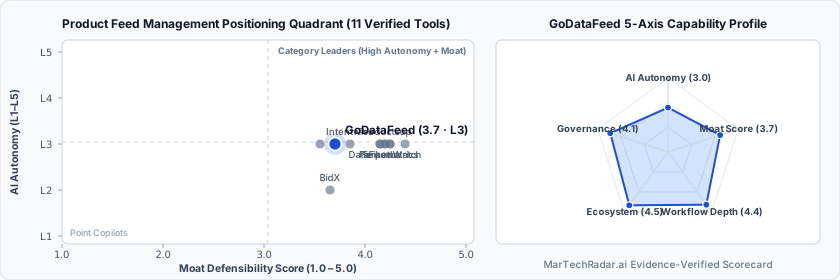
GoDataFeed is a SaaS Platform tool for Product Feed Management (Retail Media & Product Feed Management) in AdTech & Paid Media. Pricing: $39/mo. Best suited to B2B Marketing & GTM Teams. Editor ratings: AI autonomy L3 (conditional automation); moat score 3.7/5.0 (Proprietary moat). Fact-checked by Jiacky Lee on Oct 18, 2026.
AI-assisted product feed management platform combining deterministic catalog rules with generative AI for shopping channels and AI Shelf discovery.
GoDataFeed buyer fit verdict: when to choose vs. when to walk away
Choose GoDataFeed if (Best Fit)
- Target ICP & Stack Fit: You operate as B2B Marketing & GTM Teams requiring a SaaS Platform deployment for Product Feed Management, with verified ecosystem connectivity for Shopify, WooCommerce, Meta Ads.
- L3 Architecture & Defensibility: GoDataFeed sustains its competitive moat through a hybrid rule-and-supervised-AI catalog engine, automated pre-submission feed auditing, 200+ shopping and marketplace connectors, and dedicated AI Shelf feeds.
- Commercial Model Fit: Your procurement budget aligns with $39/mo and want trial evaluation before contract sign-off.
Walk away from GoDataFeed if (Deal-Breakers)
- Walk away if your workflow requires uncapped enterprise volume on the $39/mo entry plan without upgrading tiers.
- Walk away if your workflow cannot tolerate marketplace order sync tier barrier: Bidirectional marketplace order synchronization and third-party marketplace listings (such as Amazon, Walmart, eBay, and TikTok Shop) require upgrading to at least the Pro tier and purchasing marketplace add-ons, restricting entry-level plans to PPC and social feeds.
- Walk away if supervised prompt governance bottleneck is a deal-breaker for your team: While supervised AI accelerates bulk title and description rewrites, large multi-category catalogs still require human review of prompt templates and negative keyword constraints to prevent brand-voice drift or compliance rejections on strict retail channels.
GoDataFeed key facts & scorecard
| Pricing | $39/moVendor pricing page |
|---|---|
| Free plan | No / not disclosed |
| Delivery | SaaS Platform |
| Audience | B2B Marketing & GTM Teams |
| AI autonomy level | L3 · Conditional automationEditor-verified |
| Moat tier & score | 3.7 / 5.0 · Proprietary moatEditor-verified |
| Funding | Bootstrapped |
| Founders | Kieron Zabow |
| Company size | 11-50 employees |
| Ecosystem integrations | Shopify, WooCommerce, Meta Ads |
| Compliance & governance | GDPR |
| Governance & docs | Trust & Security ↗ · System Status ↗ · DPA ↗ · Terms ↗ · Privacy ↗ |
| Headquarters | Plantation, Florida, United States |
| Founded | 2007 |
| Last verified |
GoDataFeed pros & cons: strengths vs. operational limitations
Pros: core strengths & capabilities
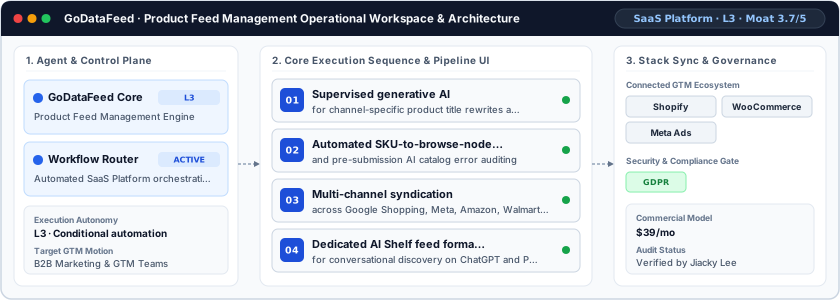
- Supervised generative AI: for channel-specific product title rewrites and keyword-rich description expansion
- Automated SKU-to-browse-node taxonomy categorization: and pre-submission AI catalog error auditing
- Multi-channel syndication: across Google Shopping, Meta, Amazon, Walmart, eBay, and TikTok Shop
- Dedicated AI Shelf feed formatting: for conversational discovery on ChatGPT and Perplexity Shopping
Cons: operational limitations & risks
- Marketplace Order Sync Tier Barrier: Bidirectional marketplace order synchronization and third-party marketplace listings (such as Amazon, Walmart, eBay, and TikTok Shop) require upgrading to at least the Pro tier and purchasing marketplace add-ons, restricting entry-level plans to PPC and social feeds.
- Supervised Prompt Governance Bottleneck: While supervised AI accelerates bulk title and description rewrites, large multi-category catalogs still require human review of prompt templates and negative keyword constraints to prevent brand-voice drift or compliance rejections on strict retail channels.
- High-Frequency Sync Ceiling: Catalogs with rapidly fluctuating flash-sale inventory must carefully configure daily sync allotments (ranging from 1 to 24 daily syncs depending on plan tier) to avoid advertising out-of-stock variants between scheduled refreshes.
GoDataFeed TCO & deal-breaker stress test
Simulate 12-month stepped TCO, hidden cost multipliers, contract lock-in exposure, and stack failure modes using only facts verified by Jiacky Lee on · Capture SHA ad5342a3.
GoDataFeed aligns with your 5-seat / $800/mo profile. Review the walk-away triggers and contract levers below before deployment.
| Plan / Tier | Verified Rate | Scale Fit | Scope & Quota Notes |
|---|---|---|---|
| Lite | $39/mo | 1–2 seats | Right-sized for launch. Lite covers 1,000 SKUs and your single PPC feed. Add channels later for |
| Growth / Professional | $99/mo | 5 seats | Marketplace Channels |
- Moat Score
- 3.7 / 5.0
- AI Autonomy
- L3
- Free Tier / Trial
- Free trial
Triggered audit signals & failure modes
- Published Self-Serve Entry FloorVerified Pricing Ledger
GoDataFeed publishes a transparent entry point ($39/mo) with a free trial for initial validation before committing.
- Tier Fit for 5-Seat Scale: Growth / Professional ($99/mo)Verified Tier Schedule
Marketplace Channels
- Primary Operational Bottleneck: Marketplace Order Sync Tier BarrierAudit by Jiacky Lee
Bidirectional marketplace order synchronization and third-party marketplace listings (such as Amazon, Walmart, eBay, and TikTok Shop) require upgrading to at least the Pro tier and purchasing marketplace add-ons, restricting entry-level plans to PPC and social feeds.
Hidden TCO Multipliers & Quota Gates
- Enterprise Governance & Add-On Gating: Advanced capabilities such as Single Sign-On (SSO), custom role permissions, or specialized analytics modules are gated behind upper tiers or paid add-ons.
- Marketplace Order Sync Tier Barrier: Bidirectional marketplace order synchronization and third-party marketplace listings (such as Amazon, Walmart, eBay, and TikTok Shop) require upgrading to at least the Pro tier and purchasing marketplace add-ons, restricting entry-level plans to PPC and social feeds.
- Supervised Prompt Governance Bottleneck: While supervised AI accelerates bulk title and description rewrites, large multi-category catalogs still require human review of prompt templates and negative keyword constraints to prevent brand-voice drift or compliance rejections on strict retail channels.
When to Walk Away & Negotiation Levers
- Walk away if your workflow requires uncapped enterprise volume on the $39/mo entry plan without upgrading tiers.
- Walk away if your workflow cannot tolerate marketplace order sync tier barrier: Bidirectional marketplace order synchronization and third-party marketplace listings (such as Amazon, Walmart, eBay, and TikTok Shop) require upgrading to at least the Pro tier and purchasing marketplace add-ons, restricting entry-level plans to PPC and social feeds.
- Walk away if supervised prompt governance bottleneck is a deal-breaker for your team: While supervised AI accelerates bulk title and description rewrites, large multi-category catalogs still require human review of prompt templates and negative keyword constraints to prevent brand-voice drift or compliance rejections on strict retail channels.
- Validate exact quota thresholds (seats, credits, or API calls) included in GoDataFeed's $39/mo tier before converting from monthly to annual billing.
- Require a sandbox proof-of-concept testing marketplace order sync tier barrier against your live CRM/data schema before annual sign-off.
Ask a custom procurement or TCO stress-test question about GoDataFeed
Lower 5-seat floor (~$29/mo vs. $99 / mo)
Lower 5-seat floor (~$64/mo vs. $99 / mo)
GoDataFeed key entities, modules & ecosystem stack
GoDataFeed moat & subtrack positioning
GoDataFeed sustains its competitive moat through a hybrid rule-and-supervised-AI catalog engine, automated pre-submission feed auditing, 200+ shopping and marketplace connectors, and dedicated AI Shelf feeds.
Editorial review
Fact-checked by Jiacky Lee (Managing Editor, AI Autonomy & Moat Methodology) on .
Background
Founded in 2007 by Kieron Zabow and headquartered in Plantation, Florida, United States, GoDataFeed (godatafeed.com) is an e-commerce product feed management and catalog syndication platform built for online retailers, multi-brand merchants, and digital marketing agencies. Operating with a team of 11-50 employees as an established bootstrapped software vendor, the company enables commerce teams to normalize, enrich, validate, and syndicate product catalog data from store backends to more than 200 paid search, social commerce, affiliate, and third-party marketplace channels. Rather than forcing merchandisers to manually reformat CSV exports for every ad network or lose impression share due to generic manufacturer titles and missing taxonomy fields, GoDataFeed automates catalog transformation through a blend of deterministic business logic and supervised generative AI.
How GoDataFeed works
GoDataFeed operates at Level 3 autonomy by pairing a deterministic conditional rule engine with supervised AI optimization workflows and pre-submission feed auditing. The platform ingests catalog data directly from Shopify, BigCommerce, WooCommerce, Adobe Commerce, Wix, or custom APIs, and runs an AI feed audit to flag missing GTINs, weak attributes, and formatting errors before submission. Merchandisers use supervised AI to automatically rewrite channel-specific product titles, enrich descriptions with high-intent search keywords, and execute automated SKU-to-browse-node taxonomy categorization across Google Shopping, Meta Ads, Microsoft Ads, TikTok Shop, Amazon, Walmart, and eBay. In addition to traditional shopping and marketplace syndication, GoDataFeed provides dedicated "AI Shelf" feeds structured specifically for conversational product discovery on ChatGPT and Perplexity Shopping while maintaining GDPR compliance.
Limitations
Operational limitations and technical trade-offs include:
- Marketplace Order Sync Tier Barrier: Bidirectional marketplace order synchronization and third-party marketplace listings (such as Amazon, Walmart, eBay, and TikTok Shop) require upgrading to at least the Pro tier and purchasing marketplace add-ons, restricting entry-level plans to PPC and social feeds.
- Supervised Prompt Governance Bottleneck: While supervised AI accelerates bulk title and description rewrites, large multi-category catalogs still require human review of prompt templates and negative keyword constraints to prevent brand-voice drift or compliance rejections on strict retail channels.
- High-Frequency Sync Ceiling: Catalogs with rapidly fluctuating flash-sale inventory must carefully configure daily sync allotments (ranging from 1 to 24 daily syncs depending on plan tier) to avoid advertising out-of-stock variants between scheduled refreshes.
GoDataFeed pricing
GoDataFeed offers transparent, modular SaaS pricing with a 14-day free trial and free expert onboarding across four core tiers: Lite at $39/month (1,000 SKUs, 1 PPC feed, 1 daily sync), Plus at $99/month (5,000 SKUs, 4 PPC feeds, 4 daily syncs), Pro at $199/month (20,000 SKUs, 8 PPC feeds, 1 marketplace feed, 16 daily syncs, and priority support), and Premium at $399/month (40,000 SKUs, 20 PPC feeds, 4 marketplace feeds, 24 daily syncs, and dedicated support). Merchants can customize capacity with self-serve add-ons, including $5 per additional 1,000 SKUs, $29/month per extra PPC channel, and $99/month per additional marketplace channel, or request custom multi-store agency and fully managed service quotes.
How GoDataFeed compares
Within the Retail Media & Product Feed Management category, GoDataFeed competes against catalog management platforms such as Channable, Feedonomics, and Feedoptimise. Versus Feedonomics, which focuses heavily on high-cost managed service retainers for enterprise retailers, GoDataFeed differentiates itself through transparent self-serve pricing starting at $39/month, supervised AI title and taxonomy automation, and optional done-for-you feed setup services. Compared to Channable, GoDataFeed provides deep US marketplace integration alongside specialized AI Shelf feed formatting for ChatGPT and Perplexity Shopping.
Frequently asked questions about GoDataFeed
How much does GoDataFeed cost and what pricing tiers are available?
Published pricing summary for GoDataFeed: $39/mo. GoDataFeed does not list a permanent free tier, though trial evaluation options may be offered. Verified tier schedule: Lite ($39/mo for 1–2 seats); Growth / Professional ($99/mo for 5 seats). GoDataFeed offers transparent, modular SaaS pricing with a 14-day free trial and free expert onboarding across four core tiers: Lite at $39/month (1,000 SKUs, 1 PPC feed, 1 daily sync), Plus at $99/month (5,000 SKUs, 4 PPC feeds, 4 daily syncs), Pro at $199/month (20,000 SKUs, 8 PPC feeds, 1 marketplace feed, 16 daily syncs, and priority support), and Premium at $399/month (40,000 SKUs, 20 PPC feeds, 4 marketplace feeds, 24 daily syncs, and dedicated support).
How does GoDataFeed work and how autonomous is its AI architecture?
AI-assisted product feed management platform combining deterministic catalog rules with generative AI for shopping channels and AI Shelf discovery. Within Product Feed Management (Retail Media & Product Feed Management), MarTechRadar rates its execution architecture at L3 · Conditional automation with a verified Moat Score of 3.7 / 5.0 (Proprietary moat). GoDataFeed sustains its competitive moat through a hybrid rule-and-supervised-AI catalog engine, automated pre-submission feed auditing, 200+ shopping and marketplace connectors, and dedicated AI Shelf feeds. Corporate profile: Founded by Kieron Zabow, operating at 11-50 employees scale.
What are the main limitations of GoDataFeed and when should buyers walk away?
Based on our editorial technical audit, key operational considerations and boundaries for GoDataFeed include: (1) Marketplace Order Sync Tier Barrier: Bidirectional marketplace order synchronization and third-party marketplace listings (such as Amazon, Walmart, eBay, and TikTok Shop) require upgrading to at least the Pro tier and purchasing marketplace add-ons, restricting entry-level plans to PPC and social feeds. (2) Supervised Prompt Governance Bottleneck: While supervised AI accelerates bulk title and description rewrites, large multi-category catalogs still require human review of prompt templates and negative keyword constraints to prevent brand-voice drift or compliance rejections on strict retail channels. (3) High-Frequency Sync Ceiling: Catalogs with rapidly fluctuating flash-sale inventory must carefully configure daily sync allotments (ranging from 1 to 24 daily syncs depending on plan tier) to avoid advertising out-of-stock variants between scheduled refreshes. Primary procurement walk-away rule: Walk away if your workflow requires uncapped enterprise volume on the $39/mo entry plan without upgrading tiers.
What integrations, compliance certifications, and contract terms apply to GoDataFeed?
Verified ecosystem and stack integrations include Shopify, WooCommerce, Meta Ads. Documented security and governance attestations include GDPR. First-party governance and developer endpoints verified on domain include: Trust/Security (https://www.godatafeed.com/compliance/privacy-policy), Status (https://status.godatafeed.com), DPA (https://www.godatafeed.com/compliance/sub-processors). Key TCO multiplier to watch: Enterprise Governance & Add-On Gating (Advanced capabilities such as Single Sign-On (SSO), custom role permissions, or specialized analytics modules are gated behind upper tiers or paid add-ons.) Before signing a contract, procurement teams should validate exact quota thresholds (seats, credits, or API calls) included in GoDataFeed's $39/mo tier before converting from monthly to annual billing.
What are the best GoDataFeed alternatives and head-to-head competitors in 2026?
Top fact-checked alternatives to GoDataFeed in Product Feed Management (Retail Media & Product Feed Management) include Feedonomics (Custom / enterprise pricing), Feedoptimise (Pricing not disclosed), Channable (From $29/mo), Intentwise (Custom / enterprise pricing). Within the Retail Media & Product Feed Management category, GoDataFeed competes against catalog management platforms such as Channable, Feedonomics, and Feedoptimise.
Verified sources & evidence trail
- Official product domain: https://godatafeed.com
- Commercial pricing verification: https://www.godatafeed.com/pricing
- Verified corporate entity profiles (
sameAs): LinkedIn Company Profile · Crunchbase Entity Record - First-party governance & documentation links: Trust & Security · System Status · DPA · Terms · Privacy
- Editorial audit sign-off: Fact-checked by Jiacky Lee on under the MarTechRadar Evidence-Ledger Protocol.