Feedoptimise Review (2026): Product Feed Management Pricing, Limits & Alternatives
Bottom line
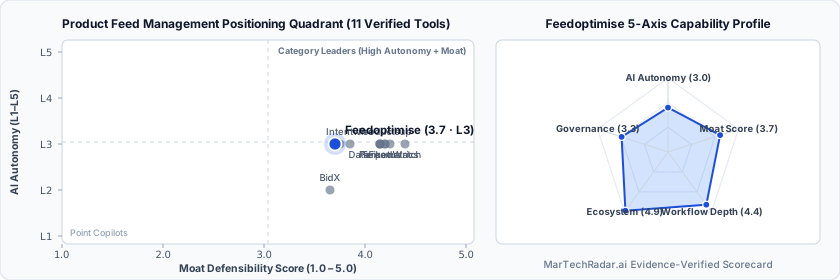
Feedoptimise is a SaaS Platform tool for Product Feed Management (Retail Media & Product Feed Management) in AdTech & Paid Media. Pricing: Pricing not disclosed. Best suited to B2B Marketing & GTM Teams. Editor ratings: AI autonomy L3 (conditional automation); moat score 3.7/5.0 (Proprietary moat). Fact-checked by Jiacky Lee on Oct 18, 2026.
AI-driven product feed management and agentic commerce platform enriching and syndicating catalogs across 3,500+ channels and AI shopping assistants.
Feedoptimise buyer fit verdict: when to choose vs. when to walk away
Choose Feedoptimise if (Best Fit)
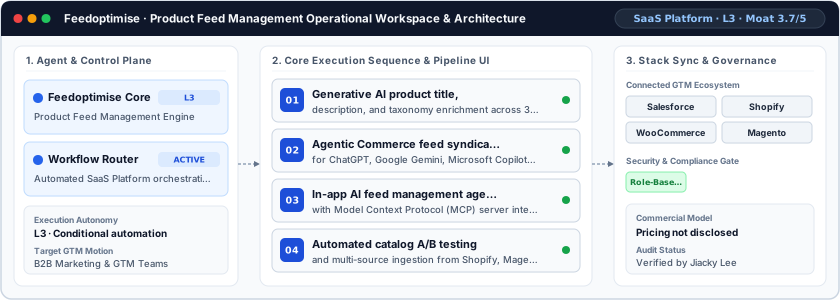
- Target ICP & Stack Fit: You operate as B2B Marketing & GTM Teams requiring a SaaS Platform deployment for Product Feed Management, with verified ecosystem connectivity for Salesforce, Shopify, WooCommerce, Magento.
- L3 Architecture & Defensibility: Feedoptimise builds its competitive moat by combining deterministic catalog manipulation rules with generative AI feed enrichment, MCP server agent connectivity, and Agentic Commerce syndication across 3,500+ channels.
- Commercial Model Fit: Your procurement budget aligns with Pricing not disclosed.
Walk away from Feedoptimise if (Deal-Breakers)
- Walk away if you require transparent self-serve monthly billing or your budget ceiling is under $1,000/mo (Feedoptimise requires sales-gated custom quoting).
- Walk away if your workflow cannot tolerate upstream inventory data dependency: While generative AI can enrich product titles and infer missing visual or categorical tags, inaccurate stock counts, missing GTIN/MPN identifiers, or malformed pricing fields in the source ERP or e-commerce database will still trigger merchant center disapprovals.
- Walk away if large-catalog rule complexity bottleneck is a deal-breaker for your team: Managing overlapping conditional overrides, dynamic pricing rules, and seasonal promotional labels across hundreds of thousands of SKUs and dozens of regional feeds introduces governance overhead if rule hierarchies are not carefully audited.
Feedoptimise key facts & scorecard
| Pricing | Pricing not disclosed |
|---|---|
| Free plan | No / not disclosed |
| Delivery | SaaS Platform |
| Audience | B2B Marketing & GTM Teams |
| AI autonomy level | L3 · Conditional automationEditor-verified |
| Moat tier & score | 3.7 / 5.0 · Proprietary moatEditor-verified |
| Funding | Bootstrapped |
| Founders | Marcin Rosinski |
| Company size | 11-50 employees |
| Ecosystem integrations | Salesforce, Shopify, WooCommerce, Magento |
| Governance & docs | System Status ↗ · Terms ↗ · Privacy ↗ |
| Headquarters | Milton Keynes, England, United Kingdom |
| Founded | 2011 |
| Last verified |
Feedoptimise pros & cons: strengths vs. operational limitations
Pros: core strengths & capabilities
- Generative AI product title,: description, and taxonomy enrichment across 3,500+ global shopping channels
- Agentic Commerce feed syndication formatted: for ChatGPT, Google Gemini, Microsoft Copilot, and Perplexity
- In-app AI feed management agent equipped: with Model Context Protocol (MCP) server integration
- Automated catalog A/B testing: and multi-source ingestion from Shopify, Magento, WooCommerce, and cloud storage
Cons: operational limitations & risks
- Upstream Inventory Data Dependency: While generative AI can enrich product titles and infer missing visual or categorical tags, inaccurate stock counts, missing GTIN/MPN identifiers, or malformed pricing fields in the source ERP or e-commerce database will still trigger merchant center disapprovals.
- Large-Catalog Rule Complexity Bottleneck: Managing overlapping conditional overrides, dynamic pricing rules, and seasonal promotional labels across hundreds of thousands of SKUs and dozens of regional feeds introduces governance overhead if rule hierarchies are not carefully audited.
- Agentic Commerce Attribution Barrier: While syndicating structured feeds to conversational assistants like ChatGPT and Perplexity expands discovery reach, downstream checkout attribution from zero-click conversational sessions remains harder to reconcile than traditional paid shopping clicks.
Feedoptimise TCO & deal-breaker stress test
Simulate 12-month stepped TCO, hidden cost multipliers, contract lock-in exposure, and stack failure modes using only facts verified by Jiacky Lee on · Capture SHA 4b66c121.
Feedoptimise triggers high-severity friction under your 5-seat / $800/mo constraints. Benchmark the verified subtrack alternatives below before committing.
| Plan / Tier | Verified Rate | Scale Fit | Scope & Quota Notes |
|---|---|---|---|
| Enterprise / Custom | Custom quote | 15–50+ seats (Enterprise SLA) | Sales-negotiated annual contract for custom volume, SSO/RBAC governance, and dedicated SLA. |
- Moat Score
- 3.7 / 5.0
- AI Autonomy
- L3
- Free Tier / Trial
- None disclosed
Triggered audit signals & failure modes
- Opaque Enterprise Quoting vs. SMB/Mid-Market BudgetVerified Pricing Ledger
Feedoptimise does not disclose a public self-serve floor (Pricing not disclosed). Buyers with a $800/mo cap face high sales-qualification friction.
- Sales-Gated Contract TermsFact-checked by Jiacky Lee
Feedoptimise operates on a tiered SaaS subscription model with custom enterprise configurations and pricing available on request.
- Primary Operational Bottleneck: Upstream Inventory Data DependencyAudit by Jiacky Lee
While generative AI can enrich product titles and infer missing visual or categorical tags, inaccurate stock counts, missing GTIN/MPN identifiers, or malformed pricing fields in the source ERP or e-commerce database will still trigger merchant center disapprovals.
Hidden TCO Multipliers & Quota Gates
- Upstream Inventory Data Dependency: While generative AI can enrich product titles and infer missing visual or categorical tags, inaccurate stock counts, missing GTIN/MPN identifiers, or malformed pricing fields in the source ERP or e-commerce database will still trigger merchant center disapprovals.
- Large-Catalog Rule Complexity Bottleneck: Managing overlapping conditional overrides, dynamic pricing rules, and seasonal promotional labels across hundreds of thousands of SKUs and dozens of regional feeds introduces governance overhead if rule hierarchies are not carefully audited.
When to Walk Away & Negotiation Levers
- Walk away if you require transparent self-serve monthly billing or your budget ceiling is under $1,000/mo (Feedoptimise requires sales-gated custom quoting).
- Walk away if your workflow cannot tolerate upstream inventory data dependency: While generative AI can enrich product titles and infer missing visual or categorical tags, inaccurate stock counts, missing GTIN/MPN identifiers, or malformed pricing fields in the source ERP or e-commerce database will still trigger merchant center disapprovals.
- Walk away if large-catalog rule complexity bottleneck is a deal-breaker for your team: Managing overlapping conditional overrides, dynamic pricing rules, and seasonal promotional labels across hundreds of thousands of SKUs and dozens of regional feeds introduces governance overhead if rule hierarchies are not carefully audited.
- Demand a 30- to 60-day paid pilot opt-out clause in the Feedoptimise order form before signing a 12-month enterprise commitment.
- Require a sandbox proof-of-concept testing upstream inventory data dependency against your live CRM/data schema before annual sign-off.
Ask a custom procurement or TCO stress-test question about Feedoptimise
Lower 5-seat floor (~$39/mo vs. Custom Quote) · Transparent self-serve entry without mandatory annual lock-in
Lower 5-seat floor (~$29/mo vs. Custom Quote) · Transparent self-serve entry without mandatory annual lock-in
Feedoptimise key entities, modules & ecosystem stack
Feedoptimise moat & subtrack positioning
Feedoptimise builds its competitive moat by combining deterministic catalog manipulation rules with generative AI feed enrichment, MCP server agent connectivity, and Agentic Commerce syndication across 3,500+ channels.
Editorial review
Fact-checked by Jiacky Lee (Managing Editor, AI Autonomy & Moat Methodology) on .
Background
Founded in 2011 by Marcin Rosinski and headquartered in Milton Keynes, England, United Kingdom, Feedoptimise (feedoptimise.com) is an AI-driven product feed management and agentic commerce syndication platform built for e-commerce retailers and digital performance agencies. Operating with a team of 11-50 employees as a bootstrapped software provider, the company enables merchants to ingest, enrich, validate, and distribute structured product catalogs across more than 3,500 global shopping channels, retail media networks, and conversational AI shopping assistants. Rather than relying on brittle spreadsheet macros or IT engineering tickets to fix disapproved SKUs and rewrite thin manufacturer descriptions, Feedoptimise provides an automated transformation layer between store backends and downstream advertising and discovery ecosystems.
How Feedoptimise works
Feedoptimise operates at Level 3 autonomy by combining deterministic catalog manipulation rules with generative AI enrichment and an in-app AI feed management agent equipped with Model Context Protocol (MCP) server support. The platform ingests raw inventory data from Shopify, Magento, WooCommerce, Salesforce Commerce Cloud, AWS S3, Google Cloud Storage, Azure Storage, or custom sFTP and API endpoints, then automatically normalizes attributes, strips HTML noise, and maps products to channel-specific taxonomies. Its generative AI engine rewrites product titles, expands feature descriptions, and executes automated A/B testing on feed attributes to maximize click-through and conversion rates on Google Merchant Center, Meta Catalogs, and OpenAI Ads Manager. Furthermore, its Agentic Commerce module formats and syndicates real-time product feeds directly into conversational discovery surfaces including ChatGPT, Google Gemini, Microsoft Copilot, and Perplexity.
Limitations
Operational limitations and technical trade-offs include:
- Upstream Inventory Data Dependency: While generative AI can enrich product titles and infer missing visual or categorical tags, inaccurate stock counts, missing GTIN/MPN identifiers, or malformed pricing fields in the source ERP or e-commerce database will still trigger merchant center disapprovals.
- Large-Catalog Rule Complexity Bottleneck: Managing overlapping conditional overrides, dynamic pricing rules, and seasonal promotional labels across hundreds of thousands of SKUs and dozens of regional feeds introduces governance overhead if rule hierarchies are not carefully audited.
- Agentic Commerce Attribution Barrier: While syndicating structured feeds to conversational assistants like ChatGPT and Perplexity expands discovery reach, downstream checkout attribution from zero-click conversational sessions remains harder to reconcile than traditional paid shopping clicks.
Feedoptimise pricing
Feedoptimise operates on a tiered SaaS subscription model with custom enterprise configurations and pricing available on request. Plans scale according to total active SKU volume, number of source imports, output channel feeds, and sync frequency—ranging from entry-level Lite and Standard packages for growing merchants up to high-frequency Enterprise deployments with dedicated infrastructure and SLAs. Prospective retail teams and agencies can initiate a 7-day free trial or request a tailored quote based on catalog size and synchronization frequency.
How Feedoptimise compares
Within the Retail Media & Product Feed Management category, Feedoptimise competes against catalog syndication platforms such as Feedonomics, Channable, and GoDataFeed. Versus Feedonomics, which emphasizes managed full-service enterprise feed operations, Feedoptimise differentiates itself through its agile self-serve rule engine, native MCP server integration for AI agent control, and early-mover Agentic Commerce connectors for ChatGPT, Gemini, Copilot, and Perplexity. Compared to GoDataFeed, Feedoptimise offers broader European and global shopping comparison channel coverage alongside built-in feed A/B testing workflows.
Frequently asked questions about Feedoptimise
How much does Feedoptimise cost and does it require a custom enterprise quote?
Published pricing summary for Feedoptimise: Pricing not disclosed. A permanent free plan is not disclosed for Feedoptimise. Feedoptimise operates on a tiered SaaS subscription model with custom enterprise configurations and pricing available on request.
How does Feedoptimise work and how autonomous is its AI architecture?
AI-driven product feed management and agentic commerce platform enriching and syndicating catalogs across 3,500+ channels and AI shopping assistants. Within Product Feed Management (Retail Media & Product Feed Management), MarTechRadar rates its execution architecture at L3 · Conditional automation with a verified Moat Score of 3.7 / 5.0 (Proprietary moat). Feedoptimise builds its competitive moat by combining deterministic catalog manipulation rules with generative AI feed enrichment, MCP server agent connectivity, and Agentic Commerce syndication across 3,500+ channels. Corporate profile: Founded by Marcin Rosinski, operating at 11-50 employees scale.
What are the main limitations of Feedoptimise and when should buyers walk away?
Based on our editorial technical audit, key operational considerations and boundaries for Feedoptimise include: (1) Upstream Inventory Data Dependency: While generative AI can enrich product titles and infer missing visual or categorical tags, inaccurate stock counts, missing GTIN/MPN identifiers, or malformed pricing fields in the source ERP or e-commerce database will still trigger merchant center disapprovals. (2) Large-Catalog Rule Complexity Bottleneck: Managing overlapping conditional overrides, dynamic pricing rules, and seasonal promotional labels across hundreds of thousands of SKUs and dozens of regional feeds introduces governance overhead if rule hierarchies are not carefully audited. (3) Agentic Commerce Attribution Barrier: While syndicating structured feeds to conversational assistants like ChatGPT and Perplexity expands discovery reach, downstream checkout attribution from zero-click conversational sessions remains harder to reconcile than traditional paid shopping clicks. Primary procurement walk-away rule: Walk away if you require transparent self-serve monthly billing or your budget ceiling is under $1,000/mo (Feedoptimise requires sales-gated custom quoting).
What integrations, compliance certifications, and contract terms apply to Feedoptimise?
Verified ecosystem and stack integrations include Salesforce, Shopify, WooCommerce, Magento. First-party governance and developer endpoints verified on domain include: Status (https://status.feedoptimise.com). Key TCO multiplier to watch: Upstream Inventory Data Dependency (While generative AI can enrich product titles and infer missing visual or categorical tags, inaccurate stock counts, missing GTIN/MPN identifiers, or malformed pricing fields in the source ERP or e-commerce database will still trigger merchant center disapprovals.) Before signing a contract, procurement teams should demand a 30- to 60-day paid pilot opt-out clause in the Feedoptimise order form before signing a 12-month enterprise commitment.
What are the best Feedoptimise alternatives and head-to-head competitors in 2026?
Top fact-checked alternatives to Feedoptimise in Product Feed Management (Retail Media & Product Feed Management) include Feedonomics (Custom / enterprise pricing), GoDataFeed ($39/mo), Flywheel Digital (Pricing not disclosed), Perpetua (From $695/mo). Within the Retail Media & Product Feed Management category, Feedoptimise competes against catalog syndication platforms such as Feedonomics, Channable, and GoDataFeed.
Verified sources & evidence trail
- Official product domain: https://feedoptimise.com
- Commercial pricing verification: Verified against official vendor pricing policy (Pricing not disclosed)
- Verified corporate entity profiles (
sameAs): LinkedIn Company Profile · Crunchbase Entity Record - First-party governance & documentation links: System Status · Terms · Privacy
- Editorial audit sign-off: Fact-checked by Jiacky Lee on under the MarTechRadar Evidence-Ledger Protocol.