Postwise Review (2026): Social Media Scheduling Pricing, Limits & Alternatives
Bottom line
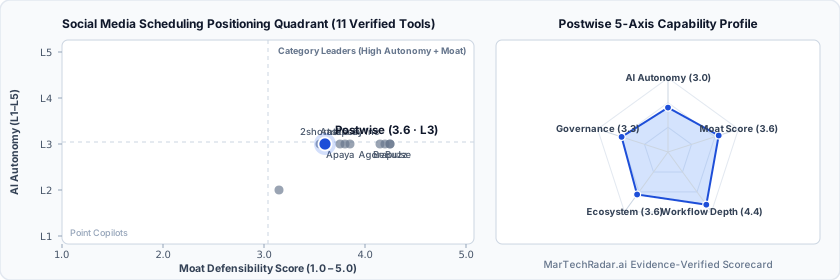
Postwise is a Web SaaS tool for Social Media Scheduling (Social Media Scheduling & Auto-Publishing) in Social & Influencer. Pricing: From $37/mo. Best suited to B2B SaaS and Creators / Solo. Editor ratings: AI autonomy L3 (conditional automation); moat score 3.6/5.0 (Proprietary moat). Fact-checked by Anthony Hay on Oct 15, 2026.
AI-powered social media copywriting and auto-publishing platform designed to generate viral content and schedule cross-channel distribution.
Postwise buyer fit verdict: when to choose vs. when to walk away
Choose Postwise if (Best Fit)
- Target ICP & Stack Fit: You operate as B2B SaaS and Creators / Solo requiring a Web SaaS deployment for Social Media Scheduling, with verified ecosystem connectivity for LinkedIn.
- L3 Architecture & Defensibility: Defensibility centers on its proprietary GhostWriter AI persona-training engine and high-engagement formatting templates optimized for algorithmic feed distribution, though underlying switching costs remain modest due to reliance on public social APIs.
- Commercial Model Fit: Your procurement budget aligns with From $37/mo.
Walk away from Postwise if (Deal-Breakers)
- Walk away if your workflow requires uncapped enterprise volume on the From $37/mo entry plan without upgrading tiers.
- Walk away if your workflow cannot tolerate API rate limiting and ephemeral network deprecations: Throughput remains strictly bound to upstream platform rate constraints, where abrupt policy shifts or API throttles on networks like X/Twitter can delay automated publishing queues without internal operational fallback.
- Walk away if deep context and factual drift is a deal-breaker for your team: The GhostWriter generation engine lacks deep retrieval-augmented integration into private enterprise systems, occasionally hallucinating domain statistics or producing generic phrasing across complex technical niches.
Postwise key facts & scorecard
| Pricing | From $37/moVendor pricing page |
|---|---|
| Free plan | No / not disclosed |
| Delivery | Web SaaS |
| Audience | B2B SaaS, Creators / Solo |
| AI autonomy level | L3 · Conditional automationEditor-verified |
| Moat tier & score | 3.6 / 5.0 · Proprietary moatEditor-verified |
| Funding | Bootstrapped |
| Company size | 2-10 employees |
| Ecosystem integrations | |
| Governance & docs | Terms ↗ · Privacy ↗ |
| Headquarters | London, GB |
| Founded | 2022 |
| Last verified |
Postwise pros & cons: strengths vs. operational limitations
Pros: core strengths & capabilities
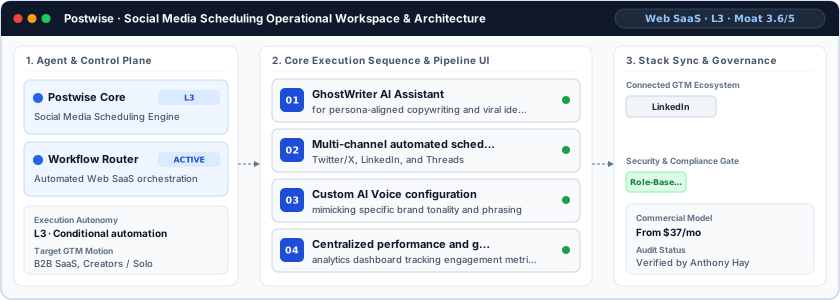
- GhostWriter AI Assistant: for persona-aligned copywriting and viral ideation
- Multi-channel automated scheduler supporting: Twitter/X, LinkedIn, and Threads
- Custom AI Voice configuration: mimicking specific brand tonality and phrasing
- Centralized performance and growth: analytics dashboard tracking engagement metrics
Cons: operational limitations & risks
- API Rate Limiting and Ephemeral Network Deprecations: Throughput remains strictly bound to upstream platform rate constraints, where abrupt policy shifts or API throttles on networks like X/Twitter can delay automated publishing queues without internal operational fallback.
- Deep Context and Factual Drift: The GhostWriter generation engine lacks deep retrieval-augmented integration into private enterprise systems, occasionally hallucinating domain statistics or producing generic phrasing across complex technical niches.
- Multi-Tiered Governance Gaps: Enterprise compliance controls—such as multi-stage legal approval workflows, role-based access permissioning, and automated audit logs—are absent, restricting deployment within heavily regulated corporate environments.
Postwise TCO & deal-breaker stress test
Simulate 12-month stepped TCO, hidden cost multipliers, contract lock-in exposure, and stack failure modes using only facts verified by Anthony Hay on · Capture SHA 081f68b1.
Postwise aligns with your 5-seat / $800/mo profile. Review the walk-away triggers and contract levers below before deployment.
| Plan / Tier | Verified Rate | Scale Fit | Scope & Quota Notes |
|---|---|---|---|
| Basic | $37/mo | 1–2 seats | Jumpstart your social media growth |
| Free | $59/mo | 5 seats | Scale your social media presence |
| Advanced | $97/mo | 15 seats | Start 7-Day Free Trial |
- Moat Score
- 3.6 / 5.0
- AI Autonomy
- L3
- Free Tier / Trial
- None disclosed
Triggered audit signals & failure modes
- Published Self-Serve Entry FloorVerified Pricing Ledger
Postwise publishes a transparent entry point (From $37/mo) for initial validation before committing.
- Tier Fit for 5-Seat Scale: Free ($59/mo)Verified Tier Schedule
Scale your social media presence
- Primary Operational Bottleneck: API Rate Limiting and Ephemeral Network DeprecationsAudit by Anthony Hay
Throughput remains strictly bound to upstream platform rate constraints, where abrupt policy shifts or API throttles on networks like X/Twitter can delay automated publishing queues without internal operational fallback.
Hidden TCO Multipliers & Quota Gates
- Credit & Usage Burn Multiplier: Automated workflows consume metered credits/usage quotas; multi-step enrichment, voice minutes, or high-frequency agent runs can trigger mid-cycle top-up packs.
- API Rate Limiting and Ephemeral Network Deprecations: Throughput remains strictly bound to upstream platform rate constraints, where abrupt policy shifts or API throttles on networks like X/Twitter can delay automated publishing queues without internal operational fallback.
- Deep Context and Factual Drift: The GhostWriter generation engine lacks deep retrieval-augmented integration into private enterprise systems, occasionally hallucinating domain statistics or producing generic phrasing across complex technical niches.
When to Walk Away & Negotiation Levers
- Walk away if your workflow requires uncapped enterprise volume on the From $37/mo entry plan without upgrading tiers.
- Walk away if your workflow cannot tolerate API rate limiting and ephemeral network deprecations: Throughput remains strictly bound to upstream platform rate constraints, where abrupt policy shifts or API throttles on networks like X/Twitter can delay automated publishing queues without internal operational fallback.
- Walk away if deep context and factual drift is a deal-breaker for your team: The GhostWriter generation engine lacks deep retrieval-augmented integration into private enterprise systems, occasionally hallucinating domain statistics or producing generic phrasing across complex technical niches.
- Validate exact quota thresholds (seats, credits, or API calls) included in Postwise's From $37/mo tier before converting from monthly to annual billing.
- Require a sandbox proof-of-concept testing API rate limiting and ephemeral network deprecations against your live CRM/data schema before annual sign-off.
Ask a custom procurement or TCO stress-test question about Postwise
Lower 5-seat floor (~$13/mo vs. $59 / mo)
Lower 5-seat floor (~$29/mo vs. $59 / mo)
Postwise key entities, modules & ecosystem stack
Postwise moat & subtrack positioning
Defensibility centers on its proprietary GhostWriter AI persona-training engine and high-engagement formatting templates optimized for algorithmic feed distribution, though underlying switching costs remain modest due to reliance on public social APIs.
Editorial review
Fact-checked by Anthony Hay (Senior SEO, Search Intelligence & Content Operations Editor) on .
Background
To capture algorithmic distribution on modern feed-driven networks, digital brands and growth teams require specialized generation engines rather than manual composition workflows. Established in 2022 and headquartered in London, GB, Postwise automates social content drafting and cross-platform publishing. Engineered primarily for independent creators, digital agencies, and B2B growth marketing teams, the platform translates raw topic prompts into feed-native short-form copy. Within the social media scheduling and auto-publishing domain, it addresses the friction of continuous publishing cadence across fast-moving network feeds.
How Postwise works
At its operational core, Postwise couples an LLM-driven generation layer dubbed GhostWriter with programmatic multi-network scheduling queues. Ingestion begins when a user submits seed topics, reference URLs, or stylistic guidelines. The platform's natural language engine parses these inputs against structural templates optimized for viral engagement metrics on X/Twitter, LinkedIn, and Threads. Once content variations are generated and tuned against custom brand voices, the orchestration engine pushes payloads through official social APIs according to predetermined calendar intervals, executing distribution at an autonomous L3 operating level.
Limitations
Operational considerations and platform boundaries include:
- API Rate Limiting and Ephemeral Network Deprecations: Throughput remains strictly bound to upstream platform rate constraints, where abrupt policy shifts or API throttles on networks like X/Twitter can delay automated publishing queues without internal operational fallback.
- Deep Context and Factual Drift: The GhostWriter generation engine lacks deep retrieval-augmented integration into private enterprise systems, occasionally hallucinating domain statistics or producing generic phrasing across complex technical niches.
- Multi-Tiered Governance Gaps: Enterprise compliance controls—such as multi-stage legal approval workflows, role-based access permissioning, and automated audit logs—are absent, restricting deployment within heavily regulated corporate environments.
Postwise pricing
Postwise employs a tiered self-serve subscription structure. Licensing begins at $37 per month for the Basic plan, which provisions 3 social accounts, 500 AI-generated posts, and 3-month scheduling horizons. The Boss tier scales to $59 per month to support 5 accounts, 1,000 monthly generated posts, and an extended 12-month scheduling window with advanced analytics. High-volume teams can adopt the Unlimited plan at $97 per month, which lifts volume thresholds across connected accounts, post generation, and calendar horizons.
How Postwise compares
Within social media operations, Postwise differentiates itself by prioritizing native generative copy synthesis over the heavy listening and governance capabilities seen across enterprise suites. While competitors like Agorapulse emphasize unified social inboxes, team governance, and customer support ticket routing, Postwise focuses squarely on outbound copy generation and queue saturation. Emerging players such as Antela.ai, Inc. and Apaya target specific content workflows, but Postwise remains optimal for agility-focused B2B teams and solo marketers who demand rapid content output across X and LinkedIn without complex administrative overhead. It is best suited for enterprise marketing teams and growth practitioners seeking disciplined workflow orchestration.
Direct competitors & market radar
Top algorithmic competitors based on category positioning, capability overlap, and ICP alignment.
Frequently asked questions about Postwise
How much does Postwise cost and what pricing tiers are available?
Published pricing summary for Postwise: From $37/mo. A permanent free plan is not disclosed for Postwise. Verified tier schedule: Basic ($37/mo for 1–2 seats); Free ($59/mo for 5 seats); Advanced ($97/mo for 15 seats). Postwise employs a tiered self-serve subscription structure. Licensing begins at $37 per month for the Basic plan, which provisions 3 social accounts, 500 AI-generated posts, and 3-month scheduling horizons.
How does Postwise work and how autonomous is its AI architecture?
AI-powered social media copywriting and auto-publishing platform designed to generate viral content and schedule cross-channel distribution. Within Social Media Scheduling (Social Media Scheduling & Auto-Publishing), MarTechRadar rates its execution architecture at L3 · Conditional automation with a verified Moat Score of 3.6 / 5.0 (Proprietary moat). Defensibility centers on its proprietary GhostWriter AI persona-training engine and high-engagement formatting templates optimized for algorithmic feed distribution, though underlying switching costs remain modest due to reliance on public social APIs. Corporate profile: operating at 2-10 employees scale.
What are the main limitations of Postwise and when should buyers walk away?
Based on our editorial technical audit, key operational considerations and boundaries for Postwise include: (1) API Rate Limiting and Ephemeral Network Deprecations: Throughput remains strictly bound to upstream platform rate constraints, where abrupt policy shifts or API throttles on networks like X/Twitter can delay automated publishing queues without internal operational fallback. (2) Deep Context and Factual Drift: The GhostWriter generation engine lacks deep retrieval-augmented integration into private enterprise systems, occasionally hallucinating domain statistics or producing generic phrasing across complex technical niches. (3) Multi-Tiered Governance Gaps: Enterprise compliance controls—such as multi-stage legal approval workflows, role-based access permissioning, and automated audit logs—are absent, restricting deployment within heavily regulated corporate environments. Primary procurement walk-away rule: Walk away if your workflow requires uncapped enterprise volume on the From $37/mo entry plan without upgrading tiers.
What integrations, compliance certifications, and contract terms apply to Postwise?
Verified ecosystem and stack integrations include LinkedIn. Key TCO multiplier to watch: Credit & Usage Burn Multiplier (Automated workflows consume metered credits/usage quotas; multi-step enrichment, voice minutes, or high-frequency agent runs can trigger mid-cycle top-up packs.) Before signing a contract, procurement teams should validate exact quota thresholds (seats, credits, or API calls) included in Postwise's From $37/mo tier before converting from monthly to annual billing.
What are the best Postwise alternatives and head-to-head competitors in 2026?
Top fact-checked alternatives to Postwise in Social Media Scheduling (Social Media Scheduling & Auto-Publishing) include Plann (From $12.50/mo), Planoly (From $3/mo), Sked Social (Free plan · $0/mo · Enterprise plan), TweetHunter (From $29/mo). Within social media operations, Postwise differentiates itself by prioritizing native generative copy synthesis over the heavy listening and governance capabilities seen across enterprise suites.
Verified sources & evidence trail
- Official product domain: https://postwise.ai
- Commercial pricing verification: https://postwise.ai/pricing
- Verified corporate entity profiles (
sameAs): LinkedIn Company Profile · Crunchbase Entity Record - First-party governance & documentation links: Terms · Privacy
- Editorial audit sign-off: Fact-checked by Anthony Hay on under the MarTechRadar Evidence-Ledger Protocol.