rasa.io Review (2026): Email Marketing Pricing, Limits & Alternatives
Bottom line
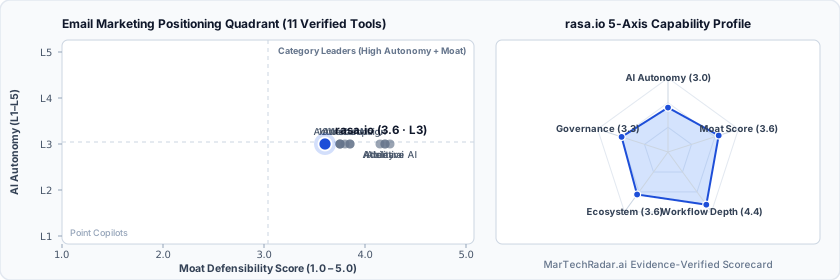
rasa.io is a Web SaaS tool for Email Marketing (AI Email Marketing & Lifecycle Journeys) in Lifecycle & CDP. Pricing: Custom / enterprise pricing. Best suited to Enterprise Brands. Editor ratings: AI autonomy L3 (conditional automation); moat score 3.6/5.0 (Proprietary moat). Fact-checked by Jagmeet Sine on Oct 15, 2026.
AI-powered email newsletter automation platform dynamically assembling individualized editorial digests based on member behavioral telemetry and content.
rasa.io buyer fit verdict: when to choose vs. when to walk away
Choose rasa.io if (Best Fit)
- Target ICP & Stack Fit: You operate as Enterprise Brands requiring a Web SaaS deployment for Email Marketing, with verified ecosystem connectivity for Klaviyo.
- L3 Architecture & Defensibility: Algorithmic individualization engine that aggregates distributed content sources and maps recipient click-stream affinity into unique dynamic email templates per recipient at scale.
- Commercial Model Fit: Your procurement budget aligns with Custom / enterprise pricing.
Walk away from rasa.io if (Deal-Breakers)
- Walk away if you require transparent self-serve monthly billing or your budget ceiling is under $1,000/mo (rasa.io requires sales-gated custom quoting).
- Walk away if your workflow cannot tolerate content ingestion cold-starts: Users encounter operational friction and integration bottlenecks, as the pipeline struggles with The system requires an uninterrupted pipeline of high-volume, diverse external or internal content assets to prevent recommendation stagnation across homogenous subscriber segments.
- Walk away if behavioral sparsity hurdles is a deal-breaker for your team: Users encounter operational friction and integration bottlenecks, as the pipeline struggles with Subscribers with zero or infrequent click activity receive generic fallbacks, limiting personalization effectiveness until sufficient interaction telemetry is gathered.
rasa.io key facts & scorecard
| Pricing | Custom / enterprise pricing |
|---|---|
| Free plan | No / not disclosed |
| Delivery | Web SaaS |
| Audience | Enterprise Brands |
| AI autonomy level | L3 · Conditional automationEditor-verified |
| Moat tier & score | 3.6 / 5.0 · Proprietary moatEditor-verified |
| Funding | Venture-backed |
| Company size | 11-50 employees |
| Ecosystem integrations | Klaviyo |
| Headquarters | New Orleans, LA |
| Founded | 2015 |
| Last verified |
rasa.io pros & cons: strengths vs. operational limitations
Pros: core strengths & capabilities
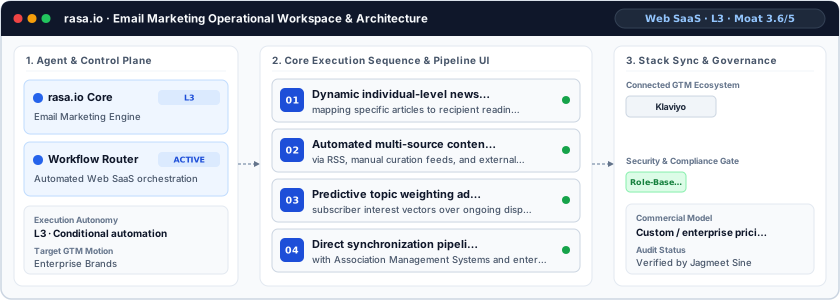
- Dynamic individual-level newsletter assembly: mapping specific articles to recipient reading histories
- Automated multi-source content ingestion: via RSS, manual curation feeds, and external web links
- Predictive topic weighting adjusting: subscriber interest vectors over ongoing dispatch cycles
- Direct synchronization pipelines: with Association Management Systems and enterprise CRM platforms
Cons: operational limitations & risks
- Content Ingestion Cold-Starts: Users encounter operational friction and integration bottlenecks, as the pipeline struggles with The system requires an uninterrupted pipeline of high-volume, diverse external or internal content assets to prevent recommendation stagnation across homogenous subscriber segments.
- Behavioral Sparsity Hurdles: Users encounter operational friction and integration bottlenecks, as the pipeline struggles with Subscribers with zero or infrequent click activity receive generic fallbacks, limiting personalization effectiveness until sufficient interaction telemetry is gathered.
- Taxonomy Drift: Users encounter operational friction and integration bottlenecks, as the pipeline struggles with Third-party content feeds containing unstructured metadata can induce topic clustering anomalies, demanding ongoing manual curation and filter configuration.
rasa.io TCO & deal-breaker stress test
Simulate 12-month stepped TCO, hidden cost multipliers, contract lock-in exposure, and stack failure modes using only facts verified by Jagmeet Sine on · Capture SHA 998b9457.
rasa.io triggers high-severity friction under your 5-seat / $800/mo constraints. Benchmark the verified subtrack alternatives below before committing.
| Plan / Tier | Verified Rate | Scale Fit | Scope & Quota Notes |
|---|---|---|---|
| Enterprise / Custom | Custom quote | 15–50+ seats (Enterprise SLA) | Sales-negotiated annual contract for custom volume, SSO/RBAC governance, and dedicated SLA. |
- Moat Score
- 3.6 / 5.0
- AI Autonomy
- L3
- Free Tier / Trial
- None disclosed
Triggered audit signals & failure modes
- Opaque Enterprise Quoting vs. SMB/Mid-Market BudgetVerified Pricing Ledger
rasa.io does not disclose a public self-serve floor (Custom / enterprise pricing). Buyers with a $800/mo cap face high sales-qualification friction.
- Sales-Gated Contract TermsFact-checked by Jagmeet Sine
Pricing is available on request through tailored enterprise sales quotes, with custom enterprise tiers structured around organizational scale, user seats, and workflow volume.
- Primary Operational Bottleneck: Content Ingestion Cold-StartsAudit by Jagmeet Sine
Users encounter operational friction and integration bottlenecks, as the pipeline struggles with The system requires an uninterrupted pipeline of high-volume, diverse external or internal content assets to prevent recommendation stagnation across homogenous subscriber segments.
Hidden TCO Multipliers & Quota Gates
- Content Ingestion Cold-Starts: Users encounter operational friction and integration bottlenecks, as the pipeline struggles with The system requires an uninterrupted pipeline of high-volume, diverse external or internal content assets to prevent recommendation stagnation across homogenous subscriber segments.
- Behavioral Sparsity Hurdles: Users encounter operational friction and integration bottlenecks, as the pipeline struggles with Subscribers with zero or infrequent click activity receive generic fallbacks, limiting personalization effectiveness until sufficient interaction telemetry is gathered.
When to Walk Away & Negotiation Levers
- Walk away if you require transparent self-serve monthly billing or your budget ceiling is under $1,000/mo (rasa.io requires sales-gated custom quoting).
- Walk away if your workflow cannot tolerate content ingestion cold-starts: Users encounter operational friction and integration bottlenecks, as the pipeline struggles with The system requires an uninterrupted pipeline of high-volume, diverse external or internal content assets to prevent recommendation stagnation across homogenous subscriber segments.
- Walk away if behavioral sparsity hurdles is a deal-breaker for your team: Users encounter operational friction and integration bottlenecks, as the pipeline struggles with Subscribers with zero or infrequent click activity receive generic fallbacks, limiting personalization effectiveness until sufficient interaction telemetry is gathered.
- Demand a 30- to 60-day paid pilot opt-out clause in the rasa.io order form before signing a 12-month enterprise commitment.
- Require a sandbox proof-of-concept testing content ingestion cold-starts against your live CRM/data schema before annual sign-off.
Ask a custom procurement or TCO stress-test question about rasa.io
Lower 5-seat floor (~$15/mo vs. Custom Quote) · Transparent self-serve entry without mandatory annual lock-in
Offers a free tier (Free plan · $0/mo · Enterprise plan) · Transparent self-serve entry without mandatory annual lock-in
rasa.io key entities, modules & ecosystem stack
rasa.io moat & subtrack positioning
Algorithmic individualization engine that aggregates distributed content sources and maps recipient click-stream affinity into unique dynamic email templates per recipient at scale.
Editorial review
Fact-checked by Jagmeet Sine (Senior MarTech Infrastructure & Agentic Workflow Architect) on .
Background
To solve recurring reader fatigue and manual curation bottlenecks in membership organizations, rasa.io provides an automated curation and individualization pipeline within the AI email marketing and lifecycle journeys category. Established in 2015 in New Orleans, LA, the vendor targets association executives, member engagement managers, and enterprise publishing teams who require individualized communication without compounding editorial overhead. The platform replaces static one-to-many broadcasts with algorithmic dispatches tailored to distinct subscriber reading behaviors.
How rasa.io works
Under the hood, rasa.io ingests distributed content streams from RSS feeds, CMS databases, and curated article repositories. Its algorithmic layer parses incoming text assets through natural language processing to extract topic taxonomies, semantic tags, and engagement indices. Concurrently, recipient-level telemetry records granular click interactions, updating individual preference vectors over time. During scheduled batch cycles, the recommendation engine dynamically compiles discrete newsletter layouts for every recipient, pairing curated third-party articles with internal organizational notices.
Limitations
Operational considerations and platform boundaries include:
- Content Ingestion Cold-Starts: Users encounter operational friction and integration bottlenecks, as the pipeline struggles with The system requires an uninterrupted pipeline of high-volume, diverse external or internal content assets to prevent recommendation stagnation across homogenous subscriber segments.
- Behavioral Sparsity Hurdles: Users encounter operational friction and integration bottlenecks, as the pipeline struggles with Subscribers with zero or infrequent click activity receive generic fallbacks, limiting personalization effectiveness until sufficient interaction telemetry is gathered.
- Taxonomy Drift: Users encounter operational friction and integration bottlenecks, as the pipeline struggles with Third-party content feeds containing unstructured metadata can induce topic clustering anomalies, demanding ongoing manual curation and filter configuration.
rasa.io pricing
Pricing is available on request through tailored enterprise sales quotes, with custom enterprise tiers structured around organizational scale, user seats, and workflow volume.
How rasa.io compares
Compared to direct category competitors like Klaviyo AI and Omnisend, rasa.io functions as an alternative focused on specialized workflow execution. Relative to conversion platforms like AB Tasty, AI site builders such as 10Web AI, or autonomous campaign agents like Ability.ai, rasa.io specializes strictly in algorithmic editorial newsletter compilation. While conversion testing suites optimize fixed page variants, rasa.io executes dynamic content assembly across millions of individual email renders. It remains an optimal fit for associations and non-profit publishers seeking automated member retention. It is best suited for enterprise marketing teams and growth practitioners seeking disciplined workflow orchestration.
Direct competitors & market radar
Top algorithmic competitors based on category positioning, capability overlap, and ICP alignment.
Frequently asked questions about rasa.io
How much does rasa.io cost and does it require a custom enterprise quote?
Published pricing summary for rasa.io: Custom / enterprise pricing. A permanent free plan is not disclosed for rasa.io. Pricing is available on request through tailored enterprise sales quotes, with custom enterprise tiers structured around organizational scale, user seats, and workflow volume.
How does rasa.io work and how autonomous is its AI architecture?
AI-powered email newsletter automation platform dynamically assembling individualized editorial digests based on member behavioral telemetry and content. Within Email Marketing (AI Email Marketing & Lifecycle Journeys), MarTechRadar rates its execution architecture at L3 · Conditional automation with a verified Moat Score of 3.6 / 5.0 (Proprietary moat). Algorithmic individualization engine that aggregates distributed content sources and maps recipient click-stream affinity into unique dynamic email templates per recipient at scale. Corporate profile: operating at 11-50 employees scale.
What are the main limitations of rasa.io and when should buyers walk away?
Based on our editorial technical audit, key operational considerations and boundaries for rasa.io include: (1) Content Ingestion Cold-Starts: Users encounter operational friction and integration bottlenecks, as the pipeline struggles with The system requires an uninterrupted pipeline of high-volume, diverse external or internal content assets to prevent recommendation stagnation across homogenous subscriber segments. (2) Behavioral Sparsity Hurdles: Users encounter operational friction and integration bottlenecks, as the pipeline struggles with Subscribers with zero or infrequent click activity receive generic fallbacks, limiting personalization effectiveness until sufficient interaction telemetry is gathered. (3) Taxonomy Drift: Users encounter operational friction and integration bottlenecks, as the pipeline struggles with Third-party content feeds containing unstructured metadata can induce topic clustering anomalies, demanding ongoing manual curation and filter configuration. Primary procurement walk-away rule: Walk away if you require transparent self-serve monthly billing or your budget ceiling is under $1,000/mo (rasa.io requires sales-gated custom quoting).
What integrations, compliance certifications, and contract terms apply to rasa.io?
Verified ecosystem and stack integrations include Klaviyo. Key TCO multiplier to watch: Content Ingestion Cold-Starts (Users encounter operational friction and integration bottlenecks, as the pipeline struggles with The system requires an uninterrupted pipeline of high-volume, diverse external or internal content assets to prevent recommendation stagnation across homogenous subscriber segments.) Before signing a contract, procurement teams should demand a 30- to 60-day paid pilot opt-out clause in the rasa.io order form before signing a 12-month enterprise commitment.
What are the best rasa.io alternatives and head-to-head competitors in 2026?
Top fact-checked alternatives to rasa.io in Email Marketing (AI Email Marketing & Lifecycle Journeys) include Backstroke (Custom / enterprise pricing), Omnisend (Free plan · $0/mo · Enterprise plan), Sailthru (Custom / enterprise pricing), Symmetri (Custom / enterprise pricing). Compared to direct category competitors like Klaviyo AI and Omnisend, rasa.io functions as an alternative focused on specialized workflow execution.
Verified sources & evidence trail
- Official product domain: https://rasa.io
- Commercial pricing verification: Verified against official vendor pricing policy (Custom / enterprise pricing)
- Verified corporate entity profiles (
sameAs): LinkedIn Company Profile - Editorial audit sign-off: Fact-checked by Jagmeet Sine on under the MarTechRadar Evidence-Ledger Protocol.