Revcontent Review (2026): AI Programmatic Advertising Pricing, Limits & Alternatives
Bottom line
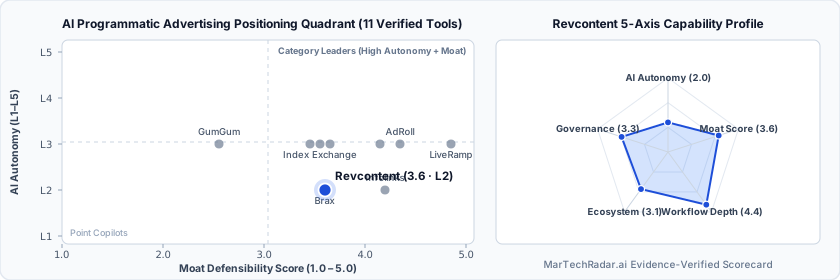
Revcontent is a Web SaaS tool for AI Programmatic Advertising (Programmatic DSP/SSP & Contextual AdTech) in AdTech & Paid Media. Pricing: Custom / enterprise pricing. Best suited to Creators / Solo. Editor ratings: AI autonomy L2 (workflow copilot); moat score 3.6/5.0 (Proprietary moat). Fact-checked by Vasilia Xia on Oct 14, 2026.
Native advertising network and content recommendation platform delivering lightweight programmatic monetization widgets for publishers and granular.
Revcontent buyer fit verdict: when to choose vs. when to walk away
Choose Revcontent if (Best Fit)
- Target ICP & Stack Fit: You operate as Creators / Solo requiring a Web SaaS deployment for AI Programmatic Advertising.
- L2 Architecture & Defensibility: Revcontent maintains competitive defensibility through lightweight JavaScript widget rendering that protects publisher Core Web Vitals, combined with selective publisher supply partnerships and private equity backing from Star Mountain Capital.
- Commercial Model Fit: Your procurement budget aligns with Custom / enterprise pricing.
Walk away from Revcontent if (Deal-Breakers)
- Walk away if you require transparent self-serve monthly billing or your budget ceiling is under $1,000/mo (Revcontent requires sales-gated custom quoting).
- Walk away if your workflow cannot tolerate traffic quality variance: Advertisers must continuously maintain exclusion lists to filter low-engagement domains across mid-tier syndicated publishers.
- Walk away if creative latency vulnerability is a deal-breaker for your team: Unoptimized third-party advertiser assets can degrade client Core Web Vitals if media payloads bypass aggressive local edge caching.
Revcontent key facts & scorecard
| Pricing | Custom / enterprise pricing |
|---|---|
| Free plan | No / not disclosed |
| Delivery | Web SaaS |
| Audience | Creators / Solo |
| AI autonomy level | L2 · Workflow copilotEditor-verified |
| Moat tier & score | 3.6 / 5.0 · Proprietary moatEditor-verified |
| Funding | AcquiredAcquired by Star Mountain Capital |
| Founders | John Lemp |
| Company size | 51-200 employees |
| Governance & docs | Privacy ↗ |
| Headquarters | Sarasota, Florida |
| Founded | 2013 |
| Last verified |
Revcontent pros & cons: strengths vs. operational limitations
Pros: core strengths & capabilities
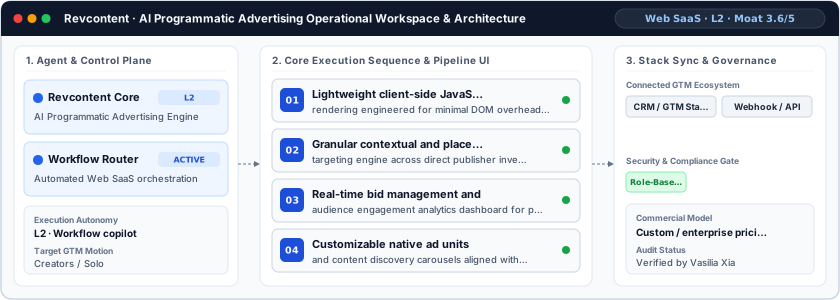
- Lightweight client-side JavaScript widget: rendering engineered for minimal DOM overhead and fast site speed
- Granular contextual and placement-level: targeting engine across direct publisher inventory
- Real-time bid management and: audience engagement analytics dashboard for performance media buyers
- Customizable native ad units: and content discovery carousels aligned with publisher editorial layouts
Cons: operational limitations & risks
- Traffic Quality Variance: Advertisers must continuously maintain exclusion lists to filter low-engagement domains across mid-tier syndicated publishers.
- Creative Latency Vulnerability: Unoptimized third-party advertiser assets can degrade client Core Web Vitals if media payloads bypass aggressive local edge caching.
- Conversion Attribution Discrepancies: Post-click tracking relies heavily on redirect parameters and pixel firing, creating reporting mismatches against strict browser privacy sandboxes.
Revcontent TCO & deal-breaker stress test
Simulate 12-month stepped TCO, hidden cost multipliers, contract lock-in exposure, and stack failure modes using only facts verified by Vasilia Xia on · Capture SHA 895c2b78.
Revcontent triggers high-severity friction under your 5-seat / $800/mo constraints. Benchmark the verified subtrack alternatives below before committing.
| Plan / Tier | Verified Rate | Scale Fit | Scope & Quota Notes |
|---|---|---|---|
| Enterprise / Custom | Custom quote | 15–50+ seats (Enterprise SLA) | Sales-negotiated annual contract for custom volume, SSO/RBAC governance, and dedicated SLA. |
- Moat Score
- 3.6 / 5.0
- AI Autonomy
- L2
- Free Tier / Trial
- None disclosed
Triggered audit signals & failure modes
- Opaque Enterprise Quoting vs. SMB/Mid-Market BudgetVerified Pricing Ledger
Revcontent does not disclose a public self-serve floor (Custom / enterprise pricing). Buyers with a $800/mo cap face high sales-qualification friction.
- Sales-Gated Contract TermsFact-checked by Vasilia Xia
Revcontent structures its commercial licensing model without published public rates.
- Primary Operational Bottleneck: Traffic Quality VarianceAudit by Vasilia Xia
Advertisers must continuously maintain exclusion lists to filter low-engagement domains across mid-tier syndicated publishers.
Hidden TCO Multipliers & Quota Gates
- Traffic Quality Variance: Advertisers must continuously maintain exclusion lists to filter low-engagement domains across mid-tier syndicated publishers.
- Creative Latency Vulnerability: Unoptimized third-party advertiser assets can degrade client Core Web Vitals if media payloads bypass aggressive local edge caching.
When to Walk Away & Negotiation Levers
- Walk away if you require transparent self-serve monthly billing or your budget ceiling is under $1,000/mo (Revcontent requires sales-gated custom quoting).
- Walk away if your workflow cannot tolerate traffic quality variance: Advertisers must continuously maintain exclusion lists to filter low-engagement domains across mid-tier syndicated publishers.
- Walk away if creative latency vulnerability is a deal-breaker for your team: Unoptimized third-party advertiser assets can degrade client Core Web Vitals if media payloads bypass aggressive local edge caching.
- Demand a 30- to 60-day paid pilot opt-out clause in the Revcontent order form before signing a 12-month enterprise commitment.
- Require a sandbox proof-of-concept testing traffic quality variance against your live CRM/data schema before annual sign-off.
Ask a custom procurement or TCO stress-test question about Revcontent
Lower 5-seat floor (~$36/mo vs. Custom Quote) · Transparent self-serve entry without mandatory annual lock-in
Transparent self-serve entry without mandatory annual lock-in
Revcontent moat & subtrack positioning
Revcontent maintains competitive defensibility through lightweight JavaScript widget rendering that protects publisher Core Web Vitals, combined with selective publisher supply partnerships and private equity backing from Star Mountain Capital.
Editorial review
Fact-checked by Vasilia Xia (E-Commerce, Lifecycle & Retention Marketing Analyst) on .
Background
Established in 2013 in Sarasota, Florida, Revcontent built an independent native advertising and content recommendation network before its acquisition by Star Mountain Capital. Operating across Programmatic DSP/SSP and contextual adtech ecosystems, the platform positions itself away from cluttered, high-latency discovery grids. Its primary personas comprise digital media publishers seeking predictable yield without degrading page performance, alongside performance marketers demanding brand-safe native inventory.
How Revcontent works
Architecturally, Revcontent functions via an asynchronous client-side JavaScript tag injected into publisher environments. When an end-user triggers a pageview, the lightweight tag fires microsecond telemetry requests to Revcontent ad servers, passing contextual page metadata, device signals, and referral parameters. The backend matching engine calculates bid priority through historical click-through rates and advertiser target parameters, rendering native content carousels directly into the document object model. Operating at an L2 autonomy tier, the system optimizes impression yields dynamically while requiring advertisers to manually define target bids, budgets, and creative variants.
Limitations
Operational considerations and platform boundaries include:
- Traffic Quality Variance: Advertisers must continuously maintain exclusion lists to filter low-engagement domains across mid-tier syndicated publishers.
- Creative Latency Vulnerability: Unoptimized third-party advertiser assets can degrade client Core Web Vitals if media payloads bypass aggressive local edge caching.
- Conversion Attribution Discrepancies: Post-click tracking relies heavily on redirect parameters and pixel firing, creating reporting mismatches against strict browser privacy sandboxes.
Revcontent pricing
Revcontent structures its commercial licensing model without published public rates. Monetization is handled through rev-share splits for publisher inventory, while commercial pricing for enterprise media buyers is available on request through tailored enterprise sales quotes based on organizational scale and seats. Advertiser spend operates through flexible managed or self-serve balance allocations determined directly with sales representatives, eliminating standardized SaaS tiers.
How Revcontent compares
Within programmatic and contextual channels, Revcontent occupies a distinct operational lane compared to broader ecosystems. While LiveRamp focuses on identity resolution data pipelines and GumGum leverages computer vision for in-image contextual placements, Revcontent concentrates strictly on editorial recommendation widgets. Unlike AdRoll, which prioritizes cross-channel social and retargeting automation for direct-to-consumer catalogs, Revcontent targets high-volume web publishers and direct-response performance media buyers seeking low-overhead contextual inventory.
Direct competitors & market radar
Top algorithmic competitors based on category positioning, capability overlap, and ICP alignment.
Frequently asked questions about Revcontent
How much does Revcontent cost and does it require a custom enterprise quote?
Published pricing summary for Revcontent: Custom / enterprise pricing. A permanent free plan is not disclosed for Revcontent. Revcontent structures its commercial licensing model without published public rates. Monetization is handled through rev-share splits for publisher inventory, while commercial pricing for enterprise media buyers is available on request through tailored enterprise sales quotes based on organizational scale and seats.
How does Revcontent work and how autonomous is its AI architecture?
Native advertising network and content recommendation platform delivering lightweight programmatic monetization widgets for publishers and granular. Within AI Programmatic Advertising (Programmatic DSP/SSP & Contextual AdTech), MarTechRadar rates its execution architecture at L2 · Workflow copilot with a verified Moat Score of 3.6 / 5.0 (Proprietary moat). Revcontent maintains competitive defensibility through lightweight JavaScript widget rendering that protects publisher Core Web Vitals, combined with selective publisher supply partnerships and private equity backing from Star Mountain Capital. Corporate profile: Founded by John Lemp, operating at 51-200 employees scale, acquired by Star Mountain Capital.
What are the main limitations of Revcontent and when should buyers walk away?
Based on our editorial technical audit, key operational considerations and boundaries for Revcontent include: (1) Traffic Quality Variance: Advertisers must continuously maintain exclusion lists to filter low-engagement domains across mid-tier syndicated publishers. (2) Creative Latency Vulnerability: Unoptimized third-party advertiser assets can degrade client Core Web Vitals if media payloads bypass aggressive local edge caching. (3) Conversion Attribution Discrepancies: Post-click tracking relies heavily on redirect parameters and pixel firing, creating reporting mismatches against strict browser privacy sandboxes. Primary procurement walk-away rule: Walk away if you require transparent self-serve monthly billing or your budget ceiling is under $1,000/mo (Revcontent requires sales-gated custom quoting).
What integrations, compliance certifications, and contract terms apply to Revcontent?
Key TCO multiplier to watch: Traffic Quality Variance (Advertisers must continuously maintain exclusion lists to filter low-engagement domains across mid-tier syndicated publishers.) Before signing a contract, procurement teams should demand a 30- to 60-day paid pilot opt-out clause in the Revcontent order form before signing a 12-month enterprise commitment.
What are the best Revcontent alternatives and head-to-head competitors in 2026?
Top fact-checked alternatives to Revcontent in AI Programmatic Advertising (Programmatic DSP/SSP & Contextual AdTech) include Brax (From $1/mo), Media.net (Custom / enterprise pricing), Imprezia (Pricing not disclosed), Seedtag (Custom / enterprise pricing). Within programmatic and contextual channels, Revcontent occupies a distinct operational lane compared to broader ecosystems.
Verified sources & evidence trail
- Official product domain: https://revcontent.com
- Commercial pricing verification: Verified against official vendor pricing policy (Custom / enterprise pricing)
- Verified corporate entity profiles (
sameAs): LinkedIn Company Profile · Crunchbase Entity Record - First-party governance & documentation links: Privacy
- Editorial audit sign-off: Fact-checked by Vasilia Xia on under the MarTechRadar Evidence-Ledger Protocol.