Sharethrough Review (2026): AI Programmatic Advertising Pricing, Limits & Alternatives
Bottom line
Sharethrough is a Web SaaS tool for AI Programmatic Advertising (Programmatic DSP/SSP & Contextual AdTech) in AdTech & Paid Media. Pricing: Custom / enterprise pricing. Best suited to DTC / eCommerce and Enterprise Brands. Editor ratings: AI autonomy L3 (conditional automation); moat score 4.2/5.0 (Proprietary moat). Fact-checked by Vasilia Xia on Oct 14, 2026.
Omnichannel supply-side platform delivering automated ad enhancement rendering, curated marketplace inventory, and carbon-reduction programmatic routing.
Sharethrough buyer fit verdict: when to choose vs. when to walk away
Choose Sharethrough if (Best Fit)
- Target ICP & Stack Fit: You operate as DTC / eCommerce and Enterprise Brands requiring a Web SaaS deployment for AI Programmatic Advertising.
- L3 Architecture & Defensibility: Proprietary client-side rendering engines that dynamically enhance standard display and CTV units, combined with direct publisher integrations and unified Equativ monetization infrastructure.
- Commercial Model Fit: Your procurement budget aligns with Custom / enterprise pricing.
Walk away from Sharethrough if (Deal-Breakers)
- Walk away if you require transparent self-serve monthly billing or your budget ceiling is under $1,000/mo (Sharethrough requires sales-gated custom quoting).
- Walk away if your workflow cannot tolerate client-side script overhead: Dynamic creative modification libraries injected during header bidding execution increase browser DOM parsing time, risking Core Web Vitals score degradation on high-density publisher layouts.
- Walk away if dsp inventory parity constraints is a deal-breaker for your team: Proprietary enhanced rendering formats can experience parsing inconsistencies across older programmatic DSP endpoints that strictly enforce plain VAST or static MRAID specifications.
Sharethrough key facts & scorecard
| Pricing | Custom / enterprise pricing |
|---|---|
| Free plan | No / not disclosed |
| Delivery | Web SaaS |
| Audience | DTC / eCommerce, Enterprise Brands |
| AI autonomy level | L3 · Conditional automationEditor-verified |
| Moat tier & score | 4.2 / 5.0 · Proprietary moatEditor-verified |
| Funding | AcquiredAcquired by Sharethrough |
| Total funding | $67.9M |
| Founders | Brett Keintz, Dan Greenberg, Matt Monahan, Robert Fan |
| Company size | 51-200 employees |
| Headquarters | Montreal, Quebec |
| Founded | 2007 |
| Last verified |
Sharethrough pros & cons: strengths vs. operational limitations
Pros: core strengths & capabilities
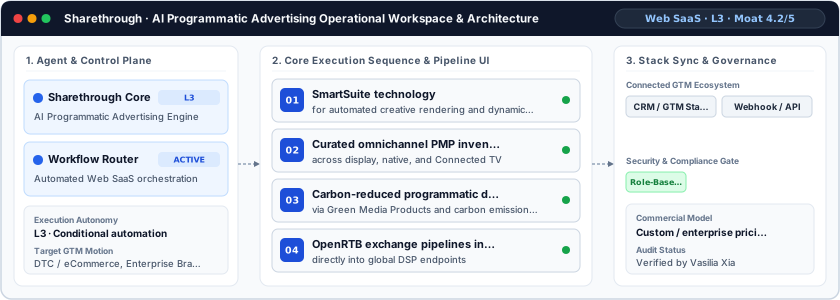
- SmartSuite technology: for automated creative rendering and dynamic video captions
- Curated omnichannel PMP inventory: across display, native, and Connected TV
- Carbon-reduced programmatic delivery: via Green Media Products and carbon emission modeling
- OpenRTB exchange pipelines integrated: directly into global DSP endpoints
Cons: operational limitations & risks
- Client-Side Script Overhead: Dynamic creative modification libraries injected during header bidding execution increase browser DOM parsing time, risking Core Web Vitals score degradation on high-density publisher layouts.
- DSP Inventory Parity Constraints: Proprietary enhanced rendering formats can experience parsing inconsistencies across older programmatic DSP endpoints that strictly enforce plain VAST or static MRAID specifications.
- Equativ Migration Friction: Unified infrastructure alignment post-merger requires ongoing reconciliation of legacy publisher IDs, reporting schemas, and contract parameters across combined ad server environments.
Sharethrough TCO & deal-breaker stress test
Simulate 12-month stepped TCO, hidden cost multipliers, contract lock-in exposure, and stack failure modes using only facts verified by Vasilia Xia on · Capture SHA df2645cf.
Sharethrough triggers high-severity friction under your 5-seat / $800/mo constraints. Benchmark the verified subtrack alternatives below before committing.
| Plan / Tier | Verified Rate | Scale Fit | Scope & Quota Notes |
|---|---|---|---|
| Enterprise / Custom | Custom quote | 15–50+ seats (Enterprise SLA) | Sales-negotiated annual contract for custom volume, SSO/RBAC governance, and dedicated SLA. |
- Moat Score
- 4.2 / 5.0
- AI Autonomy
- L3
- Free Tier / Trial
- None disclosed
Triggered audit signals & failure modes
- Opaque Enterprise Quoting vs. SMB/Mid-Market BudgetVerified Pricing Ledger
Sharethrough does not disclose a public self-serve floor (Custom / enterprise pricing). Buyers with a $800/mo cap face high sales-qualification friction.
- Sales-Gated Contract TermsFact-checked by Vasilia Xia
Sharethrough operates on an enterprise transactional model wherein commercial pricing is available on request through tailored enterprise sales quotes based on organizational scale and seats.
- Primary Operational Bottleneck: Equativ Migration FrictionAudit by Vasilia Xia
Unified infrastructure alignment post-merger requires ongoing reconciliation of legacy publisher IDs, reporting schemas, and contract parameters across combined ad server environments.
Hidden TCO Multipliers & Quota Gates
- Client-Side Script Overhead: Dynamic creative modification libraries injected during header bidding execution increase browser DOM parsing time, risking Core Web Vitals score degradation on high-density publisher layouts.
- DSP Inventory Parity Constraints: Proprietary enhanced rendering formats can experience parsing inconsistencies across older programmatic DSP endpoints that strictly enforce plain VAST or static MRAID specifications.
When to Walk Away & Negotiation Levers
- Walk away if you require transparent self-serve monthly billing or your budget ceiling is under $1,000/mo (Sharethrough requires sales-gated custom quoting).
- Walk away if your workflow cannot tolerate client-side script overhead: Dynamic creative modification libraries injected during header bidding execution increase browser DOM parsing time, risking Core Web Vitals score degradation on high-density publisher layouts.
- Walk away if dsp inventory parity constraints is a deal-breaker for your team: Proprietary enhanced rendering formats can experience parsing inconsistencies across older programmatic DSP endpoints that strictly enforce plain VAST or static MRAID specifications.
- Demand a 30- to 60-day paid pilot opt-out clause in the Sharethrough order form before signing a 12-month enterprise commitment.
- Require a sandbox proof-of-concept testing client-side script overhead against your live CRM/data schema before annual sign-off.
Ask a custom procurement or TCO stress-test question about Sharethrough
Lower 5-seat floor (~$36/mo vs. Custom Quote) · Transparent self-serve entry without mandatory annual lock-in
Verified AI Programmatic Advertising peer (Custom / enterprise pricing · Moat 4.2/5.0)
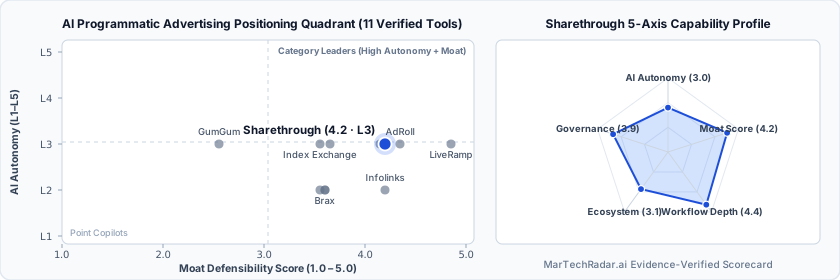
Sharethrough moat & subtrack positioning
Proprietary client-side rendering engines that dynamically enhance standard display and CTV units, combined with direct publisher integrations and unified Equativ monetization infrastructure.
Editorial review
Fact-checked by Vasilia Xia (E-Commerce, Lifecycle & Retention Marketing Analyst) on .
Background
Within the supply-side programmatic monetization landscape, Sharethrough was established in 2007 in Montreal, Quebec, securing $67.9M in aggregate funding before unifying operations under the Equativ brand. Built for enterprise publishers, agency trading desks, and programmatic media planners, the platform acts as an omnichannel supply-side exchange across display, video, and connected television. Rather than functioning as a standard intermediary pipeline, it centers on rendering-layer optimizations that modify standard standard creative assets into native, captioned, or context-aware formats to preserve publisher viewability and engagement metrics.
How Sharethrough works
Operating at an L3 conditional execution baseline, the system processes OpenRTB auction cycles via direct server-to-server endpoints and client-side header bidding wrappers. As bid requests route through the SSP exchange, Sharethrough's SmartSuite engine intercepts standard creative payloads to dynamically inject dynamic captions, optimized native framing, or interactive video overlays before rendering in browser viewports. Concurrently, the platform enforces automated supply path optimization and green media routing filters, recalculating transaction pathways based on publisher carbon impact, viewability telemetry, and direct DSP private marketplace contract configurations.
Limitations
Operational considerations and platform boundaries include:
- Client-Side Script Overhead: Dynamic creative modification libraries injected during header bidding execution increase browser DOM parsing time, risking Core Web Vitals score degradation on high-density publisher layouts.
- DSP Inventory Parity Constraints: Proprietary enhanced rendering formats can experience parsing inconsistencies across older programmatic DSP endpoints that strictly enforce plain VAST or static MRAID specifications.
- Equativ Migration Friction: Unified infrastructure alignment post-merger requires ongoing reconciliation of legacy publisher IDs, reporting schemas, and contract parameters across combined ad server environments.
Sharethrough pricing
Sharethrough operates on an enterprise transactional model wherein commercial pricing is available on request through tailored enterprise sales quotes based on organizational scale and seats. Supply partners access the SSP via automated revenue-share deductions calculated against cleared gross media auctions, while media buyers secure curated private marketplace packages and inventory deals negotiated directly through institutional programmatic managed service or seat agreements without upfront public rate cards.
How Sharethrough compares
Relative to contextual intelligence vendors like GumGum, Sharethrough focuses on dynamic rendering modifications and supply-side auction pipes rather than raw computer-vision placement gating. Compared to identity infrastructure providers like LiveRamp, the platform consumes downstream identity graphs to package addressable private marketplaces rather than orchestrating deterministic offline resolution. Against buy-side DSP tools like AdRoll, it remains an enterprise SSP suited for high-volume digital publishers and holding company media buyers requiring programmatic yield management.
Direct competitors & market radar
Top algorithmic competitors based on category positioning, capability overlap, and ICP alignment.
Frequently asked questions about Sharethrough
How much does Sharethrough cost and does it require a custom enterprise quote?
Published pricing summary for Sharethrough: Custom / enterprise pricing. A permanent free plan is not disclosed for Sharethrough. Sharethrough operates on an enterprise transactional model wherein commercial pricing is available on request through tailored enterprise sales quotes based on organizational scale and seats.
How does Sharethrough work and how autonomous is its AI architecture?
Omnichannel supply-side platform delivering automated ad enhancement rendering, curated marketplace inventory, and carbon-reduction programmatic routing. Within AI Programmatic Advertising (Programmatic DSP/SSP & Contextual AdTech), MarTechRadar rates its execution architecture at L3 · Conditional automation with a verified Moat Score of 4.2 / 5.0 (Proprietary moat). Proprietary client-side rendering engines that dynamically enhance standard display and CTV units, combined with direct publisher integrations and unified Equativ monetization infrastructure. Corporate profile: Founded by Brett Keintz, Dan Greenberg, Matt Monahan, Robert Fan, operating at 51-200 employees scale, acquired by Sharethrough.
What are the main limitations of Sharethrough and when should buyers walk away?
Based on our editorial technical audit, key operational considerations and boundaries for Sharethrough include: (1) Client-Side Script Overhead: Dynamic creative modification libraries injected during header bidding execution increase browser DOM parsing time, risking Core Web Vitals score degradation on high-density publisher layouts. (2) DSP Inventory Parity Constraints: Proprietary enhanced rendering formats can experience parsing inconsistencies across older programmatic DSP endpoints that strictly enforce plain VAST or static MRAID specifications. (3) Equativ Migration Friction: Unified infrastructure alignment post-merger requires ongoing reconciliation of legacy publisher IDs, reporting schemas, and contract parameters across combined ad server environments. Primary procurement walk-away rule: Walk away if you require transparent self-serve monthly billing or your budget ceiling is under $1,000/mo (Sharethrough requires sales-gated custom quoting).
What integrations, compliance certifications, and contract terms apply to Sharethrough?
Key TCO multiplier to watch: Client-Side Script Overhead (Dynamic creative modification libraries injected during header bidding execution increase browser DOM parsing time, risking Core Web Vitals score degradation on high-density publisher layouts.) Before signing a contract, procurement teams should demand a 30- to 60-day paid pilot opt-out clause in the Sharethrough order form before signing a 12-month enterprise commitment.
What are the best Sharethrough alternatives and head-to-head competitors in 2026?
Top fact-checked alternatives to Sharethrough in AI Programmatic Advertising (Programmatic DSP/SSP & Contextual AdTech) include Infolinks (Custom / enterprise pricing), Teads (Custom / enterprise pricing), OpenX (Custom / enterprise pricing), Index Exchange (Custom / enterprise pricing). Relative to contextual intelligence vendors like GumGum, Sharethrough focuses on dynamic rendering modifications and supply-side auction pipes rather than raw computer-vision placement gating.
Verified sources & evidence trail
- Official product domain: https://sharethrough.com
- Commercial pricing verification: Verified against official vendor pricing policy (Custom / enterprise pricing)
- Verified corporate entity profiles (
sameAs): LinkedIn Company Profile · Crunchbase Entity Record - Editorial audit sign-off: Fact-checked by Vasilia Xia on under the MarTechRadar Evidence-Ledger Protocol.