Shopsense Review (2026): Product Feed Management Pricing, Limits & Alternatives
Bottom line
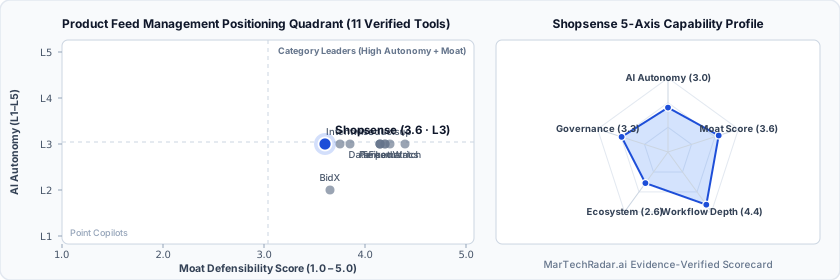
Shopsense is a Web SaaS tool for Product Feed Management (Retail Media & Product Feed Management) in AdTech & Paid Media. Pricing: Custom / enterprise pricing. Best suited to Performance Marketing Directors, Ad Agencies and Retail Media Advertisers. Editor ratings: AI autonomy L3 (conditional automation); moat score 3.6/5.0 (Proprietary moat). Fact-checked by Vasilia Xia on Oct 15, 2026.
Retail media and shoppable content platform synchronizing catalog feeds and contextual broadcast metadata to drive automated commerce conversion.
Shopsense buyer fit verdict: when to choose vs. when to walk away
Choose Shopsense if (Best Fit)
- Target ICP & Stack Fit: You operate as Performance Marketing Directors, Ad Agencies and Retail Media Advertisers requiring a Web SaaS deployment for Product Feed Management.
- L3 Architecture & Defensibility: Proprietary real-time content-to-catalog contextual mapping engine integrated across publisher broadcast metadata and retail media inventory feeds.
- Commercial Model Fit: Your procurement budget aligns with Custom / enterprise pricing.
Walk away from Shopsense if (Deal-Breakers)
- Walk away if you require transparent self-serve monthly billing or your budget ceiling is under $1,000/mo (Shopsense requires sales-gated custom quoting).
- Walk away if your workflow cannot tolerate catalog latency: High-velocity stock level fluctuations create synchronization lag, causing out-of-stock items to appear in dynamic second-screen storefronts during live broadcast spikes.
- Walk away if metadata dependency is a deal-breaker for your team: Product matching precision degrades significantly when broadcast program rundowns lack structured metadata or timestamp accuracy, requiring manual editorial overrides.
Shopsense key facts & scorecard
| Pricing | Custom / enterprise pricing |
|---|---|
| Free plan | No / not disclosed |
| Delivery | Web SaaS |
| Audience | Performance Marketing Directors, Ad Agencies, Retail Media Advertisers |
| AI autonomy level | L3 · Conditional automationEditor-verified |
| Moat tier & score | 3.6 / 5.0 · Proprietary moatEditor-verified |
| Funding | Seed |
| Headquarters | United States |
| Last verified |
Shopsense pros & cons: strengths vs. operational limitations
Pros: core strengths & capabilities
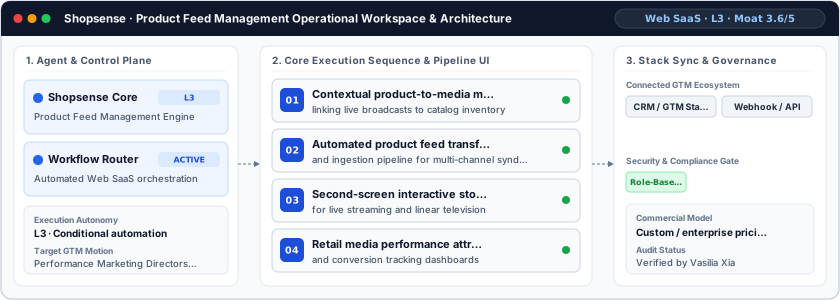
- Contextual product-to-media matching engine: linking live broadcasts to catalog inventory
- Automated product feed transformation: and ingestion pipeline for multi-channel syndication
- Second-screen interactive storefront synchronization: for live streaming and linear television
- Retail media performance attribution: and conversion tracking dashboards
Cons: operational limitations & risks
- Catalog Latency: High-velocity stock level fluctuations create synchronization lag, causing out-of-stock items to appear in dynamic second-screen storefronts during live broadcast spikes.
- Metadata Dependency: Product matching precision degrades significantly when broadcast program rundowns lack structured metadata or timestamp accuracy, requiring manual editorial overrides.
- Custom Taxonomy Ingestion: Non-standard merchant SKU attributes require custom data-mapping transformations, prolonging deployment schedules across enterprise retailers with bespoke inventory architectures.
Shopsense TCO & deal-breaker stress test
Simulate 12-month stepped TCO, hidden cost multipliers, contract lock-in exposure, and stack failure modes using only facts verified by Vasilia Xia on .
Shopsense triggers high-severity friction under your 5-seat / $800/mo constraints. Benchmark the verified subtrack alternatives below before committing.
| Plan / Tier | Verified Rate | Scale Fit | Scope & Quota Notes |
|---|---|---|---|
| Enterprise / Custom | Custom quote | 15–50+ seats (Enterprise SLA) | Sales-negotiated annual contract for custom volume, SSO/RBAC governance, and dedicated SLA. |
- Moat Score
- 3.6 / 5.0
- AI Autonomy
- L3
- Free Tier / Trial
- None disclosed
Triggered audit signals & failure modes
- Opaque Enterprise Quoting vs. SMB/Mid-Market BudgetVerified Pricing Ledger
Shopsense does not disclose a public self-serve floor (Custom / enterprise pricing). Buyers with a $800/mo cap face high sales-qualification friction.
- Sales-Gated Contract TermsFact-checked by Vasilia Xia
Pricing is available on request through tailored enterprise sales quotes, with custom enterprise tiers structured around organizational scale, user seats, and workflow volume.
- Primary Operational Bottleneck: Catalog LatencyAudit by Vasilia Xia
High-velocity stock level fluctuations create synchronization lag, causing out-of-stock items to appear in dynamic second-screen storefronts during live broadcast spikes.
Hidden TCO Multipliers & Quota Gates
- Catalog Latency: High-velocity stock level fluctuations create synchronization lag, causing out-of-stock items to appear in dynamic second-screen storefronts during live broadcast spikes.
- Metadata Dependency: Product matching precision degrades significantly when broadcast program rundowns lack structured metadata or timestamp accuracy, requiring manual editorial overrides.
When to Walk Away & Negotiation Levers
- Walk away if you require transparent self-serve monthly billing or your budget ceiling is under $1,000/mo (Shopsense requires sales-gated custom quoting).
- Walk away if your workflow cannot tolerate catalog latency: High-velocity stock level fluctuations create synchronization lag, causing out-of-stock items to appear in dynamic second-screen storefronts during live broadcast spikes.
- Walk away if metadata dependency is a deal-breaker for your team: Product matching precision degrades significantly when broadcast program rundowns lack structured metadata or timestamp accuracy, requiring manual editorial overrides.
- Demand a 30- to 60-day paid pilot opt-out clause in the Shopsense order form before signing a 12-month enterprise commitment.
- Require a sandbox proof-of-concept testing catalog latency against your live CRM/data schema before annual sign-off.
Ask a custom procurement or TCO stress-test question about Shopsense
Lower 5-seat floor (~$29/mo vs. Custom Quote) · Transparent self-serve entry without mandatory annual lock-in
Lower 5-seat floor (~$64/mo vs. Custom Quote) · Transparent self-serve entry without mandatory annual lock-in
Shopsense moat & subtrack positioning
Proprietary real-time content-to-catalog contextual mapping engine integrated across publisher broadcast metadata and retail media inventory feeds.
Editorial review
Fact-checked by Vasilia Xia (E-Commerce, Lifecycle & Retention Marketing Analyst) on .
Background
Architected to bridge broadcast media distribution with real-time commerce, Shopsense operates as a dedicated retail media and product feed infrastructure platform headquartered in the United States. Designed primarily for broadcast networks, retail media networks, and enterprise omnichannel merchants, the software coordinates catalog syndication directly into interactive viewer touchpoints. Rather than treating commerce and editorial media as disconnected silos, Shopsense unifies dynamic product feeds with second-screen experiences, allowing media publishers and brand advertisers to capture commercial intent directly from live programming.
How Shopsense works
At its technical core, Shopsense coordinates automated feed ingestion and contextual matching pipelines operating with conditional autonomy. The architecture ingests raw merchant product catalogs via scheduled file transfers and batch APIs, normalizing diverse SKU schemas into standardized product taxonomy trees. Concurrently, the engine pairs incoming broadcast timestamps, program metadata, and visual cue triggers with merchant inventory tables. This enables the platform to render dynamic shoppable storefronts in real time across web and mobile web environments without requiring manual ad insertions for every broadcast sequence.
Limitations
Operational considerations and platform boundaries include:
- Catalog Latency: High-velocity stock level fluctuations create synchronization lag, causing out-of-stock items to appear in dynamic second-screen storefronts during live broadcast spikes.
- Metadata Dependency: Product matching precision degrades significantly when broadcast program rundowns lack structured metadata or timestamp accuracy, requiring manual editorial overrides.
- Custom Taxonomy Ingestion: Non-standard merchant SKU attributes require custom data-mapping transformations, prolonging deployment schedules across enterprise retailers with bespoke inventory architectures.
Shopsense pricing
Pricing is available on request through tailored enterprise sales quotes, with custom enterprise tiers structured around organizational scale, user seats, and workflow volume.
How Shopsense compares
Within the catalog distribution ecosystem, Shopsense occupies a specialized position compared to traditional feed managers like Channable, DataFeedWatch, and BidX. While Channable and DataFeedWatch focus primarily on search, social, and marketplace syndication rules, Shopsense specializes in live broadcast synchronization and publisher retail media integration. Conversely, BidX emphasizes automated algorithmic bid adjustments within Amazon ad environments. Shopsense serves enterprise media conglomerates and major retailers seeking to monetize linear and streaming content through direct catalog connectivity. It is best suited for enterprise marketing teams and growth practitioners seeking disciplined workflow orchestration.
Direct competitors & market radar
Top algorithmic competitors based on category positioning, capability overlap, and ICP alignment.
Frequently asked questions about Shopsense
How much does Shopsense cost and does it require a custom enterprise quote?
Published pricing summary for Shopsense: Custom / enterprise pricing. A permanent free plan is not disclosed for Shopsense. Pricing is available on request through tailored enterprise sales quotes, with custom enterprise tiers structured around organizational scale, user seats, and workflow volume.
How does Shopsense work and how autonomous is its AI architecture?
Retail media and shoppable content platform synchronizing catalog feeds and contextual broadcast metadata to drive automated commerce conversion. Within Product Feed Management (Retail Media & Product Feed Management), MarTechRadar rates its execution architecture at L3 · Conditional automation with a verified Moat Score of 3.6 / 5.0 (Proprietary moat). Proprietary real-time content-to-catalog contextual mapping engine integrated across publisher broadcast metadata and retail media inventory feeds.
What are the main limitations of Shopsense and when should buyers walk away?
Based on our editorial technical audit, key operational considerations and boundaries for Shopsense include: (1) Catalog Latency: High-velocity stock level fluctuations create synchronization lag, causing out-of-stock items to appear in dynamic second-screen storefronts during live broadcast spikes. (2) Metadata Dependency: Product matching precision degrades significantly when broadcast program rundowns lack structured metadata or timestamp accuracy, requiring manual editorial overrides. (3) Custom Taxonomy Ingestion: Non-standard merchant SKU attributes require custom data-mapping transformations, prolonging deployment schedules across enterprise retailers with bespoke inventory architectures. Primary procurement walk-away rule: Walk away if you require transparent self-serve monthly billing or your budget ceiling is under $1,000/mo (Shopsense requires sales-gated custom quoting).
What integrations, compliance certifications, and contract terms apply to Shopsense?
Key TCO multiplier to watch: Catalog Latency (High-velocity stock level fluctuations create synchronization lag, causing out-of-stock items to appear in dynamic second-screen storefronts during live broadcast spikes.) Before signing a contract, procurement teams should demand a 30- to 60-day paid pilot opt-out clause in the Shopsense order form before signing a 12-month enterprise commitment.
What are the best Shopsense alternatives and head-to-head competitors in 2026?
Top fact-checked alternatives to Shopsense in Product Feed Management (Retail Media & Product Feed Management) include GumGum (Custom / enterprise pricing), Productsup (Custom / enterprise pricing), Channel3 (Pricing not disclosed), CommerceIQ (Pricing not disclosed). Within the catalog distribution ecosystem, Shopsense occupies a specialized position compared to traditional feed managers like Channable, DataFeedWatch, and BidX.
Verified sources & evidence trail
- Official product domain: https://www.shopsense.ai
- Commercial pricing verification: Verified against official vendor pricing policy (Custom / enterprise pricing)
- Editorial audit sign-off: Fact-checked by Vasilia Xia on under the MarTechRadar Evidence-Ledger Protocol.