Sight AI Review (2026): GEO Pricing, Limits & Alternatives
Bottom line
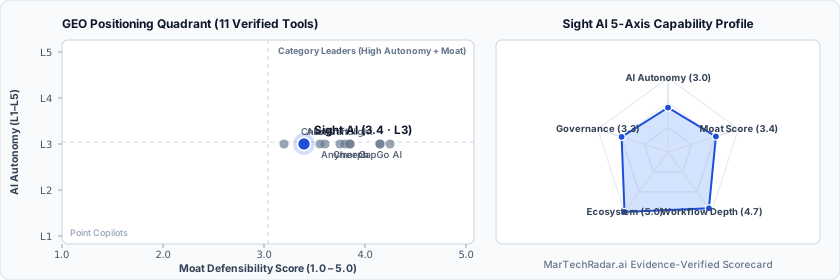
Sight AI is a Web SaaS tool for GEO (GEO Brand Tracking & LLM Rank Tracking) in GEO & AI SEO. Pricing: From $29/mo. Best suited to B2B SaaS and Growth Teams. Editor ratings: AI autonomy L3 (conditional automation); moat score 3.4/5.0 (Workflow-embedded (strong)). Fact-checked by Jagmeet Sine on Oct 16, 2026.
AI search visibility and GEO data layer tracking brand citations across 6 answer engines and exposing 116 SEO tools to agents via MCP.
Sight AI buyer fit verdict: when to choose vs. when to walk away
Choose Sight AI if (Best Fit)
- Target ICP & Stack Fit: You operate as B2B SaaS and Growth Teams requiring a Web SaaS deployment for GEO, with verified ecosystem connectivity for HubSpot, Slack, Shopify, WordPress.
- L3 Architecture & Defensibility: Direct Model Context Protocol (MCP) exposure of 116 specialized SEO and AI citation tools into developer and agent environments differentiates Sight AI from passive web dashboards.
- Commercial Model Fit: Your procurement budget aligns with From $29/mo.
Walk away from Sight AI if (Deal-Breakers)
- Walk away if your workflow requires uncapped enterprise volume on the From $29/mo entry plan without upgrading tiers.
- Walk away if your workflow cannot tolerate answer engine sampling variance: A core technical limitation is that generative answer engines exhibit non-deterministic output shifts across model weight updates, meaning short-window tracking struggles with response volatility and requires multi-week sampling baselines.
- Walk away if high-frequency credit bottleneck is a deal-breaker for your team: A practical trade-off is that running daily multi-engine citation polling alongside automated article generation creates an AI credit consumption bottleneck and queuing latency on entry plans.
Sight AI key facts & scorecard
| Pricing | From $29/moVendor pricing page |
|---|---|
| Free plan | No / not disclosed |
| Delivery | Web SaaS |
| Audience | B2B SaaS, Growth Teams |
| AI autonomy level | L3 · Conditional automationEditor-verified |
| Moat tier & score | 3.4 / 5.0 · Workflow-embedded (strong)Editor-verified |
| Funding | Bootstrapped |
| Ecosystem integrations | HubSpot, Slack, Shopify, WordPress, Webflow, Twilio Segment |
| Governance & docs | API & Docs ↗ · Terms ↗ · Privacy ↗ |
| Headquarters | United States |
| Last verified |
Sight AI pros & cons: strengths vs. operational limitations
Pros: core strengths & capabilities
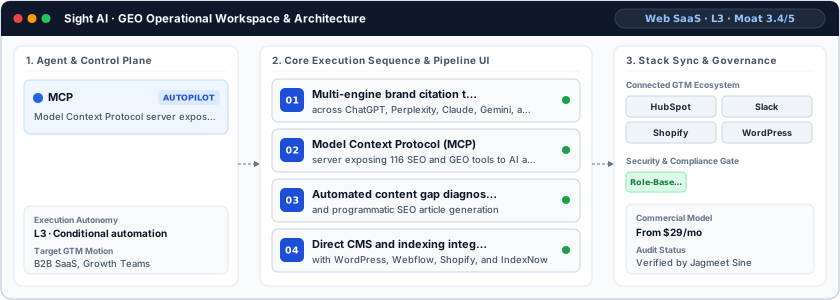
- Multi-engine brand citation tracking: across ChatGPT, Perplexity, Claude, Gemini, and Grok
- Model Context Protocol (MCP): server exposing 116 SEO and GEO tools to AI agents
- Automated content gap diagnostics: and programmatic SEO article generation
- Direct CMS and indexing integrations: with WordPress, Webflow, Shopify, and IndexNow
Cons: operational limitations & risks
- Answer Engine Sampling Variance: A core technical limitation is that generative answer engines exhibit non-deterministic output shifts across model weight updates, meaning short-window tracking struggles with response volatility and requires multi-week sampling baselines.
- High-Frequency Credit Bottleneck: A practical trade-off is that running daily multi-engine citation polling alongside automated article generation creates an AI credit consumption bottleneck and queuing latency on entry plans.
- Ungoverned Publishing Hallucination Risk: Triggering autonomous CMS publishing directly from MCP agent workflows introduces a governance barrier and potential factual hallucination risk if human editorial review gates are bypassed.
Sight AI TCO & deal-breaker stress test
Simulate 12-month stepped TCO, hidden cost multipliers, contract lock-in exposure, and stack failure modes using only facts verified by Jagmeet Sine on · Capture SHA 1aa7ac41.
Sight AI aligns with your 5-seat / $800/mo profile. Review the walk-away triggers and contract levers below before deployment.
| Plan / Tier | Verified Rate | Scale Fit | Scope & Quota Notes |
|---|---|---|---|
| Entry / Starter | $29/mo | 1–2 seats | SEO, automations and the agent for teams. |
| Growth / Professional | $59/mo | 5 seats | SEO, automations and the agent for teams. |
| Starter | $99/mo | 15 seats | AI visibility, content and the agent for one site. |
- Moat Score
- 3.4 / 5.0
- AI Autonomy
- L3
- Free Tier / Trial
- None disclosed
Triggered audit signals & failure modes
- Published Self-Serve Entry FloorVerified Pricing Ledger
Sight AI publishes a transparent entry point (From $29/mo) for initial validation before committing.
- Tier Fit for 5-Seat Scale: Growth / Professional ($59/mo)Verified Tier Schedule
SEO, automations and the agent for teams.
- Primary Operational Bottleneck: High-Frequency Credit BottleneckAudit by Jagmeet Sine
A practical trade-off is that running daily multi-engine citation polling alongside automated article generation creates an AI credit consumption bottleneck and queuing latency on entry plans.
Hidden TCO Multipliers & Quota Gates
- Annual Billing Headline vs. Monthly Premium: Headline entry rates reflect annual billing commitments (Save 20%); month-to-month flexibility carries a higher effective monthly rate or requires annual prepayment.
- Credit & Usage Burn Multiplier: Automated workflows consume metered credits/usage quotas; multi-step enrichment, voice minutes, or high-frequency agent runs can trigger mid-cycle top-up packs.
When to Walk Away & Negotiation Levers
- Walk away if your workflow requires uncapped enterprise volume on the From $29/mo entry plan without upgrading tiers.
- Walk away if your workflow cannot tolerate answer engine sampling variance: A core technical limitation is that generative answer engines exhibit non-deterministic output shifts across model weight updates, meaning short-window tracking struggles with response volatility and requires multi-week sampling baselines.
- Walk away if high-frequency credit bottleneck is a deal-breaker for your team: A practical trade-off is that running daily multi-engine citation polling alongside automated article generation creates an AI credit consumption bottleneck and queuing latency on entry plans.
- Validate exact quota thresholds (seats, credits, or API calls) included in Sight AI's From $29/mo tier before converting from monthly to annual billing.
- Require a sandbox proof-of-concept testing answer engine sampling variance against your live CRM/data schema before annual sign-off.
Ask a custom procurement or TCO stress-test question about Sight AI
Lower 5-seat floor (~$35/mo vs. $59 / mo)
Lower 5-seat floor (~$29/mo vs. $59 / mo)
Sight AI key entities, modules & ecosystem stack
Model Context Protocol server exposing 116 SEO and GEO tools to AI agents
Sight AI moat & subtrack positioning
Direct Model Context Protocol (MCP) exposure of 116 specialized SEO and AI citation tools into developer and agent environments differentiates Sight AI from passive web dashboards.
Editorial review
Fact-checked by Jagmeet Sine (Senior MarTech Infrastructure & Agentic Workflow Architect) on .
Background
Operating as an AI search visibility and Generative Engine Optimization (GEO) data layer in the United States, Sight AI (trysight.ai) is built for growth marketers, technical SEO leads, and AI-native content engineering teams. As commercial buyers increasingly rely on conversational answer engines to evaluate software and consumer brands, marketing organizations need structured telemetry on how foundation models cite their domain. Sight AI tracks brand mentions and citation share across major answer engines while streaming actionable search data directly into agentic coding and content workflows.
How Sight AI works
Sight AI operates at Level 3 autonomy by continuously probing ChatGPT, Perplexity, Anthropic Claude, Google Gemini, Grok, and Google AI Mode to measure citation frequency, prompt share of voice, and competitor positioning. Rather than isolating telemetry inside a read-only web dashboard, Sight AI provides a native Model Context Protocol (MCP) server exposing 116 specialized SEO and GEO tools. Marketing engineers connect Claude, ChatGPT, Cursor, Windsurf, or Claude Code directly to Sight AI, pulling live keyword and backlink metrics from Google Search Console, Ahrefs, and Semrush while pushing structured content updates to WordPress, Webflow, Framer, Shopify, and Bing IndexNow, alongside native workflow integrations for HubSpot, Slack, and Zapier.
Limitations
Operational limitations and technical trade-offs include:
- Answer Engine Sampling Variance: A core technical limitation is that generative answer engines exhibit non-deterministic output shifts across model weight updates, meaning short-window tracking struggles with response volatility and requires multi-week sampling baselines.
- High-Frequency Credit Bottleneck: A practical trade-off is that running daily multi-engine citation polling alongside automated article generation creates an AI credit consumption bottleneck and queuing latency on entry plans.
- Ungoverned Publishing Hallucination Risk: Triggering autonomous CMS publishing directly from MCP agent workflows introduces a governance barrier and potential factual hallucination risk if human editorial review gates are bypassed.
Sight AI pricing
Sight AI offers tiered monthly subscriptions scaled by tracked websites, monitored prompts, and monthly AI credit allowances. Entry plans start at $29/mo and $59/mo for early-stage sites, scaling to the Starter tier at $99/mo (1 site, 100 tracked AI prompts, 5,000 AI credits) and the Pro tier at $199/mo (3 sites, 10,000 AI credits, full MCP server and CMS publishing access), with larger growth and agency packages at $449/mo and $2,500/mo.
How Sight AI compares
Within the GEO Brand Tracking & LLM Rank Tracking segment, Sight AI competes alongside specialized visibility platforms such as CapGo AI, CRSTBL, and Discoverable. While standalone GEO trackers focus primarily on executive visibility charts, Sight AI differentiates itself by exposing 116 operational SEO and citation tools via an MCP server for direct execution inside Cursor and Claude Code. Technical growth teams operating agent-driven content pipelines benefit most from Sight AI's programmable architecture, whereas brand communications teams seeking passive monitoring dashboards may prefer simpler reporting tools.
Frequently asked questions about Sight AI
How much does Sight AI cost and what pricing tiers are available?
Published pricing summary for Sight AI: From $29/mo. A permanent free plan is not disclosed for Sight AI. Verified tier schedule: Entry / Starter ($29/mo for 1–2 seats); Growth / Professional ($59/mo for 5 seats); Starter ($99/mo for 15 seats). Sight AI offers tiered monthly subscriptions scaled by tracked websites, monitored prompts, and monthly AI credit allowances.
How does Sight AI work and how autonomous is its AI architecture?
AI search visibility and GEO data layer tracking brand citations across 6 answer engines and exposing 116 SEO tools to agents via MCP. Within GEO (GEO Brand Tracking & LLM Rank Tracking), MarTechRadar rates its execution architecture at L3 · Conditional automation with a verified Moat Score of 3.4 / 5.0 (Workflow-embedded (strong)). Direct Model Context Protocol (MCP) exposure of 116 specialized SEO and AI citation tools into developer and agent environments differentiates Sight AI from passive web dashboards.
What are the main limitations of Sight AI and when should buyers walk away?
Based on our editorial technical audit, key operational considerations and boundaries for Sight AI include: (1) Answer Engine Sampling Variance: A core technical limitation is that generative answer engines exhibit non-deterministic output shifts across model weight updates, meaning short-window tracking struggles with response volatility and requires multi-week sampling baselines. (2) High-Frequency Credit Bottleneck: A practical trade-off is that running daily multi-engine citation polling alongside automated article generation creates an AI credit consumption bottleneck and queuing latency on entry plans. (3) Ungoverned Publishing Hallucination Risk: Triggering autonomous CMS publishing directly from MCP agent workflows introduces a governance barrier and potential factual hallucination risk if human editorial review gates are bypassed. Primary procurement walk-away rule: Walk away if your workflow requires uncapped enterprise volume on the From $29/mo entry plan without upgrading tiers.
What integrations, compliance certifications, and contract terms apply to Sight AI?
Verified ecosystem and stack integrations include HubSpot, Slack, Shopify, WordPress, Webflow, Twilio Segment, Google Search Console, Zapier. First-party governance and developer endpoints verified on domain include: API Docs (https://docs.trysight.ai). Key TCO multiplier to watch: Annual Billing Headline vs. Monthly Premium (Headline entry rates reflect annual billing commitments (Save 20%); month-to-month flexibility carries a higher effective monthly rate or requires annual prepayment.) Before signing a contract, procurement teams should validate exact quota thresholds (seats, credits, or API calls) included in Sight AI's From $29/mo tier before converting from monthly to annual billing.
What are the best Sight AI alternatives and head-to-head competitors in 2026?
Top fact-checked alternatives to Sight AI in GEO (GEO Brand Tracking & LLM Rank Tracking) include CRSTBL (From $35/mo), Discoverable (From $79/mo), RadarKit (From $29/mo), Wildcard (From $99/mo). Within the GEO Brand Tracking & LLM Rank Tracking segment, Sight AI competes alongside specialized visibility platforms such as CapGo AI, CRSTBL, and Discoverable.
Verified sources & evidence trail
- Official product domain: https://trysight.ai
- Commercial pricing verification: https://www.trysight.ai/pricing
- First-party governance & documentation links: API & Docs · Terms · Privacy
- Editorial audit sign-off: Fact-checked by Jagmeet Sine on under the MarTechRadar Evidence-Ledger Protocol.