SpyFu Review (2026): Marketing Attribution Pricing, Limits & Alternatives
Bottom line
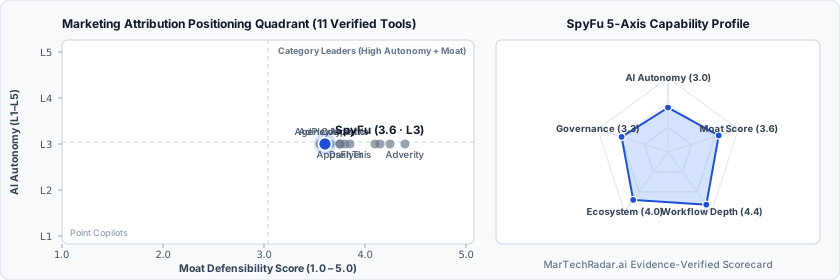
SpyFu is a Web SaaS tool for Marketing Attribution (Multi-Touch Attribution & eCommerce Dashboards) in Analytics & Attribution. Pricing: Custom / enterprise pricing. Best suited to B2B SaaS and Creators / Solo. Editor ratings: AI autonomy L3 (conditional automation); moat score 3.6/5.0 (Proprietary moat). Fact-checked by Julie Brot on Oct 14, 2026.
Competitive search intelligence platform ingesting historical SERP archives, Google Ads telemetry, and organic keyword datasets to power.
SpyFu buyer fit verdict: when to choose vs. when to walk away
Choose SpyFu if (Best Fit)
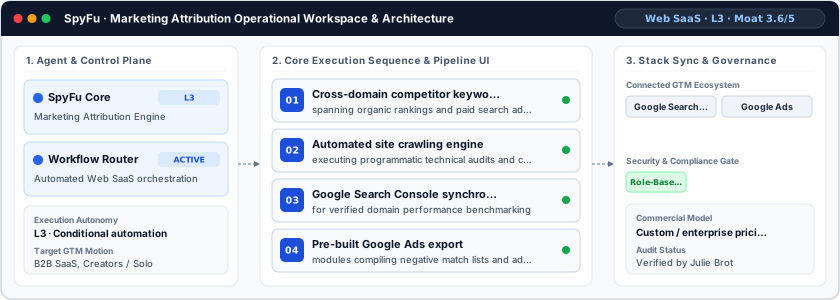
- Target ICP & Stack Fit: You operate as B2B SaaS and Creators / Solo requiring a Web SaaS deployment for Marketing Attribution, with verified ecosystem connectivity for Google Search Console, Google Ads.
- L3 Architecture & Defensibility: Decades of continuous SERP scraping archives coupled with large-scale relational indexes of domain-level Google Ads copy, spend estimates, and historical organic rankings across billions of keywords.
- Commercial Model Fit: Your procurement budget aligns with Custom / enterprise pricing.
Walk away from SpyFu if (Deal-Breakers)
- Walk away if you require transparent self-serve monthly billing or your budget ceiling is under $1,000/mo (SpyFu requires sales-gated custom quoting).
- Walk away if your workflow cannot tolerate attribution signal isolation: The platform functions primarily on external SERP observations and auction telemetry rather than deterministic user-level conversion paths, creating gaps when evaluating closed-loop transaction attribution.
- Walk away if algorithmic spend estimation lag is a deal-breaker for your team: Competitor paid search spend valuations rely on programmatic bidding heuristics and sample frequencies, which diverge from real-time dynamic auction adjustments and private Smart Bidding environments.
SpyFu key facts & scorecard
| Pricing | Custom / enterprise pricing |
|---|---|
| Free plan | No / not disclosed |
| Delivery | Web SaaS |
| Audience | B2B SaaS, Creators / Solo |
| AI autonomy level | L3 · Conditional automationEditor-verified |
| Moat tier & score | 3.6 / 5.0 · Proprietary moatEditor-verified |
| Funding | Venture-backed |
| Founders | Mike Roberts |
| Company size | 11-50 employees |
| Ecosystem integrations | Google Search Console, Google Ads |
| Governance & docs | API & Docs ↗ |
| Headquarters | Scottsdale, AZ |
| Founded | 2005 |
| Last verified |
SpyFu pros & cons: strengths vs. operational limitations
Pros: core strengths & capabilities
- Cross-domain competitor keyword indexing: spanning organic rankings and paid search ad histories
- Automated site crawling engine: executing programmatic technical audits and content remediation suggestions
- Google Search Console synchronization: for verified domain performance benchmarking
- Pre-built Google Ads export: modules compiling negative match lists and ad variation blueprints
Cons: operational limitations & risks
- Attribution Signal Isolation: The platform functions primarily on external SERP observations and auction telemetry rather than deterministic user-level conversion paths, creating gaps when evaluating closed-loop transaction attribution.
- Algorithmic Spend Estimation Lag: Competitor paid search spend valuations rely on programmatic bidding heuristics and sample frequencies, which diverge from real-time dynamic auction adjustments and private Smart Bidding environments.
- Crawl Budget Constraints: Site auditing operates under strict monthly page-crawl thresholds, requiring technical teams to partition large enterprise ecommerce architectures across segmented audit batches.
SpyFu TCO & deal-breaker stress test
Simulate 12-month stepped TCO, hidden cost multipliers, contract lock-in exposure, and stack failure modes using only facts verified by Julie Brot on · Capture SHA 2ce6bc48.
SpyFu triggers high-severity friction under your 5-seat / $800/mo constraints. Benchmark the verified subtrack alternatives below before committing.
| Plan / Tier | Verified Rate | Scale Fit | Scope & Quota Notes |
|---|---|---|---|
| Entry / Starter | $15/mo | 1–2 seats | 30-Day Money Back Guarantee |
| Growth / Professional | $30/mo | 5 seats | Verified $30/mo tier from vendor pricing schedule. |
| Scale / Advanced | $40/mo | 15 seats | Verified $40/mo tier from vendor pricing schedule. |
| Enterprise / Custom | Custom quote | 15–50+ seats (Enterprise SLA) | Sales-negotiated annual contract for custom volume, SSO/RBAC governance, and dedicated SLA. |
- Moat Score
- 3.6 / 5.0
- AI Autonomy
- L3
- Free Tier / Trial
- None disclosed
Triggered audit signals & failure modes
- Opaque Enterprise Quoting vs. SMB/Mid-Market BudgetVerified Pricing Ledger
SpyFu does not disclose a public self-serve floor (Custom / enterprise pricing). Buyers with a $800/mo cap face high sales-qualification friction.
- Sales-Gated Contract TermsFact-checked by Julie Brot
Commercial access is structured around subscription-based tiers determined by data export quotas, tracked keyword volumes, and crawl allowances.
- Tier Fit for 5-Seat Scale: Entry / Starter ($15/mo)Verified Tier Schedule
30-Day Money Back Guarantee
- Primary Operational Bottleneck: Crawl Budget ConstraintsAudit by Julie Brot
Site auditing operates under strict monthly page-crawl thresholds, requiring technical teams to partition large enterprise ecommerce architectures across segmented audit batches.
Hidden TCO Multipliers & Quota Gates
- Annual Billing Headline vs. Monthly Premium: Headline entry rates reflect annual billing commitments (save 25%); month-to-month flexibility carries a higher effective monthly rate or requires annual prepayment.
- Credit & Usage Burn Multiplier: Automated workflows consume metered credits/usage quotas; multi-step enrichment, voice minutes, or high-frequency agent runs can trigger mid-cycle top-up packs.
When to Walk Away & Negotiation Levers
- Walk away if you require transparent self-serve monthly billing or your budget ceiling is under $1,000/mo (SpyFu requires sales-gated custom quoting).
- Walk away if your workflow cannot tolerate attribution signal isolation: The platform functions primarily on external SERP observations and auction telemetry rather than deterministic user-level conversion paths, creating gaps when evaluating closed-loop transaction attribution.
- Walk away if algorithmic spend estimation lag is a deal-breaker for your team: Competitor paid search spend valuations rely on programmatic bidding heuristics and sample frequencies, which diverge from real-time dynamic auction adjustments and private Smart Bidding environments.
- Demand a 30- to 60-day paid pilot opt-out clause in the SpyFu order form before signing a 12-month enterprise commitment.
- Require a sandbox proof-of-concept testing attribution signal isolation against your live CRM/data schema before annual sign-off.
Ask a custom procurement or TCO stress-test question about SpyFu
Lower 5-seat floor (~$20/mo vs. Custom Quote)
Lower 5-seat floor (~$15/mo vs. Custom Quote) · Transparent self-serve entry without mandatory annual lock-in
SpyFu key entities, modules & ecosystem stack
SpyFu moat & subtrack positioning
Decades of continuous SERP scraping archives coupled with large-scale relational indexes of domain-level Google Ads copy, spend estimates, and historical organic rankings across billions of keywords.
Editorial review
Fact-checked by Julie Brot (Enterprise SaaS Governance & Procurement Editor) on .
Background
Architected as a search telemetry and competitive data indexing platform, SpyFu deconstructs public search engine result pages and ad auctions into structured performance records. Headquartered in Scottsdale, AZ, and established in 2005, the company targets performance marketing managers, search directors, and digital acquisition analysts. Rather than relying on speculative market surveys, the platform indexes historical keyword valuations, auction overlap metrics, and competitor creative libraries to supply programmatic organic and paid acquisition intelligence.
How SpyFu works
Under the hood, the system operates as an L3 automated data pipeline aggregating large-scale SERP scrapers and auction databases. The platform continuously crawls search engines, standardizing competitor position shifts, cost-per-click metrics, and copy variations across indexed web pages. It ingests Google Search Console data via API to calibrate proprietary click-through modeling against verified organic performance. Downstream algorithms identify domain keyword deficits, generate automated site audit diagnostics, and deliver AI-directed remediation prompts directly to digital marketing operations.
Limitations
Operational considerations and platform boundaries include:
- Attribution Signal Isolation: The platform functions primarily on external SERP observations and auction telemetry rather than deterministic user-level conversion paths, creating gaps when evaluating closed-loop transaction attribution.
- Algorithmic Spend Estimation Lag: Competitor paid search spend valuations rely on programmatic bidding heuristics and sample frequencies, which diverge from real-time dynamic auction adjustments and private Smart Bidding environments.
- Crawl Budget Constraints: Site auditing operates under strict monthly page-crawl thresholds, requiring technical teams to partition large enterprise ecommerce architectures across segmented audit batches.
SpyFu pricing
Commercial access is structured around subscription-based tiers determined by data export quotas, tracked keyword volumes, and crawl allowances. Enterprise deployments and expanded programmatic query capacity are provisioned through tailored commercial agreements on request through direct sales channels, scaling in accordance with operational footprint, crawl consumption, and organizational seat requirements.
How SpyFu compares
Within analytical marketing stacks, SpyFu occupies a specialized niche distinct from event-stream attribution engines like AppsFlyer, mobile attribution systems like Adjust, and ingestion orchestrators like Adverity. While Adverity unifies fractured omnichannel metrics across enterprise data lakes, SpyFu focuses purely on outside-in search auction indexing and competitor intelligence. The platform suits growth engineering teams seeking reverse-engineered search data over deterministic attribution pipelines.
Direct competitors & market radar
Top algorithmic competitors based on category positioning, capability overlap, and ICP alignment.
Frequently asked questions about SpyFu
How much does SpyFu cost and does it require a custom enterprise quote?
Published pricing summary for SpyFu: Custom / enterprise pricing. A permanent free plan is not disclosed for SpyFu. Verified tier schedule: Entry / Starter ($15/mo for 1–2 seats); Growth / Professional ($30/mo for 5 seats); Scale / Advanced ($40/mo for 15 seats); Enterprise / Custom (Custom quote for 15–50+ seats (Enterprise SLA)). Commercial access is structured around subscription-based tiers determined by data export quotas, tracked keyword volumes, and crawl allowances.
How does SpyFu work and how autonomous is its AI architecture?
Competitive search intelligence platform ingesting historical SERP archives, Google Ads telemetry, and organic keyword datasets to power. Within Marketing Attribution (Multi-Touch Attribution & eCommerce Dashboards), MarTechRadar rates its execution architecture at L3 · Conditional automation with a verified Moat Score of 3.6 / 5.0 (Proprietary moat). Decades of continuous SERP scraping archives coupled with large-scale relational indexes of domain-level Google Ads copy, spend estimates, and historical organic rankings across billions of keywords. Corporate profile: Founded by Mike Roberts, operating at 11-50 employees scale.
What are the main limitations of SpyFu and when should buyers walk away?
Based on our editorial technical audit, key operational considerations and boundaries for SpyFu include: (1) Attribution Signal Isolation: The platform functions primarily on external SERP observations and auction telemetry rather than deterministic user-level conversion paths, creating gaps when evaluating closed-loop transaction attribution. (2) Algorithmic Spend Estimation Lag: Competitor paid search spend valuations rely on programmatic bidding heuristics and sample frequencies, which diverge from real-time dynamic auction adjustments and private Smart Bidding environments. (3) Crawl Budget Constraints: Site auditing operates under strict monthly page-crawl thresholds, requiring technical teams to partition large enterprise ecommerce architectures across segmented audit batches. Primary procurement walk-away rule: Walk away if you require transparent self-serve monthly billing or your budget ceiling is under $1,000/mo (SpyFu requires sales-gated custom quoting).
What integrations, compliance certifications, and contract terms apply to SpyFu?
Verified ecosystem and stack integrations include Google Search Console, Google Ads. First-party governance and developer endpoints verified on domain include: API Docs (https://developer.spyfu.com). Key TCO multiplier to watch: Annual Billing Headline vs. Monthly Premium (Headline entry rates reflect annual billing commitments (save 25%); month-to-month flexibility carries a higher effective monthly rate or requires annual prepayment.) Before signing a contract, procurement teams should demand a 30- to 60-day paid pilot opt-out clause in the SpyFu order form before signing a 12-month enterprise commitment.
What are the best SpyFu alternatives and head-to-head competitors in 2026?
Top fact-checked alternatives to SpyFu in Marketing Attribution (Multi-Touch Attribution & eCommerce Dashboards) include AgencyAnalytics (From $20/mo), Kochava (Custom / enterprise pricing), Tenjin (Custom / enterprise pricing), Scibids AI (Custom / enterprise pricing). Within analytical marketing stacks, SpyFu occupies a specialized niche distinct from event-stream attribution engines like AppsFlyer, mobile attribution systems like Adjust, and ingestion orchestrators like Adverity.
Verified sources & evidence trail
- Official product domain: https://spyfu.com
- Commercial pricing verification: Verified against official vendor pricing policy (Custom / enterprise pricing)
- Verified corporate entity profiles (
sameAs): LinkedIn Company Profile · Crunchbase Entity Record - First-party governance & documentation links: API & Docs
- Editorial audit sign-off: Fact-checked by Julie Brot on under the MarTechRadar Evidence-Ledger Protocol.