Stanify Review (2026): Social Media Scheduling Pricing, Limits & Alternatives
Bottom line
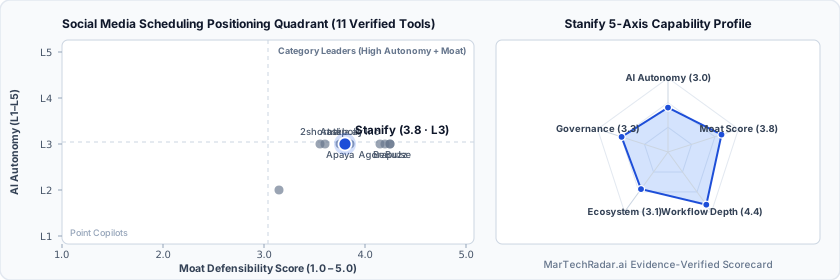
Stanify is a Web SaaS tool for Social Media Scheduling (Social Media Scheduling & Auto-Publishing) in Social & Influencer. Pricing: Custom / enterprise pricing. Best suited to Social Media Managers, Creator & Influencer Agencies and Brand Community Ops. Editor ratings: AI autonomy L3 (conditional automation); moat score 3.8/5.0 (Proprietary moat). Fact-checked by Anthony Hay on Oct 11, 2026.
Autonomous conversational AI platform managing enterprise social media direct messages and comments with automated brand voice alignment and toxicity.
Stanify buyer fit verdict: when to choose vs. when to walk away
Choose Stanify if (Best Fit)
- Target ICP & Stack Fit: You operate as Social Media Managers, Creator & Influencer Agencies and Brand Community Ops requiring a Web SaaS deployment for Social Media Scheduling.
- L3 Architecture & Defensibility: Domain-tuned conversational models tailored for real-time social context, low-latency social network API connectors, and automated brand safety guardrails.
- Commercial Model Fit: Your procurement budget aligns with Custom / enterprise pricing.
Walk away from Stanify if (Deal-Breakers)
- Walk away if you require transparent self-serve monthly billing or your budget ceiling is under $1,000/mo (Stanify requires sales-gated custom quoting).
- Walk away if your workflow cannot tolerate social network rate limits and API deprecations: The system depends heavily on third-party platform API policies; unexpected upstream rate limiting or sudden endpoint deprecations can delay message queues and halt automated direct responses.
- Walk away if multi-turn context drift is a deal-breaker for your team: Complex, multi-turn community inquiries risk hallucination or context degradation if the customer veers into nuanced account issues or out-of-domain edge cases.
Stanify key facts & scorecard
| Pricing | Custom / enterprise pricing |
|---|---|
| Free plan | No / not disclosed |
| Delivery | Web SaaS |
| Audience | Social Media Managers, Creator & Influencer Agencies, Brand Community Ops |
| AI autonomy level | L3 · Conditional automationEditor-verified |
| Moat tier & score | 3.8 / 5.0 · Proprietary moatEditor-verified |
| Funding | Pre-seed |
| Total funding | Pre-seedBacked by Allied Venture Partners |
| Company size | 11-50 employees |
| Governance & docs | Terms ↗ · Privacy ↗ |
| Headquarters | Los Angeles, CA |
| Founded | 2025 |
| Last verified |
Stanify pros & cons: strengths vs. operational limitations
Pros: core strengths & capabilities
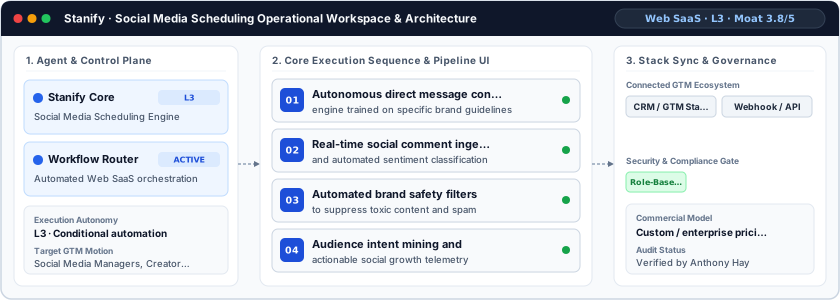
- Autonomous direct message conversational: engine trained on specific brand guidelines
- Real-time social comment ingestion: and automated sentiment classification
- Automated brand safety filters: to suppress toxic content and spam
- Audience intent mining and: actionable social growth telemetry
Cons: operational limitations & risks
- Social Network Rate Limits and API Deprecations: The system depends heavily on third-party platform API policies; unexpected upstream rate limiting or sudden endpoint deprecations can delay message queues and halt automated direct responses.
- Multi-Turn Context Drift: Complex, multi-turn community inquiries risk hallucination or context degradation if the customer veers into nuanced account issues or out-of-domain edge cases.
- Schema and Guardrail Maintenance: Corporate marketing teams must continuously maintain brand voice taxonomies and negative keyword lists to prevent embarrassing automated interactions during dynamic public relations crises.
Stanify TCO & deal-breaker stress test
Simulate 12-month stepped TCO, hidden cost multipliers, contract lock-in exposure, and stack failure modes using only facts verified by Anthony Hay on · Capture SHA b23e005c.
Stanify triggers high-severity friction under your 5-seat / $800/mo constraints. Benchmark the verified subtrack alternatives below before committing.
| Plan / Tier | Verified Rate | Scale Fit | Scope & Quota Notes |
|---|---|---|---|
| Enterprise / Custom | Custom quote | 15–50+ seats (Enterprise SLA) | Sales-negotiated annual contract for custom volume, SSO/RBAC governance, and dedicated SLA. |
- Moat Score
- 3.8 / 5.0
- AI Autonomy
- L3
- Free Tier / Trial
- None disclosed
Triggered audit signals & failure modes
- Opaque Enterprise Quoting vs. SMB/Mid-Market BudgetVerified Pricing Ledger
Stanify does not disclose a public self-serve floor (Custom / enterprise pricing). Buyers with a $800/mo cap face high sales-qualification friction.
- Sales-Gated Contract TermsFact-checked by Anthony Hay
Stanify maintains a closed enterprise deployment framework. Commercial pricing is available on request through tailored enterprise sales quotes based on organizational scale, managed channels, and administrative seats.
- Primary Operational Bottleneck: Social Network Rate Limits and API DeprecationsAudit by Anthony Hay
The system depends heavily on third-party platform API policies; unexpected upstream rate limiting or sudden endpoint deprecations can delay message queues and halt automated direct responses.
Hidden TCO Multipliers & Quota Gates
- Social Network Rate Limits and API Deprecations: The system depends heavily on third-party platform API policies; unexpected upstream rate limiting or sudden endpoint deprecations can delay message queues and halt automated direct responses.
- Multi-Turn Context Drift: Complex, multi-turn community inquiries risk hallucination or context degradation if the customer veers into nuanced account issues or out-of-domain edge cases.
When to Walk Away & Negotiation Levers
- Walk away if you require transparent self-serve monthly billing or your budget ceiling is under $1,000/mo (Stanify requires sales-gated custom quoting).
- Walk away if your workflow cannot tolerate social network rate limits and API deprecations: The system depends heavily on third-party platform API policies; unexpected upstream rate limiting or sudden endpoint deprecations can delay message queues and halt automated direct responses.
- Walk away if multi-turn context drift is a deal-breaker for your team: Complex, multi-turn community inquiries risk hallucination or context degradation if the customer veers into nuanced account issues or out-of-domain edge cases.
- Demand a 30- to 60-day paid pilot opt-out clause in the Stanify order form before signing a 12-month enterprise commitment.
- Require a sandbox proof-of-concept testing social network rate limits and API deprecations against your live CRM/data schema before annual sign-off.
Ask a custom procurement or TCO stress-test question about Stanify
Lower 5-seat floor (~$395/mo vs. Custom Quote) · Transparent self-serve entry without mandatory annual lock-in
Lower 5-seat floor (~$10/mo vs. Custom Quote) · Transparent self-serve entry without mandatory annual lock-in
Stanify moat & subtrack positioning
Domain-tuned conversational models tailored for real-time social context, low-latency social network API connectors, and automated brand safety guardrails.
Editorial review
Fact-checked by Anthony Hay (Senior SEO, Search Intelligence & Content Operations Editor) on .
Background
Stanify addresses the operational drag enterprise community teams face when moderating thousands of incoming direct messages and public comments. Established in 2025 in Los Angeles, California, the platform serves brand marketing directors, customer care teams, and social agencies seeking to protect brand reputation while accelerating audience responsiveness. Rather than treating inbound interactions as asynchronous helpdesk tickets, the system embeds autonomous natural language agents directly into brand community channels, transforming high-volume inbound chatter into structured audience intelligence and programmatic customer interactions.
How Stanify works
At its technical core, Stanify operates at an L3 conditional autonomy level by coupling social graph API ingestion pipelines across platforms like Instagram, TikTok, and YouTube with specialized language processing models. Webhook listeners capture raw message payloads and comment threads, routing them through a sentiment analysis and safety classification pipeline that strips toxic content or flags sensitive escalations. Concurrently, an LLM orchestration layer conditioned on brand-specific stylistic parameters generates context-aware, low-latency conversational replies. The architecture isolates low-confidence conversational turns, passing them to internal team members via an exception-handling queue while independently dispatching routine support, triage, and engagement responses.
Limitations
Operational considerations and platform boundaries include:
- Social Network Rate Limits and API Deprecations: The system depends heavily on third-party platform API policies; unexpected upstream rate limiting or sudden endpoint deprecations can delay message queues and halt automated direct responses.
- Multi-Turn Context Drift: Complex, multi-turn community inquiries risk hallucination or context degradation if the customer veers into nuanced account issues or out-of-domain edge cases.
- Schema and Guardrail Maintenance: Corporate marketing teams must continuously maintain brand voice taxonomies and negative keyword lists to prevent embarrassing automated interactions during dynamic public relations crises.
Stanify pricing
Stanify maintains a closed enterprise deployment framework. Commercial pricing is available on request through tailored enterprise sales quotes based on organizational scale, managed channels, and administrative seats. Contracts reflect enterprise-grade governance, bespoke prompt engineering, and onboarding support rather than self-service consumption tiers, requiring prospective buyers to engage directly with sales representatives for customized software licensing terms.
How Stanify compares
Within the community automation and publishing domain, Stanify differentiates by prioritizing autonomous inbound conversation generation and community moderation over pure scheduling workflows. While established suites such as Agorapulse emphasize manual team routing, multi-channel scheduling matrices, and standardized social listening dashboards, Stanify delegates actual conversational synthesis to autonomous agents. When compared against automated publishing tools like Antela.ai, Inc. or commerce link routing layers like Apaya, Stanify trades broad distribution tooling for deep, bidirectional natural language execution. It serves high-engagement consumer brands requiring round-the-clock comment mitigation and audience conversational responsiveness.
Frequently asked questions about Stanify
How much does Stanify cost and does it require a custom enterprise quote?
Published pricing summary for Stanify: Custom / enterprise pricing. A permanent free plan is not disclosed for Stanify. Stanify maintains a closed enterprise deployment framework. Commercial pricing is available on request through tailored enterprise sales quotes based on organizational scale, managed channels, and administrative seats.
How does Stanify work and how autonomous is its AI architecture?
Autonomous conversational AI platform managing enterprise social media direct messages and comments with automated brand voice alignment and toxicity. Within Social Media Scheduling (Social Media Scheduling & Auto-Publishing), MarTechRadar rates its execution architecture at L3 · Conditional automation with a verified Moat Score of 3.8 / 5.0 (Proprietary moat). Domain-tuned conversational models tailored for real-time social context, low-latency social network API connectors, and automated brand safety guardrails. Corporate profile: operating at 11-50 employees scale.
What are the main limitations of Stanify and when should buyers walk away?
Based on our editorial technical audit, key operational considerations and boundaries for Stanify include: (1) Social Network Rate Limits and API Deprecations: The system depends heavily on third-party platform API policies; unexpected upstream rate limiting or sudden endpoint deprecations can delay message queues and halt automated direct responses. (2) Multi-Turn Context Drift: Complex, multi-turn community inquiries risk hallucination or context degradation if the customer veers into nuanced account issues or out-of-domain edge cases. (3) Schema and Guardrail Maintenance: Corporate marketing teams must continuously maintain brand voice taxonomies and negative keyword lists to prevent embarrassing automated interactions during dynamic public relations crises. Primary procurement walk-away rule: Walk away if you require transparent self-serve monthly billing or your budget ceiling is under $1,000/mo (Stanify requires sales-gated custom quoting).
What integrations, compliance certifications, and contract terms apply to Stanify?
Key TCO multiplier to watch: Social Network Rate Limits and API Deprecations (The system depends heavily on third-party platform API policies; unexpected upstream rate limiting or sudden endpoint deprecations can delay message queues and halt automated direct responses.) Before signing a contract, procurement teams should demand a 30- to 60-day paid pilot opt-out clause in the Stanify order form before signing a 12-month enterprise commitment.
What are the best Stanify alternatives and head-to-head competitors in 2026?
Top fact-checked alternatives to Stanify in Social Media Scheduling (Social Media Scheduling & Auto-Publishing) include Flick.social (From $4/mo), Housewarming (Custom / enterprise pricing), Humeo (Custom / enterprise pricing), Iconosquare (Custom / enterprise pricing). Within the community automation and publishing domain, Stanify differentiates by prioritizing autonomous inbound conversation generation and community moderation over pure scheduling workflows.
Verified sources & evidence trail
- Official product domain: https://www.stanify.ai
- Commercial pricing verification: Verified against official vendor pricing policy (Custom / enterprise pricing)
- Verified corporate entity profiles (
sameAs): LinkedIn Company Profile · Crunchbase Entity Record - First-party governance & documentation links: Terms · Privacy
- Editorial audit sign-off: Fact-checked by Anthony Hay on under the MarTechRadar Evidence-Ledger Protocol.