Stitch Data Review (2026): Marketing Attribution Pricing, Limits & Alternatives
Bottom line
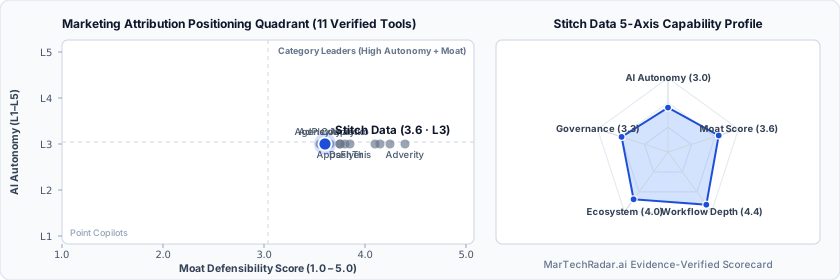
Stitch Data is a Web SaaS tool for Marketing Attribution (Multi-Touch Attribution & eCommerce Dashboards) in Analytics & Attribution. Pricing: Custom / enterprise pricing. Best suited to B2B SaaS. Editor ratings: AI autonomy L3 (conditional automation); moat score 3.6/5.0 (Proprietary moat). Fact-checked by Julie Brot on Oct 16, 2026.
Cloud-first ELT data pipeline engine that centralizes marketing, transactional, and eCommerce tracking events into enterprise analytical warehouses.
Stitch Data buyer fit verdict: when to choose vs. when to walk away
Choose Stitch Data if (Best Fit)
- Target ICP & Stack Fit: You operate as B2B SaaS requiring a Web SaaS deployment for Marketing Attribution, with verified ecosystem connectivity for Snowflake, Google BigQuery, Amazon Redshift.
- L3 Architecture & Defensibility: Stitch Data maintains technical defensibility via its deep ecosystem of open-source Singer taps and managed extraction pipelines, enabling low-latency schema migration and structured ingestion directly into modern cloud analytical warehouses without upfront transformation debt.
- Commercial Model Fit: Your procurement budget aligns with Custom / enterprise pricing.
Walk away from Stitch Data if (Deal-Breakers)
- Walk away if you require transparent self-serve monthly billing or your budget ceiling is under $1,000/mo (Stitch Data requires sales-gated custom quoting).
- Walk away if your workflow cannot tolerate transformation constraints: Because the platform operates strictly as an ELT extraction and load layer, it performs no native in-flight transformations, requiring external orchestration tools like dbt to construct finalized multi-touch attribution matrices.
- Walk away if API rate-limit sensitivity is a deal-breaker for your team: High-volume ad networks and legacy eCommerce endpoints can trigger upstream API rate limits during bulk backfills, inducing pipeline latency and delaying downstream dashboard updates.
Stitch Data key facts & scorecard
| Pricing | Custom / enterprise pricing |
|---|---|
| Free plan | No / not disclosed |
| Delivery | Web SaaS |
| Audience | B2B SaaS |
| AI autonomy level | L3 · Conditional automationEditor-verified |
| Moat tier & score | 3.6 / 5.0 · Proprietary moatEditor-verified |
| Funding | Acquired |
| Ecosystem integrations | Snowflake, Google BigQuery, Amazon Redshift |
| Headquarters | United States |
| Last verified |
Stitch Data pros & cons: strengths vs. operational limitations
Pros: core strengths & capabilities
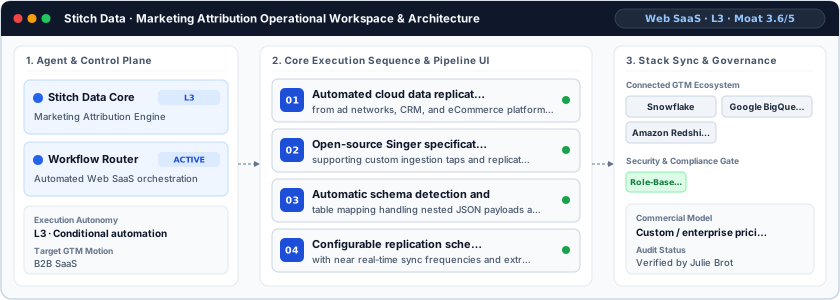
- Automated cloud data replication: from ad networks, CRM, and eCommerce platforms into centralized data warehouses
- Open-source Singer specification compatibility: supporting custom ingestion taps and replication targets
- Automatic schema detection and: table mapping handling nested JSON payloads and dynamic ad event structures
- Configurable replication scheduling: with near real-time sync frequencies and extraction monitoring
Cons: operational limitations & risks
- Transformation Constraints: Because the platform operates strictly as an ELT extraction and load layer, it performs no native in-flight transformations, requiring external orchestration tools like dbt to construct finalized multi-touch attribution matrices.
- API Rate-Limit Sensitivity: High-volume ad networks and legacy eCommerce endpoints can trigger upstream API rate limits during bulk backfills, inducing pipeline latency and delaying downstream dashboard updates.
- Mobile Deep-Linking Absence: The system lacks native mobile SDKs for real-time install attribution or SKAdNetwork signal reconciliation, relying entirely on raw third-party exports rather than programmatic mobile attribution network telemetry.
Stitch Data TCO & deal-breaker stress test
Simulate 12-month stepped TCO, hidden cost multipliers, contract lock-in exposure, and stack failure modes using only facts verified by Julie Brot on .
Stitch Data triggers high-severity friction under your 5-seat / $800/mo constraints. Benchmark the verified subtrack alternatives below before committing.
| Plan / Tier | Verified Rate | Scale Fit | Scope & Quota Notes |
|---|---|---|---|
| Enterprise / Custom | Custom quote | 15–50+ seats (Enterprise SLA) | Sales-negotiated annual contract for custom volume, SSO/RBAC governance, and dedicated SLA. |
- Moat Score
- 3.6 / 5.0
- AI Autonomy
- L3
- Free Tier / Trial
- None disclosed
Triggered audit signals & failure modes
- Opaque Enterprise Quoting vs. SMB/Mid-Market BudgetVerified Pricing Ledger
Stitch Data does not disclose a public self-serve floor (Custom / enterprise pricing). Buyers with a $800/mo cap face high sales-qualification friction.
- Sales-Gated Contract TermsFact-checked by Julie Brot
Stitch Data provides commercial licensing through custom enterprise quotes based on organizational scale, monthly active row ingestion volume, and required connector access.
- Primary Operational Bottleneck: Transformation ConstraintsAudit by Julie Brot
Because the platform operates strictly as an ELT extraction and load layer, it performs no native in-flight transformations, requiring external orchestration tools like dbt to construct finalized multi-touch attribution matrices.
Hidden TCO Multipliers & Quota Gates
- Transformation Constraints: Because the platform operates strictly as an ELT extraction and load layer, it performs no native in-flight transformations, requiring external orchestration tools like dbt to construct finalized multi-touch attribution matrices.
- API Rate-Limit Sensitivity: High-volume ad networks and legacy eCommerce endpoints can trigger upstream API rate limits during bulk backfills, inducing pipeline latency and delaying downstream dashboard updates.
When to Walk Away & Negotiation Levers
- Walk away if you require transparent self-serve monthly billing or your budget ceiling is under $1,000/mo (Stitch Data requires sales-gated custom quoting).
- Walk away if your workflow cannot tolerate transformation constraints: Because the platform operates strictly as an ELT extraction and load layer, it performs no native in-flight transformations, requiring external orchestration tools like dbt to construct finalized multi-touch attribution matrices.
- Walk away if API rate-limit sensitivity is a deal-breaker for your team: High-volume ad networks and legacy eCommerce endpoints can trigger upstream API rate limits during bulk backfills, inducing pipeline latency and delaying downstream dashboard updates.
- Demand a 30- to 60-day paid pilot opt-out clause in the Stitch Data order form before signing a 12-month enterprise commitment.
- Require a sandbox proof-of-concept testing transformation constraints against your live CRM/data schema before annual sign-off.
Ask a custom procurement or TCO stress-test question about Stitch Data
Lower 5-seat floor (~$15/mo vs. Custom Quote) · Transparent self-serve entry without mandatory annual lock-in
Lower 5-seat floor (~$79/mo vs. Custom Quote) · Transparent self-serve entry without mandatory annual lock-in
Stitch Data key entities, modules & ecosystem stack
Stitch Data moat & subtrack positioning
Stitch Data maintains technical defensibility via its deep ecosystem of open-source Singer taps and managed extraction pipelines, enabling low-latency schema migration and structured ingestion directly into modern cloud analytical warehouses without upfront transformation debt.
Editorial review
Fact-checked by Julie Brot (Enterprise SaaS Governance & Procurement Editor) on .
Background
Architectural fragmentation between programmatic ad platforms, web analytics, and payment gateways frequently blinds analytics teams attempting multi-touch attribution across customer conversion journeys. Stitch Data, based in the United States, establishes a centralized ELT data ingestion backbone specifically utilized by digital analytics directors, marketing data engineers, and revenue operations leaders. By decoupling event extraction from transformation layers, the platform funnels raw cross-channel data directly into cloud data warehouses, establishing an audited baseline for comprehensive eCommerce reporting and attribution modeling.
How Stitch Data works
Stitch Data executes automated ELT replication pipelines leveraging the Singer tap-and-target framework. The ingestion engine connects directly to source APIs across search, social, conversion, and payment nodes, reading change-data logs and REST payloads at scheduled intervals. Extracted records undergo automatic schema discovery and normalization, flattening nested JSON structures into typed columnar schemas before streaming directly into analytical destinations such as Snowflake, BigQuery, or Amazon Redshift. By persisting untransformed event data with exact ingestion timestamps, the platform enables downstream SQL attribution models to compute linear, time-decay, and algorithmic multi-touch paths without source data degradation.
Limitations
Operational considerations and platform boundaries include:
- Transformation Constraints: Because the platform operates strictly as an ELT extraction and load layer, it performs no native in-flight transformations, requiring external orchestration tools like dbt to construct finalized multi-touch attribution matrices.
- API Rate-Limit Sensitivity: High-volume ad networks and legacy eCommerce endpoints can trigger upstream API rate limits during bulk backfills, inducing pipeline latency and delaying downstream dashboard updates.
- Mobile Deep-Linking Absence: The system lacks native mobile SDKs for real-time install attribution or SKAdNetwork signal reconciliation, relying entirely on raw third-party exports rather than programmatic mobile attribution network telemetry.
Stitch Data pricing
Stitch Data provides commercial licensing through custom enterprise quotes based on organizational scale, monthly active row ingestion volume, and required connector access. Prospective buyers must contact the sales team to configure production contracts, which scale alongside data warehouse load frequencies and dedicated integration support tiers. Pricing is available on request through tailored enterprise sales quotes, with custom enterprise tiers, subscription plans, and seat licenses structured around organizational scale and monthly workflow volume.
How Stitch Data compares
Within attribution and marketing analytics architectures, Stitch Data occupies the raw pipeline layer, presenting distinct operational trade-offs against specialized alternatives. Mobile-first attribution suites like AppsFlyer and Adjust provide native SDKs, deep linking, and deterministic mobile app attribution out of the box, whereas Stitch Data requires teams to ingest and calculate these signals manually in warehouse storage. Compared to Adverity, which packages extensive pre-load marketing transformations and native BI visualization, Stitch Data prioritizes lightweight, schema-agnostic extraction designed for technical analytics teams with mature internal data modeling stacks.
Frequently asked questions about Stitch Data
How much does Stitch Data cost and does it require a custom enterprise quote?
Published pricing summary for Stitch Data: Custom / enterprise pricing. A permanent free plan is not disclosed for Stitch Data. Stitch Data provides commercial licensing through custom enterprise quotes based on organizational scale, monthly active row ingestion volume, and required connector access.
How does Stitch Data work and how autonomous is its AI architecture?
Cloud-first ELT data pipeline engine that centralizes marketing, transactional, and eCommerce tracking events into enterprise analytical warehouses. Within Marketing Attribution (Multi-Touch Attribution & eCommerce Dashboards), MarTechRadar rates its execution architecture at L3 · Conditional automation with a verified Moat Score of 3.6 / 5.0 (Proprietary moat). Stitch Data maintains technical defensibility via its deep ecosystem of open-source Singer taps and managed extraction pipelines, enabling low-latency schema migration and structured ingestion directly into modern cloud analytical warehouses without upfront transformation debt.
What are the main limitations of Stitch Data and when should buyers walk away?
Based on our editorial technical audit, key operational considerations and boundaries for Stitch Data include: (1) Transformation Constraints: Because the platform operates strictly as an ELT extraction and load layer, it performs no native in-flight transformations, requiring external orchestration tools like dbt to construct finalized multi-touch attribution matrices. (2) API Rate-Limit Sensitivity: High-volume ad networks and legacy eCommerce endpoints can trigger upstream API rate limits during bulk backfills, inducing pipeline latency and delaying downstream dashboard updates. (3) Mobile Deep-Linking Absence: The system lacks native mobile SDKs for real-time install attribution or SKAdNetwork signal reconciliation, relying entirely on raw third-party exports rather than programmatic mobile attribution network telemetry. Primary procurement walk-away rule: Walk away if you require transparent self-serve monthly billing or your budget ceiling is under $1,000/mo (Stitch Data requires sales-gated custom quoting).
What integrations, compliance certifications, and contract terms apply to Stitch Data?
Verified ecosystem and stack integrations include Snowflake, Google BigQuery, Amazon Redshift. Key TCO multiplier to watch: Transformation Constraints (Because the platform operates strictly as an ELT extraction and load layer, it performs no native in-flight transformations, requiring external orchestration tools like dbt to construct finalized multi-touch attribution matrices.) Before signing a contract, procurement teams should demand a 30- to 60-day paid pilot opt-out clause in the Stitch Data order form before signing a 12-month enterprise commitment.
What are the best Stitch Data alternatives and head-to-head competitors in 2026?
Top fact-checked alternatives to Stitch Data in Marketing Attribution (Multi-Touch Attribution & eCommerce Dashboards) include AppGrowing (Custom / enterprise pricing), ThoughtSpot Sage (Custom / enterprise pricing), Whatagraph (Custom / enterprise pricing), Nielsen ONE (Custom / enterprise pricing). Within attribution and marketing analytics architectures, Stitch Data occupies the raw pipeline layer, presenting distinct operational trade-offs against specialized alternatives.
Verified sources & evidence trail
- Official product domain: https://stitchdata.com
- Commercial pricing verification: Verified against official vendor pricing policy (Custom / enterprise pricing)
- Editorial audit sign-off: Fact-checked by Julie Brot on under the MarTechRadar Evidence-Ledger Protocol.