Swash Review (2026): DCO Pricing, Limits & Alternatives
Bottom line
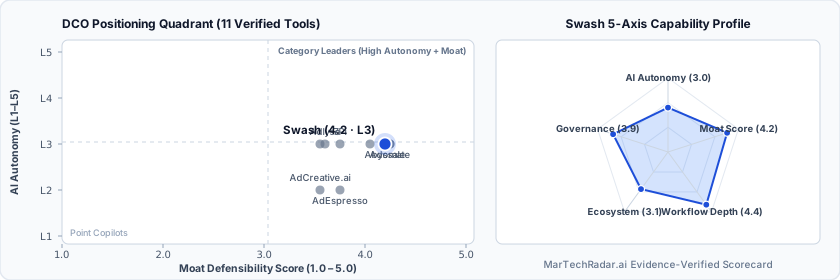
Swash is a Web SaaS tool for DCO (Dynamic Creative Optimization / DCO) in AdTech & Paid Media. Pricing: Custom / enterprise pricing. Best suited to Performance Marketing Directors, Ad Agencies and Retail Media Advertisers. Editor ratings: AI autonomy L3 (conditional automation); moat score 4.2/5.0 (Proprietary moat). Fact-checked by Anna Xia on Oct 12, 2026.
Decentralized consumer data telemetry platform capturing first-party zero-knowledge behavioral intelligence for market research and audience activation.
Swash buyer fit verdict: when to choose vs. when to walk away
Choose Swash if (Best Fit)
- Target ICP & Stack Fit: You operate as Performance Marketing Directors, Ad Agencies and Retail Media Advertisers requiring a Web SaaS deployment for DCO.
- L3 Architecture & Defensibility: Swash establishes defensibility through an opt-in consumer network generating zero-party behavioral stream data, local edge sanitization that neutralizes personally identifiable information before ingestion, and distributed token incentives ensuring ongoing panel retention.
- Commercial Model Fit: Your procurement budget aligns with Custom / enterprise pricing.
Walk away from Swash if (Deal-Breakers)
- Walk away if you require transparent self-serve monthly billing or your budget ceiling is under $1,000/mo (Swash requires sales-gated custom quoting).
- Walk away if your workflow cannot tolerate panel demographic bias: The incentive-driven data capture structure inherently over-indexes on tech-literate consumers and incentive seekers, skewing demographic distributions away from high-net-worth commercial audiences.
- Walk away if browser host-permission vulnerability is a deal-breaker for your team: Telemetry pipelines rely on browser store distribution and manifest permissions, creating systemic operational fragility whenever browser vendors alter extension privilege policies.
Swash key facts & scorecard
| Pricing | Custom / enterprise pricing |
|---|---|
| Free plan | No / not disclosed |
| Delivery | Web SaaS |
| Audience | Performance Marketing Directors, Ad Agencies, Retail Media Advertisers |
| AI autonomy level | L3 · Conditional automationEditor-verified |
| Moat tier & score | 4.2 / 5.0 · Proprietary moatEditor-verified |
| Funding | Series A |
| Total funding | $19MBacked by KuCoin, Outlier Ventures |
| Founders | Bruce Pon, Ebrahim Khalizadeh, Ioana Surpateanu, Masoud Sarabadani |
| Company size | 11-50 employees |
| Governance & docs | Privacy ↗ |
| Headquarters | London, England, United Kingdom |
| Founded | 2020 |
| Last verified |
Swash pros & cons: strengths vs. operational limitations
Pros: core strengths & capabilities
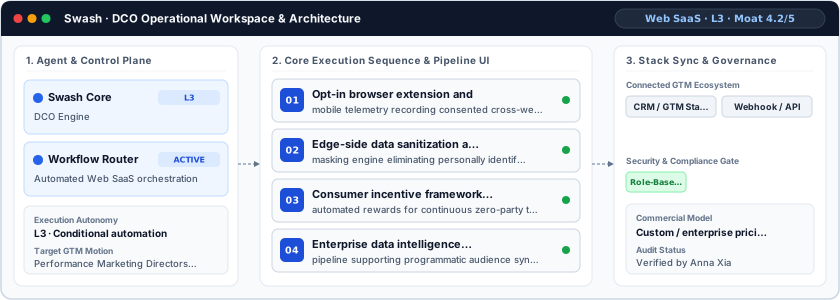
- Opt-in browser extension and: mobile telemetry recording consented cross-web digital interactions
- Edge-side data sanitization and: masking engine eliminating personally identifiable information
- Consumer incentive framework distributing: automated rewards for continuous zero-party telemetry participation
- Enterprise data intelligence query: pipeline supporting programmatic audience synthesis and behavioral analysis
Cons: operational limitations & risks
- Panel Demographic Bias: The incentive-driven data capture structure inherently over-indexes on tech-literate consumers and incentive seekers, skewing demographic distributions away from high-net-worth commercial audiences.
- Browser Host-Permission Vulnerability: Telemetry pipelines rely on browser store distribution and manifest permissions, creating systemic operational fragility whenever browser vendors alter extension privilege policies.
- Integration Pipeline Latency: Aggregating and cryptographically validating decentralized data packets introduces batch processing overhead, limiting millisecond-level ad auction creative substitution relative to native ad servers.
Swash TCO & deal-breaker stress test
Simulate 12-month stepped TCO, hidden cost multipliers, contract lock-in exposure, and stack failure modes using only facts verified by Anna Xia on · Capture SHA ada1a5a5.
Swash triggers high-severity friction under your 5-seat / $800/mo constraints. Benchmark the verified subtrack alternatives below before committing.
| Plan / Tier | Verified Rate | Scale Fit | Scope & Quota Notes |
|---|---|---|---|
| Enterprise / Custom | Custom quote | 15–50+ seats (Enterprise SLA) | Sales-negotiated annual contract for custom volume, SSO/RBAC governance, and dedicated SLA. |
- Moat Score
- 4.2 / 5.0
- AI Autonomy
- L3
- Free Tier / Trial
- None disclosed
Triggered audit signals & failure modes
- Opaque Enterprise Quoting vs. SMB/Mid-Market BudgetVerified Pricing Ledger
Swash does not disclose a public self-serve floor (Custom / enterprise pricing). Buyers with a $800/mo cap face high sales-qualification friction.
- Sales-Gated Contract TermsFact-checked by Anna Xia
Commercial access is structured around tailored enterprise sales agreements based on target audience data volume, query consumption, and programmatic integration scope.
- Primary Operational Bottleneck: Panel Demographic BiasAudit by Anna Xia
The incentive-driven data capture structure inherently over-indexes on tech-literate consumers and incentive seekers, skewing demographic distributions away from high-net-worth commercial audiences.
Hidden TCO Multipliers & Quota Gates
- Panel Demographic Bias: The incentive-driven data capture structure inherently over-indexes on tech-literate consumers and incentive seekers, skewing demographic distributions away from high-net-worth commercial audiences.
- Browser Host-Permission Vulnerability: Telemetry pipelines rely on browser store distribution and manifest permissions, creating systemic operational fragility whenever browser vendors alter extension privilege policies.
When to Walk Away & Negotiation Levers
- Walk away if you require transparent self-serve monthly billing or your budget ceiling is under $1,000/mo (Swash requires sales-gated custom quoting).
- Walk away if your workflow cannot tolerate panel demographic bias: The incentive-driven data capture structure inherently over-indexes on tech-literate consumers and incentive seekers, skewing demographic distributions away from high-net-worth commercial audiences.
- Walk away if browser host-permission vulnerability is a deal-breaker for your team: Telemetry pipelines rely on browser store distribution and manifest permissions, creating systemic operational fragility whenever browser vendors alter extension privilege policies.
- Demand a 30- to 60-day paid pilot opt-out clause in the Swash order form before signing a 12-month enterprise commitment.
- Require a sandbox proof-of-concept testing panel demographic bias against your live CRM/data schema before annual sign-off.
Ask a custom procurement or TCO stress-test question about Swash
Lower 5-seat floor (~$36/mo vs. Custom Quote) · Transparent self-serve entry without mandatory annual lock-in
Lower 5-seat floor (~$99/mo vs. Custom Quote) · Transparent self-serve entry without mandatory annual lock-in
Swash moat & subtrack positioning
Swash establishes defensibility through an opt-in consumer network generating zero-party behavioral stream data, local edge sanitization that neutralizes personally identifiable information before ingestion, and distributed token incentives ensuring ongoing panel retention.
Editorial review
Fact-checked by Anna Xia (Senior B2B GTM & Revenue Systems Analyst) on .
Background
In the privacy-restricted post-cookie ecosystem, Swash provides an opt-in data monetization network that supplies raw consumer telemetry directly to enterprise brands. Headquartered in London, England, United Kingdom, and established in 2020, the organization has secured $19M in venture funding. Built for programmatic media directors, consumer insights teams, and business intelligence architects, Swash bypasses conventional third-party tracking heuristics by establishing a direct economic exchange with verified digital consumers.
How Swash works
Swash operates via an L3 automated telemetry capture pipeline deployed through browser extensions and mobile clients. Users grant explicit consent to log clickstreams, search queries, and purchase transactions. Data sanitization occurs at the client edge, stripping personally identifiable records via local masking algorithms prior to upstream ingestion. The sanitized interaction logs stream into an aggregated intelligence data lake, enabling automated dynamic creative optimization systems to query live behavioral segments without breaching data governance protocols.
Limitations
Operational considerations and platform boundaries include:
- Panel Demographic Bias: The incentive-driven data capture structure inherently over-indexes on tech-literate consumers and incentive seekers, skewing demographic distributions away from high-net-worth commercial audiences.
- Browser Host-Permission Vulnerability: Telemetry pipelines rely on browser store distribution and manifest permissions, creating systemic operational fragility whenever browser vendors alter extension privilege policies.
- Integration Pipeline Latency: Aggregating and cryptographically validating decentralized data packets introduces batch processing overhead, limiting millisecond-level ad auction creative substitution relative to native ad servers.
Swash pricing
Commercial access is structured around tailored enterprise sales agreements based on target audience data volume, query consumption, and programmatic integration scope. Rather than listing fixed rates, commercial pricing is available on request through tailored enterprise sales quotes based on organizational scale and seats. Enterprise contracts typically combine annual audience access licenses with variable data delivery consumption tiers.
How Swash compares
While dynamic creative production tools like Abyssale and AdCreative.ai automate visual generation and generative layout variants, and 7Pi focuses on rapid ad layout rendering, Swash functions upstream as the consumer behavioral data substrate. It trades away native graphic rendering studios to provide first-party telemetry feeds, making it optimal for enterprise organizations requiring clean behavioral data to inform dynamic creative decision engines.
Direct competitors & market radar
Top algorithmic competitors based on category positioning, capability overlap, and ICP alignment.
Frequently asked questions about Swash
How much does Swash cost and does it require a custom enterprise quote?
Published pricing summary for Swash: Custom / enterprise pricing. A permanent free plan is not disclosed for Swash. Commercial access is structured around tailored enterprise sales agreements based on target audience data volume, query consumption, and programmatic integration scope.
How does Swash work and how autonomous is its AI architecture?
Decentralized consumer data telemetry platform capturing first-party zero-knowledge behavioral intelligence for market research and audience activation. Within DCO (Dynamic Creative Optimization / DCO), MarTechRadar rates its execution architecture at L3 · Conditional automation with a verified Moat Score of 4.2 / 5.0 (Proprietary moat). Swash establishes defensibility through an opt-in consumer network generating zero-party behavioral stream data, local edge sanitization that neutralizes personally identifiable information before ingestion, and distributed token incentives ensuring ongoing panel retention. Corporate profile: Founded by Bruce Pon, Ebrahim Khalizadeh, Ioana Surpateanu, Masoud Sarabadani, operating at 11-50 employees scale.
What are the main limitations of Swash and when should buyers walk away?
Based on our editorial technical audit, key operational considerations and boundaries for Swash include: (1) Panel Demographic Bias: The incentive-driven data capture structure inherently over-indexes on tech-literate consumers and incentive seekers, skewing demographic distributions away from high-net-worth commercial audiences. (2) Browser Host-Permission Vulnerability: Telemetry pipelines rely on browser store distribution and manifest permissions, creating systemic operational fragility whenever browser vendors alter extension privilege policies. (3) Integration Pipeline Latency: Aggregating and cryptographically validating decentralized data packets introduces batch processing overhead, limiting millisecond-level ad auction creative substitution relative to native ad servers. Primary procurement walk-away rule: Walk away if you require transparent self-serve monthly billing or your budget ceiling is under $1,000/mo (Swash requires sales-gated custom quoting).
What integrations, compliance certifications, and contract terms apply to Swash?
Key TCO multiplier to watch: Panel Demographic Bias (The incentive-driven data capture structure inherently over-indexes on tech-literate consumers and incentive seekers, skewing demographic distributions away from high-net-worth commercial audiences.) Before signing a contract, procurement teams should demand a 30- to 60-day paid pilot opt-out clause in the Swash order form before signing a 12-month enterprise commitment.
What are the best Swash alternatives and head-to-head competitors in 2026?
Top fact-checked alternatives to Swash in DCO (Dynamic Creative Optimization / DCO) include Oriane (Custom / enterprise pricing), Taiv (Custom / enterprise pricing), Vaudit (Formerly BlokID) (Custom / enterprise pricing), Blankspace (Custom / enterprise pricing). While dynamic creative production tools like Abyssale and AdCreative.ai automate visual generation and generative layout variants, and 7Pi focuses on rapid ad layout rendering, Swash functions upstream as the consumer behavioral data substrate.
Verified sources & evidence trail
- Official product domain: https://swashapp.io/
- Commercial pricing verification: Verified against official vendor pricing policy (Custom / enterprise pricing)
- Verified corporate entity profiles (
sameAs): LinkedIn Company Profile · Crunchbase Entity Record - First-party governance & documentation links: Privacy
- Editorial audit sign-off: Fact-checked by Anna Xia on under the MarTechRadar Evidence-Ledger Protocol.