Taiv Review (2026): DCO Pricing, Limits & Alternatives
Bottom line
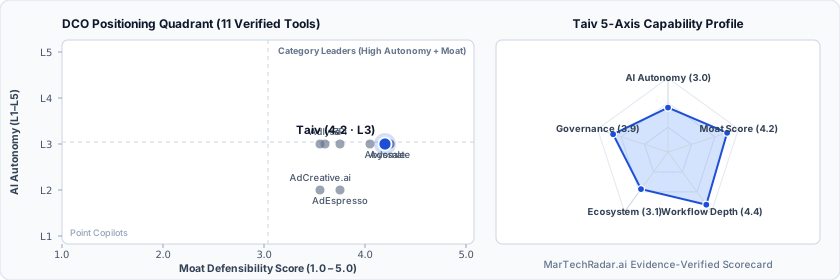
Taiv is a Web SaaS tool for DCO (Dynamic Creative Optimization / DCO) in AdTech & Paid Media. Pricing: Custom / enterprise pricing. Best suited to Performance Marketing Directors, Ad Agencies and Retail Media Advertisers. Editor ratings: AI autonomy L3 (conditional automation); moat score 4.2/5.0 (Proprietary moat). Fact-checked by Jagmeet Sine on Oct 12, 2026.
Computer vision ad-insertion hardware and software platform that detects live cable TV commercial breaks in physical venues to inject custom promotions.
Taiv buyer fit verdict: when to choose vs. when to walk away
Choose Taiv if (Best Fit)
- Target ICP & Stack Fit: You operate as Performance Marketing Directors, Ad Agencies and Retail Media Advertisers requiring a Web SaaS deployment for DCO.
- L3 Architecture & Defensibility: Proprietary edge hardware integration with sub-second computer vision models capable of real-time commercial detection and synchronized content injection on legacy broadcast streams, backed by programmatic physical venue ad networks.
- Commercial Model Fit: Your procurement budget aligns with Custom / enterprise pricing.
Walk away from Taiv if (Deal-Breakers)
- Walk away if you require transparent self-serve monthly billing or your budget ceiling is under $1,000/mo (Taiv requires sales-gated custom quoting).
- Walk away if your workflow cannot tolerate hardware footprint and edge maintenance: Because the system relies on physical inline HDMI hardware, multi-unit rollouts face physical installation dependencies, device firmware lifecycle management, and potential hardware-level video handshake failures.
- Walk away if linear stream timing edge cases is a deal-breaker for your team: Unannounced programming shifts or unusual broadcast transitions during live sporting events can cause edge-detection latency, risking clipped live play or delayed return to primary feeds.
Taiv key facts & scorecard
| Pricing | Custom / enterprise pricing |
|---|---|
| Free plan | No / not disclosed |
| Delivery | Web SaaS |
| Audience | Performance Marketing Directors, Ad Agencies, Retail Media Advertisers |
| AI autonomy level | L3 · Conditional automationEditor-verified |
| Moat tier & score | 4.2 / 5.0 · Proprietary moatEditor-verified |
| Funding | Series A |
| Total funding | $27.5MBacked by Gaingels, Y Combinator |
| Founders | Avi Stoller, Jordan Davis, Noah Palansky |
| Company size | 51-200 employees |
| Governance & docs | Privacy ↗ |
| Headquarters | Winnipeg, Manitoba |
| Founded | 2018 |
| Last verified |
Taiv pros & cons: strengths vs. operational limitations
Pros: core strengths & capabilities
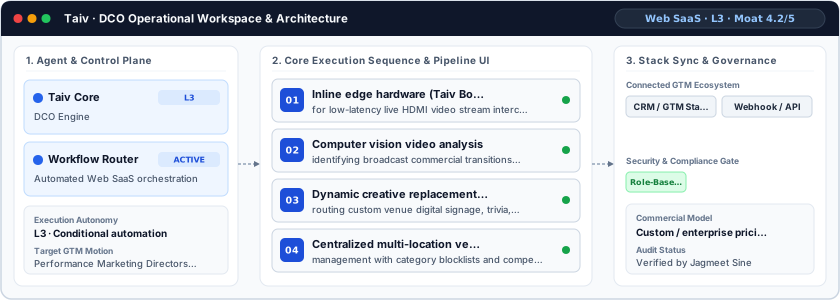
- Inline edge hardware (Taiv Box): for low-latency live HDMI video stream interception and commercial detection
- Computer vision video analysis: identifying broadcast commercial transitions and return-to-program triggers
- Dynamic creative replacement pipeline: routing custom venue digital signage, trivia, and programmatic ads
- Centralized multi-location venue fleet: management with category blocklists and competitive ad filtering
Cons: operational limitations & risks
- Hardware Footprint and Edge Maintenance: Because the system relies on physical inline HDMI hardware, multi-unit rollouts face physical installation dependencies, device firmware lifecycle management, and potential hardware-level video handshake failures.
- Linear Stream Timing Edge Cases: Unannounced programming shifts or unusual broadcast transitions during live sporting events can cause edge-detection latency, risking clipped live play or delayed return to primary feeds.
- Display Resolution and Aspect Constraints: Scaling disparate dynamic creatives across varying legacy displays can yield aspect ratio distortion, requiring rigid creative formatting boundaries to avoid degradation on non-standard in-venue screens.
Taiv TCO & deal-breaker stress test
Simulate 12-month stepped TCO, hidden cost multipliers, contract lock-in exposure, and stack failure modes using only facts verified by Jagmeet Sine on · Capture SHA 1061a6d2.
Taiv triggers high-severity friction under your 5-seat / $800/mo constraints. Benchmark the verified subtrack alternatives below before committing.
| Plan / Tier | Verified Rate | Scale Fit | Scope & Quota Notes |
|---|---|---|---|
| Enterprise / Custom | Custom quote | 15–50+ seats (Enterprise SLA) | Sales-negotiated annual contract for custom volume, SSO/RBAC governance, and dedicated SLA. |
- Moat Score
- 4.2 / 5.0
- AI Autonomy
- L3
- Free Tier / Trial
- None disclosed
Triggered audit signals & failure modes
- Opaque Enterprise Quoting vs. SMB/Mid-Market BudgetVerified Pricing Ledger
Taiv does not disclose a public self-serve floor (Custom / enterprise pricing). Buyers with a $800/mo cap face high sales-qualification friction.
- Sales-Gated Contract TermsFact-checked by Jagmeet Sine
Taiv operates a hybrid hardware-enabled commercial model consisting of a baseline venue plan and custom enterprise tiers. The base arrangement operates on an ad-revenue share structure, granting venues local content slots alongside network monetization.
- Primary Operational Bottleneck: Hardware Footprint and Edge MaintenanceAudit by Jagmeet Sine
Because the system relies on physical inline HDMI hardware, multi-unit rollouts face physical installation dependencies, device firmware lifecycle management, and potential hardware-level video handshake failures.
Hidden TCO Multipliers & Quota Gates
- Hardware Footprint and Edge Maintenance: Because the system relies on physical inline HDMI hardware, multi-unit rollouts face physical installation dependencies, device firmware lifecycle management, and potential hardware-level video handshake failures.
- Linear Stream Timing Edge Cases: Unannounced programming shifts or unusual broadcast transitions during live sporting events can cause edge-detection latency, risking clipped live play or delayed return to primary feeds.
When to Walk Away & Negotiation Levers
- Walk away if you require transparent self-serve monthly billing or your budget ceiling is under $1,000/mo (Taiv requires sales-gated custom quoting).
- Walk away if your workflow cannot tolerate hardware footprint and edge maintenance: Because the system relies on physical inline HDMI hardware, multi-unit rollouts face physical installation dependencies, device firmware lifecycle management, and potential hardware-level video handshake failures.
- Walk away if linear stream timing edge cases is a deal-breaker for your team: Unannounced programming shifts or unusual broadcast transitions during live sporting events can cause edge-detection latency, risking clipped live play or delayed return to primary feeds.
- Demand a 30- to 60-day paid pilot opt-out clause in the Taiv order form before signing a 12-month enterprise commitment.
- Require a sandbox proof-of-concept testing hardware footprint and edge maintenance against your live CRM/data schema before annual sign-off.
Ask a custom procurement or TCO stress-test question about Taiv
Lower 5-seat floor (~$36/mo vs. Custom Quote) · Transparent self-serve entry without mandatory annual lock-in
Lower 5-seat floor (~$49/mo vs. Custom Quote) · Transparent self-serve entry without mandatory annual lock-in
Taiv moat & subtrack positioning
Proprietary edge hardware integration with sub-second computer vision models capable of real-time commercial detection and synchronized content injection on legacy broadcast streams, backed by programmatic physical venue ad networks.
Editorial review
Fact-checked by Jagmeet Sine (Senior MarTech Infrastructure & Agentic Workflow Architect) on .
Background
Operating from the edge of physical display networks, Taiv converts standard broadcast television infrastructure into dynamic, programmatically monetizable ad inventory. Established in 2018 in Winnipeg, Manitoba, the company has secured $27.5M in venture financing to solve linear commercial inefficiency across hospitality, restaurant, and sports bar ecosystems. The solution targets venue operators, hospitality franchise groups, and out-of-home advertising buyers who need granular control over physical display experiences without replacing installed display panels.
How Taiv works
At the systems layer, Taiv deploys an inline hardware appliance interposed directly between venue cable or satellite receivers and downstream television displays via HDMI. The appliance executes edge-based computer vision inference against live incoming video streams to identify standard broadcast ad break transitions with sub-second response times. Upon break detection, the local system overrides the linear broadcast feed to execute dynamic creative insertion, rendering a mix of localized venue promotions, trivia modules, and programmatic ads. Telemetry signals coordinate with Taiv's cloud management plane, syncing campaign playout logs, verifying impression delivery, and resuming live broadcast feeds before standard programming returns.
Limitations
Operational considerations and platform boundaries include:
- Hardware Footprint and Edge Maintenance: Because the system relies on physical inline HDMI hardware, multi-unit rollouts face physical installation dependencies, device firmware lifecycle management, and potential hardware-level video handshake failures.
- Linear Stream Timing Edge Cases: Unannounced programming shifts or unusual broadcast transitions during live sporting events can cause edge-detection latency, risking clipped live play or delayed return to primary feeds.
- Display Resolution and Aspect Constraints: Scaling disparate dynamic creatives across varying legacy displays can yield aspect ratio distortion, requiring rigid creative formatting boundaries to avoid degradation on non-standard in-venue screens.
Taiv pricing
Taiv operates a hybrid hardware-enabled commercial model consisting of a baseline venue plan and custom enterprise tiers. The base arrangement operates on an ad-revenue share structure, granting venues local content slots alongside network monetization. For expanded inventory allocation, custom audio control, and dedicated multi-location management, commercial pricing is available on request through tailored enterprise sales quotes based on organizational scale and seats.
How Taiv compares
Within dynamic creative optimization, Taiv occupies an atypical physical edge niche compared to purely digital creative generation engines like AdCreative.ai, Abyssale, or 7Pi. While AdCreative.ai and Abyssale focus on programmatic cross-channel digital asset generation via web APIs and template rendering pipelines, Taiv manages real-time hardware stream manipulation and physical venue distribution. The optimal enterprise buyer is a multi-unit hospitality or sports entertainment brand seeking automated monetization and localized promotional control over existing in-venue TV fleets.
Direct competitors & market radar
Top algorithmic competitors based on category positioning, capability overlap, and ICP alignment.
Frequently asked questions about Taiv
How much does Taiv cost and does it require a custom enterprise quote?
Published pricing summary for Taiv: Custom / enterprise pricing. A permanent free plan is not disclosed for Taiv. Taiv operates a hybrid hardware-enabled commercial model consisting of a baseline venue plan and custom enterprise tiers. The base arrangement operates on an ad-revenue share structure, granting venues local content slots alongside network monetization.
How does Taiv work and how autonomous is its AI architecture?
Computer vision ad-insertion hardware and software platform that detects live cable TV commercial breaks in physical venues to inject custom promotions. Within DCO (Dynamic Creative Optimization / DCO), MarTechRadar rates its execution architecture at L3 · Conditional automation with a verified Moat Score of 4.2 / 5.0 (Proprietary moat). Proprietary edge hardware integration with sub-second computer vision models capable of real-time commercial detection and synchronized content injection on legacy broadcast streams, backed by programmatic physical venue ad networks. Corporate profile: Founded by Avi Stoller, Jordan Davis, Noah Palansky, operating at 51-200 employees scale.
What are the main limitations of Taiv and when should buyers walk away?
Based on our editorial technical audit, key operational considerations and boundaries for Taiv include: (1) Hardware Footprint and Edge Maintenance: Because the system relies on physical inline HDMI hardware, multi-unit rollouts face physical installation dependencies, device firmware lifecycle management, and potential hardware-level video handshake failures. (2) Linear Stream Timing Edge Cases: Unannounced programming shifts or unusual broadcast transitions during live sporting events can cause edge-detection latency, risking clipped live play or delayed return to primary feeds. (3) Display Resolution and Aspect Constraints: Scaling disparate dynamic creatives across varying legacy displays can yield aspect ratio distortion, requiring rigid creative formatting boundaries to avoid degradation on non-standard in-venue screens. Primary procurement walk-away rule: Walk away if you require transparent self-serve monthly billing or your budget ceiling is under $1,000/mo (Taiv requires sales-gated custom quoting).
What integrations, compliance certifications, and contract terms apply to Taiv?
Key TCO multiplier to watch: Hardware Footprint and Edge Maintenance (Because the system relies on physical inline HDMI hardware, multi-unit rollouts face physical installation dependencies, device firmware lifecycle management, and potential hardware-level video handshake failures.) Before signing a contract, procurement teams should demand a 30- to 60-day paid pilot opt-out clause in the Taiv order form before signing a 12-month enterprise commitment.
What are the best Taiv alternatives and head-to-head competitors in 2026?
Top fact-checked alternatives to Taiv in DCO (Dynamic Creative Optimization / DCO) include Swiftly (Custom / enterprise pricing), Oriane (Custom / enterprise pricing), Swash (Custom / enterprise pricing), Vaudit (Formerly BlokID) (Custom / enterprise pricing). Within dynamic creative optimization, Taiv occupies an atypical physical edge niche compared to purely digital creative generation engines like AdCreative.ai, Abyssale, or 7Pi.
Verified sources & evidence trail
- Official product domain: https://www.taiv.tv
- Commercial pricing verification: Verified against official vendor pricing policy (Custom / enterprise pricing)
- Verified corporate entity profiles (
sameAs): LinkedIn Company Profile · Crunchbase Entity Record - First-party governance & documentation links: Privacy
- Editorial audit sign-off: Fact-checked by Jagmeet Sine on under the MarTechRadar Evidence-Ledger Protocol.