TripleLift Review (2026): AI Programmatic Advertising Pricing, Limits & Alternatives
Bottom line
TripleLift is a Web SaaS tool for AI Programmatic Advertising (Programmatic DSP/SSP & Contextual AdTech) in AdTech & Paid Media. Pricing: Custom / enterprise pricing. Best suited to DTC / eCommerce and Enterprise Brands. Editor ratings: AI autonomy L3 (conditional automation); moat score 4.8/5.0 (Proprietary moat (category leader)). Fact-checked by Jagmeet Sine on Oct 12, 2026.
Programmatic creative SSP orchestrating dynamic native, CTV, and retail media placements through automated OpenRTB rendering engines.
TripleLift buyer fit verdict: when to choose vs. when to walk away
Choose TripleLift if (Best Fit)
- Target ICP & Stack Fit: You operate as DTC / eCommerce and Enterprise Brands requiring a Web SaaS deployment for AI Programmatic Advertising.
- L3 Architecture & Defensibility: TripleLift sustains defensibility through proprietary server-side ad templating, computer vision asset decomposition, and extensive direct publisher/CTV integrations that transform standard IAB assets into dynamic native and CTV inventory.
- Commercial Model Fit: Your procurement budget aligns with Custom / enterprise pricing.
Walk away from TripleLift if (Deal-Breakers)
- Walk away if you require transparent self-serve monthly billing or your budget ceiling is under $1,000/mo (TripleLift requires sales-gated custom quoting).
- Walk away if your workflow cannot tolerate rendering latency overhead: Client-side and server-side asset decomposition introduces execution latency that can conflict with rigid prebid wrapper auction timeout windows under constrained mobile networks.
- Walk away if ssai protocol incompatibilities is a deal-breaker for your team: CTV pause ads and dynamic video overlays experience occasional frame-accurate splicing failures when streaming environments deploy non-standard server-side ad insertion architectures.
TripleLift key facts & scorecard
| Pricing | Custom / enterprise pricing |
|---|---|
| Free plan | No / not disclosed |
| Delivery | Web SaaS |
| Audience | DTC / eCommerce, Enterprise Brands |
| AI autonomy level | L3 · Conditional automationEditor-verified |
| Moat tier & score | 4.8 / 5.0 · Proprietary moat (category leader)Editor-verified |
| Funding | AcquiredAcquired by Vista Equity Partners |
| Total funding | $16.6MBacked by Vista Equity Partners |
| Founders | Ari Levine, Eric Berry, Shaun Zacharia |
| Company size | 201-500 employees |
| Governance & docs | Terms ↗ · Privacy ↗ |
| Headquarters | New York |
| Founded | 2012 |
| Last verified |
TripleLift pros & cons: strengths vs. operational limitations
Pros: core strengths & capabilities
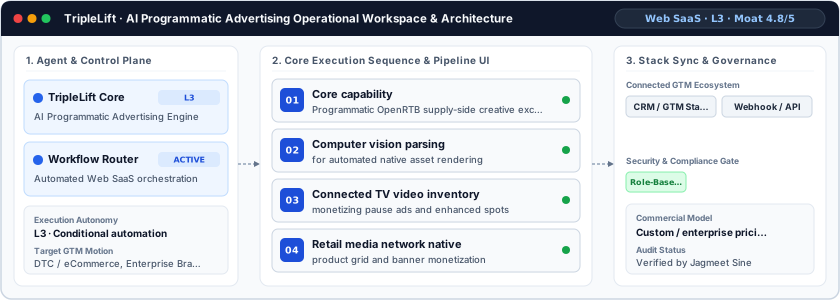
- Core capability: Programmatic OpenRTB supply-side creative exchange
- Computer vision parsing: for automated native asset rendering
- Connected TV video inventory: monetizing pause ads and enhanced spots
- Retail media network native: product grid and banner monetization
Cons: operational limitations & risks
- Rendering Latency Overhead: Client-side and server-side asset decomposition introduces execution latency that can conflict with rigid prebid wrapper auction timeout windows under constrained mobile networks.
- SSAI Protocol Incompatibilities: CTV pause ads and dynamic video overlays experience occasional frame-accurate splicing failures when streaming environments deploy non-standard server-side ad insertion architectures.
- Native Layout Drift: Dynamic publisher CSS updates and CMS layout revisions occasionally trigger visual clipping or typographic misalignment during automated native unit restyling.
TripleLift TCO & deal-breaker stress test
Simulate 12-month stepped TCO, hidden cost multipliers, contract lock-in exposure, and stack failure modes using only facts verified by Jagmeet Sine on · Capture SHA cb6cf0ce.
TripleLift triggers high-severity friction under your 5-seat / $800/mo constraints. Benchmark the verified subtrack alternatives below before committing.
| Plan / Tier | Verified Rate | Scale Fit | Scope & Quota Notes |
|---|---|---|---|
| Enterprise / Custom | Custom quote | 15–50+ seats (Enterprise SLA) | Sales-negotiated annual contract for custom volume, SSO/RBAC governance, and dedicated SLA. |
- Moat Score
- 4.8 / 5.0
- AI Autonomy
- L3
- Free Tier / Trial
- None disclosed
Triggered audit signals & failure modes
- Opaque Enterprise Quoting vs. SMB/Mid-Market BudgetVerified Pricing Ledger
TripleLift does not disclose a public self-serve floor (Custom / enterprise pricing). Buyers with a $800/mo cap face high sales-qualification friction.
- Sales-Gated Contract TermsFact-checked by Jagmeet Sine
TripleLift operates on an enterprise transaction-fee monetization model embedded within supply-side auctions. Commercial pricing is available on request through tailored enterprise sales quotes based on organizational scale and seats.
- Primary Operational Bottleneck: Rendering Latency OverheadAudit by Jagmeet Sine
Client-side and server-side asset decomposition introduces execution latency that can conflict with rigid prebid wrapper auction timeout windows under constrained mobile networks.
Hidden TCO Multipliers & Quota Gates
- Rendering Latency Overhead: Client-side and server-side asset decomposition introduces execution latency that can conflict with rigid prebid wrapper auction timeout windows under constrained mobile networks.
- SSAI Protocol Incompatibilities: CTV pause ads and dynamic video overlays experience occasional frame-accurate splicing failures when streaming environments deploy non-standard server-side ad insertion architectures.
When to Walk Away & Negotiation Levers
- Walk away if you require transparent self-serve monthly billing or your budget ceiling is under $1,000/mo (TripleLift requires sales-gated custom quoting).
- Walk away if your workflow cannot tolerate rendering latency overhead: Client-side and server-side asset decomposition introduces execution latency that can conflict with rigid prebid wrapper auction timeout windows under constrained mobile networks.
- Walk away if ssai protocol incompatibilities is a deal-breaker for your team: CTV pause ads and dynamic video overlays experience occasional frame-accurate splicing failures when streaming environments deploy non-standard server-side ad insertion architectures.
- Demand a 30- to 60-day paid pilot opt-out clause in the TripleLift order form before signing a 12-month enterprise commitment.
- Require a sandbox proof-of-concept testing rendering latency overhead against your live CRM/data schema before annual sign-off.
Ask a custom procurement or TCO stress-test question about TripleLift
Lower 5-seat floor (~$36/mo vs. Custom Quote) · Transparent self-serve entry without mandatory annual lock-in
Transparent self-serve entry without mandatory annual lock-in
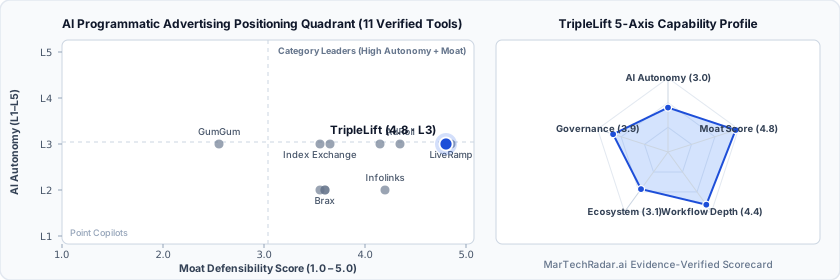
TripleLift moat & subtrack positioning
TripleLift sustains defensibility through proprietary server-side ad templating, computer vision asset decomposition, and extensive direct publisher/CTV integrations that transform standard IAB assets into dynamic native and CTV inventory.
Editorial review
Fact-checked by Jagmeet Sine (Senior MarTech Infrastructure & Agentic Workflow Architect) on .
Background
Backed by $16.6M in venture capital prior to its acquisition by Vista Equity Partners, TripleLift was founded in 2012 and is headquartered in New York. The company builds automated supply-side monetization infrastructure targeted at digital publishing executives, Connected TV streaming operators, and programmatic media buyers. The system addresses supply commoditization by transforming standard display, video, and retail media assets into tailored programmatic ad units across fragmented inventory channels.
How TripleLift works
At Level 3 autonomy, TripleLift operates an OpenRTB-compliant supply exchange integrated with dynamic creative rendering engines. When an ad impression triggers via prebid wrappers or direct tags, the platform ingests bidder responses and raw brand assets. Proprietary computer vision models decompose visual focal points, background textures, and textual elements in milliseconds. The exchange dynamically synthesizes these components into publisher-matched native layouts, retail media product units, or non-disruptive CTV placements such as pause ads and enhanced video spots before bid resolution.
Limitations
Operational considerations and platform boundaries include:
- Rendering Latency Overhead: Client-side and server-side asset decomposition introduces execution latency that can conflict with rigid prebid wrapper auction timeout windows under constrained mobile networks.
- SSAI Protocol Incompatibilities: CTV pause ads and dynamic video overlays experience occasional frame-accurate splicing failures when streaming environments deploy non-standard server-side ad insertion architectures.
- Native Layout Drift: Dynamic publisher CSS updates and CMS layout revisions occasionally trigger visual clipping or typographic misalignment during automated native unit restyling.
TripleLift pricing
TripleLift operates on an enterprise transaction-fee monetization model embedded within supply-side auctions. Commercial pricing is available on request through tailored enterprise sales quotes based on organizational scale and seats. SSP margins are typically absorbed via variable rev-share deductions on cleared programmatic inventory or custom publisher-side revenue splits across web, CTV, and retail environments.
How TripleLift compares
TripleLift competes against contextual and ad tech orchestration platforms like GumGum, LiveRamp, and AdRoll. While GumGum focuses heavily on contextual computer vision analysis and LiveRamp concentrates on deterministic identity graphs, TripleLift specializes in real-time creative adaptation across SSP auctions. AdRoll targets direct mid-market DSP campaign execution, whereas TripleLift focuses entirely on supply-side yield optimization for large-scale media owners and retail networks.
Direct competitors & market radar
Top algorithmic competitors based on category positioning, capability overlap, and ICP alignment.
Frequently asked questions about TripleLift
How much does TripleLift cost and does it require a custom enterprise quote?
Published pricing summary for TripleLift: Custom / enterprise pricing. A permanent free plan is not disclosed for TripleLift. TripleLift operates on an enterprise transaction-fee monetization model embedded within supply-side auctions. Commercial pricing is available on request through tailored enterprise sales quotes based on organizational scale and seats.
How does TripleLift work and how autonomous is its AI architecture?
Programmatic creative SSP orchestrating dynamic native, CTV, and retail media placements through automated OpenRTB rendering engines. Within AI Programmatic Advertising (Programmatic DSP/SSP & Contextual AdTech), MarTechRadar rates its execution architecture at L3 · Conditional automation with a verified Moat Score of 4.8 / 5.0 (Proprietary moat (category leader)). TripleLift sustains defensibility through proprietary server-side ad templating, computer vision asset decomposition, and extensive direct publisher/CTV integrations that transform standard IAB assets into dynamic native and CTV inventory. Corporate profile: Founded by Ari Levine, Eric Berry, Shaun Zacharia, operating at 201-500 employees scale, acquired by Vista Equity Partners.
What are the main limitations of TripleLift and when should buyers walk away?
Based on our editorial technical audit, key operational considerations and boundaries for TripleLift include: (1) Rendering Latency Overhead: Client-side and server-side asset decomposition introduces execution latency that can conflict with rigid prebid wrapper auction timeout windows under constrained mobile networks. (2) SSAI Protocol Incompatibilities: CTV pause ads and dynamic video overlays experience occasional frame-accurate splicing failures when streaming environments deploy non-standard server-side ad insertion architectures. (3) Native Layout Drift: Dynamic publisher CSS updates and CMS layout revisions occasionally trigger visual clipping or typographic misalignment during automated native unit restyling. Primary procurement walk-away rule: Walk away if you require transparent self-serve monthly billing or your budget ceiling is under $1,000/mo (TripleLift requires sales-gated custom quoting).
What integrations, compliance certifications, and contract terms apply to TripleLift?
Key TCO multiplier to watch: Rendering Latency Overhead (Client-side and server-side asset decomposition introduces execution latency that can conflict with rigid prebid wrapper auction timeout windows under constrained mobile networks.) Before signing a contract, procurement teams should demand a 30- to 60-day paid pilot opt-out clause in the TripleLift order form before signing a 12-month enterprise commitment.
What are the best TripleLift alternatives and head-to-head competitors in 2026?
Top fact-checked alternatives to TripleLift in AI Programmatic Advertising (Programmatic DSP/SSP & Contextual AdTech) include GumGum (Custom / enterprise pricing), The Trade Desk Kokai (Custom / enterprise pricing), Viant AI (Custom / enterprise pricing), Outbrain Smartlogic (Custom / enterprise pricing). TripleLift competes against contextual and ad tech orchestration platforms like GumGum, LiveRamp, and AdRoll. While GumGum focuses heavily on contextual computer vision analysis and LiveRamp concentrates on deterministic identity graphs, TripleLift specializes in real-time creative adaptation across SSP auctions.
Verified sources & evidence trail
- Official product domain: https://triplelift.com
- Commercial pricing verification: Verified against official vendor pricing policy (Custom / enterprise pricing)
- Verified corporate entity profiles (
sameAs): LinkedIn Company Profile · Crunchbase Entity Record - First-party governance & documentation links: Terms · Privacy
- Editorial audit sign-off: Fact-checked by Jagmeet Sine on under the MarTechRadar Evidence-Ledger Protocol.