UpLead Review (2026): ABM Pricing, Limits & Alternatives
Bottom line
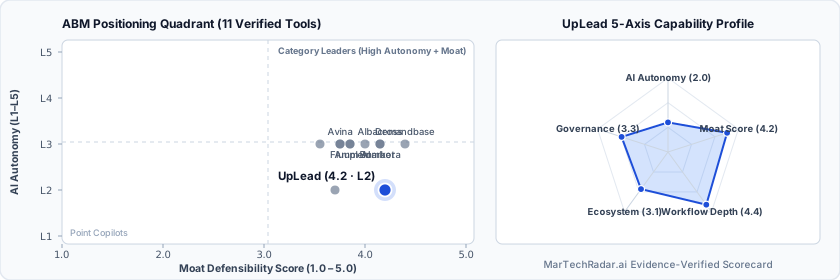
UpLead is a Web SaaS tool for ABM (Buyer Intent Data & Account-Based Marketing) in AI SDR & Outbound. Pricing: $99–$199/mo. Best suited to B2B SaaS. Editor ratings: AI autonomy L2 (workflow copilot); moat score 4.2/5.0 (Proprietary moat). Fact-checked by Anthony Hay on Oct 12, 2026.
B2B prospecting and intelligence engine providing real-time verified business contact data, mobile phone coverage, and buyer intent signals for outbound.
UpLead buyer fit verdict: when to choose vs. when to walk away
Choose UpLead if (Best Fit)
- Target ICP & Stack Fit: You operate as B2B SaaS requiring a Web SaaS deployment for ABM.
- L2 Architecture & Defensibility: UpLead couples a proprietary real-time email verification filter with external intent data integrations, though its long-term defensibility relies on continuous contact enrichment pipelines rather than proprietary machine learning models.
- Commercial Model Fit: Your procurement budget aligns with $99–$199/mo.
Walk away from UpLead if (Deal-Breakers)
- Walk away if your workflow requires uncapped enterprise volume on the $99–$199/mo entry plan without upgrading tiers.
- Walk away if your workflow cannot tolerate verification latency overhead: Executing real-time SMTP handshake protocols at the point of query induces perceptible export delays when processing multi-thousand contact batches compared to static database exports.
- Walk away if credit consumption economics is a deal-breaker for your team: The platform enforces strict credit-metered access, which penalizes broad exploratory account mapping where contact validity verification depletes allocation limits rapidly.
UpLead key facts & scorecard
| Pricing | $99–$199/moVendor pricing page |
|---|---|
| Free plan | No / not disclosed |
| Delivery | Web SaaS |
| Audience | B2B SaaS |
| AI autonomy level | L2 · Workflow copilotEditor-verified |
| Moat tier & score | 4.2 / 5.0 · Proprietary moatEditor-verified |
| Funding | Bootstrapped |
| Founders | Will Cannon |
| Company size | 51-200 employees |
| Governance & docs | System Status ↗ · API & Docs ↗ · Privacy ↗ |
| Headquarters | Covina, California |
| Founded | 2017 |
| Last verified |
UpLead pros & cons: strengths vs. operational limitations
Pros: core strengths & capabilities
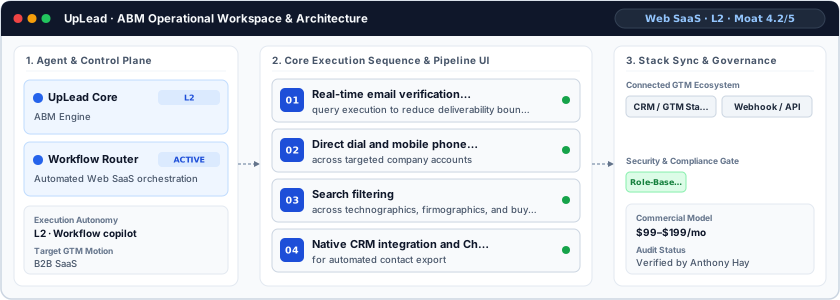
- Real-time email verification during: query execution to reduce deliverability bounce rates
- Direct dial and mobile phone data enrichment: across targeted company accounts
- Search filtering: across technographics, firmographics, and buyer intent parameters
- Native CRM integration and Chrome extension: for automated contact export
Cons: operational limitations & risks
- Verification latency overhead: Executing real-time SMTP handshake protocols at the point of query induces perceptible export delays when processing multi-thousand contact batches compared to static database exports.
- Credit consumption economics: The platform enforces strict credit-metered access, which penalizes broad exploratory account mapping where contact validity verification depletes allocation limits rapidly.
- Ecosystem intent depth: Third-party intent telemetry lacks direct integration into bidirectional ad orchestration engines, forcing operators to execute campaign activation in separate outbound platforms.
UpLead TCO & deal-breaker stress test
Simulate 12-month stepped TCO, hidden cost multipliers, contract lock-in exposure, and stack failure modes using only facts verified by Anthony Hay on · Capture SHA 73b29465.
UpLead aligns with your 5-seat / $800/mo profile. Review the walk-away triggers and contract levers below before deployment.
| Plan / Tier | Verified Rate | Scale Fit | Scope & Quota Notes |
|---|---|---|---|
| Essentials | $99/mo | 1–2 seats | Everything in Free and: |
| Plus | $199/mo | 5 seats | Everything in Essentials and: |
- Moat Score
- 4.2 / 5.0
- AI Autonomy
- L2
- Free Tier / Trial
- None disclosed
Triggered audit signals & failure modes
- Published Self-Serve Entry FloorVerified Pricing Ledger
UpLead publishes a transparent entry point ($99–$199/mo) for initial validation before committing.
- Tier Fit for 5-Seat Scale: Plus ($199/mo)Verified Tier Schedule
Everything in Essentials and:
- Primary Operational Bottleneck: Credit consumption economicsAudit by Anthony Hay
The platform enforces strict credit-metered access, which penalizes broad exploratory account mapping where contact validity verification depletes allocation limits rapidly.
Hidden TCO Multipliers & Quota Gates
- Annual Billing Headline vs. Monthly Premium: Headline entry rates reflect annual billing commitments; month-to-month flexibility carries a higher effective monthly rate or requires annual prepayment.
- Credit & Usage Burn Multiplier: Automated workflows consume metered credits/usage quotas; multi-step enrichment, voice minutes, or high-frequency agent runs can trigger mid-cycle top-up packs.
When to Walk Away & Negotiation Levers
- Walk away if your workflow requires uncapped enterprise volume on the $99–$199/mo entry plan without upgrading tiers.
- Walk away if your workflow cannot tolerate verification latency overhead: Executing real-time SMTP handshake protocols at the point of query induces perceptible export delays when processing multi-thousand contact batches compared to static database exports.
- Walk away if credit consumption economics is a deal-breaker for your team: The platform enforces strict credit-metered access, which penalizes broad exploratory account mapping where contact validity verification depletes allocation limits rapidly.
- Validate exact quota thresholds (seats, credits, or API calls) included in UpLead's $99–$199/mo tier before converting from monthly to annual billing.
- Require a sandbox proof-of-concept testing verification latency overhead against your live CRM/data schema before annual sign-off.
Ask a custom procurement or TCO stress-test question about UpLead
Lower 5-seat floor (~$49/mo vs. $199 / mo)
Lower 5-seat floor (~$29/mo vs. $199 / mo)
UpLead moat & subtrack positioning
UpLead couples a proprietary real-time email verification filter with external intent data integrations, though its long-term defensibility relies on continuous contact enrichment pipelines rather than proprietary machine learning models.
Editorial review
Fact-checked by Anthony Hay (Senior SEO, Search Intelligence & Content Operations Editor) on .
Background
Established in 2017 in Covina, California, UpLead addresses the persistent operational challenge of pipeline decay caused by stale contact directories and high outbound bounce rates. Built for sales development representatives, revenue operations managers, and commercial account executives, the platform provides direct access to verified B2B contact intelligence and buyer intent signals. By validating email records at the point of request rather than serving unverified historical dumps, UpLead targets organizations seeking targeted account lists without heavy data waste.
How UpLead works
At an architectural level, the platform processes queries against a structured firmographic index combined with external intent feeds. When an operator triggers an account search, UpLead applies real-time SMTP handshakes and domain verification checks before releasing contact records, discarding invalid mailboxes dynamically. Users enrich account schemas through technographic parameters, industry classifications, and direct dial matching. The system operates via direct CRM connectors and browser extensions, synchronizing structured prospect payloads into operational outbound pipelines.
Limitations
Operational considerations and platform boundaries include:
- Verification latency overhead: Executing real-time SMTP handshake protocols at the point of query induces perceptible export delays when processing multi-thousand contact batches compared to static database exports.
- Credit consumption economics: The platform enforces strict credit-metered access, which penalizes broad exploratory account mapping where contact validity verification depletes allocation limits rapidly.
- Ecosystem intent depth: Third-party intent telemetry lacks direct integration into bidirectional ad orchestration engines, forcing operators to execute campaign activation in separate outbound platforms.
UpLead pricing
UpLead operates on a credit-based subscription model across recurring monthly billing cycles. Entry begins with the Essentials tier at $99 per month, which delivers contact verification, mobile dials, and CRM connectivity. For scaling revenue operations requiring broader enrichment options, the Plus tier is available at $199 per month, allocating 400 credits alongside advanced search filters. Prospective customers can evaluate data coverage via a $0 trial tier configured with initial testing credits.
How UpLead compares
Within buyer intent and account intelligence, UpLead contrasts sharply with enterprise predictive platforms like 6sense, which prioritize predictive machine learning models and programmatic display orchestration over point-and-click prospecting. Unlike Albacross, which focuses primarily on deanonymizing website visitor traffic, UpLead concentrates on direct outbound contact retrieval. Meanwhile, Amplemarket merges prospecting intelligence directly into automated multi-channel sequences. UpLead remains optimal for mid-market outbound teams requiring verified contact data without multi-tier contract commitments.
Direct competitors & market radar
Top algorithmic competitors based on category positioning, capability overlap, and ICP alignment.
Frequently asked questions about UpLead
How much does UpLead cost and what pricing tiers are available?
Published pricing summary for UpLead: $99–$199/mo. A permanent free plan is not disclosed for UpLead. Verified tier schedule: Essentials ($99/mo for 1–2 seats); Plus ($199/mo for 5 seats). UpLead operates on a credit-based subscription model across recurring monthly billing cycles. Entry begins with the Essentials tier at $99 per month, which delivers contact verification, mobile dials, and CRM connectivity.
How does UpLead work and how autonomous is its AI architecture?
B2B prospecting and intelligence engine providing real-time verified business contact data, mobile phone coverage, and buyer intent signals for outbound. Within ABM (Buyer Intent Data & Account-Based Marketing), MarTechRadar rates its execution architecture at L2 · Workflow copilot with a verified Moat Score of 4.2 / 5.0 (Proprietary moat). UpLead couples a proprietary real-time email verification filter with external intent data integrations, though its long-term defensibility relies on continuous contact enrichment pipelines rather than proprietary machine learning models. Corporate profile: Founded by Will Cannon, operating at 51-200 employees scale.
What are the main limitations of UpLead and when should buyers walk away?
Based on our editorial technical audit, key operational considerations and boundaries for UpLead include: (1) Verification latency overhead: Executing real-time SMTP handshake protocols at the point of query induces perceptible export delays when processing multi-thousand contact batches compared to static database exports. (2) Credit consumption economics: The platform enforces strict credit-metered access, which penalizes broad exploratory account mapping where contact validity verification depletes allocation limits rapidly. (3) Ecosystem intent depth: Third-party intent telemetry lacks direct integration into bidirectional ad orchestration engines, forcing operators to execute campaign activation in separate outbound platforms. Primary procurement walk-away rule: Walk away if your workflow requires uncapped enterprise volume on the $99–$199/mo entry plan without upgrading tiers.
What integrations, compliance certifications, and contract terms apply to UpLead?
First-party governance and developer endpoints verified on domain include: Status (https://status.uplead.com), API Docs (https://docs.uplead.com). Key TCO multiplier to watch: Annual Billing Headline vs. Monthly Premium (Headline entry rates reflect annual billing commitments; month-to-month flexibility carries a higher effective monthly rate or requires annual prepayment.) Before signing a contract, procurement teams should validate exact quota thresholds (seats, credits, or API calls) included in UpLead's $99–$199/mo tier before converting from monthly to annual billing.
What are the best UpLead alternatives and head-to-head competitors in 2026?
Top fact-checked alternatives to UpLead in ABM (Buyer Intent Data & Account-Based Marketing) include AI Ark ($49/mo), ListEasier (Custom / enterprise pricing), Terminus (Custom / enterprise pricing), Fluum AI (Custom / enterprise pricing). Within buyer intent and account intelligence, UpLead contrasts sharply with enterprise predictive platforms like 6sense, which prioritize predictive machine learning models and programmatic display orchestration over point-and-click prospecting.
Verified sources & evidence trail
- Official product domain: https://uplead.com
- Commercial pricing verification: https://www.uplead.com/pricing/
- Verified corporate entity profiles (
sameAs): LinkedIn Company Profile · Crunchbase Entity Record - First-party governance & documentation links: System Status · API & Docs · Privacy
- Editorial audit sign-off: Fact-checked by Anthony Hay on under the MarTechRadar Evidence-Ledger Protocol.