Wildcard Review (2026): GEO Pricing, Limits & Alternatives
Bottom line
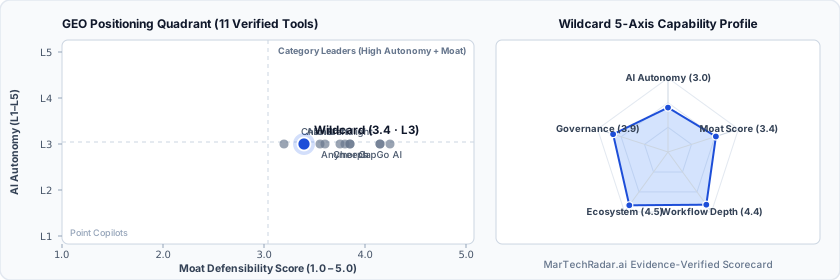
Wildcard is a Web SaaS tool for GEO (GEO Brand Tracking & LLM Rank Tracking) in GEO & AI SEO. Pricing: From $99/mo. Best suited to B2B SaaS and Marketing & Growth Teams. Editor ratings: AI autonomy L3 (conditional automation); moat score 3.4/5.0 (Workflow-embedded (strong)). Fact-checked by Julie Brot on Oct 16, 2026.
Full-stack AEO and GEO platform for e-commerce and retail brands optimizing product discovery across ChatGPT, Amazon Rufus, and Walmart Sparky.
Wildcard buyer fit verdict: when to choose vs. when to walk away
Choose Wildcard if (Best Fit)
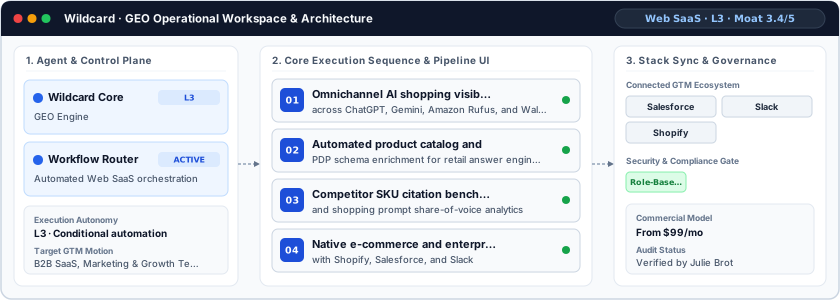
- Target ICP & Stack Fit: You operate as B2B SaaS and Marketing & Growth Teams requiring a Web SaaS deployment for GEO, with verified ecosystem connectivity for Salesforce, Slack, Shopify.
- L3 Architecture & Defensibility: Purpose-built retail SKU and shopping-agent optimization spanning Amazon Rufus, Walmart Sparky, and ChatGPT Shopping gives consumer brands specialized coverage that B2B GEO trackers lack.
- Commercial Model Fit: Your procurement budget aligns with From $99/mo.
Walk away from Wildcard if (Deal-Breakers)
- Walk away if your workflow requires uncapped enterprise volume on the From $99/mo entry plan without upgrading tiers.
- Walk away if your workflow cannot tolerate marketplace algorithm opacity limitation: Retailer-owned shopping agents like Amazon Rufus and Walmart Sparky blend organic relevance with proprietary inventory and ad signals, meaning third-party optimization struggles with black-box ranking shifts.
- Walk away if large sku catalog credit bottleneck is a deal-breaker for your team: Auditing and enriching thousands of seasonal e-commerce SKUs across multiple shopping engines simultaneously creates a credit consumption bottleneck and execution latency.
Wildcard key facts & scorecard
| Pricing | From $99/moVendor pricing page |
|---|---|
| Free plan | No / not disclosed |
| Delivery | Web SaaS |
| Audience | B2B SaaS, Marketing & Growth Teams |
| AI autonomy level | L3 · Conditional automationEditor-verified |
| Moat tier & score | 3.4 / 5.0 · Workflow-embedded (strong)Editor-verified |
| Funding | Pre-seed |
| Total funding | $500K |
| Founders | Kaushik Mahorker, Yagnya Patel |
| Company size | 2-10 employees |
| Ecosystem integrations | Salesforce, Slack, Shopify |
| Governance & docs | Changelog ↗ · Terms ↗ · Privacy ↗ |
| Headquarters | San Francisco, CA |
| Founded | 2025 |
| Last verified |
Wildcard pros & cons: strengths vs. operational limitations
Pros: core strengths & capabilities
- Omnichannel AI shopping visibility audits: across ChatGPT, Gemini, Amazon Rufus, and Walmart Sparky
- Automated product catalog and: PDP schema enrichment for retail answer engine retrieval
- Competitor SKU citation benchmarking: and shopping prompt share-of-voice analytics
- Native e-commerce and enterprise integrations: with Shopify, Salesforce, and Slack
Cons: operational limitations & risks
- Marketplace Algorithm Opacity Limitation: Retailer-owned shopping agents like Amazon Rufus and Walmart Sparky blend organic relevance with proprietary inventory and ad signals, meaning third-party optimization struggles with black-box ranking shifts.
- Large SKU Catalog Credit Bottleneck: Auditing and enriching thousands of seasonal e-commerce SKUs across multiple shopping engines simultaneously creates a credit consumption bottleneck and execution latency.
- B2B Lead-Gen Boundary: Because the data model is engineered around retail product feeds and marketplace PDPs, it is not built for complex B2B enterprise software sales cycles or long-form whitepaper SEO.
Wildcard TCO & deal-breaker stress test
Simulate 12-month stepped TCO, hidden cost multipliers, contract lock-in exposure, and stack failure modes using only facts verified by Julie Brot on · Capture SHA f2cb49d4.
Wildcard is viable for 5 seats, but requires commercial or technical verification on the flagged items below.
| Plan / Tier | Verified Rate | Scale Fit | Scope & Quota Notes |
|---|---|---|---|
| Basic | $99/mo | 1–2 seats | Verified $99/mo tier from vendor pricing schedule. |
| Starter | $100/mo | 5 seats | Purchased credits never expire. |
| Scale / Advanced | $250/mo | 15 seats | Purchased credits never expire. |
- Moat Score
- 3.4 / 5.0
- AI Autonomy
- L3
- Free Tier / Trial
- None disclosed
Triggered audit signals & failure modes
- Published Self-Serve Entry FloorVerified Pricing Ledger
Wildcard publishes a transparent entry point (From $99/mo) for initial validation before committing.
- Usage / Credit Burn VolatilityCommercial Model Audit
Wildcard uses credit or usage-metered billing (From $99/mo). High-volume automated workflows across 5 seats can trigger mid-cycle overage charges.
- Tier Fit for 5-Seat Scale: Starter ($100/mo)Verified Tier Schedule
Purchased credits never expire.
- Primary Operational Bottleneck: Large SKU Catalog Credit BottleneckAudit by Julie Brot
Auditing and enriching thousands of seasonal e-commerce SKUs across multiple shopping engines simultaneously creates a credit consumption bottleneck and execution latency.
Hidden TCO Multipliers & Quota Gates
- Credit & Usage Burn Multiplier: Automated workflows consume metered credits/usage quotas; multi-step enrichment, voice minutes, or high-frequency agent runs can trigger mid-cycle top-up packs.
- Enterprise Governance & Add-On Gating: Advanced capabilities such as Single Sign-On (SSO), custom role permissions, or specialized analytics modules are gated behind upper tiers or paid add-ons.
When to Walk Away & Negotiation Levers
- Walk away if your workflow requires uncapped enterprise volume on the From $99/mo entry plan without upgrading tiers.
- Walk away if your workflow cannot tolerate marketplace algorithm opacity limitation: Retailer-owned shopping agents like Amazon Rufus and Walmart Sparky blend organic relevance with proprietary inventory and ad signals, meaning third-party optimization struggles with black-box ranking shifts.
- Walk away if large sku catalog credit bottleneck is a deal-breaker for your team: Auditing and enriching thousands of seasonal e-commerce SKUs across multiple shopping engines simultaneously creates a credit consumption bottleneck and execution latency.
- Validate exact quota thresholds (seats, credits, or API calls) included in Wildcard's From $99/mo tier before converting from monthly to annual billing.
- Require a sandbox proof-of-concept testing marketplace algorithm opacity limitation against your live CRM/data schema before annual sign-off.
Ask a custom procurement or TCO stress-test question about Wildcard
Lower 5-seat floor (~$79/mo vs. $100 / mo)
Lower 5-seat floor (~$29/mo vs. $100 / mo)
Wildcard key entities, modules & ecosystem stack
Wildcard moat & subtrack positioning
Purpose-built retail SKU and shopping-agent optimization spanning Amazon Rufus, Walmart Sparky, and ChatGPT Shopping gives consumer brands specialized coverage that B2B GEO trackers lack.
Editorial review
Fact-checked by Julie Brot (Enterprise SaaS Governance & Procurement Editor) on .
Background
Founded in 2025 by Kaushik Mahorker and Yagnya Patel and headquartered in San Francisco, CA, Wildcard (wild-card.ai) is a full-stack Answer Engine Optimization (AEO) and Generative Engine Optimization (GEO) platform built specifically for e-commerce merchants, retail brands, and marketplace growth teams. Backed by $500K in Pre-Seed funding from Y Combinator (W25) and operating with an engineering team of 2 to 10 employees, the company addresses the rapid shift of consumer product discovery toward conversational shopping assistants. Wildcard audits and optimizes how retail SKUs surface across both horizontal LLMs and retailer-native AI agents.
How Wildcard works
Wildcard operates at Level 3 autonomy by simulating high-intent consumer shopping queries across ChatGPT, Google AI Overviews, Google Gemini, Amazon Rufus/Alexa, and Walmart Sparky. The platform analyzes how each shopping engine evaluates product attributes, customer reviews, pricing, and third-party editorial comparisons when assembling product carousels. Connecting directly to Shopify, Salesforce Commerce, and Slack, Wildcard identifies catalog data deficits and automatically generates enriched product detail page (PDP) copy, structured JSON-LD schemas, and off-site citation roadmaps to close visibility gaps.
Limitations
Operational limitations and technical trade-offs include:
- Marketplace Algorithm Opacity Limitation: Retailer-owned shopping agents like Amazon Rufus and Walmart Sparky blend organic relevance with proprietary inventory and ad signals, meaning third-party optimization struggles with black-box ranking shifts.
- Large SKU Catalog Credit Bottleneck: Auditing and enriching thousands of seasonal e-commerce SKUs across multiple shopping engines simultaneously creates a credit consumption bottleneck and execution latency.
- B2B Lead-Gen Boundary: Because the data model is engineered around retail product feeds and marketplace PDPs, it is not built for complex B2B enterprise software sales cycles or long-form whitepaper SEO.
Wildcard pricing
Wildcard offers hybrid subscription and usage-metered pricing tailored to e-commerce catalog sizes. Self-serve plans start at $99/mo, $100/mo, and $250/mo for growing DTC brands, with per-audit and per-SKU action credits metered between $0.3, $0.4, and $0.5 depending on query depth, alongside custom enterprise retail agreements.
How Wildcard compares
Within the GEO Brand Tracking & LLM Rank Tracking category, Wildcard competes against horizontal AEO platforms such as AthenaHQ, Sight AI, and ContentMonk. Whereas horizontal GEO tools focus primarily on B2B SaaS blog citations in ChatGPT and Perplexity, Wildcard differentiates itself through deep vertical integration with retail shopping agents including Amazon Rufus, Walmart Sparky, and Shopify product feeds. Multi-channel consumer brands and marketplace sellers rely on Wildcard to win AI-assisted shopping shelf space, while B2B software marketers typically select general-purpose GEO suites.
Frequently asked questions about Wildcard
How much does Wildcard cost and what pricing tiers are available?
Published pricing summary for Wildcard: From $99/mo. A permanent free plan is not disclosed for Wildcard. Verified tier schedule: Basic ($99/mo for 1–2 seats); Starter ($100/mo for 5 seats); Scale / Advanced ($250/mo for 15 seats). Wildcard offers hybrid subscription and usage-metered pricing tailored to e-commerce catalog sizes.
How does Wildcard work and how autonomous is its AI architecture?
Full-stack AEO and GEO platform for e-commerce and retail brands optimizing product discovery across ChatGPT, Amazon Rufus, and Walmart Sparky. Within GEO (GEO Brand Tracking & LLM Rank Tracking), MarTechRadar rates its execution architecture at L3 · Conditional automation with a verified Moat Score of 3.4 / 5.0 (Workflow-embedded (strong)). Purpose-built retail SKU and shopping-agent optimization spanning Amazon Rufus, Walmart Sparky, and ChatGPT Shopping gives consumer brands specialized coverage that B2B GEO trackers lack. Corporate profile: Founded by Kaushik Mahorker, Yagnya Patel, operating at 2-10 employees scale.
What are the main limitations of Wildcard and when should buyers walk away?
Based on our editorial technical audit, key operational considerations and boundaries for Wildcard include: (1) Marketplace Algorithm Opacity Limitation: Retailer-owned shopping agents like Amazon Rufus and Walmart Sparky blend organic relevance with proprietary inventory and ad signals, meaning third-party optimization struggles with black-box ranking shifts. (2) Large SKU Catalog Credit Bottleneck: Auditing and enriching thousands of seasonal e-commerce SKUs across multiple shopping engines simultaneously creates a credit consumption bottleneck and execution latency. (3) B2B Lead-Gen Boundary: Because the data model is engineered around retail product feeds and marketplace PDPs, it is not built for complex B2B enterprise software sales cycles or long-form whitepaper SEO. Primary procurement walk-away rule: Walk away if your workflow requires uncapped enterprise volume on the From $99/mo entry plan without upgrading tiers.
What integrations, compliance certifications, and contract terms apply to Wildcard?
Verified ecosystem and stack integrations include Salesforce, Slack, Shopify. Key TCO multiplier to watch: Credit & Usage Burn Multiplier (Automated workflows consume metered credits/usage quotas; multi-step enrichment, voice minutes, or high-frequency agent runs can trigger mid-cycle top-up packs.) Before signing a contract, procurement teams should validate exact quota thresholds (seats, credits, or API calls) included in Wildcard's From $99/mo tier before converting from monthly to annual billing.
What are the best Wildcard alternatives and head-to-head competitors in 2026?
Top fact-checked alternatives to Wildcard in GEO (GEO Brand Tracking & LLM Rank Tracking) include ContentMonk (From $99/mo), Sight AI (From $29/mo), Discoverable (From $79/mo), Rankability (From $97/mo). Within the GEO Brand Tracking & LLM Rank Tracking category, Wildcard competes against horizontal AEO platforms such as AthenaHQ, Sight AI, and ContentMonk.
Verified sources & evidence trail
- Official product domain: https://wild-card.ai
- Commercial pricing verification: https://wild-card.ai/pricing
- Verified corporate entity profiles (
sameAs): LinkedIn Company Profile · Crunchbase Entity Record - First-party governance & documentation links: Changelog · Terms · Privacy
- Editorial audit sign-off: Fact-checked by Julie Brot on under the MarTechRadar Evidence-Ledger Protocol.