Charles Review (2026): AI Marketing Agent Pricing, Limits & Alternatives
Bottom line
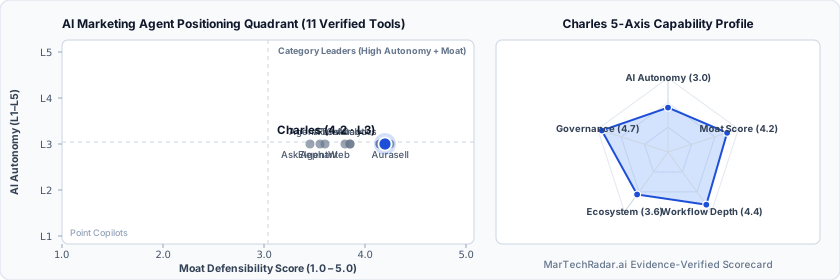
Charles is a Web SaaS tool for AI Marketing Agent (Autonomous Marketing Agents & Digital Coworkers) in Agent & Marketing Ops. Pricing: Custom / enterprise pricing. Best suited to GTM Operations Teams, Enterprise Marketing Executives and Automated Ops Teams. Editor ratings: AI autonomy L3 (conditional automation); moat score 4.2/5.0 (Proprietary moat). Fact-checked by Jiacky Lee on Oct 12, 2026.
Conversational commerce and messaging orchestration platform integrating WhatsApp APIs with e-commerce systems for automated retention, customer.
Charles buyer fit verdict: when to choose vs. when to walk away
Choose Charles if (Best Fit)
- Target ICP & Stack Fit: You operate as GTM Operations Teams, Enterprise Marketing Executives and Automated Ops Teams requiring a Web SaaS deployment for AI Marketing Agent, with verified ecosystem connectivity for Shopify.
- L3 Architecture & Defensibility: Deep European WhatsApp Business Platform infrastructure, tight bi-directional synchronization with Shopify and CRM stacks, and proprietary opt-in consent routing optimized for strict GDPR compliance.
- Commercial Model Fit: Your procurement budget aligns with Custom / enterprise pricing.
Walk away from Charles if (Deal-Breakers)
- Walk away if you require transparent self-serve monthly billing or your budget ceiling is under $1,000/mo (Charles requires sales-gated custom quoting).
- Walk away if your workflow cannot tolerate protocol-level throughput throttling: High-volume broadcast dispatches remain bound by Meta's WhatsApp Business API rate tiers and template verification delays, preventing instant mass delivery during peak promotional events.
- Walk away if bi-directional catalog schema drift is a deal-breaker for your team: Complex multi-variant inventory updates across headless commerce backends frequently require custom webhook reconciliations to avoid delivering out-of-stock SKU recommendations in active chat threads.
Charles key facts & scorecard
| Pricing | Custom / enterprise pricing |
|---|---|
| Free plan | No / not disclosed |
| Delivery | Web SaaS |
| Audience | GTM Operations Teams, Enterprise Marketing Executives, Automated Ops Teams |
| AI autonomy level | L3 · Conditional automationEditor-verified |
| Moat tier & score | 4.2 / 5.0 · Proprietary moatEditor-verified |
| Funding | Series A |
| Total funding | $28.8MBacked by Accel, Google for Startups |
| Founders | Andreas Tussing, Artjem Weissbeck |
| Company size | 51-200 employees |
| Ecosystem integrations | Shopify |
| Compliance & governance | GDPR |
| Governance & docs | Privacy ↗ |
| Headquarters | Berlin |
| Founded | 2019 |
| Last verified |
Charles pros & cons: strengths vs. operational limitations
Pros: core strengths & capabilities
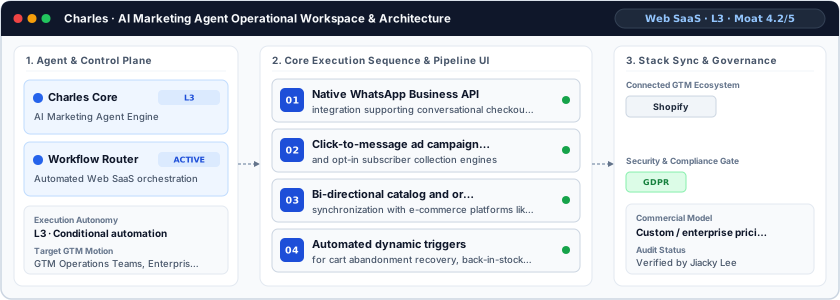
- Native WhatsApp Business API: integration supporting conversational checkout and automated shopping interactions
- Click-to-message ad campaign routing: and opt-in subscriber collection engines
- Bi-directional catalog and order: synchronization with e-commerce platforms like Shopify
- Automated dynamic triggers: for cart abandonment recovery, back-in-stock alerts, and shipping updates
Cons: operational limitations & risks
- Protocol-level throughput throttling: High-volume broadcast dispatches remain bound by Meta's WhatsApp Business API rate tiers and template verification delays, preventing instant mass delivery during peak promotional events.
- Bi-directional catalog schema drift: Complex multi-variant inventory updates across headless commerce backends frequently require custom webhook reconciliations to avoid delivering out-of-stock SKU recommendations in active chat threads.
- Strict opt-in consent maintenance: Maintaining zero-party consent fidelity under GDPR mandates requires strict audit trails across landing pages and ad units, causing workflow breakage if external opt-in trackers desynchronize.
Charles TCO & deal-breaker stress test
Simulate 12-month stepped TCO, hidden cost multipliers, contract lock-in exposure, and stack failure modes using only facts verified by Jiacky Lee on · Capture SHA fef10034.
Charles triggers high-severity friction under your 5-seat / $800/mo constraints. Benchmark the verified subtrack alternatives below before committing.
| Plan / Tier | Verified Rate | Scale Fit | Scope & Quota Notes |
|---|---|---|---|
| Enterprise / Custom | Custom quote | 15–50+ seats (Enterprise SLA) | Sales-negotiated annual contract for custom volume, SSO/RBAC governance, and dedicated SLA. |
- Moat Score
- 4.2 / 5.0
- AI Autonomy
- L3
- Free Tier / Trial
- None disclosed
Triggered audit signals & failure modes
- Opaque Enterprise Quoting vs. SMB/Mid-Market BudgetVerified Pricing Ledger
Charles does not disclose a public self-serve floor (Custom / enterprise pricing). Buyers with a $800/mo cap face high sales-qualification friction.
- Sales-Gated Contract TermsFact-checked by Jiacky Lee
Commercial access is provisioned through customized software contracts available on request through tailored enterprise sales quotes based on organizational scale and seats.
- Primary Operational Bottleneck: Protocol-level throughput throttlingAudit by Jiacky Lee
High-volume broadcast dispatches remain bound by Meta's WhatsApp Business API rate tiers and template verification delays, preventing instant mass delivery during peak promotional events.
Hidden TCO Multipliers & Quota Gates
- Protocol-level throughput throttling: High-volume broadcast dispatches remain bound by Meta's WhatsApp Business API rate tiers and template verification delays, preventing instant mass delivery during peak promotional events.
- Bi-directional catalog schema drift: Complex multi-variant inventory updates across headless commerce backends frequently require custom webhook reconciliations to avoid delivering out-of-stock SKU recommendations in active chat threads.
When to Walk Away & Negotiation Levers
- Walk away if you require transparent self-serve monthly billing or your budget ceiling is under $1,000/mo (Charles requires sales-gated custom quoting).
- Walk away if your workflow cannot tolerate protocol-level throughput throttling: High-volume broadcast dispatches remain bound by Meta's WhatsApp Business API rate tiers and template verification delays, preventing instant mass delivery during peak promotional events.
- Walk away if bi-directional catalog schema drift is a deal-breaker for your team: Complex multi-variant inventory updates across headless commerce backends frequently require custom webhook reconciliations to avoid delivering out-of-stock SKU recommendations in active chat threads.
- Demand a 30- to 60-day paid pilot opt-out clause in the Charles order form before signing a 12-month enterprise commitment.
- Require a sandbox proof-of-concept testing protocol-level throughput throttling against your live CRM/data schema before annual sign-off.
Ask a custom procurement or TCO stress-test question about Charles
Lower 5-seat floor (~$79/mo vs. Custom Quote) · Transparent self-serve entry without mandatory annual lock-in
Lower 5-seat floor (~$100/mo vs. Custom Quote) · Transparent self-serve entry without mandatory annual lock-in
Charles key entities, modules & ecosystem stack
Charles moat & subtrack positioning
Deep European WhatsApp Business Platform infrastructure, tight bi-directional synchronization with Shopify and CRM stacks, and proprietary opt-in consent routing optimized for strict GDPR compliance.
Editorial review
Fact-checked by Jiacky Lee (Managing Editor, AI Autonomy & Moat Methodology) on .
Background
Within the messaging ecosystem, Charles operates as an enterprise conversational commerce platform engineered to anchor chat infrastructure into core transactional funnels. Headquartered in Berlin and founded in 2019, the organization has secured $28.8M in venture capital funding. The platform primarily targets direct-to-consumer e-commerce brands, digital marketing leaders, and customer retention teams seeking to turn WhatsApp into an interactive, revenue-generating communication channel.
How Charles works
Architecturally, Charles functions via a bidirectional orchestration engine linking commerce cores like Shopify to the WhatsApp Business API. The system ingests store catalog feeds, user order states, and behavioral signals through event-driven webhooks. When triggered by on-site abandonment or click-to-message ad inputs, its runtime automates conversational workflows, dynamically queries inventory, presents rich product cards, and facilitates in-chat checkout while routing multi-turn interactions through an L3 semi-autonomous agent framework.
Limitations
Operational considerations and platform boundaries include:
- Protocol-level throughput throttling: High-volume broadcast dispatches remain bound by Meta's WhatsApp Business API rate tiers and template verification delays, preventing instant mass delivery during peak promotional events.
- Bi-directional catalog schema drift: Complex multi-variant inventory updates across headless commerce backends frequently require custom webhook reconciliations to avoid delivering out-of-stock SKU recommendations in active chat threads.
- Strict opt-in consent maintenance: Maintaining zero-party consent fidelity under GDPR mandates requires strict audit trails across landing pages and ad units, causing workflow breakage if external opt-in trackers desynchronize.
Charles pricing
Commercial access is provisioned through customized software contracts available on request through tailored enterprise sales quotes based on organizational scale and seats. The model typically pairs a base platform subscription covering core connectors with consumption tiers calculated from active conversation volume and outbound message processing across regional carrier networks.
How Charles compares
Against broader autonomous marketing agent solutions such as ai-marketing-claude, allGood, and AskElephant, Charles differentiates by concentrating on structured retail checkout and compliant European messaging rails rather than generic copy generation or multi-channel SDR orchestration. Charles suits mid-market and enterprise online retailers with established customer acquisition pipelines seeking a transactional WhatsApp retention channel.
Direct competitors & market radar
Top algorithmic competitors based on category positioning, capability overlap, and ICP alignment.
Frequently asked questions about Charles
How much does Charles cost and does it require a custom enterprise quote?
Published pricing summary for Charles: Custom / enterprise pricing. A permanent free plan is not disclosed for Charles. Commercial access is provisioned through customized software contracts available on request through tailored enterprise sales quotes based on organizational scale and seats.
How does Charles work and how autonomous is its AI architecture?
Conversational commerce and messaging orchestration platform integrating WhatsApp APIs with e-commerce systems for automated retention, customer. Within AI Marketing Agent (Autonomous Marketing Agents & Digital Coworkers), MarTechRadar rates its execution architecture at L3 · Conditional automation with a verified Moat Score of 4.2 / 5.0 (Proprietary moat). Deep European WhatsApp Business Platform infrastructure, tight bi-directional synchronization with Shopify and CRM stacks, and proprietary opt-in consent routing optimized for strict GDPR compliance. Corporate profile: Founded by Andreas Tussing, Artjem Weissbeck, operating at 51-200 employees scale.
What are the main limitations of Charles and when should buyers walk away?
Based on our editorial technical audit, key operational considerations and boundaries for Charles include: (1) Protocol-level throughput throttling: High-volume broadcast dispatches remain bound by Meta's WhatsApp Business API rate tiers and template verification delays, preventing instant mass delivery during peak promotional events. (2) Bi-directional catalog schema drift: Complex multi-variant inventory updates across headless commerce backends frequently require custom webhook reconciliations to avoid delivering out-of-stock SKU recommendations in active chat threads. (3) Strict opt-in consent maintenance: Maintaining zero-party consent fidelity under GDPR mandates requires strict audit trails across landing pages and ad units, causing workflow breakage if external opt-in trackers desynchronize. Primary procurement walk-away rule: Walk away if you require transparent self-serve monthly billing or your budget ceiling is under $1,000/mo (Charles requires sales-gated custom quoting).
What integrations, compliance certifications, and contract terms apply to Charles?
Verified ecosystem and stack integrations include Shopify. Documented security and governance attestations include GDPR. Key TCO multiplier to watch: Protocol-level throughput throttling (High-volume broadcast dispatches remain bound by Meta's WhatsApp Business API rate tiers and template verification delays, preventing instant mass delivery during peak promotional events.) Before signing a contract, procurement teams should demand a 30- to 60-day paid pilot opt-out clause in the Charles order form before signing a 12-month enterprise commitment.
What are the best Charles alternatives and head-to-head competitors in 2026?
Top fact-checked alternatives to Charles in AI Marketing Agent (Autonomous Marketing Agents & Digital Coworkers) include Blaze (From $79/mo), Automation Anywhere (Custom / enterprise pricing), Celonis (Custom / enterprise pricing), Kantiv (Custom / enterprise pricing). Against broader autonomous marketing agent solutions such as ai-marketing-claude, allGood, and AskElephant, Charles differentiates by concentrating on structured retail checkout and compliant European messaging rails rather than generic copy generation or multi-channel SDR orchestration.
Verified sources & evidence trail
- Official product domain: https://www.hello-charles.com/
- Commercial pricing verification: Verified against official vendor pricing policy (Custom / enterprise pricing)
- Verified corporate entity profiles (
sameAs): LinkedIn Company Profile · Crunchbase Entity Record - First-party governance & documentation links: Privacy
- Editorial audit sign-off: Fact-checked by Jiacky Lee on under the MarTechRadar Evidence-Ledger Protocol.