Crisp Review (2026): eCommerce Chatbot Pricing, Limits & Alternatives
Bottom line
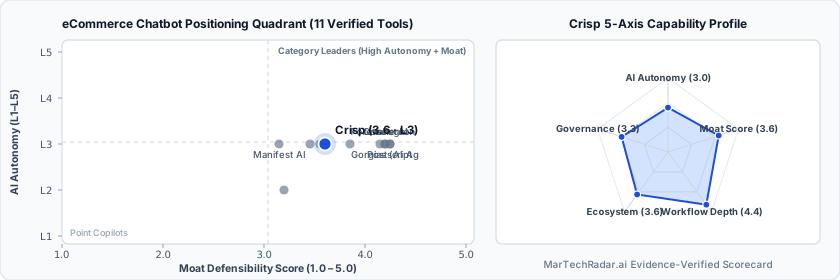
Crisp is a Web SaaS tool for eCommerce Chatbot (Conversational eCommerce & Support Bots) in Lifecycle & CDP. Pricing: Free plan · $0/mo · Enterprise plan. Best suited to B2B SaaS and Creators / Solo. Editor ratings: AI autonomy L3 (conditional automation); moat score 3.6/5.0 (Proprietary moat). Fact-checked by Anthony Hay on Oct 14, 2026.
Crisp is an AI-first customer support and shared inbox platform featuring automated agent assistance, multi-channel messaging, and integrated customer.
Crisp buyer fit verdict: when to choose vs. when to walk away
Choose Crisp if (Best Fit)
- Target ICP & Stack Fit: You operate as B2B SaaS and Creators / Solo requiring a Web SaaS deployment for eCommerce Chatbot, with verified ecosystem connectivity for Shopify.
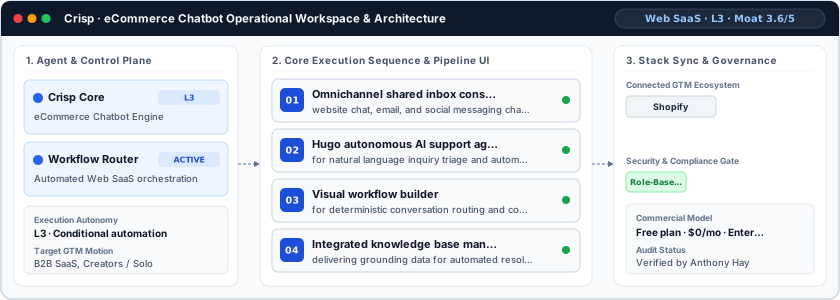
- L3 Architecture & Defensibility: Crisp combines a consolidated omnichannel communication gateway with proprietary bot orchestration and Hugo AI agent technology, offering low-latency message distribution and predictable flat-rate unit economics.
- Commercial Model Fit: Your procurement budget aligns with Free plan · $0/mo · Enterprise plan and want a self-serve free tier for zero-cost initial validation.
Walk away from Crisp if (Deal-Breakers)
- Walk away if your workflow requires uncapped enterprise volume on the Free plan · $0/mo · Enterprise plan entry plan without upgrading tiers.
- Walk away if your workflow cannot tolerate contextual grounding drift: Hugo relies strictly on synced internal knowledge sources; outdated knowledge base documentation leads to factual divergence and requires manual corpus curation.
- Walk away if high-volume webhook rate limits is a deal-breaker for your team: Enterprises running high-concurrency event ingestion risk transient queue latency when pushing rapid external CRM events across non-batched endpoints.
Crisp key facts & scorecard
| Pricing | Free plan · $0/mo · Enterprise planVendor pricing page |
|---|---|
| Free plan | Yes |
| Delivery | Web SaaS |
| Audience | B2B SaaS, Creators / Solo |
| AI autonomy level | L3 · Conditional automationEditor-verified |
| Moat tier & score | 3.6 / 5.0 · Proprietary moatEditor-verified |
| Funding | Venture-backed |
| Founders | Baptiste Jamin, Valerian Saliou |
| Company size | 11-50 employees |
| Ecosystem integrations | Shopify |
| Governance & docs | System Status ↗ · API & Docs ↗ · Terms ↗ · Privacy ↗ |
| Headquarters | Nantes, Pays de la Loire |
| Founded | 2015 |
| Last verified |
Crisp pros & cons: strengths vs. operational limitations
Pros: core strengths & capabilities
- Omnichannel shared inbox consolidating: website chat, email, and social messaging channels
- Hugo autonomous AI support agent: for natural language inquiry triage and automated deflection
- Visual workflow builder: for deterministic conversation routing and conditional logic execution
- Integrated knowledge base management: delivering grounding data for automated resolutions
Cons: operational limitations & risks
- Contextual Grounding Drift: Hugo relies strictly on synced internal knowledge sources; outdated knowledge base documentation leads to factual divergence and requires manual corpus curation.
- High-Volume Webhook Rate Limits: Enterprises running high-concurrency event ingestion risk transient queue latency when pushing rapid external CRM events across non-batched endpoints.
- Complex Multi-Entity Permissions: The flat organization model introduces governance challenges when segmenting data access across complex multi-brand enterprises requiring strict compartmentalization.
Crisp TCO & deal-breaker stress test
Simulate 12-month stepped TCO, hidden cost multipliers, contract lock-in exposure, and stack failure modes using only facts verified by Anthony Hay on · Capture SHA 565158e3.
Crisp is viable for 5 seats, but requires commercial or technical verification on the flagged items below.
| Plan / Tier | Verified Rate | Scale Fit | Scope & Quota Notes |
|---|---|---|---|
| Free / Sandbox | $0 | 1–2 seats (Evaluation) | Entry free tier with capped usage or feature quotas for initial workflow testing. |
| Entry / Starter | $5/mo | 1–2 seats | Custom email domain |
| Growth / Professional | $25/mo | 5 seats | Workflow automation builder |
| Scale / Advanced | $45/mo | 15 seats | per month, per workspace |
- Moat Score
- 3.6 / 5.0
- AI Autonomy
- L3
- Free Tier / Trial
- Free plan
Triggered audit signals & failure modes
- Opaque Enterprise Quoting vs. SMB/Mid-Market BudgetVerified Pricing Ledger
Crisp does not disclose a public self-serve floor (Free plan · $0/mo · Enterprise plan). Buyers with a $800/mo cap face high sales-qualification friction.
- Published Self-Serve Entry FloorVerified Pricing Ledger
Crisp publishes a transparent entry point (Free plan · $0/mo · Enterprise plan) with a free tier for initial validation before committing.
- Tier Fit for 5-Seat Scale: Entry / Starter ($5/mo)Verified Tier Schedule
Custom email domain
- Primary Operational Bottleneck: Contextual Grounding DriftAudit by Anthony Hay
Hugo relies strictly on synced internal knowledge sources; outdated knowledge base documentation leads to factual divergence and requires manual corpus curation.
Hidden TCO Multipliers & Quota Gates
- Credit & Usage Burn Multiplier: Automated workflows consume metered credits/usage quotas; multi-step enrichment, voice minutes, or high-frequency agent runs can trigger mid-cycle top-up packs.
- Contextual Grounding Drift: Hugo relies strictly on synced internal knowledge sources; outdated knowledge base documentation leads to factual divergence and requires manual corpus curation.
- High-Volume Webhook Rate Limits: Enterprises running high-concurrency event ingestion risk transient queue latency when pushing rapid external CRM events across non-batched endpoints.
When to Walk Away & Negotiation Levers
- Walk away if your workflow requires uncapped enterprise volume on the Free plan · $0/mo · Enterprise plan entry plan without upgrading tiers.
- Walk away if your workflow cannot tolerate contextual grounding drift: Hugo relies strictly on synced internal knowledge sources; outdated knowledge base documentation leads to factual divergence and requires manual corpus curation.
- Walk away if high-volume webhook rate limits is a deal-breaker for your team: Enterprises running high-concurrency event ingestion risk transient queue latency when pushing rapid external CRM events across non-batched endpoints.
- Validate exact quota thresholds (seats, credits, or API calls) included in Crisp's Free plan · $0/mo · Enterprise plan tier before converting from monthly to annual billing.
- Require a sandbox proof-of-concept testing contextual grounding drift against your live CRM/data schema before annual sign-off.
Ask a custom procurement or TCO stress-test question about Crisp
Lower 5-seat floor (~$43/mo vs. Custom Quote)
Lower 5-seat floor (~$49/mo vs. Custom Quote)
Crisp key entities, modules & ecosystem stack
Crisp moat & subtrack positioning
Crisp combines a consolidated omnichannel communication gateway with proprietary bot orchestration and Hugo AI agent technology, offering low-latency message distribution and predictable flat-rate unit economics.
Editorial review
Fact-checked by Anthony Hay (Senior SEO, Search Intelligence & Content Operations Editor) on .
Background
Architected as a unified operational interface rather than a collection of disparate communication silos, Crisp serves as an AI-first customer support platform for growth-stage and mid-market organizations. Established in 2015 and headquartered in Nantes, Pays de la Loire, the company engineers communication infrastructure for customer support leaders and digital commerce managers seeking to consolidate fragmented communication pipelines. The platform coordinates inbound conversations across multiple channels through a single operational console, pairing automated conversation workflows with centralized customer intelligence.
How Crisp works
At its architectural core, Crisp executes at Level 3 autonomy by pairing real-time event-driven ingest nodes with Hugo, its native autonomous conversational agent. The engine accepts high-concurrency event streams from live web chat, email, and external messaging gateways via persistent WebSocket connections and REST endpoints. Incoming text payloads are processed through retrieval-augmented semantic evaluation models grounded in structured knowledge bases, executing intent classification and deflection before escalating unresolved contextual threads to human operators through dynamic deterministic routing logic.
Limitations
Operational considerations and platform boundaries include:
- Contextual Grounding Drift: Hugo relies strictly on synced internal knowledge sources; outdated knowledge base documentation leads to factual divergence and requires manual corpus curation.
- High-Volume Webhook Rate Limits: Enterprises running high-concurrency event ingestion risk transient queue latency when pushing rapid external CRM events across non-batched endpoints.
- Complex Multi-Entity Permissions: The flat organization model introduces governance challenges when segmenting data access across complex multi-brand enterprises requiring strict compartmentalization.
Crisp pricing
Crisp distributes its software via tiered seat-agnostic licensing, featuring a baseline tier at $0 per month that delivers foundational shared inbox functionality. Scaled operations transition from this $0 entry tier into fixed subscription tiers designed to avoid punitive per-agent software penalties, while larger organizations leverage custom enterprise plans configured with elevated API quotas, customized security controls, and dedicated implementation assistance.
How Crisp compares
Within conversational support environments, Crisp competes against platforms like Forethought, Ada.cx, and Manifest AI. While enterprise players such as Forethought and Ada.cx require intensive, professional-services-heavy deployments to integrate into existing ticketing systems, Crisp delivers a fully self-contained shared inbox and native agent stack with lower operational overhead. Unlike Shopify-native tools like Manifest AI, Crisp serves horizontal web environments, making it suitable for mid-market digital businesses requiring predictable licensing and rapid AI containment.
Direct competitors & market radar
Top algorithmic competitors based on category positioning, capability overlap, and ICP alignment.
Frequently asked questions about Crisp
How much does Crisp cost and what pricing tiers are available?
Published pricing summary for Crisp: Free plan · $0/mo · Enterprise plan. Crisp includes a free tier or sandbox entry point. Verified tier schedule: Free / Sandbox ($0 for 1–2 seats (Evaluation)); Entry / Starter ($5/mo for 1–2 seats); Growth / Professional ($25/mo for 5 seats); Scale / Advanced ($45/mo for 15 seats). Crisp distributes its software via tiered seat-agnostic licensing, featuring a baseline tier at $0 per month that delivers foundational shared inbox functionality.
How does Crisp work and how autonomous is its AI architecture?
Crisp is an AI-first customer support and shared inbox platform featuring automated agent assistance, multi-channel messaging, and integrated customer. Within eCommerce Chatbot (Conversational eCommerce & Support Bots), MarTechRadar rates its execution architecture at L3 · Conditional automation with a verified Moat Score of 3.6 / 5.0 (Proprietary moat). Crisp combines a consolidated omnichannel communication gateway with proprietary bot orchestration and Hugo AI agent technology, offering low-latency message distribution and predictable flat-rate unit economics. Corporate profile: Founded by Baptiste Jamin, Valerian Saliou, operating at 11-50 employees scale.
What are the main limitations of Crisp and when should buyers walk away?
Based on our editorial technical audit, key operational considerations and boundaries for Crisp include: (1) Contextual Grounding Drift: Hugo relies strictly on synced internal knowledge sources; outdated knowledge base documentation leads to factual divergence and requires manual corpus curation. (2) High-Volume Webhook Rate Limits: Enterprises running high-concurrency event ingestion risk transient queue latency when pushing rapid external CRM events across non-batched endpoints. (3) Complex Multi-Entity Permissions: The flat organization model introduces governance challenges when segmenting data access across complex multi-brand enterprises requiring strict compartmentalization. Primary procurement walk-away rule: Walk away if your workflow requires uncapped enterprise volume on the Free plan · $0/mo · Enterprise plan entry plan without upgrading tiers.
What integrations, compliance certifications, and contract terms apply to Crisp?
Verified ecosystem and stack integrations include Shopify. First-party governance and developer endpoints verified on domain include: Status (https://crisp.chat/en/status), API Docs (https://docs.crisp.chat). Key TCO multiplier to watch: Credit & Usage Burn Multiplier (Automated workflows consume metered credits/usage quotas; multi-step enrichment, voice minutes, or high-frequency agent runs can trigger mid-cycle top-up packs.) Before signing a contract, procurement teams should validate exact quota thresholds (seats, credits, or API calls) included in Crisp's Free plan · $0/mo · Enterprise plan tier before converting from monthly to annual billing.
What are the best Crisp alternatives and head-to-head competitors in 2026?
Top fact-checked alternatives to Crisp in eCommerce Chatbot (Conversational eCommerce & Support Bots) include Manifest AI (Custom / enterprise pricing), Octane AI (From $43/mo), LivePerson (Custom / enterprise pricing), Intercom Fin for Marketing (From $0.99/mo). Within conversational support environments, Crisp competes against platforms like Forethought, Ada.cx, and Manifest AI.
Verified sources & evidence trail
- Official product domain: https://crisp.chat
- Commercial pricing verification: https://crisp.chat/en/pricing/
- Verified corporate entity profiles (
sameAs): LinkedIn Company Profile · Crunchbase Entity Record - First-party governance & documentation links: System Status · API & Docs · Terms · Privacy
- Editorial audit sign-off: Fact-checked by Anthony Hay on under the MarTechRadar Evidence-Ledger Protocol.