Faraday Review (2026): Predictive AI Pricing, Limits & Alternatives
Bottom line
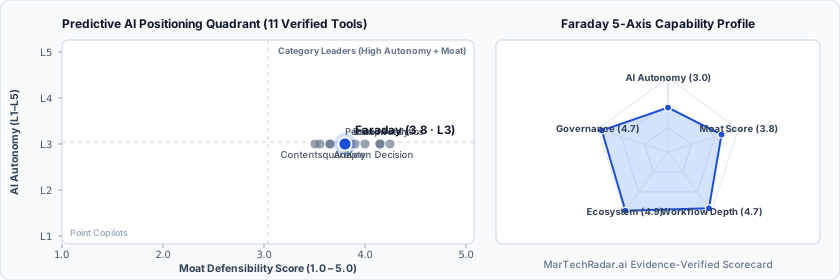
Faraday is a Web SaaS tool for Predictive AI (Predictive LTV, Churn & Customer Analytics) in Analytics & Attribution. Pricing: Pricing not disclosed. Best suited to B2B SaaS and Marketing & Growth Teams. Editor ratings: AI autonomy L3 (conditional automation); moat score 3.8/5.0 (Proprietary moat). Fact-checked by Sarah Per on Oct 17, 2026.
Predictive consumer intelligence and propensity modeling platform combining a US household graph with automated ML.
Faraday buyer fit verdict: when to choose vs. when to walk away
Choose Faraday if (Best Fit)
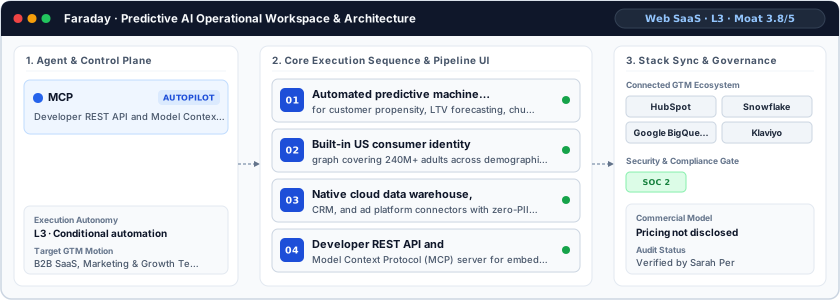
- Target ICP & Stack Fit: You operate as B2B SaaS and Marketing & Growth Teams requiring a Web SaaS deployment for Predictive AI, with verified ecosystem connectivity for HubSpot, Snowflake, Google BigQuery, Klaviyo.
- L3 Architecture & Defensibility: Faraday builds a durable data and modeling moat by fusing a proprietary graph of 240M+ US consumers and 1,500+ household attributes with automated propensity, LTV, and churn prediction models and MCP support.
- Commercial Model Fit: Your procurement budget aligns with Pricing not disclosed.
Walk away from Faraday if (Deal-Breakers)
- Walk away if you require transparent self-serve monthly billing or your budget ceiling is under $1,000/mo (Faraday requires sales-gated custom quoting).
- Walk away if your workflow cannot tolerate us consumer geography boundary: Because Faraday's built-in identity and household enrichment graph is engineered around US consumer and property records, international B2C brands or global B2B software companies face limited enrichment coverage outside the United States.
- Walk away if historical cohort volume threshold is a deal-breaker for your team: Training reliable custom propensity and LTV models requires sufficient historical conversion and churn events, creating a cold-start accuracy bottleneck for newly launched consumer startups.
Faraday key facts & scorecard
| Pricing | Pricing not disclosed |
|---|---|
| Free plan | No / not disclosed |
| Delivery | Web SaaS |
| Audience | B2B SaaS, Marketing & Growth Teams |
| AI autonomy level | L3 · Conditional automationEditor-verified |
| Moat tier & score | 3.8 / 5.0 · Proprietary moatEditor-verified |
| Funding | Seed |
| Total funding | $11.4M |
| Founders | Andy Rossmeissl, Ian Hough, Robbie Adler, Seamus Abshere |
| Company size | 11-50 employees |
| Ecosystem integrations | HubSpot, Snowflake, Google BigQuery, Klaviyo |
| Compliance & governance | SOC 2 |
| Governance & docs | Trust & Security ↗ · System Status ↗ · API & Docs ↗ · Changelog ↗ |
| Headquarters | Burlington, Vermont |
| Founded | 2012 |
| Last verified |
Faraday pros & cons: strengths vs. operational limitations
Pros: core strengths & capabilities
- Automated predictive machine learning: for customer propensity, LTV forecasting, churn risk, and persona clustering
- Built-in US consumer identity: graph covering 240M+ adults across demographic, financial, and lifestyle signals
- Native cloud data warehouse,: CRM, and ad platform connectors with zero-PII-exposure predictive scoring
- Developer REST API and: Model Context Protocol (MCP) server for embedding consumer predictions into AI agents
Cons: operational limitations & risks
- US Consumer Geography Boundary: Because Faraday's built-in identity and household enrichment graph is engineered around US consumer and property records, international B2C brands or global B2B software companies face limited enrichment coverage outside the United States.
- Historical Cohort Volume Threshold: Training reliable custom propensity and LTV models requires sufficient historical conversion and churn events, creating a cold-start accuracy bottleneck for newly launched consumer startups.
- Pipeline Sync & Warehouse Schema Setup: Mapping first-party event schemas and configuring automated scoring pipelines across enterprise cloud data warehouses introduces an initial data-engineering learning curve.
Faraday TCO & deal-breaker stress test
Simulate 12-month stepped TCO, hidden cost multipliers, contract lock-in exposure, and stack failure modes using only facts verified by Sarah Per on · Capture SHA 9b52ddaf.
Faraday triggers high-severity friction under your 5-seat / $800/mo constraints. Benchmark the verified subtrack alternatives below before committing.
| Plan / Tier | Verified Rate | Scale Fit | Scope & Quota Notes |
|---|---|---|---|
| Enterprise / Custom | Custom quote | 15–50+ seats (Enterprise SLA) | Sales-negotiated annual contract for custom volume, SSO/RBAC governance, and dedicated SLA. |
- Moat Score
- 3.8 / 5.0
- AI Autonomy
- L3
- Free Tier / Trial
- None disclosed
Triggered audit signals & failure modes
- Opaque Enterprise Quoting vs. SMB/Mid-Market BudgetVerified Pricing Ledger
Faraday does not disclose a public self-serve floor (Pricing not disclosed). Buyers with a $800/mo cap face high sales-qualification friction.
- Sales-Gated Contract TermsFact-checked by Sarah Per
Pricing is available on request through custom commercial quotes scaled by prediction volume, enrichment credit consumption, and warehouse connector tiers, alongside a self-serve developer sandbox offering free evaluation credits.
- Primary Operational Bottleneck: US Consumer Geography BoundaryAudit by Sarah Per
Because Faraday's built-in identity and household enrichment graph is engineered around US consumer and property records, international B2C brands or global B2B software companies face limited enrichment coverage outside the United States.
Hidden TCO Multipliers & Quota Gates
- Credit & Usage Burn Multiplier: Automated workflows consume metered credits/usage quotas; multi-step enrichment, voice minutes, or high-frequency agent runs can trigger mid-cycle top-up packs.
- US Consumer Geography Boundary: Because Faraday's built-in identity and household enrichment graph is engineered around US consumer and property records, international B2C brands or global B2B software companies face limited enrichment coverage outside the United States.
- Historical Cohort Volume Threshold: Training reliable custom propensity and LTV models requires sufficient historical conversion and churn events, creating a cold-start accuracy bottleneck for newly launched consumer startups.
When to Walk Away & Negotiation Levers
- Walk away if you require transparent self-serve monthly billing or your budget ceiling is under $1,000/mo (Faraday requires sales-gated custom quoting).
- Walk away if your workflow cannot tolerate us consumer geography boundary: Because Faraday's built-in identity and household enrichment graph is engineered around US consumer and property records, international B2C brands or global B2B software companies face limited enrichment coverage outside the United States.
- Walk away if historical cohort volume threshold is a deal-breaker for your team: Training reliable custom propensity and LTV models requires sufficient historical conversion and churn events, creating a cold-start accuracy bottleneck for newly launched consumer startups.
- Demand a 30- to 60-day paid pilot opt-out clause in the Faraday order form before signing a 12-month enterprise commitment.
- Require a sandbox proof-of-concept testing us consumer geography boundary against your live CRM/data schema before annual sign-off.
Ask a custom procurement or TCO stress-test question about Faraday
Offers a free tier (Free plan · $2,500 · Enterprise plan) · Transparent self-serve entry without mandatory annual lock-in
Offers a free tier (Free plan · $0/mo · Enterprise plan) · Transparent self-serve entry without mandatory annual lock-in
Faraday key entities, modules & ecosystem stack
Developer REST API and Model Context Protocol server for embedding consumer predictions into AI agents
Faraday moat & subtrack positioning
Faraday builds a durable data and modeling moat by fusing a proprietary graph of 240M+ US consumers and 1,500+ household attributes with automated propensity, LTV, and churn prediction models and MCP support.
Editorial review
Fact-checked by Sarah Per (Principal Content Systems & Generative Media Editor) on .
Background
Founded in 2012 by Andy Rossmeissl, Ian Hough, Robbie Adler, and Seamus Abshere and headquartered in Burlington, Vermont, Faraday (faraday.ai) is a predictive consumer intelligence and customer lifetime value (LTV) modeling platform built for B2C enterprise growth, lifecycle marketing, and data science teams. Operating with a team of 11 to 50 employees and backed by $11.4M in funding from 3Degrees, FreshTracks Capital, LaunchCapital, Intercap, and John Replogle, the company enables consumer brands in financial services, retail, home services, and clean energy to predict buyer behavior without building in-house machine learning pipelines.
How Faraday works
Faraday operates at Level 3 autonomy through a unified US consumer identity graph, an automated feature-engineering and gradient-boosted ML training pipeline, and a real-time scoring API and Model Context Protocol (MCP) server. Growth teams connect their first-party customer records from Snowflake, BigQuery, HubSpot, or Klaviyo; Faraday resolves those records against 1,500+ third-party household, property, and demographic attributes and trains custom models to predict conversion likelihood, expected LTV, churn probability, and next-best product affinity. Predictions sync back into ad networks and lifecycle channels or are queried by AI agents via Faraday's MCP integration under SOC 2 Type II security controls.
Limitations
Operational limitations and technical trade-offs include:
- US Consumer Geography Boundary: Because Faraday's built-in identity and household enrichment graph is engineered around US consumer and property records, international B2C brands or global B2B software companies face limited enrichment coverage outside the United States.
- Historical Cohort Volume Threshold: Training reliable custom propensity and LTV models requires sufficient historical conversion and churn events, creating a cold-start accuracy bottleneck for newly launched consumer startups.
- Pipeline Sync & Warehouse Schema Setup: Mapping first-party event schemas and configuring automated scoring pipelines across enterprise cloud data warehouses introduces an initial data-engineering learning curve.
Faraday pricing
Pricing is available on request through custom commercial quotes scaled by prediction volume, enrichment credit consumption, and warehouse connector tiers, alongside a self-serve developer sandbox offering free evaluation credits. Growth and data teams can request a custom pricing quote via the Faraday website.
How Faraday compares
Within the Predictive LTV, Churn & Customer Analytics category, Faraday competes against predictive customer modeling alternatives such as Black Crow AI, Voyantis, and Pecan AI. Versus e-commerce pixel-only tools like Black Crow AI or pure BYO-data AutoML tools like Pecan AI that lack third-party enrichment, Faraday differentiates itself by bundling a built-in 240M+ US consumer graph directly with automated propensity modeling and MCP agent access. Consumer enterprises choose Faraday to optimize acquisition spend and retention targeting around predicted LTV.
Frequently asked questions about Faraday
How much does Faraday cost and does it require a custom enterprise quote?
Published pricing summary for Faraday: Pricing not disclosed. A permanent free plan is not disclosed for Faraday. Pricing is available on request through custom commercial quotes scaled by prediction volume, enrichment credit consumption, and warehouse connector tiers, alongside a self-serve developer sandbox offering free evaluation credits. Growth and data teams can request a custom pricing quote via the Faraday website.
How does Faraday work and how autonomous is its AI architecture?
Predictive consumer intelligence and propensity modeling platform combining a US household graph with automated ML. Within Predictive AI (Predictive LTV, Churn & Customer Analytics), MarTechRadar rates its execution architecture at L3 · Conditional automation with a verified Moat Score of 3.8 / 5.0 (Proprietary moat). Faraday builds a durable data and modeling moat by fusing a proprietary graph of 240M+ US consumers and 1,500+ household attributes with automated propensity, LTV, and churn prediction models and MCP support. Corporate profile: Founded by Andy Rossmeissl, Ian Hough, Robbie Adler, Seamus Abshere, operating at 11-50 employees scale.
What are the main limitations of Faraday and when should buyers walk away?
Based on our editorial technical audit, key operational considerations and boundaries for Faraday include: (1) US Consumer Geography Boundary: Because Faraday's built-in identity and household enrichment graph is engineered around US consumer and property records, international B2C brands or global B2B software companies face limited enrichment coverage outside the United States. (2) Historical Cohort Volume Threshold: Training reliable custom propensity and LTV models requires sufficient historical conversion and churn events, creating a cold-start accuracy bottleneck for newly launched consumer startups. (3) Pipeline Sync & Warehouse Schema Setup: Mapping first-party event schemas and configuring automated scoring pipelines across enterprise cloud data warehouses introduces an initial data-engineering learning curve. Primary procurement walk-away rule: Walk away if you require transparent self-serve monthly billing or your budget ceiling is under $1,000/mo (Faraday requires sales-gated custom quoting).
What integrations, compliance certifications, and contract terms apply to Faraday?
Verified ecosystem and stack integrations include HubSpot, Snowflake, Google BigQuery, Klaviyo. Documented security and governance attestations include SOC 2. First-party governance and developer endpoints verified on domain include: Trust/Security (https://faraday.ai/security), Status (https://status.faraday.ai), API Docs (https://faraday.ai/docs). Key TCO multiplier to watch: Credit & Usage Burn Multiplier (Automated workflows consume metered credits/usage quotas; multi-step enrichment, voice minutes, or high-frequency agent runs can trigger mid-cycle top-up packs.) Before signing a contract, procurement teams should demand a 30- to 60-day paid pilot opt-out clause in the Faraday order form before signing a 12-month enterprise commitment.
What are the best Faraday alternatives and head-to-head competitors in 2026?
Top fact-checked alternatives to Faraday in Predictive AI (Predictive LTV, Churn & Customer Analytics) include Pecan AI (Custom / enterprise pricing), Voyantis (Custom / enterprise pricing), Keen Decision Systems (Custom / enterprise pricing), Gainsight (Pricing not disclosed). Within the Predictive LTV, Churn & Customer Analytics category, Faraday competes against predictive customer modeling alternatives such as Black Crow AI, Voyantis, and Pecan AI.
Verified sources & evidence trail
- Official product domain: https://faraday.ai
- Commercial pricing verification: Verified against official vendor pricing policy (Pricing not disclosed)
- Verified corporate entity profiles (
sameAs): LinkedIn Company Profile · Crunchbase Entity Record - First-party governance & documentation links: Trust & Security · System Status · API & Docs · Changelog
- Editorial audit sign-off: Fact-checked by Sarah Per on under the MarTechRadar Evidence-Ledger Protocol.