Fixture Review (2026): CDP Pricing, Limits & Alternatives
Bottom line
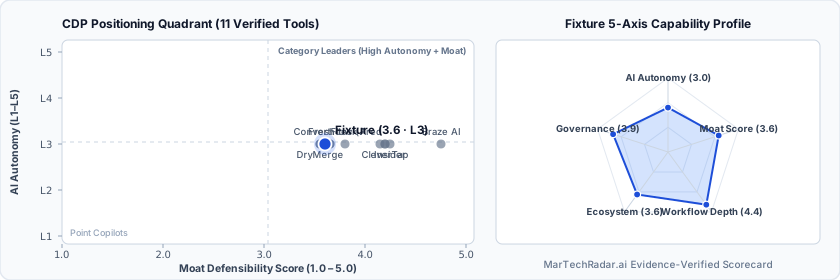
Fixture is a Web SaaS tool for CDP (Customer Data Platform & Journey Orchestration) in Lifecycle & CDP. Pricing: Pricing not disclosed. Best suited to B2B SaaS and Marketing & Growth Teams. Editor ratings: AI autonomy L3 (conditional automation); moat score 3.6/5.0 (Proprietary moat). Fact-checked by Jagmeet Sine on Oct 16, 2026.
Agentic CRM and GTM context platform built for startups that self-updates from customer communications, website traffic, and external AI coding/agent tools.
Fixture buyer fit verdict: when to choose vs. when to walk away
Choose Fixture if (Best Fit)
- Target ICP & Stack Fit: You operate as B2B SaaS and Marketing & Growth Teams requiring a Web SaaS deployment for CDP, with verified ecosystem connectivity for Salesforce.
- L3 Architecture & Defensibility: Unifying customer communication channels and web traffic telemetry into a programmable GTM context store accessible via web UI and external agents like Claude Code creates high developer-founder stickiness.
- Commercial Model Fit: Your procurement budget aligns with Pricing not disclosed.
Walk away from Fixture if (Deal-Breakers)
- Walk away if you require transparent self-serve monthly billing or your budget ceiling is under $1,000/mo (Fixture requires sales-gated custom quoting).
- Walk away if your workflow cannot tolerate enterprise legacy CRM migration boundary: Because Fixture is architected as a greenfield agentic CRM for agile startups, large enterprises deeply entrenched in multi-year Salesforce CPQ, territory hierarchy, and ERP billing customizations face a steep migration boundary.
- Walk away if early-stage ecosystem connector depth is a deal-breaker for your team: Compared to decade-old CRM marketplaces with thousands of third-party plugins, early adopters integrating niche vertical telephony or legacy accounting tools can encounter an integration bottleneck.
Fixture key facts & scorecard
| Pricing | Pricing not disclosed |
|---|---|
| Free plan | No / not disclosed |
| Delivery | Web SaaS |
| Audience | B2B SaaS, Marketing & Growth Teams |
| AI autonomy level | L3 · Conditional automationEditor-verified |
| Moat tier & score | 3.6 / 5.0 · Proprietary moatEditor-verified |
| Funding | Pre-seed |
| Total funding | $500K |
| Founders | Matt Riley, Quin Hoxie |
| Company size | 2-10 employees |
| Ecosystem integrations | Salesforce |
| Governance & docs | API & Docs ↗ · Terms ↗ · Privacy ↗ |
| Headquarters | San Francisco, California |
| Founded | 2026 |
| Last verified |
Fixture pros & cons: strengths vs. operational limitations
Pros: core strengths & capabilities
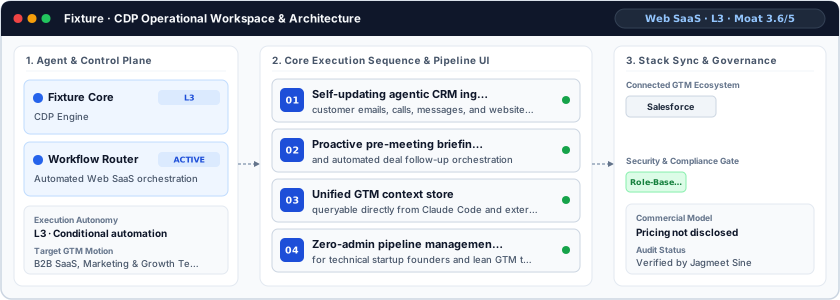
- Self-updating agentic CRM ingesting: customer emails, calls, messages, and website traffic signals
- Proactive pre-meeting briefing generation: and automated deal follow-up orchestration
- Unified GTM context store: queryable directly from Claude Code and external AI agent workflows
- Zero-admin pipeline management purpose-built: for technical startup founders and lean GTM teams
Cons: operational limitations & risks
- Enterprise Legacy CRM Migration Boundary: Because Fixture is architected as a greenfield agentic CRM for agile startups, large enterprises deeply entrenched in multi-year Salesforce CPQ, territory hierarchy, and ERP billing customizations face a steep migration boundary.
- Early-Stage Ecosystem Connector Depth: Compared to decade-old CRM marketplaces with thousands of third-party plugins, early adopters integrating niche vertical telephony or legacy accounting tools can encounter an integration bottleneck.
- Agent Tool-Calling Governance Barrier: Exposing live customer CRM records to external coding and reasoning agents (such as Claude Code) requires careful API permission scoping and data-access governance controls.
Fixture TCO & deal-breaker stress test
Simulate 12-month stepped TCO, hidden cost multipliers, contract lock-in exposure, and stack failure modes using only facts verified by Jagmeet Sine on · Capture SHA 71b62e93.
Fixture triggers high-severity friction under your 5-seat / $800/mo constraints. Benchmark the verified subtrack alternatives below before committing.
| Plan / Tier | Verified Rate | Scale Fit | Scope & Quota Notes |
|---|---|---|---|
| Enterprise / Custom | Custom quote | 15–50+ seats (Enterprise SLA) | Sales-negotiated annual contract for custom volume, SSO/RBAC governance, and dedicated SLA. |
- Moat Score
- 3.6 / 5.0
- AI Autonomy
- L3
- Free Tier / Trial
- None disclosed
Triggered audit signals & failure modes
- Opaque Enterprise Quoting vs. SMB/Mid-Market BudgetVerified Pricing Ledger
Fixture does not disclose a public self-serve floor (Pricing not disclosed). Buyers with a $800/mo cap face high sales-qualification friction.
- Annual Contract Lock-in Risk DetectedFact-checked by Jagmeet Sine
Pricing is available on request through enterprise sales quotes, with customized tiers based on seat counts or usage volume. Startup teams can request workspace access directly through the Fixture website to onboard their communication channels and GTM data streams.
- Primary Operational Bottleneck: Enterprise Legacy CRM Migration BoundaryAudit by Jagmeet Sine
Because Fixture is architected as a greenfield agentic CRM for agile startups, large enterprises deeply entrenched in multi-year Salesforce CPQ, territory hierarchy, and ERP billing customizations face a steep migration boundary.
Hidden TCO Multipliers & Quota Gates
- Enterprise Legacy CRM Migration Boundary: Because Fixture is architected as a greenfield agentic CRM for agile startups, large enterprises deeply entrenched in multi-year Salesforce CPQ, territory hierarchy, and ERP billing customizations face a steep migration boundary.
- Early-Stage Ecosystem Connector Depth: Compared to decade-old CRM marketplaces with thousands of third-party plugins, early adopters integrating niche vertical telephony or legacy accounting tools can encounter an integration bottleneck.
When to Walk Away & Negotiation Levers
- Walk away if you require transparent self-serve monthly billing or your budget ceiling is under $1,000/mo (Fixture requires sales-gated custom quoting).
- Walk away if your workflow cannot tolerate enterprise legacy CRM migration boundary: Because Fixture is architected as a greenfield agentic CRM for agile startups, large enterprises deeply entrenched in multi-year Salesforce CPQ, territory hierarchy, and ERP billing customizations face a steep migration boundary.
- Walk away if early-stage ecosystem connector depth is a deal-breaker for your team: Compared to decade-old CRM marketplaces with thousands of third-party plugins, early adopters integrating niche vertical telephony or legacy accounting tools can encounter an integration bottleneck.
- Demand a 30- to 60-day paid pilot opt-out clause in the Fixture order form before signing a 12-month enterprise commitment.
- Require a sandbox proof-of-concept testing enterprise legacy CRM migration boundary against your live CRM/data schema before annual sign-off.
Ask a custom procurement or TCO stress-test question about Fixture
Lower 5-seat floor (~$85/mo vs. Custom Quote) · Transparent self-serve entry without mandatory annual lock-in
Lower 5-seat floor (~$19/mo vs. Custom Quote) · Transparent self-serve entry without mandatory annual lock-in
Fixture key entities, modules & ecosystem stack
Fixture moat & subtrack positioning
Unifying customer communication channels and web traffic telemetry into a programmable GTM context store accessible via web UI and external agents like Claude Code creates high developer-founder stickiness.
Editorial review
Fact-checked by Jagmeet Sine (Senior MarTech Infrastructure & Agentic Workflow Architect) on .
Background
Founded in 2026 by Matt Riley and Quin Hoxie and headquartered in San Francisco, California, Fixture (fixture.ai) is an agentic CRM and go-to-market (GTM) context platform built specifically for startup founders, technical sellers, and early-to-growth-stage revenue teams. Operating with a team of 2 to 10 employees and backed by $500K in Pre-Seed funding from Y Combinator (W26), the company replaces bloated legacy CRMs that require constant manual data entry with a self-updating system of record that lets founders focus on talking to customers while Fixture handles the rest.
How Fixture works
Fixture operates at Level 3 autonomy by integrating directly with a startup's customer communication channels (email, calendar, messaging, and call transcripts) alongside top-of-funnel marketing telemetry such as website visitor traffic and product sign-ups. The platform synthesizes these streams into a unified GTM context store that automatically updates account timelines, prepares pre-meeting dossiers before every sales call, and tracks pending follow-ups so deals never stall. Crucially, Fixture exposes its context layer through an open agentic interface, allowing technical teams to query pipeline state and trigger GTM actions directly from Fixture's web UI or external AI environments such as Anthropic Claude Code.
Limitations
Operational limitations and technical trade-offs include:
- Enterprise Legacy CRM Migration Boundary: Because Fixture is architected as a greenfield agentic CRM for agile startups, large enterprises deeply entrenched in multi-year Salesforce CPQ, territory hierarchy, and ERP billing customizations face a steep migration boundary.
- Early-Stage Ecosystem Connector Depth: Compared to decade-old CRM marketplaces with thousands of third-party plugins, early adopters integrating niche vertical telephony or legacy accounting tools can encounter an integration bottleneck.
- Agent Tool-Calling Governance Barrier: Exposing live customer CRM records to external coding and reasoning agents (such as Claude Code) requires careful API permission scoping and data-access governance controls.
Fixture pricing
Pricing is available on request through enterprise sales quotes, with customized tiers based on seat counts or usage volume. Startup teams can request workspace access directly through the Fixture website to onboard their communication channels and GTM data streams.
How Fixture compares
Within the Customer Data Platform & Journey Orchestration and AI-Native CRM category, Fixture competes against modern startup CRM alternatives such as Attio, Coffee, and Folk. Versus schema-flexible manual CRMs like Attio or contact address books like Folk, Fixture differentiates itself by combining web-traffic marketing telemetry with a self-updating agentic CRM that connects natively to developer-friendly AI tools like Claude Code. Technical B2B founders and lean startup GTM teams choose Fixture for zero-admin deal execution.
Frequently asked questions about Fixture
How much does Fixture cost and does it require a custom enterprise quote?
Published pricing summary for Fixture: Pricing not disclosed. A permanent free plan is not disclosed for Fixture. Pricing is available on request through enterprise sales quotes, with customized tiers based on seat counts or usage volume. Startup teams can request workspace access directly through the Fixture website to onboard their communication channels and GTM data streams.
How does Fixture work and how autonomous is its AI architecture?
Agentic CRM and GTM context platform built for startups that self-updates from customer communications, website traffic, and external AI coding/agent tools. Within CDP (Customer Data Platform & Journey Orchestration), MarTechRadar rates its execution architecture at L3 · Conditional automation with a verified Moat Score of 3.6 / 5.0 (Proprietary moat). Unifying customer communication channels and web traffic telemetry into a programmable GTM context store accessible via web UI and external agents like Claude Code creates high developer-founder stickiness. Corporate profile: Founded by Matt Riley, Quin Hoxie, operating at 2-10 employees scale.
What are the main limitations of Fixture and when should buyers walk away?
Based on our editorial technical audit, key operational considerations and boundaries for Fixture include: (1) Enterprise Legacy CRM Migration Boundary: Because Fixture is architected as a greenfield agentic CRM for agile startups, large enterprises deeply entrenched in multi-year Salesforce CPQ, territory hierarchy, and ERP billing customizations face a steep migration boundary. (2) Early-Stage Ecosystem Connector Depth: Compared to decade-old CRM marketplaces with thousands of third-party plugins, early adopters integrating niche vertical telephony or legacy accounting tools can encounter an integration bottleneck. (3) Agent Tool-Calling Governance Barrier: Exposing live customer CRM records to external coding and reasoning agents (such as Claude Code) requires careful API permission scoping and data-access governance controls. Primary procurement walk-away rule: Walk away if you require transparent self-serve monthly billing or your budget ceiling is under $1,000/mo (Fixture requires sales-gated custom quoting).
What integrations, compliance certifications, and contract terms apply to Fixture?
Verified ecosystem and stack integrations include Salesforce. First-party governance and developer endpoints verified on domain include: API Docs (https://www.fixture.ai/docs). Key TCO multiplier to watch: Enterprise Legacy CRM Migration Boundary (Because Fixture is architected as a greenfield agentic CRM for agile startups, large enterprises deeply entrenched in multi-year Salesforce CPQ, territory hierarchy, and ERP billing customizations face a steep migration boundary.) Before signing a contract, procurement teams should demand a 30- to 60-day paid pilot opt-out clause in the Fixture order form before signing a 12-month enterprise commitment.
What are the best Fixture alternatives and head-to-head competitors in 2026?
Top fact-checked alternatives to Fixture in CDP (Customer Data Platform & Journey Orchestration) include Ergo (Pricing not disclosed), Wavelength (Pricing not disclosed), Attio ($44–$99/seat/mo), Braze AI (Custom / enterprise pricing). Within the Customer Data Platform & Journey Orchestration and AI-Native CRM category, Fixture competes against modern startup CRM alternatives such as Attio, Coffee, and Folk.
Verified sources & evidence trail
- Official product domain: https://fixture.ai
- Commercial pricing verification: Verified against official vendor pricing policy (Pricing not disclosed)
- Verified corporate entity profiles (
sameAs): LinkedIn Company Profile · Crunchbase Entity Record - First-party governance & documentation links: API & Docs · Terms · Privacy
- Editorial audit sign-off: Fact-checked by Jagmeet Sine on under the MarTechRadar Evidence-Ledger Protocol.