Fluency Review (2026): DCO Pricing, Limits & Alternatives
Bottom line
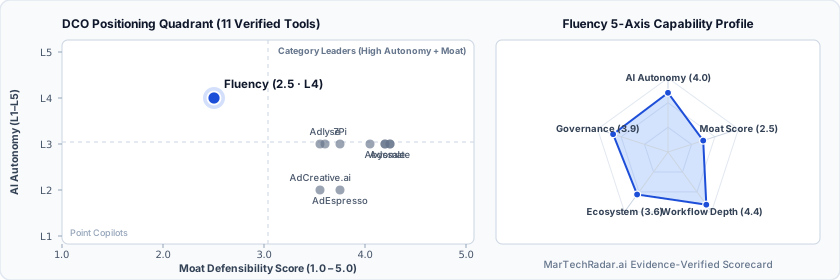
Fluency is a Web SaaS tool for DCO (Dynamic Creative Optimization / DCO) in AdTech & Paid Media. Pricing: Custom / enterprise pricing. Best suited to DTC / eCommerce and Enterprise Brands. Editor ratings: AI autonomy L4 (autonomous agent); moat score 2.5/5.0 (Workflow-embedded). Fact-checked by Jiacky Lee on Oct 6, 2026.
Agentic advertising operations platform that automates campaign creation, budget optimization, and multi-channel creative distribution for scaled agencies.
Fluency buyer fit verdict: when to choose vs. when to walk away
Choose Fluency if (Best Fit)
- Target ICP & Stack Fit: You operate as DTC / eCommerce and Enterprise Brands requiring a Web SaaS deployment for DCO, with verified ecosystem connectivity for Google Ads.
- L4 Architecture & Defensibility: Proprietary robotic process automation engine capable of programmatic execution across disparate ad networks, purpose-built blueprint architectures for multi-location campaigns, and early-mover enterprise agency lock-in.
- Commercial Model Fit: Your procurement budget aligns with Custom / enterprise pricing.
Walk away from Fluency if (Deal-Breakers)
- Walk away if you require transparent self-serve monthly billing or your budget ceiling is under $1,000/mo (Fluency requires sales-gated custom quoting).
- Walk away if your workflow cannot tolerate API rate limits and ad network latency: Executing continuous automated updates across thousands of multi-location ad accounts exposes operations to publisher API call quotas and asynchronous review delays.
- Walk away if product catalog schema brittleness is a deal-breaker for your team: Dynamic creative generation depends heavily on pristine inventory data feeds, where unmapped attributes or sudden field taxonomy shifts disrupt creative assembly.
Fluency key facts & scorecard
| Pricing | Custom / enterprise pricing |
|---|---|
| Free plan | No / not disclosed |
| Delivery | Web SaaS |
| Audience | DTC / eCommerce, Enterprise Brands |
| AI autonomy level | L4 · Autonomous agentEditor-verified |
| Moat tier & score | 2.5 / 5.0 · Workflow-embeddedEditor-verified |
| Funding | Series A |
| Total funding | $41MBacked by Undisclosed Investors |
| Founders | Brian McVey, Eric Mayhew, Michael Lane, Scott Gale |
| Company size | 51-200 employees |
| Ecosystem integrations | Google Ads |
| Governance & docs | Trust & Security ↗ · Privacy ↗ |
| Headquarters | Burlington, Vermont |
| Founded | 2017 |
| Last verified |
Fluency pros & cons: strengths vs. operational limitations
Pros: core strengths & capabilities
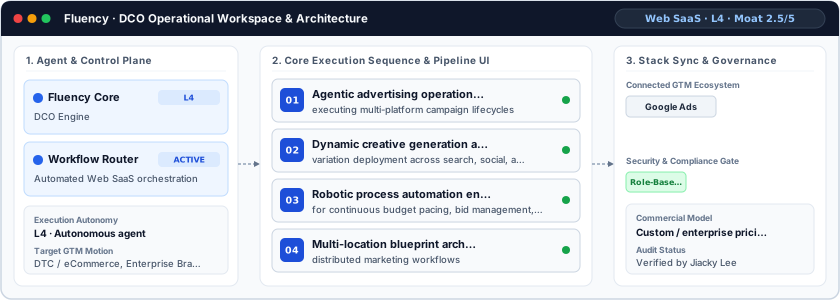
- Agentic advertising operations framework: executing multi-platform campaign lifecycles
- Dynamic creative generation and: variation deployment across search, social, and display channels
- Robotic process automation engine: for continuous budget pacing, bid management, and account auditing
- Multi-location blueprint architecture standardizing: distributed marketing workflows
Cons: operational limitations & risks
- API Rate Limits and Ad Network Latency: Executing continuous automated updates across thousands of multi-location ad accounts exposes operations to publisher API call quotas and asynchronous review delays.
- Product Catalog Schema Brittleness: Dynamic creative generation depends heavily on pristine inventory data feeds, where unmapped attributes or sudden field taxonomy shifts disrupt creative assembly.
- Loss of Granular Ad-Hoc Interventions: The blueprint automation model enforces rigid structural consistency, requiring architectural template modifications when practitioners attempt to run highly customized, one-off campaign tests.
Fluency TCO & deal-breaker stress test
Simulate 12-month stepped TCO, hidden cost multipliers, contract lock-in exposure, and stack failure modes using only facts verified by Jiacky Lee on · Capture SHA 0be145b4.
Fluency triggers high-severity friction under your 5-seat / $800/mo constraints. Benchmark the verified subtrack alternatives below before committing.
| Plan / Tier | Verified Rate | Scale Fit | Scope & Quota Notes |
|---|---|---|---|
| Enterprise / Custom | Custom quote | 15–50+ seats (Enterprise SLA) | Sales-negotiated annual contract for custom volume, SSO/RBAC governance, and dedicated SLA. |
- Moat Score
- 2.5 / 5.0
- AI Autonomy
- L4
- Free Tier / Trial
- None disclosed
Triggered audit signals & failure modes
- Opaque Enterprise Quoting vs. SMB/Mid-Market BudgetVerified Pricing Ledger
Fluency does not disclose a public self-serve floor (Custom / enterprise pricing). Buyers with a $800/mo cap face high sales-qualification friction.
- Sales-Gated Contract TermsFact-checked by Jiacky Lee
Commercial pricing is available on request through tailored enterprise sales quotes based on organizational scale and seats.
- Primary Operational Bottleneck: API Rate Limits and Ad Network LatencyAudit by Jiacky Lee
Executing continuous automated updates across thousands of multi-location ad accounts exposes operations to publisher API call quotas and asynchronous review delays.
Hidden TCO Multipliers & Quota Gates
- API Rate Limits and Ad Network Latency: Executing continuous automated updates across thousands of multi-location ad accounts exposes operations to publisher API call quotas and asynchronous review delays.
- Product Catalog Schema Brittleness: Dynamic creative generation depends heavily on pristine inventory data feeds, where unmapped attributes or sudden field taxonomy shifts disrupt creative assembly.
When to Walk Away & Negotiation Levers
- Walk away if you require transparent self-serve monthly billing or your budget ceiling is under $1,000/mo (Fluency requires sales-gated custom quoting).
- Walk away if your workflow cannot tolerate API rate limits and ad network latency: Executing continuous automated updates across thousands of multi-location ad accounts exposes operations to publisher API call quotas and asynchronous review delays.
- Walk away if product catalog schema brittleness is a deal-breaker for your team: Dynamic creative generation depends heavily on pristine inventory data feeds, where unmapped attributes or sudden field taxonomy shifts disrupt creative assembly.
- Demand a 30- to 60-day paid pilot opt-out clause in the Fluency order form before signing a 12-month enterprise commitment.
- Require a sandbox proof-of-concept testing API rate limits and ad network latency against your live CRM/data schema before annual sign-off.
Ask a custom procurement or TCO stress-test question about Fluency
Lower 5-seat floor (~$30/mo vs. Custom Quote) · Transparent self-serve entry without mandatory annual lock-in
Offers a free tier (Free plan · $0/mo · Enterprise plan) · Transparent self-serve entry without mandatory annual lock-in
Fluency key entities, modules & ecosystem stack
Fluency moat & subtrack positioning
Proprietary robotic process automation engine capable of programmatic execution across disparate ad networks, purpose-built blueprint architectures for multi-location campaigns, and early-mover enterprise agency lock-in.
Editorial review
Fact-checked by Jiacky Lee (Managing Editor, AI Autonomy & Moat Methodology) on .
Background
Backed by $41M in venture financing, Fluency was established in 2017 in Burlington, Vermont, to address operational bottlenecks in digital advertising execution. Engineered primarily for media agencies, automotive dealer networks, and distributed multi-location enterprises, the platform replaces manual ad management workflows with programmatic execution. Fluency positions its software as an agentic advertising operating system, enabling centralized media teams to launch, govern, and optimize digital ad strategies across extensive account portfolios without linear headcount expansion.
How Fluency works
Fluency functions as an automated campaign execution engine. The platform ingests business intelligence feeds, localized inventories, and creative assets into standardized campaign blueprints. Its agentic workflow layer then programmatically translates these blueprints into structured ad variations, budgets, and targeting parameters via direct API integrations with Google Ads, Meta, and Microsoft Advertising. Continuous monitoring agents inspect ad delivery, execute corrective adjustments for budget pacing, and trigger dynamic creative replacements without human intervention.
Limitations
Operational considerations and platform boundaries include:
- API Rate Limits and Ad Network Latency: Executing continuous automated updates across thousands of multi-location ad accounts exposes operations to publisher API call quotas and asynchronous review delays.
- Product Catalog Schema Brittleness: Dynamic creative generation depends heavily on pristine inventory data feeds, where unmapped attributes or sudden field taxonomy shifts disrupt creative assembly.
- Loss of Granular Ad-Hoc Interventions: The blueprint automation model enforces rigid structural consistency, requiring architectural template modifications when practitioners attempt to run highly customized, one-off campaign tests.
Fluency pricing
Commercial pricing is available on request through tailored enterprise sales quotes based on organizational scale and seats. Fluency licenses its software under customized annual software agreements scaled by media portfolio size, account volume, and deployment scope across in-house or agency teams. Standard enterprise contracts incorporate tiered onboarding, operational blueprint architecture consulting, and dedicated technical support.
How Fluency compares
Fluency occupies a specialized position compared to dynamic creative optimization tools like Abyssale and AdCreative.ai, which primarily emphasize visual asset rendering and design variant automation. While 7Pi and AdCreative.ai focus on creative intelligence and content variations, Fluency acts as an operational execution fabric that ties creative generation directly into cross-network bidding and account management. The platform is best suited for organizations managing high-frequency, multi-location advertising portfolios where campaign management overhead exceeds raw graphic design demands.
Direct competitors & market radar
Top algorithmic competitors based on category positioning, capability overlap, and ICP alignment.
Frequently asked questions about Fluency
How much does Fluency cost and does it require a custom enterprise quote?
Published pricing summary for Fluency: Custom / enterprise pricing. A permanent free plan is not disclosed for Fluency. Commercial pricing is available on request through tailored enterprise sales quotes based on organizational scale and seats. Fluency licenses its software under customized annual software agreements scaled by media portfolio size, account volume, and deployment scope across in-house or agency teams.
How does Fluency work and how autonomous is its AI architecture?
Agentic advertising operations platform that automates campaign creation, budget optimization, and multi-channel creative distribution for scaled agencies. Within DCO (Dynamic Creative Optimization / DCO), MarTechRadar rates its execution architecture at L4 · Autonomous agent with a verified Moat Score of 2.5 / 5.0 (Workflow-embedded). Proprietary robotic process automation engine capable of programmatic execution across disparate ad networks, purpose-built blueprint architectures for multi-location campaigns, and early-mover enterprise agency lock-in. Corporate profile: Founded by Brian McVey, Eric Mayhew, Michael Lane, Scott Gale, operating at 51-200 employees scale.
What are the main limitations of Fluency and when should buyers walk away?
Based on our editorial technical audit, key operational considerations and boundaries for Fluency include: (1) API Rate Limits and Ad Network Latency: Executing continuous automated updates across thousands of multi-location ad accounts exposes operations to publisher API call quotas and asynchronous review delays. (2) Product Catalog Schema Brittleness: Dynamic creative generation depends heavily on pristine inventory data feeds, where unmapped attributes or sudden field taxonomy shifts disrupt creative assembly. (3) Loss of Granular Ad-Hoc Interventions: The blueprint automation model enforces rigid structural consistency, requiring architectural template modifications when practitioners attempt to run highly customized, one-off campaign tests. Primary procurement walk-away rule: Walk away if you require transparent self-serve monthly billing or your budget ceiling is under $1,000/mo (Fluency requires sales-gated custom quoting).
What integrations, compliance certifications, and contract terms apply to Fluency?
Verified ecosystem and stack integrations include Google Ads. First-party governance and developer endpoints verified on domain include: Trust/Security (https://trust.fluency.inc). Key TCO multiplier to watch: API Rate Limits and Ad Network Latency (Executing continuous automated updates across thousands of multi-location ad accounts exposes operations to publisher API call quotas and asynchronous review delays.) Before signing a contract, procurement teams should demand a 30- to 60-day paid pilot opt-out clause in the Fluency order form before signing a 12-month enterprise commitment.
What are the best Fluency alternatives and head-to-head competitors in 2026?
Top fact-checked alternatives to Fluency in DCO (Dynamic Creative Optimization / DCO) include Pixis (Custom / enterprise pricing), InMobi (Custom / enterprise pricing), Hookmill (Free plan · $0/mo · Enterprise plan), Dimension Studios (Custom / enterprise pricing). Fluency occupies a specialized position compared to dynamic creative optimization tools like Abyssale and AdCreative.ai, which primarily emphasize visual asset rendering and design variant automation.
Verified sources & evidence trail
- Official product domain: https://fluency.inc
- Commercial pricing verification: Verified against official vendor pricing policy (Custom / enterprise pricing)
- Verified corporate entity profiles (
sameAs): LinkedIn Company Profile · Crunchbase Entity Record - First-party governance & documentation links: Trust & Security · Privacy
- Editorial audit sign-off: Fact-checked by Jiacky Lee on under the MarTechRadar Evidence-Ledger Protocol.