Goodie AI Review (2026): Technical SEO Pricing, Limits & Alternatives
Bottom line
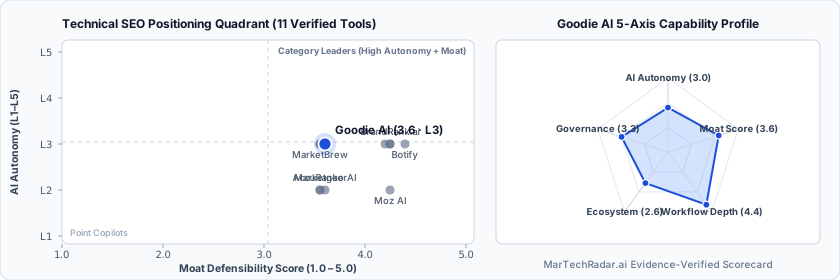
Goodie AI is a Web SaaS tool for Technical SEO (Technical SEO Auditing & Indexing) in GEO & AI SEO. Pricing: Custom / enterprise pricing. Best suited to DTC / eCommerce and Enterprise Brands. Editor ratings: AI autonomy L3 (conditional automation); moat score 3.6/5.0 (Proprietary moat). Fact-checked by Jiacky Lee on Oct 15, 2026.
E-commerce generative engine optimization platform tracking and engineering SKU visibility across conversational AI assistants.
Goodie AI buyer fit verdict: when to choose vs. when to walk away
Choose Goodie AI if (Best Fit)
- Target ICP & Stack Fit: You operate as DTC / eCommerce and Enterprise Brands requiring a Web SaaS deployment for Technical SEO.
- L3 Architecture & Defensibility: Defensibility relies on synthetic prompt orchestration infrastructure across commercial foundation models, automated SKU attribution pipelines, and proprietary generative visibility scoring across conversational search channels.
- Commercial Model Fit: Your procurement budget aligns with Custom / enterprise pricing.
Walk away from Goodie AI if (Deal-Breakers)
- Walk away if you require transparent self-serve monthly billing or your budget ceiling is under $1,000/mo (Goodie AI requires sales-gated custom quoting).
- Walk away if your workflow cannot tolerate dynamic model stochasticity: Model non-determinism and frequent temperature adjustments across third-party LLM providers cause synthetic prompt test results to fluctuate, requiring high-volume query replication to establish statistical significance.
- Walk away if attribution latency and caching is a deal-breaker for your team: Inability to directly access underlying foundation model weights or vector caches restricts operational diagnostics to post-hoc output scraping, creating blind spots regarding how recently updated product schema impacts answer synthesis.
Goodie AI key facts & scorecard
| Pricing | Custom / enterprise pricing |
|---|---|
| Free plan | No / not disclosed |
| Delivery | Web SaaS |
| Audience | DTC / eCommerce, Enterprise Brands |
| AI autonomy level | L3 · Conditional automationEditor-verified |
| Moat tier & score | 3.6 / 5.0 · Proprietary moatEditor-verified |
| Funding | Seed |
| Headquarters | Germany |
| Founded | 2024 |
| Last verified |
Goodie AI pros & cons: strengths vs. operational limitations
Pros: core strengths & capabilities
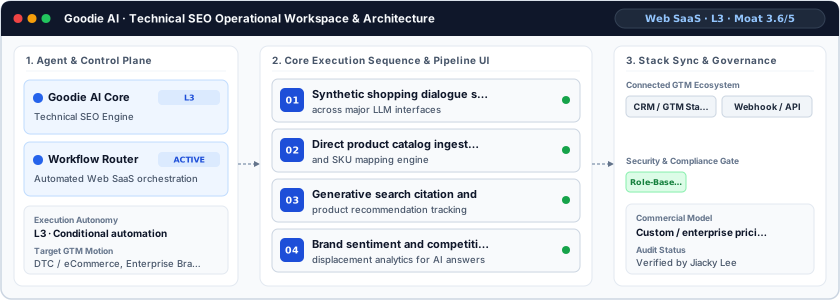
- Synthetic shopping dialogue simulation: across major LLM interfaces
- Direct product catalog ingestion: and SKU mapping engine
- Generative search citation and: product recommendation tracking
- Brand sentiment and competitive: displacement analytics for AI answers
Cons: operational limitations & risks
- Dynamic Model Stochasticity: Model non-determinism and frequent temperature adjustments across third-party LLM providers cause synthetic prompt test results to fluctuate, requiring high-volume query replication to establish statistical significance.
- Attribution Latency and Caching: Inability to directly access underlying foundation model weights or vector caches restricts operational diagnostics to post-hoc output scraping, creating blind spots regarding how recently updated product schema impacts answer synthesis.
- Infrastructure Maintenance Volatility: The vendor's primary web domain exhibits unstable operational availability and empty server responses, signaling substantial risk regarding underlying system uptime and ongoing service reliability.
Goodie AI TCO & deal-breaker stress test
Simulate 12-month stepped TCO, hidden cost multipliers, contract lock-in exposure, and stack failure modes using only facts verified by Jiacky Lee on · Capture SHA 7390ab6e.
Goodie AI triggers high-severity friction under your 5-seat / $800/mo constraints. Benchmark the verified subtrack alternatives below before committing.
| Plan / Tier | Verified Rate | Scale Fit | Scope & Quota Notes |
|---|---|---|---|
| Enterprise / Custom | Custom quote | 15–50+ seats (Enterprise SLA) | Sales-negotiated annual contract for custom volume, SSO/RBAC governance, and dedicated SLA. |
- Moat Score
- 3.6 / 5.0
- AI Autonomy
- L3
- Free Tier / Trial
- None disclosed
Triggered audit signals & failure modes
- Opaque Enterprise Quoting vs. SMB/Mid-Market BudgetVerified Pricing Ledger
Goodie AI does not disclose a public self-serve floor (Custom / enterprise pricing). Buyers with a $800/mo cap face high sales-qualification friction.
- Sales-Gated Contract TermsFact-checked by Jiacky Lee
Pricing is available on request through tailored enterprise sales quotes, with custom enterprise tiers structured around organizational scale, user seats, and workflow volume.
- Primary Operational Bottleneck: Dynamic Model StochasticityAudit by Jiacky Lee
Model non-determinism and frequent temperature adjustments across third-party LLM providers cause synthetic prompt test results to fluctuate, requiring high-volume query replication to establish statistical significance.
Hidden TCO Multipliers & Quota Gates
- Enterprise Governance & Add-On Gating: Advanced capabilities such as Single Sign-On (SSO), custom role permissions, or specialized analytics modules are gated behind upper tiers or paid add-ons.
- Dynamic Model Stochasticity: Model non-determinism and frequent temperature adjustments across third-party LLM providers cause synthetic prompt test results to fluctuate, requiring high-volume query replication to establish statistical significance.
- Attribution Latency and Caching: Inability to directly access underlying foundation model weights or vector caches restricts operational diagnostics to post-hoc output scraping, creating blind spots regarding how recently updated product schema impacts answer synthesis.
When to Walk Away & Negotiation Levers
- Walk away if you require transparent self-serve monthly billing or your budget ceiling is under $1,000/mo (Goodie AI requires sales-gated custom quoting).
- Walk away if your workflow cannot tolerate dynamic model stochasticity: Model non-determinism and frequent temperature adjustments across third-party LLM providers cause synthetic prompt test results to fluctuate, requiring high-volume query replication to establish statistical significance.
- Walk away if attribution latency and caching is a deal-breaker for your team: Inability to directly access underlying foundation model weights or vector caches restricts operational diagnostics to post-hoc output scraping, creating blind spots regarding how recently updated product schema impacts answer synthesis.
- Demand a 30- to 60-day paid pilot opt-out clause in the Goodie AI order form before signing a 12-month enterprise commitment.
- Require a sandbox proof-of-concept testing dynamic model stochasticity against your live CRM/data schema before annual sign-off.
Ask a custom procurement or TCO stress-test question about Goodie AI
Lower 5-seat floor (~$11/mo vs. Custom Quote) · Transparent self-serve entry without mandatory annual lock-in
Lower 5-seat floor (~$499/mo vs. Custom Quote) · Transparent self-serve entry without mandatory annual lock-in
Goodie AI moat & subtrack positioning
Defensibility relies on synthetic prompt orchestration infrastructure across commercial foundation models, automated SKU attribution pipelines, and proprietary generative visibility scoring across conversational search channels.
Editorial review
Fact-checked by Jiacky Lee (Managing Editor, AI Autonomy & Moat Methodology) on .
Background
Operating out of Germany, Goodie AI targets digital commerce directors and technical SEO practitioners navigating the migration of organic product discovery toward conversational interfaces. As end-user query behavior shifts from traditional search result pages to natural language dialogs, the vendor provides visibility monitoring for commercial catalog items within synthetic model outputs. The platform exists to measure how direct-to-consumer and retail brands surface when consumers query generative interfaces for category-level buying advice.
How Goodie AI works
Goodie AI ingests raw product catalog feeds and continuously executes programmatic conversational queries across large language model endpoints, including OpenAI, Anthropic, Perplexity, and Google. The architecture automates prompt permutations that mimic purchase-intent scenarios, extracting citations, recommended SKUs, and brand attribution patterns. By parsing unstructured model outputs into structured relational telemetry, the system calculates algorithmic visibility scores, tracks entity displacement against rival brands, and highlights content gaps that prevent catalog indexing by generative answer engines.
Limitations
Operational considerations and platform boundaries include:
- Dynamic Model Stochasticity: Model non-determinism and frequent temperature adjustments across third-party LLM providers cause synthetic prompt test results to fluctuate, requiring high-volume query replication to establish statistical significance.
- Attribution Latency and Caching: Inability to directly access underlying foundation model weights or vector caches restricts operational diagnostics to post-hoc output scraping, creating blind spots regarding how recently updated product schema impacts answer synthesis.
- Infrastructure Maintenance Volatility: The vendor's primary web domain exhibits unstable operational availability and empty server responses, signaling substantial risk regarding underlying system uptime and ongoing service reliability.
Goodie AI pricing
Pricing is available on request through tailored enterprise sales quotes, with custom enterprise tiers structured around organizational scale, user seats, and workflow volume.
How Goodie AI compares
Compared to direct category competitors like Profound and Peec AI, Goodie AI functions as an alternative focused on specialized workflow execution. Unlike deterministic crawler platforms like Screaming Frog SEO or Sitebulb that parse static document object models, Goodie AI measures prompt-driven discovery across generative interfaces. Enterprise crawlers such as Botify audit log files and enterprise server rendering to optimize classic search indexing. Goodie AI trades crawl-depth granularity for synthetic answer telemetry, serving enterprise retail teams focused explicitly on monitoring SKU share-of-voice within generative search engines. It is best suited for enterprise marketing teams and growth practitioners seeking disciplined workflow orchestration.
Direct competitors & market radar
Top algorithmic competitors based on category positioning, capability overlap, and ICP alignment.
Frequently asked questions about Goodie AI
How much does Goodie AI cost and does it require a custom enterprise quote?
Published pricing summary for Goodie AI: Custom / enterprise pricing. A permanent free plan is not disclosed for Goodie AI. Pricing is available on request through tailored enterprise sales quotes, with custom enterprise tiers structured around organizational scale, user seats, and workflow volume.
How does Goodie AI work and how autonomous is its AI architecture?
E-commerce generative engine optimization platform tracking and engineering SKU visibility across conversational AI assistants. Within Technical SEO (Technical SEO Auditing & Indexing), MarTechRadar rates its execution architecture at L3 · Conditional automation with a verified Moat Score of 3.6 / 5.0 (Proprietary moat). Defensibility relies on synthetic prompt orchestration infrastructure across commercial foundation models, automated SKU attribution pipelines, and proprietary generative visibility scoring across conversational search channels.
What are the main limitations of Goodie AI and when should buyers walk away?
Based on our editorial technical audit, key operational considerations and boundaries for Goodie AI include: (1) Dynamic Model Stochasticity: Model non-determinism and frequent temperature adjustments across third-party LLM providers cause synthetic prompt test results to fluctuate, requiring high-volume query replication to establish statistical significance. (2) Attribution Latency and Caching: Inability to directly access underlying foundation model weights or vector caches restricts operational diagnostics to post-hoc output scraping, creating blind spots regarding how recently updated product schema impacts answer synthesis. (3) Infrastructure Maintenance Volatility: The vendor's primary web domain exhibits unstable operational availability and empty server responses, signaling substantial risk regarding underlying system uptime and ongoing service reliability. Primary procurement walk-away rule: Walk away if you require transparent self-serve monthly billing or your budget ceiling is under $1,000/mo (Goodie AI requires sales-gated custom quoting).
What integrations, compliance certifications, and contract terms apply to Goodie AI?
Key TCO multiplier to watch: Enterprise Governance & Add-On Gating (Advanced capabilities such as Single Sign-On (SSO), custom role permissions, or specialized analytics modules are gated behind upper tiers or paid add-ons.) Before signing a contract, procurement teams should demand a 30- to 60-day paid pilot opt-out clause in the Goodie AI order form before signing a 12-month enterprise commitment.
What are the best Goodie AI alternatives and head-to-head competitors in 2026?
Top fact-checked alternatives to Goodie AI in Technical SEO (Technical SEO Auditing & Indexing) include Sitebulb ($11–$125/mo), BrandRank.ai (Custom / enterprise pricing), Woorank (From $12.99/mo), OnCrawl (Custom / enterprise pricing). Compared to direct category competitors like Profound and Peec AI, Goodie AI functions as an alternative focused on specialized workflow execution.
Verified sources & evidence trail
- Official product domain: https://goodie.ai
- Commercial pricing verification: Verified against official vendor pricing policy (Custom / enterprise pricing)
- Editorial audit sign-off: Fact-checked by Jiacky Lee on under the MarTechRadar Evidence-Ledger Protocol.