Hyperbound Review (2026): AI SDR Pricing, Limits & Alternatives
Bottom line
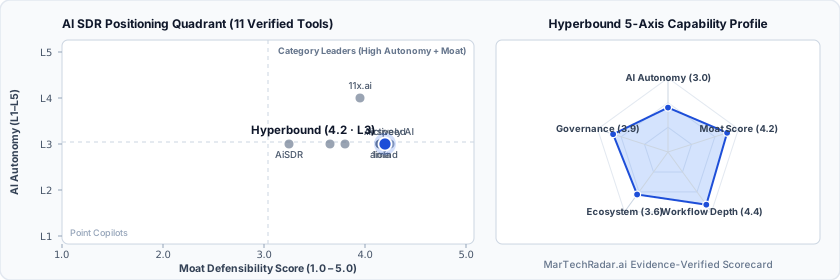
Hyperbound is a Web SaaS tool for AI SDR (Autonomous B2B Sales Agents & AI BDRs) in AI SDR & Outbound. Pricing: Custom / enterprise pricing. Best suited to B2B Sales Leaders, SDR/BDR Teams and Revenue Operations (RevOps). Editor ratings: AI autonomy L3 (conditional automation); moat score 4.2/5.0 (Proprietary moat). Fact-checked by Tim Fenolz on Oct 12, 2026.
Simulated AI buyer roleplay and automated sales coaching platform designed to accelerate sales representative ramp times through interactive voice.
Hyperbound buyer fit verdict: when to choose vs. when to walk away
Choose Hyperbound if (Best Fit)
- Target ICP & Stack Fit: You operate as B2B Sales Leaders, SDR/BDR Teams and Revenue Operations (RevOps) requiring a Web SaaS deployment for AI SDR, with verified ecosystem connectivity for Outreach.
- L3 Architecture & Defensibility: Defensibility centers on proprietary voice-roleplay interaction models, low-latency conversational audio streaming, customized objection-handling trees, and Gartner-recognized enterprise simulation scorecards.
- Commercial Model Fit: Your procurement budget aligns with Custom / enterprise pricing.
Walk away from Hyperbound if (Deal-Breakers)
- Walk away if you require transparent self-serve monthly billing or your budget ceiling is under $1,000/mo (Hyperbound requires sales-gated custom quoting).
- Walk away if your workflow cannot tolerate acoustic latency overhead: Network jitter and round-trip audio inference delays can occasionally introduce micro-pauses that break human conversational cadence during rapid verbal exchanges.
- Walk away if persona context boundary drift is a deal-breaker for your team: When reps introduce non-standard technical edge cases outside ingested collateral, synthetic buyers can hallucinate organizational priorities or concede points prematurely.
Hyperbound key facts & scorecard
| Pricing | Custom / enterprise pricing |
|---|---|
| Free plan | No / not disclosed |
| Delivery | Web SaaS |
| Audience | B2B Sales Leaders, SDR/BDR Teams, Revenue Operations (RevOps) |
| AI autonomy level | L3 · Conditional automationEditor-verified |
| Moat tier & score | 4.2 / 5.0 · Proprietary moatEditor-verified |
| Funding | Series A |
| Total funding | $18.3MBacked by Y Combinator, Peak State Ventures |
| Founders | Atul Raghunathan, Sriharsha Guduguntla |
| Company size | 11-50 employees |
| Ecosystem integrations | Outreach |
| Governance & docs | Privacy ↗ |
| Headquarters | San Francisco, CA |
| Founded | 2023 |
| Last verified |
Hyperbound pros & cons: strengths vs. operational limitations
Pros: core strengths & capabilities
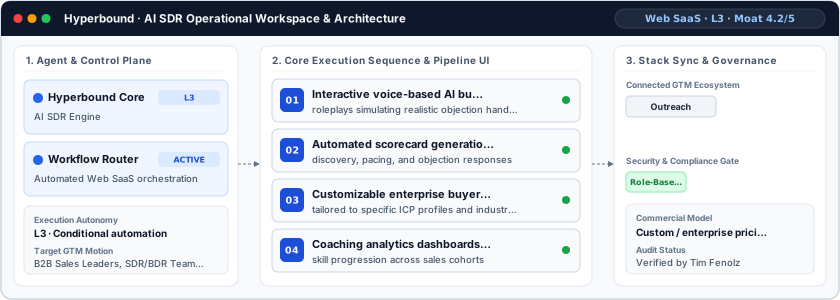
- Interactive voice-based AI buyer: roleplays simulating realistic objection handling
- Automated scorecard generation scoring: discovery, pacing, and objection responses
- Customizable enterprise buyer personas: tailored to specific ICP profiles and industries
- Coaching analytics dashboards tracking: skill progression across sales cohorts
Cons: operational limitations & risks
- Acoustic latency overhead: Network jitter and round-trip audio inference delays can occasionally introduce micro-pauses that break human conversational cadence during rapid verbal exchanges.
- Persona context boundary drift: When reps introduce non-standard technical edge cases outside ingested collateral, synthetic buyers can hallucinate organizational priorities or concede points prematurely.
- Scorecard rubric calibration: Enterprise deployments require continuous manual refinement of scoring prompts to align automated call grading with internal company qualification methodologies.
Hyperbound TCO & deal-breaker stress test
Simulate 12-month stepped TCO, hidden cost multipliers, contract lock-in exposure, and stack failure modes using only facts verified by Tim Fenolz on · Capture SHA 8aa39b95.
Hyperbound triggers high-severity friction under your 5-seat / $800/mo constraints. Benchmark the verified subtrack alternatives below before committing.
| Plan / Tier | Verified Rate | Scale Fit | Scope & Quota Notes |
|---|---|---|---|
| Enterprise / Custom | Custom quote | 15–50+ seats (Enterprise SLA) | Sales-negotiated annual contract for custom volume, SSO/RBAC governance, and dedicated SLA. |
- Moat Score
- 4.2 / 5.0
- AI Autonomy
- L3
- Free Tier / Trial
- None disclosed
Triggered audit signals & failure modes
- Opaque Enterprise Quoting vs. SMB/Mid-Market BudgetVerified Pricing Ledger
Hyperbound does not disclose a public self-serve floor (Custom / enterprise pricing). Buyers with a $800/mo cap face high sales-qualification friction.
- Sales-Gated Contract TermsFact-checked by Tim Fenolz
Hyperbound provides entry-level access for initial evaluation, while scaled deployment is delivered under custom enterprise pricing models.
- Primary Operational Bottleneck: Acoustic latency overheadAudit by Tim Fenolz
Network jitter and round-trip audio inference delays can occasionally introduce micro-pauses that break human conversational cadence during rapid verbal exchanges.
Hidden TCO Multipliers & Quota Gates
- Enterprise Governance & Add-On Gating: Advanced capabilities such as Single Sign-On (SSO), custom role permissions, or specialized analytics modules are gated behind upper tiers or paid add-ons.
- Acoustic latency overhead: Network jitter and round-trip audio inference delays can occasionally introduce micro-pauses that break human conversational cadence during rapid verbal exchanges.
- Persona context boundary drift: When reps introduce non-standard technical edge cases outside ingested collateral, synthetic buyers can hallucinate organizational priorities or concede points prematurely.
When to Walk Away & Negotiation Levers
- Walk away if you require transparent self-serve monthly billing or your budget ceiling is under $1,000/mo (Hyperbound requires sales-gated custom quoting).
- Walk away if your workflow cannot tolerate acoustic latency overhead: Network jitter and round-trip audio inference delays can occasionally introduce micro-pauses that break human conversational cadence during rapid verbal exchanges.
- Walk away if persona context boundary drift is a deal-breaker for your team: When reps introduce non-standard technical edge cases outside ingested collateral, synthetic buyers can hallucinate organizational priorities or concede points prematurely.
- Demand a 30- to 60-day paid pilot opt-out clause in the Hyperbound order form before signing a 12-month enterprise commitment.
- Require a sandbox proof-of-concept testing acoustic latency overhead against your live CRM/data schema before annual sign-off.
Ask a custom procurement or TCO stress-test question about Hyperbound
Lower 5-seat floor (~$39/mo vs. Custom Quote) · Transparent self-serve entry without mandatory annual lock-in
Transparent self-serve entry without mandatory annual lock-in
Hyperbound key entities, modules & ecosystem stack
Hyperbound moat & subtrack positioning
Defensibility centers on proprietary voice-roleplay interaction models, low-latency conversational audio streaming, customized objection-handling trees, and Gartner-recognized enterprise simulation scorecards.
Editorial review
Fact-checked by Tim Fenolz (Lead AdTech, Programmatic & Attribution Analyst) on .
Background
Backed by $18.3M in venture funding and established in 2023 in San Francisco, CA, Hyperbound develops enterprise-grade conversational AI simulation infrastructure for commercial sales organizations. Engineered for revenue enablement leaders and sales development directors, the platform addresses rep onboarding bottlenecks by replacing manual manager peer drills with scalable synthetic practice. Rather than forcing managers to spend hours roleplaying cold calls, the software deploys interactive audio bots representing target enterprise buyer personas.
How Hyperbound works
Architecturally, the system operates as a Level 3 conversational agent utilizing bidirectional audio streaming, low-latency speech-to-text transcription, and fine-tuned large language models programmed with behavioral buyer profiles. Sellers dial simulated prospects via WebRTC telephony connections, encountering programmatic interruptions, nuanced objections, and contextual pushback. Upon call completion, the pipeline processes the conversational transcript against predefined rubric matrices, outputting structured scorecard analytics covering pitch clarity, question cadence, and rebuttal compliance.
Limitations
Operational considerations and platform boundaries include:
- Acoustic latency overhead: Network jitter and round-trip audio inference delays can occasionally introduce micro-pauses that break human conversational cadence during rapid verbal exchanges.
- Persona context boundary drift: When reps introduce non-standard technical edge cases outside ingested collateral, synthetic buyers can hallucinate organizational priorities or concede points prematurely.
- Scorecard rubric calibration: Enterprise deployments require continuous manual refinement of scoring prompts to align automated call grading with internal company qualification methodologies.
Hyperbound pricing
Hyperbound provides entry-level access for initial evaluation, while scaled deployment is delivered under custom enterprise pricing models. Production contracts require custom commercial quotes negotiated through direct sales engagements based on organizational scale, active trainee seats, and administrative coaching integration requirements. Enterprise packages incorporate customized persona modeling, bespoke scorecard development, dedicated administrative controls, and specialized onboarding support.
How Hyperbound compares
While autonomous outbound agents like 11x.ai, 1mind, and Actively AI prioritize direct outbound pipeline generation through synthetic autonomous outreach, Hyperbound optimizes internal workforce capability through automated simulation. This creates a technical trade-off: organizations seeking fully automated prospect outreach favor execution agents, whereas enablement teams prioritizing rep skill development adopt Hyperbound. It serves mid-market and enterprise B2B sales development organizations seeking to compress new-hire ramp periods.
Direct competitors & market radar
Top algorithmic competitors based on category positioning, capability overlap, and ICP alignment.
Frequently asked questions about Hyperbound
How much does Hyperbound cost and does it require a custom enterprise quote?
Published pricing summary for Hyperbound: Custom / enterprise pricing. A permanent free plan is not disclosed for Hyperbound. Hyperbound provides entry-level access for initial evaluation, while scaled deployment is delivered under custom enterprise pricing models.
How does Hyperbound work and how autonomous is its AI architecture?
Simulated AI buyer roleplay and automated sales coaching platform designed to accelerate sales representative ramp times through interactive voice. Within AI SDR (Autonomous B2B Sales Agents & AI BDRs), MarTechRadar rates its execution architecture at L3 · Conditional automation with a verified Moat Score of 4.2 / 5.0 (Proprietary moat). Defensibility centers on proprietary voice-roleplay interaction models, low-latency conversational audio streaming, customized objection-handling trees, and Gartner-recognized enterprise simulation scorecards. Corporate profile: Founded by Atul Raghunathan, Sriharsha Guduguntla, operating at 11-50 employees scale.
What are the main limitations of Hyperbound and when should buyers walk away?
Based on our editorial technical audit, key operational considerations and boundaries for Hyperbound include: (1) Acoustic latency overhead: Network jitter and round-trip audio inference delays can occasionally introduce micro-pauses that break human conversational cadence during rapid verbal exchanges. (2) Persona context boundary drift: When reps introduce non-standard technical edge cases outside ingested collateral, synthetic buyers can hallucinate organizational priorities or concede points prematurely. (3) Scorecard rubric calibration: Enterprise deployments require continuous manual refinement of scoring prompts to align automated call grading with internal company qualification methodologies. Primary procurement walk-away rule: Walk away if you require transparent self-serve monthly billing or your budget ceiling is under $1,000/mo (Hyperbound requires sales-gated custom quoting).
What integrations, compliance certifications, and contract terms apply to Hyperbound?
Verified ecosystem and stack integrations include Outreach. Key TCO multiplier to watch: Enterprise Governance & Add-On Gating (Advanced capabilities such as Single Sign-On (SSO), custom role permissions, or specialized analytics modules are gated behind upper tiers or paid add-ons.) Before signing a contract, procurement teams should demand a 30- to 60-day paid pilot opt-out clause in the Hyperbound order form before signing a 12-month enterprise commitment.
What are the best Hyperbound alternatives and head-to-head competitors in 2026?
Top fact-checked alternatives to Hyperbound in AI SDR (Autonomous B2B Sales Agents & AI BDRs) include Quotain ($0 · Enterprise plan), Aligned (Custom / enterprise pricing), Diffly (Custom / enterprise pricing), Donna (Custom / enterprise pricing). While autonomous outbound agents like 11x.ai, 1mind, and Actively AI prioritize direct outbound pipeline generation through synthetic autonomous outreach, Hyperbound optimizes internal workforce capability through automated simulation.
Verified sources & evidence trail
- Official product domain: https://www.hyperbound.ai/
- Commercial pricing verification: Verified against official vendor pricing policy (Custom / enterprise pricing)
- Verified corporate entity profiles (
sameAs): LinkedIn Company Profile · Crunchbase Entity Record - First-party governance & documentation links: Privacy
- Editorial audit sign-off: Fact-checked by Tim Fenolz on under the MarTechRadar Evidence-Ledger Protocol.