InLinks Review (2026): Content Optimization Pricing, Limits & Alternatives
Bottom line
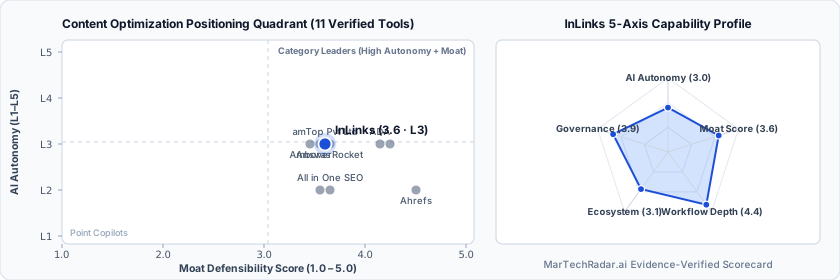
InLinks is a Web SaaS tool for Content Optimization (Content Optimization & SERP Intelligence) in GEO & AI SEO. Pricing: Custom / enterprise pricing. Best suited to B2B SaaS. Editor ratings: AI autonomy L3 (conditional automation); moat score 3.6/5.0 (Proprietary moat). Fact-checked by Jiacky Lee on Oct 15, 2026.
Entity-based SEO platform automating internal linking, schema generation, and content optimization via knowledge graph technology.
InLinks buyer fit verdict: when to choose vs. when to walk away
Choose InLinks if (Best Fit)
- Target ICP & Stack Fit: You operate as B2B SaaS requiring a Web SaaS deployment for Content Optimization.
- L3 Architecture & Defensibility: Proprietary natural language processing engine configured around semantic knowledge graphs and automated client-side JavaScript injection for dynamic internal linking and schema deployment.
- Commercial Model Fit: Your procurement budget aligns with Custom / enterprise pricing.
Walk away from InLinks if (Deal-Breakers)
- Walk away if you require transparent self-serve monthly billing or your budget ceiling is under $1,000/mo (InLinks requires sales-gated custom quoting).
- Walk away if your workflow cannot tolerate client-side rendering dependency: Dynamic link injection relies heavily on client-side JavaScript execution, risking indexing delays if search engine web crawlers experience rendering resource budget exhaustion.
- Walk away if over-automation anchor drift is a deal-breaker for your team: Unsupervised entity matching across large, complex content repositories can occasionally generate grammatically awkward anchor text associations that require human editorial overrides.
InLinks key facts & scorecard
| Pricing | Custom / enterprise pricing |
|---|---|
| Free plan | No / not disclosed |
| Delivery | Web SaaS |
| Audience | B2B SaaS |
| AI autonomy level | L3 · Conditional automationEditor-verified |
| Moat tier & score | 3.6 / 5.0 · Proprietary moatEditor-verified |
| Funding | Bootstrapped |
| Total funding | £15K |
| Founders | Dixon Jones, Fred Laurent |
| Company size | 2-10 employees |
| Governance & docs | Trust & Security ↗ · Privacy ↗ |
| Headquarters | Dunstable, Beds. |
| Founded | 2019 |
| Last verified |
InLinks pros & cons: strengths vs. operational limitations
Pros: core strengths & capabilities
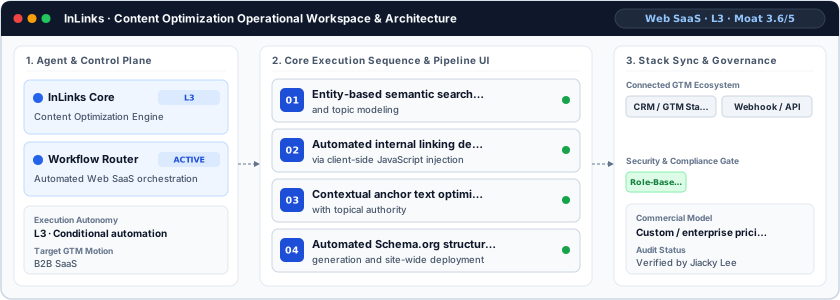
- Entity-based semantic search optimization: and topic modeling
- Automated internal linking deployment: via client-side JavaScript injection
- Contextual anchor text optimization aligned: with topical authority
- Automated Schema.org structured data: generation and site-wide deployment
Cons: operational limitations & risks
- Client-Side Rendering Dependency: Dynamic link injection relies heavily on client-side JavaScript execution, risking indexing delays if search engine web crawlers experience rendering resource budget exhaustion.
- Over-Automation Anchor Drift: Unsupervised entity matching across large, complex content repositories can occasionally generate grammatically awkward anchor text associations that require human editorial overrides.
- CMS Decoupling Friction: Because generated internal links exist primarily in the injected DOM layer rather than database-backed CMS records, migrating away from the script drops the architectural link equity immediately.
InLinks TCO & deal-breaker stress test
Simulate 12-month stepped TCO, hidden cost multipliers, contract lock-in exposure, and stack failure modes using only facts verified by Jiacky Lee on · Capture SHA bdd99896.
InLinks triggers high-severity friction under your 5-seat / $800/mo constraints. Benchmark the verified subtrack alternatives below before committing.
| Plan / Tier | Verified Rate | Scale Fit | Scope & Quota Notes |
|---|---|---|---|
| Entry / Starter | $49/mo | 1–2 seats | 100 pages and grow as needed |
| Agency | $196/mo | 5 seats | Everything in Freelancer Plus: |
| Enterprise / Custom | Custom quote | 15–50+ seats (Enterprise SLA) | Sales-negotiated annual contract for custom volume, SSO/RBAC governance, and dedicated SLA. |
- Moat Score
- 3.6 / 5.0
- AI Autonomy
- L3
- Free Tier / Trial
- None disclosed
Triggered audit signals & failure modes
- Opaque Enterprise Quoting vs. SMB/Mid-Market BudgetVerified Pricing Ledger
InLinks does not disclose a public self-serve floor (Custom / enterprise pricing). Buyers with a $800/mo cap face high sales-qualification friction.
- Sales-Gated Contract TermsFact-checked by Jiacky Lee
Pricing is available on request through tailored enterprise sales quotes, with custom enterprise tiers structured around organizational scale, user seats, and workflow volume.
- Tier Fit for 5-Seat Scale: Entry / Starter ($49/mo)Verified Tier Schedule
100 pages and grow as needed
- Primary Operational Bottleneck: Client-Side Rendering DependencyAudit by Jiacky Lee
Dynamic link injection relies heavily on client-side JavaScript execution, risking indexing delays if search engine web crawlers experience rendering resource budget exhaustion.
Hidden TCO Multipliers & Quota Gates
- Client-Side Rendering Dependency: Dynamic link injection relies heavily on client-side JavaScript execution, risking indexing delays if search engine web crawlers experience rendering resource budget exhaustion.
- Over-Automation Anchor Drift: Unsupervised entity matching across large, complex content repositories can occasionally generate grammatically awkward anchor text associations that require human editorial overrides.
When to Walk Away & Negotiation Levers
- Walk away if you require transparent self-serve monthly billing or your budget ceiling is under $1,000/mo (InLinks requires sales-gated custom quoting).
- Walk away if your workflow cannot tolerate client-side rendering dependency: Dynamic link injection relies heavily on client-side JavaScript execution, risking indexing delays if search engine web crawlers experience rendering resource budget exhaustion.
- Walk away if over-automation anchor drift is a deal-breaker for your team: Unsupervised entity matching across large, complex content repositories can occasionally generate grammatically awkward anchor text associations that require human editorial overrides.
- Demand a 30- to 60-day paid pilot opt-out clause in the InLinks order form before signing a 12-month enterprise commitment.
- Require a sandbox proof-of-concept testing client-side rendering dependency against your live CRM/data schema before annual sign-off.
Ask a custom procurement or TCO stress-test question about InLinks
Lower 5-seat floor (~$29/mo vs. Custom Quote) · Transparent self-serve entry without mandatory annual lock-in
Lower 5-seat floor (~$50/mo vs. Custom Quote) · Transparent self-serve entry without mandatory annual lock-in
InLinks moat & subtrack positioning
Proprietary natural language processing engine configured around semantic knowledge graphs and automated client-side JavaScript injection for dynamic internal linking and schema deployment.
Editorial review
Fact-checked by Jiacky Lee (Managing Editor, AI Autonomy & Moat Methodology) on .
Background
Rather than evaluating search visibility through isolated keyword frequencies, InLinks structures organic discovery around semantic knowledge graphs and entity relationships. Headquartered in Dunstable, Beds., and established in 2019 with £15K in early capital, the company engineers automated semantic SEO infrastructure for enterprise web publishers, digital marketing directors, and technical search teams seeking programmatic topical authority without burdensome manual content editing.
How InLinks works
The platform operates as an L3 semi-autonomous system by deploying a lightweight JavaScript snippet across the client website header. Its proprietary natural language processing pipeline parses target domains, maps content against established entity ontologies, and identifies conceptual correlations across pages. Once configured, the platform autonomously injects bidirectional contextual internal links with precise anchor text directly into the rendered DOM, alongside structured JSON-LD schema markups that define page entities for search engine crawlers.
Limitations
Operational considerations and platform boundaries include:
- Client-Side Rendering Dependency: Dynamic link injection relies heavily on client-side JavaScript execution, risking indexing delays if search engine web crawlers experience rendering resource budget exhaustion.
- Over-Automation Anchor Drift: Unsupervised entity matching across large, complex content repositories can occasionally generate grammatically awkward anchor text associations that require human editorial overrides.
- CMS Decoupling Friction: Because generated internal links exist primarily in the injected DOM layer rather than database-backed CMS records, migrating away from the script drops the architectural link equity immediately.
InLinks pricing
Pricing is available on request through tailored enterprise sales quotes, with custom enterprise tiers structured around organizational scale, user seats, and workflow volume.
How InLinks compares
While traditional discovery suites like Ahrefs deliver backlink telemetry and competitive SERP indexing without direct site execution, InLinks differentiates through active DOM manipulation and automated semantic graph synthesis. Point alternatives such as Amboras or standalone brief editors like Clearscope lack dedicated search entity engineering, positioning InLinks as an optimized selection for mid-to-large editorial properties requiring automated semantic graph management. It is best suited for enterprise marketing teams and growth practitioners seeking disciplined workflow orchestration.
Frequently asked questions about InLinks
How much does InLinks cost and does it require a custom enterprise quote?
Published pricing summary for InLinks: Custom / enterprise pricing. A permanent free plan is not disclosed for InLinks. Verified tier schedule: Entry / Starter ($49/mo for 1–2 seats); Agency ($196/mo for 5 seats); Enterprise / Custom (Custom quote for 15–50+ seats (Enterprise SLA)). Pricing is available on request through tailored enterprise sales quotes, with custom enterprise tiers structured around organizational scale, user seats, and workflow volume.
How does InLinks work and how autonomous is its AI architecture?
Entity-based SEO platform automating internal linking, schema generation, and content optimization via knowledge graph technology. Within Content Optimization (Content Optimization & SERP Intelligence), MarTechRadar rates its execution architecture at L3 · Conditional automation with a verified Moat Score of 3.6 / 5.0 (Proprietary moat). Proprietary natural language processing engine configured around semantic knowledge graphs and automated client-side JavaScript injection for dynamic internal linking and schema deployment. Corporate profile: Founded by Dixon Jones, Fred Laurent, operating at 2-10 employees scale.
What are the main limitations of InLinks and when should buyers walk away?
Based on our editorial technical audit, key operational considerations and boundaries for InLinks include: (1) Client-Side Rendering Dependency: Dynamic link injection relies heavily on client-side JavaScript execution, risking indexing delays if search engine web crawlers experience rendering resource budget exhaustion. (2) Over-Automation Anchor Drift: Unsupervised entity matching across large, complex content repositories can occasionally generate grammatically awkward anchor text associations that require human editorial overrides. (3) CMS Decoupling Friction: Because generated internal links exist primarily in the injected DOM layer rather than database-backed CMS records, migrating away from the script drops the architectural link equity immediately. Primary procurement walk-away rule: Walk away if you require transparent self-serve monthly billing or your budget ceiling is under $1,000/mo (InLinks requires sales-gated custom quoting).
What integrations, compliance certifications, and contract terms apply to InLinks?
First-party governance and developer endpoints verified on domain include: Trust/Security (https://inlinks.com/security). Key TCO multiplier to watch: Client-Side Rendering Dependency (Dynamic link injection relies heavily on client-side JavaScript execution, risking indexing delays if search engine web crawlers experience rendering resource budget exhaustion.) Before signing a contract, procurement teams should demand a 30- to 60-day paid pilot opt-out clause in the InLinks order form before signing a 12-month enterprise commitment.
What are the best InLinks alternatives and head-to-head competitors in 2026?
Top fact-checked alternatives to InLinks in Content Optimization (Content Optimization & SERP Intelligence) include ListEasier (Custom / enterprise pricing), ADA (Custom / enterprise pricing), Digital Udyami (Custom / enterprise pricing), amTop Pvt Ltd (Custom / enterprise pricing). While traditional discovery suites like Ahrefs deliver backlink telemetry and competitive SERP indexing without direct site execution, InLinks differentiates through active DOM manipulation and automated semantic graph synthesis.
Verified sources & evidence trail
- Official product domain: https://inlinks.net
- Commercial pricing verification: Verified against official vendor pricing policy (Custom / enterprise pricing)
- Verified corporate entity profiles (
sameAs): LinkedIn Company Profile · Crunchbase Entity Record - First-party governance & documentation links: Trust & Security · Privacy
- Editorial audit sign-off: Fact-checked by Jiacky Lee on under the MarTechRadar Evidence-Ledger Protocol.