Lava Review (2026): ChatGPT for Marketing Pricing, Limits & Alternatives
Bottom line
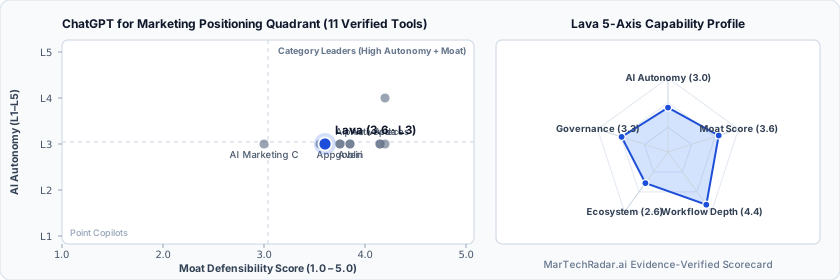
Lava is a Web SaaS tool for ChatGPT for Marketing (Open-Source Marketing Agents & Prompts) in Agent & Marketing Ops. Pricing: Custom / enterprise pricing. Best suited to B2B SaaS. Editor ratings: AI autonomy L3 (conditional automation); moat score 3.6/5.0 (Proprietary moat). Fact-checked by Tim Fenolz on Oct 16, 2026.
Context-aware autonomous agent operating directly within workspace applications to automate multi-step marketing operations and workflow execution.
Lava buyer fit verdict: when to choose vs. when to walk away
Choose Lava if (Best Fit)
- Target ICP & Stack Fit: You operate as B2B SaaS requiring a Web SaaS deployment for ChatGPT for Marketing.
- L3 Architecture & Defensibility: Moat rests primarily on contextual session persistence and in-application action execution, though defensibility remains vulnerable to native browser-level copilot integrations.
- Commercial Model Fit: Your procurement budget aligns with Custom / enterprise pricing.
Walk away from Lava if (Deal-Breakers)
- Walk away if you require transparent self-serve monthly billing or your budget ceiling is under $1,000/mo (Lava requires sales-gated custom quoting).
- Walk away if your workflow cannot tolerate dom instability and schema drift: Dynamic UI updates in target SaaS applications can disrupt selector stability, leading to execution failures during automated multi-step runs.
- Walk away if context window memory limits is a deal-breaker for your team: Deeply nested workspace sessions with extensive conversational state risk context truncation, degrading LLM reasoning accuracy over long workflows.
Lava key facts & scorecard
| Pricing | Custom / enterprise pricing |
|---|---|
| Free plan | No / not disclosed |
| Delivery | Web SaaS |
| Audience | B2B SaaS |
| AI autonomy level | L3 · Conditional automationEditor-verified |
| Moat tier & score | 3.6 / 5.0 · Proprietary moatEditor-verified |
| Funding | Venture-backed |
| Headquarters | United States |
| Last verified |
Lava pros & cons: strengths vs. operational limitations
Pros: core strengths & capabilities
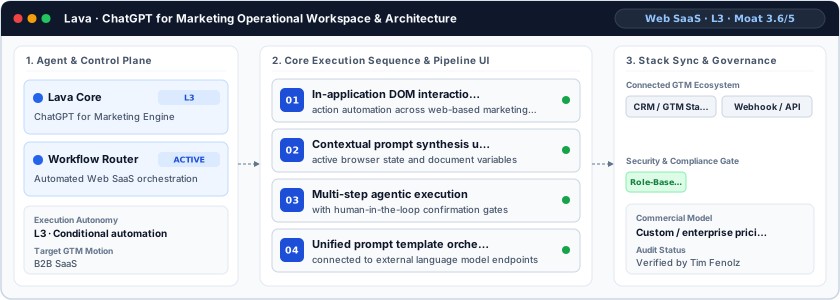
- In-application DOM interaction and: action automation across web-based marketing consoles
- Contextual prompt synthesis utilizing: active browser state and document variables
- Multi-step agentic execution: with human-in-the-loop confirmation gates
- Unified prompt template orchestration: connected to external language model endpoints
Cons: operational limitations & risks
- DOM Instability and Schema Drift: Dynamic UI updates in target SaaS applications can disrupt selector stability, leading to execution failures during automated multi-step runs.
- Context Window Memory Limits: Deeply nested workspace sessions with extensive conversational state risk context truncation, degrading LLM reasoning accuracy over long workflows.
- Permission Isolation Friction: Strict client-side enterprise security policies and cross-origin resource sharing restrictions can constrain the agent's ability to orchestrate cross-tab actions.
Lava TCO & deal-breaker stress test
Simulate 12-month stepped TCO, hidden cost multipliers, contract lock-in exposure, and stack failure modes using only facts verified by Tim Fenolz on .
Lava triggers high-severity friction under your 5-seat / $800/mo constraints. Benchmark the verified subtrack alternatives below before committing.
| Plan / Tier | Verified Rate | Scale Fit | Scope & Quota Notes |
|---|---|---|---|
| Enterprise / Custom | Custom quote | 15–50+ seats (Enterprise SLA) | Sales-negotiated annual contract for custom volume, SSO/RBAC governance, and dedicated SLA. |
- Moat Score
- 3.6 / 5.0
- AI Autonomy
- L3
- Free Tier / Trial
- None disclosed
Triggered audit signals & failure modes
- Opaque Enterprise Quoting vs. SMB/Mid-Market BudgetVerified Pricing Ledger
Lava does not disclose a public self-serve floor (Custom / enterprise pricing). Buyers with a $800/mo cap face high sales-qualification friction.
- Sales-Gated Contract TermsFact-checked by Tim Fenolz
The commercial licensing structure operates on custom enterprise pricing available on request through tailored sales quotes. Engagements are determined by organizational scale, active user seats, and overall agent execution volume across workspace environments.
- Primary Operational Bottleneck: DOM Instability and Schema DriftAudit by Tim Fenolz
Dynamic UI updates in target SaaS applications can disrupt selector stability, leading to execution failures during automated multi-step runs.
Hidden TCO Multipliers & Quota Gates
- Profile / Workspace Quota Ceilings: Base tiers cap the number of connected profiles, workspaces, or contact records, forcing tier upgrades before seat limits are reached.
- DOM Instability and Schema Drift: Dynamic UI updates in target SaaS applications can disrupt selector stability, leading to execution failures during automated multi-step runs.
- Context Window Memory Limits: Deeply nested workspace sessions with extensive conversational state risk context truncation, degrading LLM reasoning accuracy over long workflows.
When to Walk Away & Negotiation Levers
- Walk away if you require transparent self-serve monthly billing or your budget ceiling is under $1,000/mo (Lava requires sales-gated custom quoting).
- Walk away if your workflow cannot tolerate dom instability and schema drift: Dynamic UI updates in target SaaS applications can disrupt selector stability, leading to execution failures during automated multi-step runs.
- Walk away if context window memory limits is a deal-breaker for your team: Deeply nested workspace sessions with extensive conversational state risk context truncation, degrading LLM reasoning accuracy over long workflows.
- Demand a 30- to 60-day paid pilot opt-out clause in the Lava order form before signing a 12-month enterprise commitment.
- Require a sandbox proof-of-concept testing dom instability and schema drift against your live CRM/data schema before annual sign-off.
Ask a custom procurement or TCO stress-test question about Lava
Lower 5-seat floor (~$99/mo vs. Custom Quote) · Transparent self-serve entry without mandatory annual lock-in
Lower 5-seat floor (~$99/mo vs. Custom Quote) · Transparent self-serve entry without mandatory annual lock-in
Lava moat & subtrack positioning
Moat rests primarily on contextual session persistence and in-application action execution, though defensibility remains vulnerable to native browser-level copilot integrations.
Editorial review
Fact-checked by Tim Fenolz (Lead AdTech, Programmatic & Attribution Analyst) on .
Background
Architectured as an embedded execution layer, Lava deploys directly into enterprise workspaces to automate repetitive marketing operations. Headquartered in the United States, the platform addresses workflow fragmentation encountered by marketing operations teams and growth analysts who navigate detached browser-based tools. Rather than requiring users to manually export tabular datasets or copy context into isolated chat interfaces, the system operates as an ambient copilot directly within operational interfaces. The platform targets growth engineering and demand generation leads seeking to consolidate contextual execution without expanding brittle internal scripting infrastructures.
How Lava works
At the architectural layer, the system autonomy, the system leverages a client-side execution container paired with an orchestration layer that parses live application state. It ingests active DOM structures, document trees, and session variables, mapping these inputs into an operational state graph. When triggered via targeted prompt sequences, the agent plans multi-step tasks, decomposing operational workflows into discreet micro-actions such as form population, cohort tagging, or report extraction. It queries large language model endpoints via secure API gateways, utilizing prompt chaining and structured output parsers to execute actions while retaining a human-in-the-loop review interface before mutating external records.
Limitations
Operational considerations and platform boundaries include:
- DOM Instability and Schema Drift: Dynamic UI updates in target SaaS applications can disrupt selector stability, leading to execution failures during automated multi-step runs.
- Context Window Memory Limits: Deeply nested workspace sessions with extensive conversational state risk context truncation, degrading LLM reasoning accuracy over long workflows.
- Permission Isolation Friction: Strict client-side enterprise security policies and cross-origin resource sharing restrictions can constrain the agent's ability to orchestrate cross-tab actions.
Lava pricing
The commercial licensing structure operates on custom enterprise pricing available on request through tailored sales quotes. Engagements are determined by organizational scale, active user seats, and overall agent execution volume across workspace environments. The model packages enterprise administrative controls, dedicated tenant security, and direct integration support into bespoke annual contracts, requiring prospective buyers to engage directly with sales representatives for specific billing parameters.
How Lava compares
Within the ecosystem of operational marketing agents, the tool competes against platforms such as Alphie, Appgoblin, and Arda. While Alphie emphasizes automated narrative generation and Arda concentrates on developer-centric prompt management pipelines, this platform prioritizes embedded UI-level execution directly inside active SaaS workflows. Appgoblin provides targeted app store operational intelligence, whereas this agent functions as a general-purpose execution overlay. It is best suited for growth marketing teams requiring inline task automation across disparate web-based consoles without investing in custom browser automation infrastructure.
Frequently asked questions about Lava
How much does Lava cost and does it require a custom enterprise quote?
Published pricing summary for Lava: Custom / enterprise pricing. A permanent free plan is not disclosed for Lava. The commercial licensing structure operates on custom enterprise pricing available on request through tailored sales quotes. Engagements are determined by organizational scale, active user seats, and overall agent execution volume across workspace environments.
How does Lava work and how autonomous is its AI architecture?
Context-aware autonomous agent operating directly within workspace applications to automate multi-step marketing operations and workflow execution. Within ChatGPT for Marketing (Open-Source Marketing Agents & Prompts), MarTechRadar rates its execution architecture at L3 · Conditional automation with a verified Moat Score of 3.6 / 5.0 (Proprietary moat). Moat rests primarily on contextual session persistence and in-application action execution, though defensibility remains vulnerable to native browser-level copilot integrations.
What are the main limitations of Lava and when should buyers walk away?
Based on our editorial technical audit, key operational considerations and boundaries for Lava include: (1) DOM Instability and Schema Drift: Dynamic UI updates in target SaaS applications can disrupt selector stability, leading to execution failures during automated multi-step runs. (2) Context Window Memory Limits: Deeply nested workspace sessions with extensive conversational state risk context truncation, degrading LLM reasoning accuracy over long workflows. (3) Permission Isolation Friction: Strict client-side enterprise security policies and cross-origin resource sharing restrictions can constrain the agent's ability to orchestrate cross-tab actions. Primary procurement walk-away rule: Walk away if you require transparent self-serve monthly billing or your budget ceiling is under $1,000/mo (Lava requires sales-gated custom quoting).
What integrations, compliance certifications, and contract terms apply to Lava?
Key TCO multiplier to watch: Profile / Workspace Quota Ceilings (Base tiers cap the number of connected profiles, workspaces, or contact records, forcing tier upgrades before seat limits are reached.) Before signing a contract, procurement teams should demand a 30- to 60-day paid pilot opt-out clause in the Lava order form before signing a 12-month enterprise commitment.
What are the best Lava alternatives and head-to-head competitors in 2026?
Top fact-checked alternatives to Lava in ChatGPT for Marketing (Open-Source Marketing Agents & Prompts) include Hermoso (Custom / enterprise pricing), Rate My AI Site (Custom / enterprise pricing), Lookatshow Open Tools (Custom / enterprise pricing), Market Ldr Architecture (Custom / enterprise pricing). Within the ecosystem of operational marketing agents, the tool competes against platforms such as Alphie, Appgoblin, and Arda.
Verified sources & evidence trail
- Official product domain: https://www.lava.so/
- Commercial pricing verification: Verified against official vendor pricing policy (Custom / enterprise pricing)
- Editorial audit sign-off: Fact-checked by Tim Fenolz on under the MarTechRadar Evidence-Ledger Protocol.