LeadGenius Review (2026): AI SDR Pricing, Limits & Alternatives
Bottom line
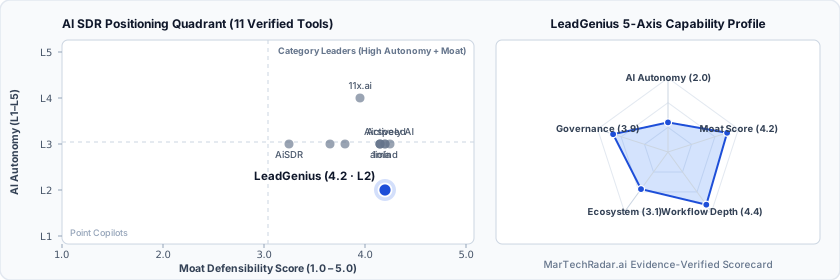
LeadGenius is a Web SaaS tool for AI SDR (Autonomous B2B Sales Agents & AI BDRs) in AI SDR & Outbound. Pricing: Custom / enterprise pricing. Best suited to B2B SaaS, DTC / eCommerce and Enterprise Brands. Editor ratings: AI autonomy L2 (workflow copilot); moat score 4.2/5.0 (Proprietary moat). Fact-checked by Sarah Per on Oct 14, 2026.
Enterprise B2B contact intelligence and account data enrichment combining automated web crawlers with human-in-the-loop verification.
LeadGenius buyer fit verdict: when to choose vs. when to walk away
Choose LeadGenius if (Best Fit)
- Target ICP & Stack Fit: You operate as B2B SaaS, DTC / eCommerce and Enterprise Brands requiring a Web SaaS deployment for AI SDR.
- L2 Architecture & Defensibility: LeadGenius establishes defensibility through its hybrid data verification architecture, combining automated scraping algorithms with an orchestrated global network of human researchers to extract bespoke, non-standard account intelligence that pure-software scrapers cannot resolve.
- Commercial Model Fit: Your procurement budget aligns with Custom / enterprise pricing.
Walk away from LeadGenius if (Deal-Breakers)
- Walk away if you require transparent self-serve monthly billing or your budget ceiling is under $1,000/mo (LeadGenius requires sales-gated custom quoting).
- Walk away if your workflow cannot tolerate turnaround latency: Human-in-the-loop verification introduces latency compared to programmatic APIs, preventing instantaneous real-time lead enrichment during rapid inbound routing.
- Walk away if integration throughput and rate limits is a deal-breaker for your team: Batch synchronization of bespoke contact schemas frequently encounters field-mapping mismatches and API rate throttling when pushing complex custom attributes into legacy CRM architectures.
LeadGenius key facts & scorecard
| Pricing | Custom / enterprise pricing |
|---|---|
| Free plan | No / not disclosed |
| Delivery | Web SaaS |
| Audience | B2B SaaS, DTC / eCommerce, Enterprise Brands |
| AI autonomy level | L2 · Workflow copilotEditor-verified |
| Moat tier & score | 4.2 / 5.0 · Proprietary moatEditor-verified |
| Funding | Series B |
| Total funding | $30.4M |
| Founders | Anand Kulkarni, David Rolnitzky, Philipp Gutheim, Prayag Narula |
| Company size | 201-500 employees |
| Governance & docs | Terms ↗ · Privacy ↗ |
| Headquarters | Berkeley, CA |
| Founded | 2011 |
| Last verified |
LeadGenius pros & cons: strengths vs. operational limitations
Pros: core strengths & capabilities
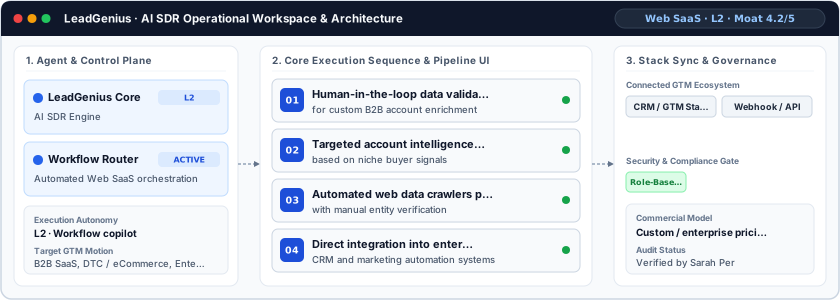
- Human-in-the-loop data validation pipeline: for custom B2B account enrichment
- Targeted account intelligence gathering: based on niche buyer signals
- Automated web data crawlers paired: with manual entity verification
- Direct integration into enterprise: CRM and marketing automation systems
Cons: operational limitations & risks
- Turnaround Latency: Human-in-the-loop verification introduces latency compared to programmatic APIs, preventing instantaneous real-time lead enrichment during rapid inbound routing.
- Integration Throughput and Rate Limits: Batch synchronization of bespoke contact schemas frequently encounters field-mapping mismatches and API rate throttling when pushing complex custom attributes into legacy CRM architectures.
- Human Verification Variance: Relying on distributed human researchers can introduce inconsistent data hygiene and variable QA fidelity across highly technical or niche regional compliance parameters.
LeadGenius TCO & deal-breaker stress test
Simulate 12-month stepped TCO, hidden cost multipliers, contract lock-in exposure, and stack failure modes using only facts verified by Sarah Per on · Capture SHA d922b7d5.
LeadGenius triggers high-severity friction under your 5-seat / $800/mo constraints. Benchmark the verified subtrack alternatives below before committing.
| Plan / Tier | Verified Rate | Scale Fit | Scope & Quota Notes |
|---|---|---|---|
| Enterprise / Custom | Custom quote | 15–50+ seats (Enterprise SLA) | Sales-negotiated annual contract for custom volume, SSO/RBAC governance, and dedicated SLA. |
- Moat Score
- 4.2 / 5.0
- AI Autonomy
- L2
- Free Tier / Trial
- None disclosed
Triggered audit signals & failure modes
- Opaque Enterprise Quoting vs. SMB/Mid-Market BudgetVerified Pricing Ledger
LeadGenius does not disclose a public self-serve floor (Custom / enterprise pricing). Buyers with a $800/mo cap face high sales-qualification friction.
- Sales-Gated Contract TermsFact-checked by Sarah Per
LeadGenius bypasses self-serve transactional tiers in favor of custom enterprise contracts. Commercial pricing is available on request through tailored enterprise sales quotes based on organizational scale and seats.
- Primary Operational Bottleneck: Turnaround LatencyAudit by Sarah Per
Human-in-the-loop verification introduces latency compared to programmatic APIs, preventing instantaneous real-time lead enrichment during rapid inbound routing.
Hidden TCO Multipliers & Quota Gates
- Turnaround Latency: Human-in-the-loop verification introduces latency compared to programmatic APIs, preventing instantaneous real-time lead enrichment during rapid inbound routing.
- Integration Throughput and Rate Limits: Batch synchronization of bespoke contact schemas frequently encounters field-mapping mismatches and API rate throttling when pushing complex custom attributes into legacy CRM architectures.
When to Walk Away & Negotiation Levers
- Walk away if you require transparent self-serve monthly billing or your budget ceiling is under $1,000/mo (LeadGenius requires sales-gated custom quoting).
- Walk away if your workflow cannot tolerate turnaround latency: Human-in-the-loop verification introduces latency compared to programmatic APIs, preventing instantaneous real-time lead enrichment during rapid inbound routing.
- Walk away if integration throughput and rate limits is a deal-breaker for your team: Batch synchronization of bespoke contact schemas frequently encounters field-mapping mismatches and API rate throttling when pushing complex custom attributes into legacy CRM architectures.
- Demand a 30- to 60-day paid pilot opt-out clause in the LeadGenius order form before signing a 12-month enterprise commitment.
- Require a sandbox proof-of-concept testing turnaround latency against your live CRM/data schema before annual sign-off.
Ask a custom procurement or TCO stress-test question about LeadGenius
Lower 5-seat floor (~$49/mo vs. Custom Quote) · Transparent self-serve entry without mandatory annual lock-in
Lower 5-seat floor (~$39/mo vs. Custom Quote) · Transparent self-serve entry without mandatory annual lock-in
LeadGenius moat & subtrack positioning
LeadGenius establishes defensibility through its hybrid data verification architecture, combining automated scraping algorithms with an orchestrated global network of human researchers to extract bespoke, non-standard account intelligence that pure-software scrapers cannot resolve.
Editorial review
Fact-checked by Sarah Per (Principal Content Systems & Generative Media Editor) on .
Background
Headquartered in Berkeley, CA, LeadGenius was founded in 2011 to resolve a persistent revenue engineering bottleneck: the unreliability of static B2B databases when mapping non-standard ideal customer profiles. Backed by $30.4M in total venture funding, the company targets enterprise sales operations leaders, demand generation directors, and outbound revenue teams seeking bespoke prospect intelligence. Rather than relying solely on automated directory scrapes, the platform focuses on delivering verified, highly contextual account and contact records.
How LeadGenius works
At its architectural core, LeadGenius operates as an L2 autonomous system utilizing a hybrid engine that pairs automated data mining with managed human-in-the-loop verification. Algorithmic web scrapers and machine learning parsers ingest public signals, regulatory registries, and domain endpoints to map target accounts. Because unstructured web data frequently suffers from hallucinated contact associations and stale employment telemetry, tasks route through an orchestrated distributed workforce that manually validates contact validity, corporate reporting hierarchies, and specialized buying criteria before ingesting records into enterprise CRMs.
Limitations
Operational considerations and platform boundaries include:
- Turnaround Latency: Human-in-the-loop verification introduces latency compared to programmatic APIs, preventing instantaneous real-time lead enrichment during rapid inbound routing.
- Integration Throughput and Rate Limits: Batch synchronization of bespoke contact schemas frequently encounters field-mapping mismatches and API rate throttling when pushing complex custom attributes into legacy CRM architectures.
- Human Verification Variance: Relying on distributed human researchers can introduce inconsistent data hygiene and variable QA fidelity across highly technical or niche regional compliance parameters.
LeadGenius pricing
LeadGenius bypasses self-serve transactional tiers in favor of custom enterprise contracts. Commercial pricing is available on request through tailored enterprise sales quotes based on organizational scale and seats. Contracts are structured around committed annualized volume, custom data research scopes, ongoing enrichment maintenance, and dedicated managed researcher allocations.
How LeadGenius compares
Compared to autonomous AI BDR engines like 11x.ai, 1mind, and Actively AI—which prioritize fully automated multi-channel outbound orchestration via autonomous agents—LeadGenius prioritizes rigorous upstream data integrity. While purely algorithmic competitors execute rapid, unvalidated prospecting sequences that risk domain reputation, LeadGenius trades conversational automation speed for data fidelity. This model best suits enterprise revenue organizations selling high-contract-value solutions requiring custom qualification criteria that off-the-shelf software cannot uncover.
Direct competitors & market radar
Top algorithmic competitors based on category positioning, capability overlap, and ICP alignment.
Frequently asked questions about LeadGenius
How much does LeadGenius cost and does it require a custom enterprise quote?
Published pricing summary for LeadGenius: Custom / enterprise pricing. A permanent free plan is not disclosed for LeadGenius. LeadGenius bypasses self-serve transactional tiers in favor of custom enterprise contracts. Commercial pricing is available on request through tailored enterprise sales quotes based on organizational scale and seats.
How does LeadGenius work and how autonomous is its AI architecture?
Enterprise B2B contact intelligence and account data enrichment combining automated web crawlers with human-in-the-loop verification. Within AI SDR (Autonomous B2B Sales Agents & AI BDRs), MarTechRadar rates its execution architecture at L2 · Workflow copilot with a verified Moat Score of 4.2 / 5.0 (Proprietary moat). LeadGenius establishes defensibility through its hybrid data verification architecture, combining automated scraping algorithms with an orchestrated global network of human researchers to extract bespoke, non-standard account intelligence that pure-software scrapers cannot resolve. Corporate profile: Founded by Anand Kulkarni, David Rolnitzky, Philipp Gutheim, Prayag Narula, operating at 201-500 employees scale.
What are the main limitations of LeadGenius and when should buyers walk away?
Based on our editorial technical audit, key operational considerations and boundaries for LeadGenius include: (1) Turnaround Latency: Human-in-the-loop verification introduces latency compared to programmatic APIs, preventing instantaneous real-time lead enrichment during rapid inbound routing. (2) Integration Throughput and Rate Limits: Batch synchronization of bespoke contact schemas frequently encounters field-mapping mismatches and API rate throttling when pushing complex custom attributes into legacy CRM architectures. (3) Human Verification Variance: Relying on distributed human researchers can introduce inconsistent data hygiene and variable QA fidelity across highly technical or niche regional compliance parameters. Primary procurement walk-away rule: Walk away if you require transparent self-serve monthly billing or your budget ceiling is under $1,000/mo (LeadGenius requires sales-gated custom quoting).
What integrations, compliance certifications, and contract terms apply to LeadGenius?
Key TCO multiplier to watch: Turnaround Latency (Human-in-the-loop verification introduces latency compared to programmatic APIs, preventing instantaneous real-time lead enrichment during rapid inbound routing.) Before signing a contract, procurement teams should demand a 30- to 60-day paid pilot opt-out clause in the LeadGenius order form before signing a 12-month enterprise commitment.
What are the best LeadGenius alternatives and head-to-head competitors in 2026?
Top fact-checked alternatives to LeadGenius in AI SDR (Autonomous B2B Sales Agents & AI BDRs) include Donna (Custom / enterprise pricing), Hypersonix (Custom / enterprise pricing), Letter AI (Custom / enterprise pricing), Nex.ai (From $49/mo). Compared to autonomous AI BDR engines like 11x.ai, 1mind, and Actively AI—which prioritize fully automated multi-channel outbound orchestration via autonomous agents—LeadGenius prioritizes rigorous upstream data integrity.
Verified sources & evidence trail
- Official product domain: https://leadgenius.com
- Commercial pricing verification: Verified against official vendor pricing policy (Custom / enterprise pricing)
- Verified corporate entity profiles (
sameAs): LinkedIn Company Profile · Crunchbase Entity Record - First-party governance & documentation links: Terms · Privacy
- Editorial audit sign-off: Fact-checked by Sarah Per on under the MarTechRadar Evidence-Ledger Protocol.