Lindy Review (2026): AI Marketing Agent Pricing, Limits & Alternatives
Bottom line
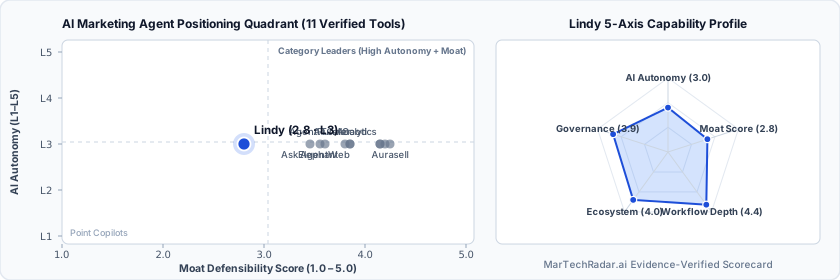
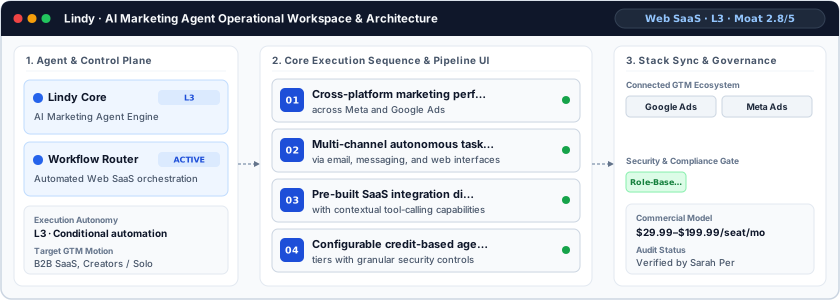
Lindy is a Web SaaS tool for AI Marketing Agent (Autonomous Marketing Agents & Digital Coworkers) in Agent & Marketing Ops. Pricing: $29.99–$199.99/seat/mo. Best suited to B2B SaaS and Creators / Solo. Editor ratings: AI autonomy L3 (conditional automation); moat score 2.8/5.0 (Workflow-embedded). Fact-checked by Sarah Per on Oct 7, 2026.
Autonomous digital coworker platform that integrates with enterprise SaaS tools to execute recurring marketing operations and multi-channel campaign tasks.
Lindy buyer fit verdict: when to choose vs. when to walk away
Choose Lindy if (Best Fit)
- Target ICP & Stack Fit: You operate as B2B SaaS and Creators / Solo requiring a Web SaaS deployment for AI Marketing Agent, with verified ecosystem connectivity for Google Ads, Meta Ads.
- L3 Architecture & Defensibility: Defensibility stems from a composable agent runtime integrating deep SaaS action connectors with persistent contextual memory, reducing the overhead of maintaining brittle point-to-point automation workflows.
- Commercial Model Fit: Your procurement budget aligns with $29.99–$199.99/seat/mo.
Walk away from Lindy if (Deal-Breakers)
- Walk away if your workflow requires uncapped enterprise volume on the $29.99–$199.99/seat/mo entry plan without upgrading tiers.
- Walk away if your workflow cannot tolerate API rate limits: High-frequency task execution across third-party marketing networks faces standard provider throttling, which can delay agent reporting cycles.
- Walk away if schema maintenance is a deal-breaker for your team: Frequent updates to upstream platform data schemas and ad taxonomies require ongoing prompt adjustments and integration calibration.
Lindy key facts & scorecard
| Pricing | $29.99–$199.99/seat/moVendor pricing page |
|---|---|
| Free plan | No / not disclosed |
| Delivery | Web SaaS |
| Audience | B2B SaaS, Creators / Solo |
| AI autonomy level | L3 · Conditional automationEditor-verified |
| Moat tier & score | 2.8 / 5.0 · Workflow-embeddedEditor-verified |
| Funding | Series B |
| Total funding | $49.9MBacked by Menlo Ventures, SV Angel, Coatue, Battery Ventures, GTMfund |
| Founders | Florent Crivello |
| Company size | 11-50 employees |
| Ecosystem integrations | Google Ads, Meta Ads |
| Governance & docs | Trust & Security ↗ · API & Docs ↗ · Terms ↗ · Privacy ↗ |
| Headquarters | San Francisco, United States |
| Founded | 2023 |
| Last verified |
Lindy pros & cons: strengths vs. operational limitations
Pros: core strengths & capabilities
- Cross-platform marketing performance aggregation: across Meta and Google Ads
- Multi-channel autonomous task execution: via email, messaging, and web interfaces
- Pre-built SaaS integration directory: with contextual tool-calling capabilities
- Configurable credit-based agent execution: tiers with granular security controls
Cons: operational limitations & risks
- API Rate Limits: High-frequency task execution across third-party marketing networks faces standard provider throttling, which can delay agent reporting cycles.
- Schema Maintenance: Frequent updates to upstream platform data schemas and ad taxonomies require ongoing prompt adjustments and integration calibration.
- Context Drift: Multi-agent task chains spanning extended operating windows run the risk of hallucination or intent deviation during complex multi-step routines.
Lindy TCO & deal-breaker stress test
Simulate 12-month stepped TCO, hidden cost multipliers, contract lock-in exposure, and stack failure modes using only facts verified by Sarah Per on · Capture SHA 307302a2.
Lindy aligns with your 5-seat / $800/mo profile. Review the walk-away triggers and contract levers below before deployment.
| Plan / Tier | Verified Rate | Scale Fit | Scope & Quota Notes |
|---|---|---|---|
| Plus | $50/seat/mo | 1–2 seats | 3k credits / user / mo |
- Moat Score
- 2.8 / 5.0
- AI Autonomy
- L3
- Free Tier / Trial
- None disclosed
Triggered audit signals & failure modes
- Published Self-Serve Entry FloorVerified Pricing Ledger
Lindy publishes a transparent entry point ($29.99–$199.99/seat/mo) for initial validation before committing.
- Linear Per-Seat Scaling (5 Seats × $29.99/seat/mo)Commercial Model Audit
Base license scales linearly with operator headcount ($150/mo for 5 seats on Plus).
- Primary Operational Bottleneck: API Rate LimitsAudit by Sarah Per
High-frequency task execution across third-party marketing networks faces standard provider throttling, which can delay agent reporting cycles.
Hidden TCO Multipliers & Quota Gates
- Per-Seat Linear Scaling: Lindy prices licenses on a per-user/seat basis ($29.99–$199.99/seat/mo); expanding from 2 to 15+ operators multiplies base recurring spend linearly.
- Credit & Usage Burn Multiplier: Automated workflows consume metered credits/usage quotas; multi-step enrichment, voice minutes, or high-frequency agent runs can trigger mid-cycle top-up packs.
When to Walk Away & Negotiation Levers
- Walk away if your workflow requires uncapped enterprise volume on the $29.99–$199.99/seat/mo entry plan without upgrading tiers.
- Walk away if your workflow cannot tolerate API rate limits: High-frequency task execution across third-party marketing networks faces standard provider throttling, which can delay agent reporting cycles.
- Walk away if schema maintenance is a deal-breaker for your team: Frequent updates to upstream platform data schemas and ad taxonomies require ongoing prompt adjustments and integration calibration.
- Validate exact quota thresholds (seats, credits, or API calls) included in Lindy's $29.99–$199.99/seat/mo tier before converting from monthly to annual billing.
- Require a sandbox proof-of-concept testing API rate limits against your live CRM/data schema before annual sign-off.
Ask a custom procurement or TCO stress-test question about Lindy
Lower 5-seat floor (~$20/mo vs. $150 / mo)
Lower 5-seat floor (~$100/mo vs. $150 / mo)
Lindy key entities, modules & ecosystem stack
Lindy moat & subtrack positioning
Defensibility stems from a composable agent runtime integrating deep SaaS action connectors with persistent contextual memory, reducing the overhead of maintaining brittle point-to-point automation workflows.
Editorial review
Fact-checked by Sarah Per (Principal Content Systems & Generative Media Editor) on .
Background
To eliminate repetitive manual coordination across marketing stacks, Lindy provides autonomous digital coworkers that execute operational tasks directly within existing communication workflows. Headquartered in San Francisco, United States, and established in 2023, the organization has raised $49.9M in aggregate capital. The software is built for demand generation teams and marketing operations leads seeking to automate multi-step processes across advertising dashboards, messaging systems, and data stores without maintaining fragile low-code automation graphs.
How Lindy works
Lindy operates as an L3 autonomous agent platform that coordinates tool-calling models against integrated software environments. The engine ingests user prompts alongside operational parameters to orchestrate task graphs across connected endpoints, including Google Ads, Meta Ads, and enterprise messaging systems. By combining dynamic context retrieval with direct API execution, the agent resolves cross-platform dependencies—such as pulling advertising spend across disparate ad networks and drafting analytical updates—without requiring constant step-by-step human intervention.
Limitations
Operational considerations and platform boundaries include:
- API Rate Limits: High-frequency task execution across third-party marketing networks faces standard provider throttling, which can delay agent reporting cycles.
- Schema Maintenance: Frequent updates to upstream platform data schemas and ad taxonomies require ongoing prompt adjustments and integration calibration.
- Context Drift: Multi-agent task chains spanning extended operating windows run the risk of hallucination or intent deviation during complex multi-step routines.
Lindy pricing
Lindy employs a tiered per-seat subscription structure centered on consumption credits. Teams can evaluate the workspace using $50 in complimentary credits. Formal tiers start with the Plus edition at $29.99 per user monthly for 3,000 credits, stepping up to the Pro edition at $99.99 per user monthly for 15,000 credits. High-volume teams utilize the Max tier at $199.99 per user monthly for 35,000 credits, while custom Enterprise arrangements provide dedicated compliance agreements and enterprise governance controls.
How Lindy compares
Within the autonomous marketing coworker category, Lindy competes against platforms such as ai-marketing-claude, allGood, and AskElephant. While specialized prompt wrappers like ai-marketing-claude focus heavily on conversational text generation, Lindy prioritizes deep action invocation and autonomous workspace task execution. Compared to intelligence-focused point tools like allGood and AskElephant, Lindy trades niche ad attribution models for generalized operational execution, making it suited for marketing organizations needing automated operational labor across fragmented operational tools.
Direct competitors & market radar
Top algorithmic competitors based on category positioning, capability overlap, and ICP alignment.
Frequently asked questions about Lindy
How much does Lindy cost per seat and does it have a free plan?
Published pricing summary for Lindy: $29.99–$199.99/seat/mo. A permanent free plan is not disclosed for Lindy. Lindy employs a tiered per-seat subscription structure centered on consumption credits. Teams can evaluate the workspace using $50 in complimentary credits.
How does Lindy work and how autonomous is its AI architecture?
Autonomous digital coworker platform that integrates with enterprise SaaS tools to execute recurring marketing operations and multi-channel campaign tasks. Within AI Marketing Agent (Autonomous Marketing Agents & Digital Coworkers), MarTechRadar rates its execution architecture at L3 · Conditional automation with a verified Moat Score of 2.8 / 5.0 (Workflow-embedded). Defensibility stems from a composable agent runtime integrating deep SaaS action connectors with persistent contextual memory, reducing the overhead of maintaining brittle point-to-point automation workflows. Corporate profile: Founded by Florent Crivello, operating at 11-50 employees scale.
What are the main limitations of Lindy and when should buyers walk away?
Based on our editorial technical audit, key operational considerations and boundaries for Lindy include: (1) API Rate Limits: High-frequency task execution across third-party marketing networks faces standard provider throttling, which can delay agent reporting cycles. (2) Schema Maintenance: Frequent updates to upstream platform data schemas and ad taxonomies require ongoing prompt adjustments and integration calibration. (3) Context Drift: Multi-agent task chains spanning extended operating windows run the risk of hallucination or intent deviation during complex multi-step routines. Primary procurement walk-away rule: Walk away if your workflow requires uncapped enterprise volume on the $29.99–$199.99/seat/mo entry plan without upgrading tiers.
What integrations, compliance certifications, and contract terms apply to Lindy?
Verified ecosystem and stack integrations include Google Ads, Meta Ads. First-party governance and developer endpoints verified on domain include: Trust/Security (https://www.lindy.ai/security), API Docs (https://docs.lindy.ai). Key TCO multiplier to watch: Per-Seat Linear Scaling (Lindy prices licenses on a per-user/seat basis ($29.99–$199.99/seat/mo); expanding from 2 to 15+ operators multiplies base recurring spend linearly.) Before signing a contract, procurement teams should validate exact quota thresholds (seats, credits, or API calls) included in Lindy's $29.99–$199.99/seat/mo tier before converting from monthly to annual billing.
What are the best Lindy alternatives and head-to-head competitors in 2026?
Top fact-checked alternatives to Lindy in AI Marketing Agent (Autonomous Marketing Agents & Digital Coworkers) include Nexuscale.ai (From $79/mo), Workato (Free plan · $100/mo · Enterprise plan), Aurasell (From $15,000/yr), Blaze (From $79/mo). Within the autonomous marketing coworker category, Lindy competes against platforms such as ai-marketing-claude, allGood, and AskElephant.
Verified sources & evidence trail
- Official product domain: https://lindy.ai
- Commercial pricing verification: https://www.lindy.ai/pricing
- Verified corporate entity profiles (
sameAs): LinkedIn Company Profile · Crunchbase Entity Record - First-party governance & documentation links: Trust & Security · API & Docs · Terms · Privacy
- Editorial audit sign-off: Fact-checked by Sarah Per on under the MarTechRadar Evidence-Ledger Protocol.