ModelRoom Review (2026): DCO Pricing, Limits & Alternatives
Bottom line
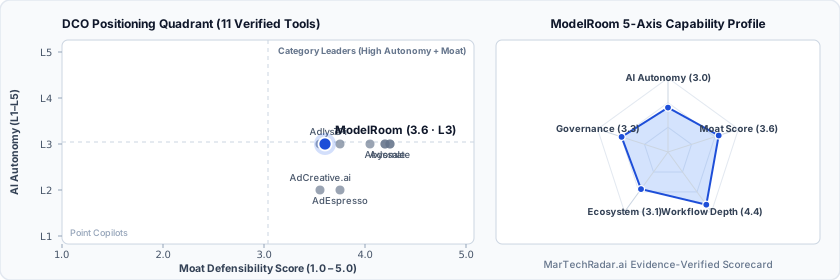
ModelRoom is a Web SaaS tool for DCO (Dynamic Creative Optimization / DCO) in AdTech & Paid Media. Pricing: From $39/mo. Best suited to Performance Marketing Directors, Ad Agencies and Retail Media Advertisers. Editor ratings: AI autonomy L3 (conditional automation); moat score 3.6/5.0 (Proprietary moat). Fact-checked by Tim Fenolz on Oct 14, 2026.
Agentic creative studio orchestrating top-tier audiovisual diffusion models to assemble, storyboard, and direct high-converting dynamic performance video.
ModelRoom buyer fit verdict: when to choose vs. when to walk away
Choose ModelRoom if (Best Fit)
- Target ICP & Stack Fit: You operate as Performance Marketing Directors, Ad Agencies and Retail Media Advertisers requiring a Web SaaS deployment for DCO.
- L3 Architecture & Defensibility: Proprietary multi-model orchestration pipeline that abstracts commercial video models into automated storyboard logic and ad layout templates, bridging direct-response creative frameworks with autonomous generation.
- Commercial Model Fit: Your procurement budget aligns with From $39/mo.
Walk away from ModelRoom if (Deal-Breakers)
- Walk away if your workflow requires uncapped enterprise volume on the From $39/mo entry plan without upgrading tiers.
- Walk away if your workflow cannot tolerate upstream model latency and API degradation: Because the rendering pipeline delegates asset generation to external foundation model endpoints, processing spikes and third-party rate limits can induce unpredictable queue delays during high-volume ad batching runs.
- Walk away if direct-response format rigidity is a deal-breaker for your team: Pre-configured narrative templates—such as problem-to-product reveals and UGC monologues—constrain structural flexibility, presenting integration friction for unconventional brand guidelines or bespoke kinetic typography systems.
ModelRoom key facts & scorecard
| Pricing | From $39/moVendor pricing page |
|---|---|
| Free plan | No / not disclosed |
| Delivery | Web SaaS |
| Audience | Performance Marketing Directors, Ad Agencies, Retail Media Advertisers |
| AI autonomy level | L3 · Conditional automationEditor-verified |
| Moat tier & score | 3.6 / 5.0 · Proprietary moatEditor-verified |
| Funding | Undisclosed |
| Company size | 2-10 employees |
| Governance & docs | DPA ↗ · Terms ↗ · Privacy ↗ |
| Headquarters | Paphos, Cyprus |
| Founded | 2026 |
| Last verified |
ModelRoom pros & cons: strengths vs. operational limitations
Pros: core strengths & capabilities
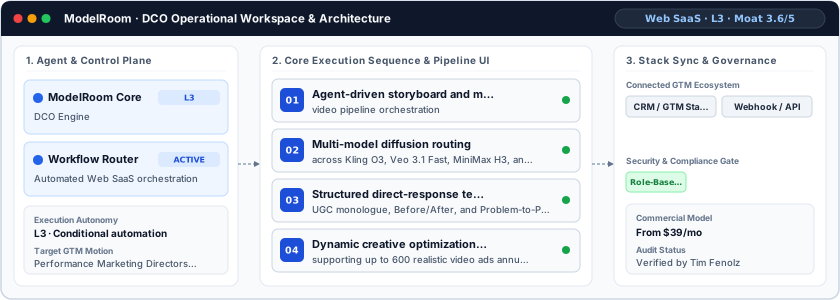
- Agent-driven storyboard and multi-shot: video pipeline orchestration
- Multi-model diffusion routing: across Kling O3, Veo 3.1 Fast, MiniMax H3, and Grok Imagine Video
- Structured direct-response templates including: UGC monologue, Before/After, and Problem-to-Product reveal
- Dynamic creative optimization workflows: supporting up to 600 realistic video ads annually on baseline tiers
Cons: operational limitations & risks
- Upstream Model Latency and API Degradation: Because the rendering pipeline delegates asset generation to external foundation model endpoints, processing spikes and third-party rate limits can induce unpredictable queue delays during high-volume ad batching runs.
- Direct-Response Format Rigidity: Pre-configured narrative templates—such as problem-to-product reveals and UGC monologues—constrain structural flexibility, presenting integration friction for unconventional brand guidelines or bespoke kinetic typography systems.
- Credit Burn Governance: The allocation of annual compute credits across experimental video diffusion runs creates financial forecasting overhead, as regenerative iterations on failed generations deplete annual allowances without net asset production.
ModelRoom TCO & deal-breaker stress test
Simulate 12-month stepped TCO, hidden cost multipliers, contract lock-in exposure, and stack failure modes using only facts verified by Tim Fenolz on · Capture SHA d241a958.
ModelRoom is viable for 5 seats, but requires commercial or technical verification on the flagged items below.
| Plan / Tier | Verified Rate | Scale Fit | Scope & Quota Notes |
|---|---|---|---|
| Starter | $39/mo | 1–2 seats | Start creating realistic ads with AI |
| Creator | $119/mo | 5 seats | $1788 $1428 billed annually |
| Scale / Advanced | $468/mo | 15 seats | Verified $468/mo tier from vendor pricing schedule. |
- Moat Score
- 3.6 / 5.0
- AI Autonomy
- L3
- Free Tier / Trial
- None disclosed
Triggered audit signals & failure modes
- Published Self-Serve Entry FloorVerified Pricing Ledger
ModelRoom publishes a transparent entry point (From $39/mo) for initial validation before committing.
- Usage / Credit Burn VolatilityCommercial Model Audit
ModelRoom uses credit or usage-metered billing (From $39/mo). High-volume automated workflows across 5 seats can trigger mid-cycle overage charges.
- Tier Fit for 5-Seat Scale: Creator ($119/mo)Verified Tier Schedule
$1788 $1428 billed annually
- Primary Operational Bottleneck: Credit Burn GovernanceAudit by Tim Fenolz
The allocation of annual compute credits across experimental video diffusion runs creates financial forecasting overhead, as regenerative iterations on failed generations deplete annual allowances without net asset production.
Hidden TCO Multipliers & Quota Gates
- Annual Billing Headline vs. Monthly Premium: Headline entry rates reflect annual billing commitments (Save $120); month-to-month flexibility carries a higher effective monthly rate or requires annual prepayment.
- Credit & Usage Burn Multiplier: Automated workflows consume metered credits/usage quotas; multi-step enrichment, voice minutes, or high-frequency agent runs can trigger mid-cycle top-up packs.
When to Walk Away & Negotiation Levers
- Walk away if your workflow requires uncapped enterprise volume on the From $39/mo entry plan without upgrading tiers.
- Walk away if your workflow cannot tolerate upstream model latency and API degradation: Because the rendering pipeline delegates asset generation to external foundation model endpoints, processing spikes and third-party rate limits can induce unpredictable queue delays during high-volume ad batching runs.
- Walk away if direct-response format rigidity is a deal-breaker for your team: Pre-configured narrative templates—such as problem-to-product reveals and UGC monologues—constrain structural flexibility, presenting integration friction for unconventional brand guidelines or bespoke kinetic typography systems.
- Validate exact quota thresholds (seats, credits, or API calls) included in ModelRoom's From $39/mo tier before converting from monthly to annual billing.
- Require a sandbox proof-of-concept testing upstream model latency and API degradation against your live CRM/data schema before annual sign-off.
Ask a custom procurement or TCO stress-test question about ModelRoom
Lower 5-seat floor (~$15/mo vs. $119 / mo)
Lower 5-seat floor (~$36/mo vs. $119 / mo)
ModelRoom moat & subtrack positioning
Proprietary multi-model orchestration pipeline that abstracts commercial video models into automated storyboard logic and ad layout templates, bridging direct-response creative frameworks with autonomous generation.
Editorial review
Fact-checked by Tim Fenolz (Lead AdTech, Programmatic & Attribution Analyst) on .
Background
Performance growth teams face severe operational friction when scaling multi-variant video assets across paid acquisition channels. ModelRoom addresses this bottleneck through an agentic creative interface designed for growth marketing leads and creative strategists. Established in 2026 and headquartered in Paphos, Cyprus, the platform positions itself within the dynamic creative optimization category by substituting manual motion design with autonomous generative agents. Instead of assembling raw footage manually, creative directors supervise autonomous agent workflows that generate direct-response ad structures, such as problem-and-reveal narratives and synthetic user-generated content.
How ModelRoom works
Operating at an L3 conditional autonomy tier, ModelRoom functions as an orchestration layer over foundation audiovisual models including Kling O3, Veo 3.1 Fast, and MiniMax H3. Users provide brand inputs, product parameters, and narrative intents, prompting internal planning agents to synthesize storyboards, frame-by-frame prompts, and scene transitions. The rendering engine coordinates third-party diffusion and image synthesis APIs, sequencing audio tracks, visual assets, and text overlays into coherent video outputs. The graphical interface allows human directors to intervene at the storyboard or timeline stage, adjusting specific frames before final multi-variant batch rendering occurs.
Limitations
Operational considerations and platform boundaries include:
- Upstream Model Latency and API Degradation: Because the rendering pipeline delegates asset generation to external foundation model endpoints, processing spikes and third-party rate limits can induce unpredictable queue delays during high-volume ad batching runs.
- Direct-Response Format Rigidity: Pre-configured narrative templates—such as problem-to-product reveals and UGC monologues—constrain structural flexibility, presenting integration friction for unconventional brand guidelines or bespoke kinetic typography systems.
- Credit Burn Governance: The allocation of annual compute credits across experimental video diffusion runs creates financial forecasting overhead, as regenerative iterations on failed generations deplete annual allowances without net asset production.
ModelRoom pricing
Commercial access follows a credit-based subscription model. Entry-level usage is available from $39 per month, or $468 when billed annually down from $588, which saves $120. This Starter tier provides 6,000 annual credits, supporting up to 20 personalized templates and approximately 600 generated video ad units across foundational models.
How ModelRoom compares
While Abyssale focuses on structured, template-driven image and banner automation, and AdCreative.ai emphasizes algorithmic display and static creative scoring, ModelRoom targets generative audiovisual synthesis. Compared to dynamic testing suites like 7Pi that alter metadata overlays on existing live-action assets, ModelRoom generates foundational video pixels via multi-model routing. It serves mid-market e-commerce brands and performance marketing agencies prioritizing rapid short-form video variant production over deterministic graphic design constraints.
Frequently asked questions about ModelRoom
How much does ModelRoom cost and what pricing tiers are available?
Published pricing summary for ModelRoom: From $39/mo. A permanent free plan is not disclosed for ModelRoom. Verified tier schedule: Starter ($39/mo for 1–2 seats); Creator ($119/mo for 5 seats); Scale / Advanced ($468/mo for 15 seats). Commercial access follows a credit-based subscription model. Entry-level usage is available from $39 per month, or $468 when billed annually down from $588, which saves $120.
How does ModelRoom work and how autonomous is its AI architecture?
Agentic creative studio orchestrating top-tier audiovisual diffusion models to assemble, storyboard, and direct high-converting dynamic performance video. Within DCO (Dynamic Creative Optimization / DCO), MarTechRadar rates its execution architecture at L3 · Conditional automation with a verified Moat Score of 3.6 / 5.0 (Proprietary moat). Proprietary multi-model orchestration pipeline that abstracts commercial video models into automated storyboard logic and ad layout templates, bridging direct-response creative frameworks with autonomous generation. Corporate profile: operating at 2-10 employees scale.
What are the main limitations of ModelRoom and when should buyers walk away?
Based on our editorial technical audit, key operational considerations and boundaries for ModelRoom include: (1) Upstream Model Latency and API Degradation: Because the rendering pipeline delegates asset generation to external foundation model endpoints, processing spikes and third-party rate limits can induce unpredictable queue delays during high-volume ad batching runs. (2) Direct-Response Format Rigidity: Pre-configured narrative templates—such as problem-to-product reveals and UGC monologues—constrain structural flexibility, presenting integration friction for unconventional brand guidelines or bespoke kinetic typography systems. (3) Credit Burn Governance: The allocation of annual compute credits across experimental video diffusion runs creates financial forecasting overhead, as regenerative iterations on failed generations deplete annual allowances without net asset production. Primary procurement walk-away rule: Walk away if your workflow requires uncapped enterprise volume on the From $39/mo entry plan without upgrading tiers.
What integrations, compliance certifications, and contract terms apply to ModelRoom?
First-party governance and developer endpoints verified on domain include: DPA (https://modelroom.ai/data-processing-addendum). Key TCO multiplier to watch: Annual Billing Headline vs. Monthly Premium (Headline entry rates reflect annual billing commitments (Save $120); month-to-month flexibility carries a higher effective monthly rate or requires annual prepayment.) Before signing a contract, procurement teams should validate exact quota thresholds (seats, credits, or API calls) included in ModelRoom's From $39/mo tier before converting from monthly to annual billing.
What are the best ModelRoom alternatives and head-to-head competitors in 2026?
Top fact-checked alternatives to ModelRoom in DCO (Dynamic Creative Optimization / DCO) include Clippable (Free plan · $0/mo · Enterprise plan), MatchCraft (Free plan · $0/mo · Enterprise plan), RelayThat (From $15/mo), Socioh (From $3.20/mo). While Abyssale focuses on structured, template-driven image and banner automation, and AdCreative.ai emphasizes algorithmic display and static creative scoring, ModelRoom targets generative audiovisual synthesis.
Verified sources & evidence trail
- Official product domain: https://modelroom.ai/
- Commercial pricing verification: https://modelroom.ai/plans
- Verified corporate entity profiles (
sameAs): LinkedIn Company Profile · Crunchbase Entity Record - First-party governance & documentation links: DPA · Terms · Privacy
- Editorial audit sign-off: Fact-checked by Tim Fenolz on under the MarTechRadar Evidence-Ledger Protocol.